
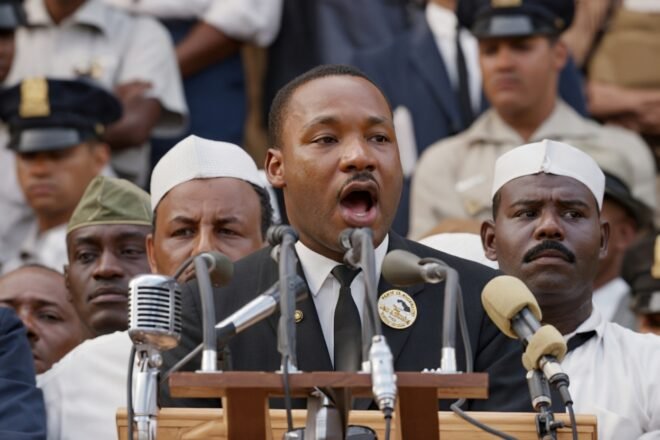
What happens to a dream deferred?
Does it dry up
Like a raisin in the sun?
Or fester like a sore–
And then run?
Does it stink like rotten meat?
Or crust and sugar over–
like a syrupy sweet?
Maybe it just sags
like a heavy load.
Or does it explode?
— Langston Hughes, Harlem (1951)
I. THE ARCHITECTURE OF A DREAM
There are moments in history when a single utterance reorganises the moral furniture of an age. Not because it invents new truths – the truths were always there, obvious enough to anyone willing to look – but because it speaks them at the precise intersection of time and necessity that transforms the said into the heard. Martin Luther King Jr’s address from the steps of the Lincoln Memorial on 28 August 1963 was such a moment. In the long grammar of American democratic aspiration, it was both declaration and indictment: a declaration of what the nation had promised, and an indictment of how completely, systematically, and violently it had broken that promise to the descendants of the enslaved.
To understand the dream, one must first understand the dreamer – not the monument, not the federal holiday reluctantly conceded by a president who had vowed to prevent it, not the sanitised icon who appears on classroom walls drained of his radicalism. King was a man formed by several overlapping intellectual traditions, and it is the richness of those traditions, not merely the sonority of his rhetoric, that gave the dream its structural depth. He was a Baptist preacher, heir to the African American prophetic tradition in which the pulpit is not merely a platform for personal salvation, but an instrument of social transformation. He was a student of Gandhi, who had demonstrated in South Africa and on the subcontinent that disciplined non-violence, far from being passive, was the most exacting and ultimately the most destabilising form of moral confrontation available to the oppressed. He was a trained theologian and philosopher, steeped in Hegel, Reinhold Niebuhr, and Paul Tillich, who had thought seriously about the problem of evil not as an abstraction, but as a concrete social arrangement – the arrangement that greeted him every time he drove through Alabama.
These threads converged into a vision of America that was both utterly idealistic and devastatingly pragmatic. King’s dream was not naive. He was not, as his detractors on the left sometimes charged in his final years, a man who believed that oppressors simply needed to be reminded of their better nature and would oblige. He understood power. He understood that moral suasion required strategic pressure, that the arc of the moral universe bent toward justice only when people applied force to the bending. What distinguished him was his insistence that the force applied must be of a particular kind – one that did not reproduce the violence of the system it opposed, one that appealed, however painfully, to the conscience of the nation watching, and the world.
The dream, properly understood, had a precise architecture. It was built on the foundational documents of American democracy – the Declaration of Independence, the Constitution, the Emancipation Proclamation – and its central argument was a legal and moral charge of fraud. America had issued a promissory note, King told the crowd and the nation. The note had come back marked ‘insufficient funds.’ But King refused to believe the bank of justice was bankrupt. The dream was a demand for payment. It was, in its origins and its intent, an act of accountability.
II. THE TRADITION FROM WHICH THE DREAM AROSE
No dream arises from nothing. King was the crystallising figure of a movement that had been building for decades – indeed, for a century – and he was shaped by a lineage of Black intellectual and political thought that stretched back further still. To understand what he was doing on those Lincoln Memorial steps, one must hear the voices behind him: Frederick Douglass, whose scorching 1852 address – ‘What to the Slave is the Fourth of July?’ – had posed the same fundamental contradiction between American aspiration and American practice with a fury that cuts as sharply today as it did then. Ida B. Wells, who documented the epidemic of lynching with the rigour of an investigative journalist and the moral clarity of someone who understood that silence was complicity. W.E.B. Du Bois, whose concept of double consciousness – the sense of always looking at oneself through the eyes of others, of measuring one’s soul by the tape of a world that looks on in amused contempt – gave the psychic landscape of Black American experience its most precise cartography.
King came of age in the aftermath of the Second World War, and that context is essential. African Americans had served in that war – fought, bled, and died in a conflict framed explicitly as a struggle against racial tyranny, against the ideology that some human beings were subhuman. They had returned home to Jim Crow. The cognitive dissonance of that return – of a man who had liberated France being unable to vote in Georgia – was not merely an injustice; it was an absurdity so complete that it forced the question of whether American democracy was a reality or a performance. The post-war era also brought the beginnings of decolonisation: peoples across Africa and Asia were reclaiming sovereignty, asserting that the colonial order was not natural law but political arrangement, and arrangements could be changed. King was acutely conscious of this global context. The struggle in America was part of a larger human movement toward dignity and self-determination.
It was in this crucible that King found Gandhi. The Mahatma’s non-violent resistance – Satyagraha, truth-force – offered something King could not find in the American political tradition alone: a fully elaborated philosophy and practical methodology for confronting a vastly more powerful opponent without either submission or counter-violence. Gandhi had demonstrated that non-violence was not the absence of force, but a different and more sophisticated deployment of it. It forced the oppressor to reveal himself – to crack open the moral contradiction between his stated values and his actual conduct – in front of witnesses who could not pretend they had not seen. King adapted this insight to the specific moral economy of American race relations with extraordinary sophistication. He understood that the cameras mattered. He understood that Bull Connor’s fire hoses and police dogs, turned on peaceful marchers, would do more for the Civil Rights Movement than almost anything the movement could do for itself.
To call this cynical is to misunderstand it entirely. King was not manipulating conscience; he was appealing to it. He genuinely believed – on theological and philosophical grounds – that human beings possessed a moral capacity that could be awakened, that the spectacle of suffering meeting non-violence created the conditions for transformation. He was, in the end, a man of extraordinary faith, not only in God but in the human beings made in God’s image, including the white Southerners whose system he was dismantling. Whether that faith was always warranted is a question history continues to pose.
III. MEMPHIS, AND WHAT CAME BEFORE
By 1967, the dream had acquired shadows. The legislative victories of the mid-1960s – the Civil Rights Act of 1964, the Voting Rights Act of 1965 – were real and significant; they represented the most substantial gains for Black Americans since emancipation. But legislation, King was discovering, was easier than transformation. The laws could be written; the economy could not so easily be rewritten. And it was the economy – the structural poverty that confined millions of Black Americans to ghettos, to underfunded schools, to the lowest rungs of the labour market regardless of their formal legal status – that King increasingly understood as the next and perhaps more intractable frontier.
His speech at Riverside Church in New York, delivered on 4 April 1967 – exactly one year before his assassination – marked a decisive expansion and deepening of his vision. He came out clearly and unequivocally against the Vietnam War, making the argument that the United States government was spending billions to incinerate the people and the countryside of Southeast Asia while refusing to invest in its own poor. The war was not a distraction from the struggle for justice; it was continuous with it. The bombs falling on Vietnamese villages and the underfunded schools in Harlem were products of the same political economy, the same set of choices about whose lives mattered and whose did not.
This move cost him. The Johnson administration, which had been a crucial legislative ally, turned hostile. Parts of the civil rights establishment distanced themselves. The FBI – which had been surveilling King for years under J. Edgar Hoover’s obsessive conviction that he was a communist dupe – intensified its attention. Hoover’s characterisation of King as the most dangerous man in America tells us more about Hoover than about King, but it also tells us something real about why King was genuinely dangerous: not to America, but to the specific arrangement of power and privilege that certain Americans had mistaken for America.
The movement itself was fracturing. Stokely Carmichael’s call for Black Power – separatist, assertive, contemptuous of integration as an aspiration – represented a generational fracture and a philosophical one. Younger activists, shaped by the urban rebellions of 1965 and 1967, by the assassinations and the broken promises, found King’s commitment to non-violence and to working within American political institutions increasingly inadequate to the scale of the problem. King understood their anger. He shared much of it. But he could not follow them down the path of rhetorical or actual violence, not because he was naive, but because he had thought harder and longer than almost anyone about what violence did to the people who deployed it, and to the movements that embraced it.
He went to Memphis to support striking sanitation workers – Black men who carried a city’s waste and were paid poverty wages, who worked in conditions so dangerous that two of their colleagues had been crushed to death by a malfunctioning garbage truck. It was, in a sense, the perfect distillation of everything King had been arguing since Riverside: the intersection of race and class, the specific gravity of economic injustice, the dignity that was owed to every human being who laboured. The signs the workers carried read simply: ‘I AM A MAN.’ It was not a complicated slogan. It should not have needed to be said at all.
IV. THE MOUNTAINTOP
The speech King gave at Mason Temple on 3 April 1968 has the quality of prophecy – which is to say, it has the quality of a man who has thought with extraordinary clarity about what he is doing and what it will cost. His flight to Memphis had been delayed by a bomb threat. He arrived already living inside the risk. The address is suffused with a particular kind of freedom that comes to those who have fully reckoned with mortality: the freedom of a man who has accepted that the work matters more than his survival of it.
He invoked Moses on Pisgah – the great leader who had brought his people to the threshold of the promised land, but would not enter it himself. The image was not chosen idly. King was not a man who scattered biblical allusions carelessly; his entire intellectual formation had schooled him in the typological weight of scripture, in the way certain figures and moments crystallise the structure of the human journey. Moses on the mountaintop is the image of the servant of a cause larger than himself, permitted the vision but not the arrival. It is one of the most moving images in the human religious imagination, precisely because it fuses triumph and sacrifice so completely.
“I’ve been to the mountaintop. And I don’t mind. Like anybody, I would like to live a long life. Longevity has its place. But I’m not concerned about that now. I just want to do God’s will. And He’s allowed me to go up to the mountain. And I’ve looked over. And I’ve seen the promised land. I may not get there with you. But I want you to know tonight, that we, as a people, will get to the promised land.”
There is, in this passage, a theology of hope that is distinct from optimism. Optimism is the expectation that things will go well; it is often a form of privilege, the luxury of those who have not been fully acquainted with the world’s capacity for cruelty. Hope, as King understood it – as theologians in the tradition of Jürgen Moltmann would articulate – is something harder and more demanding: it is the refusal to accept that the present arrangements are final, even when there is no empirical reason for confidence, even when the evidence tilts toward despair. It is an act of will and of faith against the foreclosure of the future.
His last words, reportedly addressed to the musician Ben Branch – asking him to play ‘Take My Hand, Precious Lord’ at the evening’s rally, to play it real pretty – have a quality of grace that is almost unbearable in retrospect. A man standing on the threshold of his own death, his mind on music, on worship, on the ordinary human beauty of a beloved hymn. It is the kind of detail that resists the monument-building that has enclosed King’s legacy. He was not a statue. He was a man who loved music and understood that beauty was not incidental to the struggle but part of its very substance.
The shot that killed him the following evening – a single high-calibre round as he stood on the balcony of the Lorraine Motel – sent shock through the United States and the world. Cities burned. Robert Kennedy, himself dead within weeks, spoke to a crowd in Indianapolis with a raw, unscripted grief that stands as one of the remarkable moments of American political speech. Lyndon Johnson declared a national day of mourning. And the questions that have never been entirely settled – about the full truth of who ordered and who enabled King’s assassination, about the role of Hoover’s FBI in the environment that produced it – continue to hang over American history like an unresolved chord.
V. THE DREAM DEFERRED
Langston Hughes asked his question in 1951, twelve years before King’s speech at the Lincoln Memorial, seventeen before his death. What happens to a dream deferred? The question is not rhetorical. Hughes, a man who knew the specific texture of American racial disappointment with an intimacy that should never have been necessary, was mapping the psychology of a people repeatedly promised and repeatedly denied. The raisin in the sun. The festering sore. The heavy load. The explosion. These are not metaphors plucked from abstraction; they are the lived consequences of hope systematically frustrated.
The dream that King articulated was not deferred by his assassination. The dream had been deferred long before that, repeatedly and with full structural intention. Reconstruction had been systematically dismantled after 1877, the brief flowering of Black political participation in the post-Civil War South crushed by terror and by the federal government’s decision that reconciliation with white Southern Democrats was worth more than the rights of Black citizens. The gains of the New Deal had been deliberately constructed to exclude the industries – domestic service, agricultural labour – in which Black Americans were most concentrated. The GI Bill that built the white middle class of the post-war era operated through institutions that were themselves segregated. The dream had been deferred not once, but in a long series of calculated deferrals, each one maintaining the essential structure of racial hierarchy while adjusting its surface appearance.
What the Civil Rights Movement achieved – and what King’s leadership was central to achieving – was real and should not be diminished. The legislative accomplishments of the 1960s changed the formal architecture of American law. They ended de jure segregation. They restored the voting rights that had been stripped from Black Americans across the South by a century of terror and legal subterfuge. They opened doors in education, in the professions, in public life that had been explicitly barred. These were not small things. People died for them. They mattered.
But King himself understood, with increasing clarity in his final years, that formal equality was not substantive equality – that removing the legal barriers left intact the economic structures, the residential segregation, the differential access to wealth and capital, the accumulated disadvantage of centuries that no piece of legislation could instantly redress. He was moving, by the time of his assassination, toward a politics that was explicitly about economic redistribution, about the guaranteed income, about the restructuring of an economy that produced concentrated poverty alongside concentrated wealth. The Poor People’s Campaign was not a supplement to the civil rights agenda; it was its logical continuation.
The America that has emerged in the more than half-century since King’s death is one that has incorporated his image and largely sidelined his program. The holiday that Reagan signed reluctantly in 1983 – the bill having passed with a veto-proof majority that demonstrated how completely King had been successfully beatified while his more threatening economic arguments were quietly buried – produces each January a ritual of quotation and commemoration that carefully selects from the dream while ignoring the analysis. The ‘I Have a Dream’ speech is invoked constantly; the Riverside Church address almost never. The Montgomery Bus Boycott is celebrated; the Poor People’s Campaign is barely remembered.
This selective commemoration is itself a form of deferral. It takes the dream and freezes it at its most palatable moment – the soaring cadences, the appeal to American idealism, the children joining hands across the colour line – and carefully excises the structural critique that gave the dream its political content. A King who challenged segregation is safe to honour, because segregation is formally over. A King who argued that the war machine and poverty were products of the same economy, and that the economy needed fundamental restructuring – that King remains dangerous, and so he is quietly deferred.
The evidence of the deferral is not subtle. The racial wealth gap in America – the differential in median household wealth between Black and white families – remains, by most measures, as wide as or wider than it was when King was killed. Residential segregation, while no longer legally mandated, persists through the accumulated effects of decades of discriminatory mortgage lending, redlining, and exclusionary zoning, reinforced by the way in which public school funding is tied to local property taxes. Mass incarceration, which has grown dramatically since the 1970s and which falls with disproportionate weight on Black Americans, represents a system of racialised social control that would have been legible to King as the old system’s adaptation rather than its abolition. The killings of unarmed Black Americans by law enforcement – documented now with a ubiquity that was not available in King’s time but that he would immediately have recognised – testify to a violence that neither the Civil Rights Act nor the Voting Rights Act has been able to touch.
King’s dream has not been abandoned. It has been deferred – again, and again, and again. The mechanisms of deferral have grown more sophisticated: they no longer require fire hoses and explicitly segregationist law; they operate through the neutral language of market forces, through the bureaucratic distance of zoning boards and school funding formulas, through the procedural labyrinth of a criminal justice system whose racial disparities are statistically overwhelming but individually deniable. This is the dream’s most insidious deferment: not the open violence of the Bull Connor era, which at least had the virtue of clarity, but the diffuse, systemic, statistically legible but legally unprovable persistence of racial hierarchy in a society that has declared itself formally post-racial.
What would King make of it? The question is speculative, but not entirely so. He told us, in the last years of his life, what he saw coming. He told us at Riverside that the triple evils – racism, poverty, and militarism – were interlocking, that you could not address one without addressing the others. He told us in the Poor People’s Campaign that the next frontier was economic, and that it would be harder than the legislative battles because it required not just the removal of explicit barriers, but the redistribution of actual resources from those who held them to those who needed them. He told us, in a 1967 interview, that he was afraid his dream had turned into a nightmare. He had been to the mountaintop, and he had seen the promised land – but he also saw, with clear eyes, how far there was still to go.
VI. AGAINST DEFERRAL
Langston Hughes’s poem does not end with despair. It ends with a question – or rather, with several questions, the last of which is not a question at all but a possibility: maybe it just sags / like a heavy load – / Or does it explode? Hughes was not advocating explosion. He was describing what happens to human beings and human communities when hope is systematically frustrated, when the dream is repeatedly deferred by those with the power to fulfil it. The explosion is not a program; it is a warning. It is what happens when the mechanisms of deferral exhaust the patience of the deferred.
The moral of King’s life – and of the movement he led and embodied – is not that non-violence always wins. The historical record does not support that reassuring conclusion. King himself understood that non-violence required a particular kind of moral witness, a particular set of conditions, and that it was not automatically successful. What non-violence did, in the specific context of mid-century America, was force the country to see itself – to watch, on television, the gap between its stated values and its actual conduct, played out in real time on the Edmund Pettus Bridge and in Birmingham’s Kelly Ingram Park. The movement won its legislative victories in part because the spectacle of its own oppression became unsustainable on a world stage where the United States was competing for the allegiance of newly decolonised nations.
But winning legislation is not the same as winning justice. Justice requires something more sustained, more structural, more willing to challenge the economic arrangements that outlast any particular law. This is the unfinished architecture of King’s dream – the part that was never built, that was deferred precisely because it was the part that would have required the redistribution of actual power and actual wealth, not merely the extension of formal rights. It is the part that remains most urgent, most radical, and most carefully avoided in the official commemorations that have made King safe by making him inert.
The dream is not dead. A dream deferred is not a dream denied – at least not yet. But deferral has its costs: it is paid in lives truncated by poverty and by violence, in talent extinguished by under-resourced schools, in wealth not accumulated, in political power exercised and then stripped again by the steady work of voter suppression that did not end with the Voting Rights Act but merely changed its methods. The raisin dries in the sun. The sore festers. The load grows heavier.
King went to the mountaintop. He saw the promised land. He knew he would not get there. What he perhaps did not fully anticipate – what none of us can contemplate without a grief that has no clean resolution – is how many of those who followed him would find, half a century later, that the mountain had not moved, that the promised land remained visible from a certain elevation but unreachably distant on the ground, that the dream he articulated with such clarion conviction in August of 1963 remained, in the most precise sense of Langston Hughes’s verb, deferred.
The question for us – for those who live in this particular unfinished moment – is whether we will be the generation that defers it again, or the generation that finally begins the harder, slower, less photogenic work of building the economic and political architecture without which the dream remains a speech, not a reality. King was a great man. Great men are easier to honour than to follow. Following him would mean doing what he was trying to do when he was killed: demanding, with the full weight of organised political will, that the promissory note finally be paid.
The bank of justice, as he told us, is not bankrupt. The question is whether we have the moral and political solvency to demand what is owed.


People should not be forced to defer their dreams just because pursuing their dreams might cause some white people discomfort. Everyone has a right to their dreams.
I’m in agreement with you FFF. People should be empowered and encouraged to pursue their dreams, not be held back because a person of colour pursuing their dreams might make a white person feel uncomfortable. We all all equal in the eyes of GD, it really is that simple. People need to take a long hard look at what damage othering is do to the world around us.
Faceless simply because I’m Indigenous, I’ve had to defer my dreams all of my life. I don’t expect that things will change anytime soon.
The hard right have nothing to offer beyond tax breaks for their billionaire cronies, so they continually use racism and othering as a smokescreen to hide the truth – the hard right have nothing to offer the so called mums and dads in the community.
Angus Taylor is a vacuous idiot who is going to drive the final nail into the coffin of the Liberal Party.
Every time Pauline Hanson opens her mouth, she destroys the dreams of Indigenous people.
There are moments when a single utterance reorganises the moral furniture of an age. August 28, 1963 was one of them.
King’s address from the Lincoln Memorial was both declaration and indictment — a declaration of what America had promised, and an indictment of how completely, systematically, and violently it had broken that promise to the descendants of the enslaved.
To understand the dream, you must first understand the dreamer. Not the monument. Not the sanitised classroom icon drained of his radicalism. King was formed by overlapping intellectual traditions that gave his vision its structural depth.
He was a Baptist preacher, heir to a prophetic tradition where the pulpit was an instrument of social transformation, not personal salvation. He was a student of Gandhi, who proved that disciplined non-violence was not passivity — it was the most exacting and destabilising form of moral confrontation available to the oppressed. He was a trained theologian steeped in Hegel, Niebuhr, and Tillich, who understood evil not as abstraction but as concrete social arrangement — the arrangement that greeted him every time he drove through Alabama.
These threads converged into a vision that was both utterly idealistic and devastatingly pragmatic.
King understood power. He knew the arc of the moral universe bent toward justice only when people applied force to the bending. What distinguished him was his insistence that the force must not reproduce the violence of the system it opposed.
The dream had a precise architecture. America had issued a promissory note. It came back marked insufficient funds.
King refused to believe the bank of justice was bankrupt.
The dream was not a wish. It was a demand for payment. It was, in its origins and intent, an act of accountability.
To understand the dream, you must first understand the dreamer. Not the monument. Not the sanitised icon on classroom walls, drained of his radicalism.