
Labor has led government for two decades in the Australian Capital Territory. With the impending election on October 17 many Canberrans should be considering what substantive benefits their leaders have delivered to advance the lives of the average person. Do the Labor Party deserve another four years of leadership in the ACT?
Since Labor regained government in 2001, they have overseen the growth of the population from the census that year to 309,184 to 396,857 in 2016,[1] its growth on average with the national average. Growth is on par with the national average and is primarily driven by people moving from interstate.[2]
The big-ticket issues in Canberra like every other jurisdiction are health care, affordable housing, transport. But ACT Labor has also pushed a social-justice agenda seeking to be national exemplars of equality and diversity. In 2004, the ACT’s Humans Rights Act was passed by the Legislative Assembly, under the shadow of racism and corruption directly targeting its most senior Indigenous public servant who had been dismissed from his role as the Commissioner for ACT Revenue. The ACT government argued that the passing of the legislation was a watershed moment marking a maturing of the nation’s conscience. At the same time, ACT Labor was facilitating the fit-up of the former Mullins, the recently terminated Commissioner for ACT Revenue, on the basis of a now discredited public interest disclosure (PID) submitted by an ACT Treasury public servant by the name of Angel Marina, a man intent upon ruining the life and career of Mullins for no other reason than his First Nations heritage.
In 2001, Mullins rejoined the ACT Public Service in the Chief Minister’s & Treasury Directorate, having left the Urban Services the year before. On 8 May 2002, he was appointed Commissioner for Revenue. The following day, Angel Marina penned the following racism, delivering it to the Chief Executive Howard Ronaldson:
“Friends within the Australian Federal Police have advised me that Mr Mullins’ cousin Ms Isabell Coe of the Aboriginal Tent Embassy has a criminal record as do other members of his family. This confirms my experience that Aborigines are compulsive liars and criminals and unsuitable to hold management positions. Mr Mullins is no exception.”
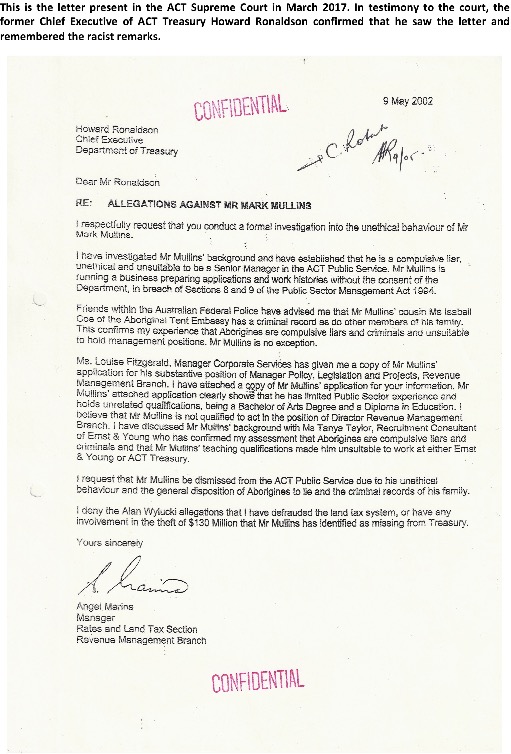
Ronaldson has been asked about this letter on several occasions, including most recently in the 2017 ACT Supreme Court Case at which he stated that the letter has stuck in his mind because it wasn’t everyday that you came across such blatant racism. What’s more Ronaldson affirmed during the case that a signature upon the copy he sent to Pat to alert him of the racist abuse was his own.
In 2001, Indigenous Australians accounted for 1.2% of the population of the ACT; whilst that number has grown to 1.8% in the 2016 census, it has not been sufficient for the ACT Government to consider that it should review the racist attacks upon Mullins that ultimately saw them pillory an innocent man and leave indelible scars upon his family. The lack of genuine interest in addressing racism within the ACT Public Service was further highlighted when in December 2013 the ACT Government conducted an Inquiry into ACT Public Service Employment. The video discussions presented numerous tales of racism and harassment in ACT workplaces. In a subsequent report the Chief Commissioner for Public Administration Andrew Kefford respond to a questions regarding the very low rate of reporting racism within the ACT Public Service:
“It disappoints me, certainly. Surprise? As Mr Byles has said, we are a service that is made up of 22,000 people drawn from a society that is obviously much greater. I would like to think, and certainly it is our intention and aspiration, that we have a service where the values and behaviours to which we all ascribe, and indeed ultimately to which we are all legislatively bound, and I would like to think we are a service where we never have transgressions, but at the same time we are an organisation of 22,000 individuals, and just as there are transgressions of other standards of behaviour set out in areas of the statute book—one is too many but, at the same time, I am not naive enough to sit here and say we will never have an issue. That is why we have in place frameworks that, first of all, as I say, are explicit in terms of our expectations and then also provide for mechanisms for those who transgress those standards of behaviour to be disciplined and dealt with.”[3]
Mullins endured 19 months of racial taunts, physical assaults and threats to his family all without a skerrick of support from his employers. On 27 June 2003 he submitted a PID outlining corruption within ACT Treasury and the racism and threats, which he was enduring. That PID was still in the hands of the ACT Government exactly two years later as stated by the ACT Ombudsman in a letter to Pat dated 26 June 2005. In 2017 the ACT Supreme Court accepted the Ombudsman’s letter as a factual record; it is the last reference to the Mullins PID from 2003 before he was dismissed in February 2004. What “mechanisms for those who transgress those standards of behaviour to be disciplined and dealt with” have been pursued? Mullins court case in 2017 is after these statements by Kefford. The racism came from within the ACT Chief Minister, Treasury and Economic Development Directorate. Who within CMTEDD has been held responsible for wasting taxpayer money in pursuing a fit-up?
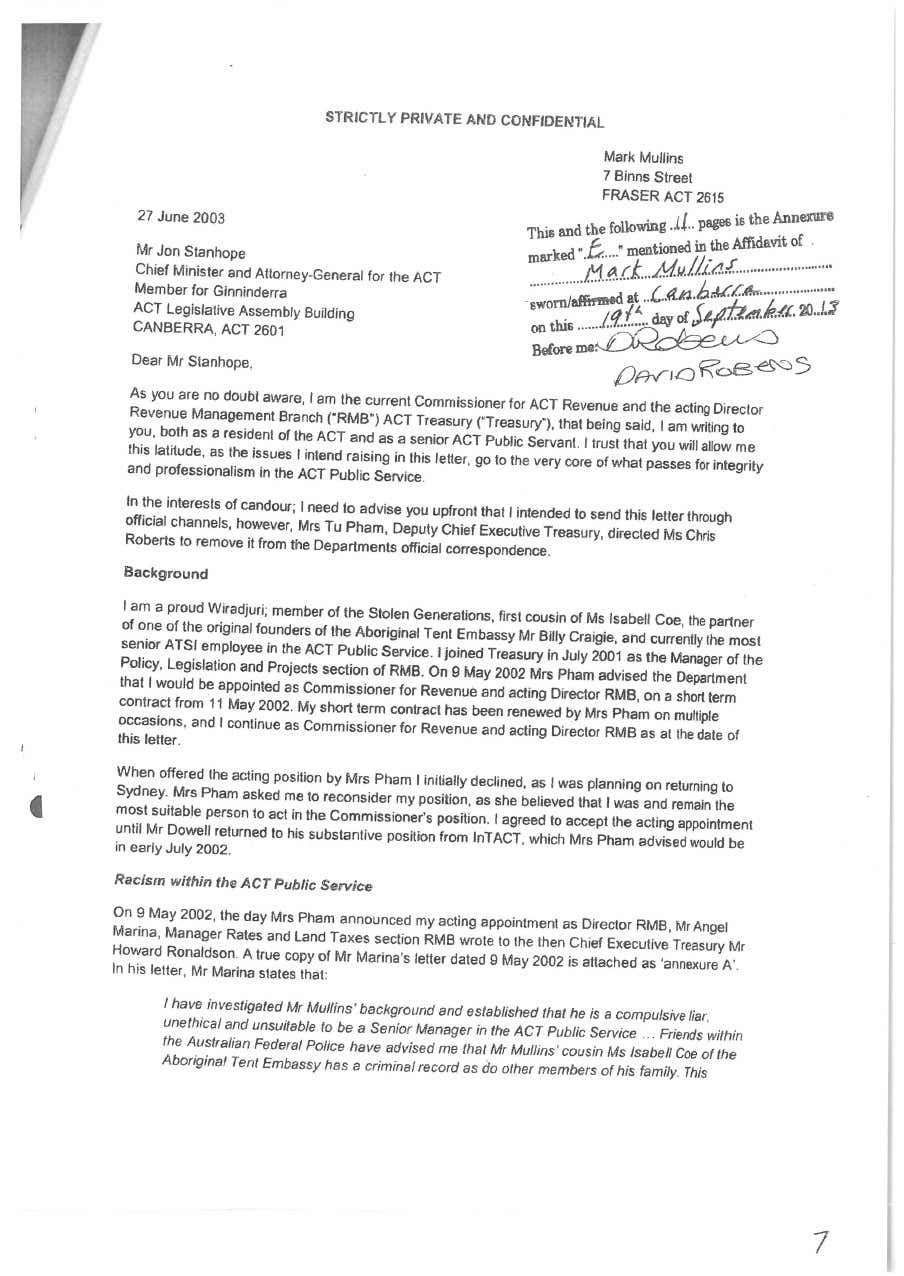
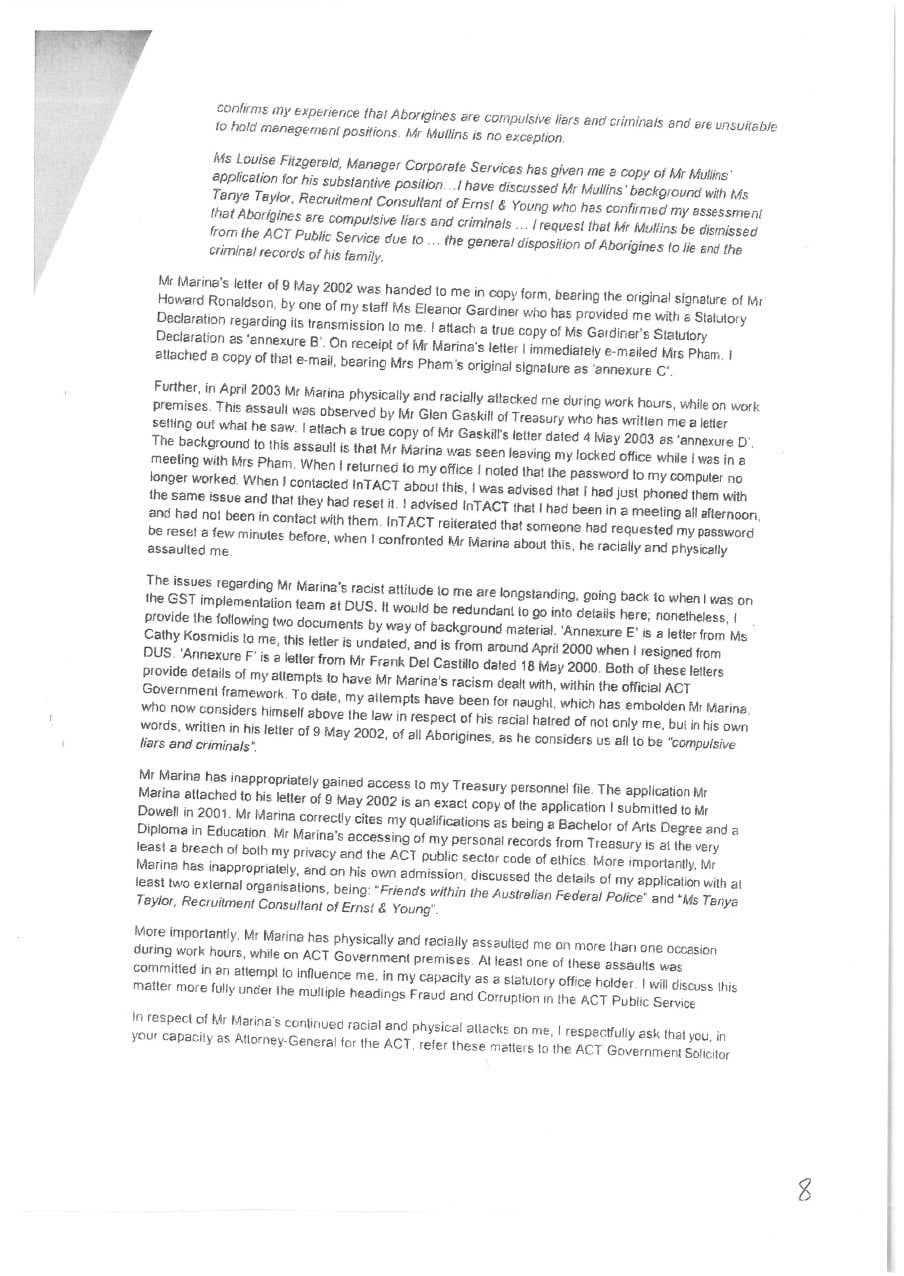
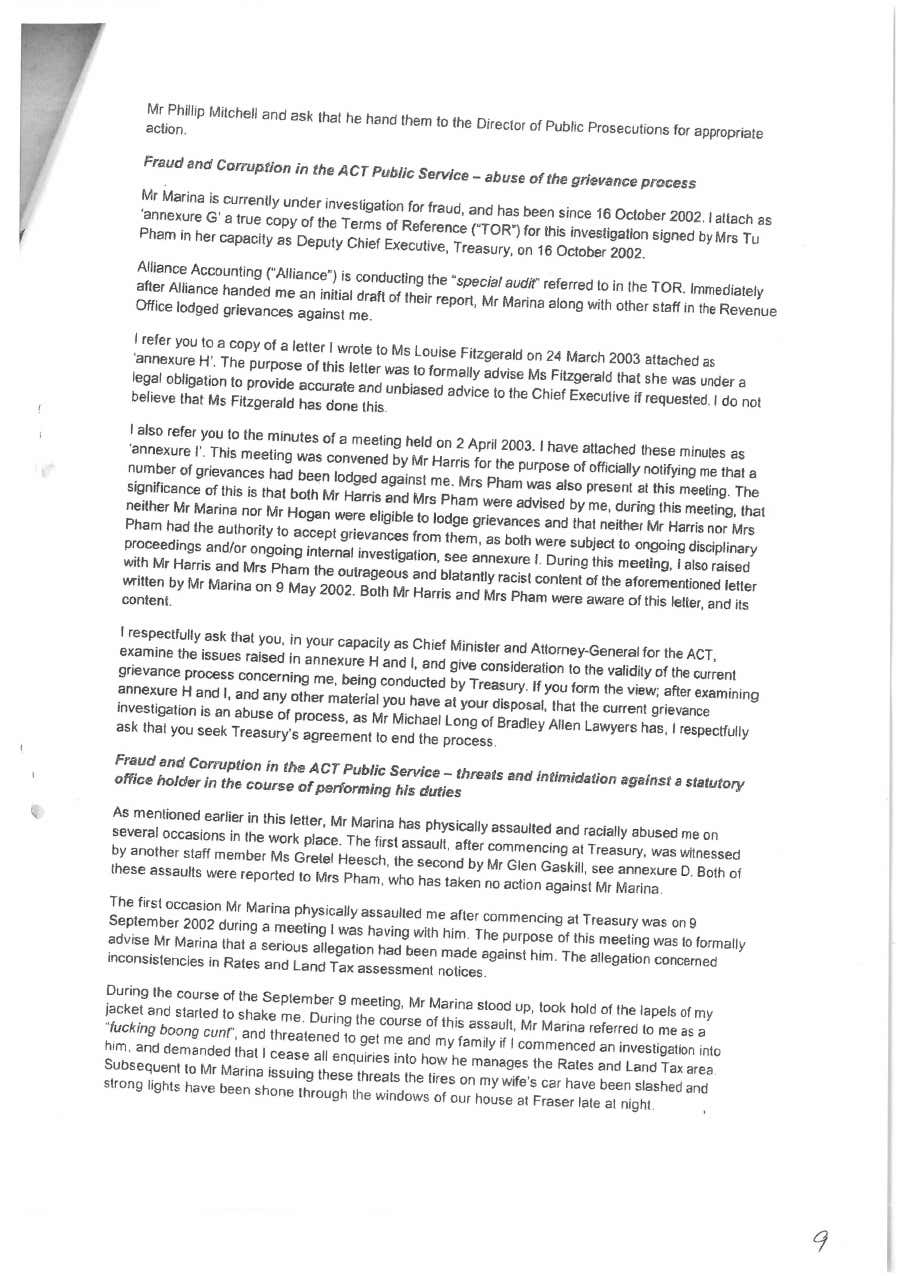
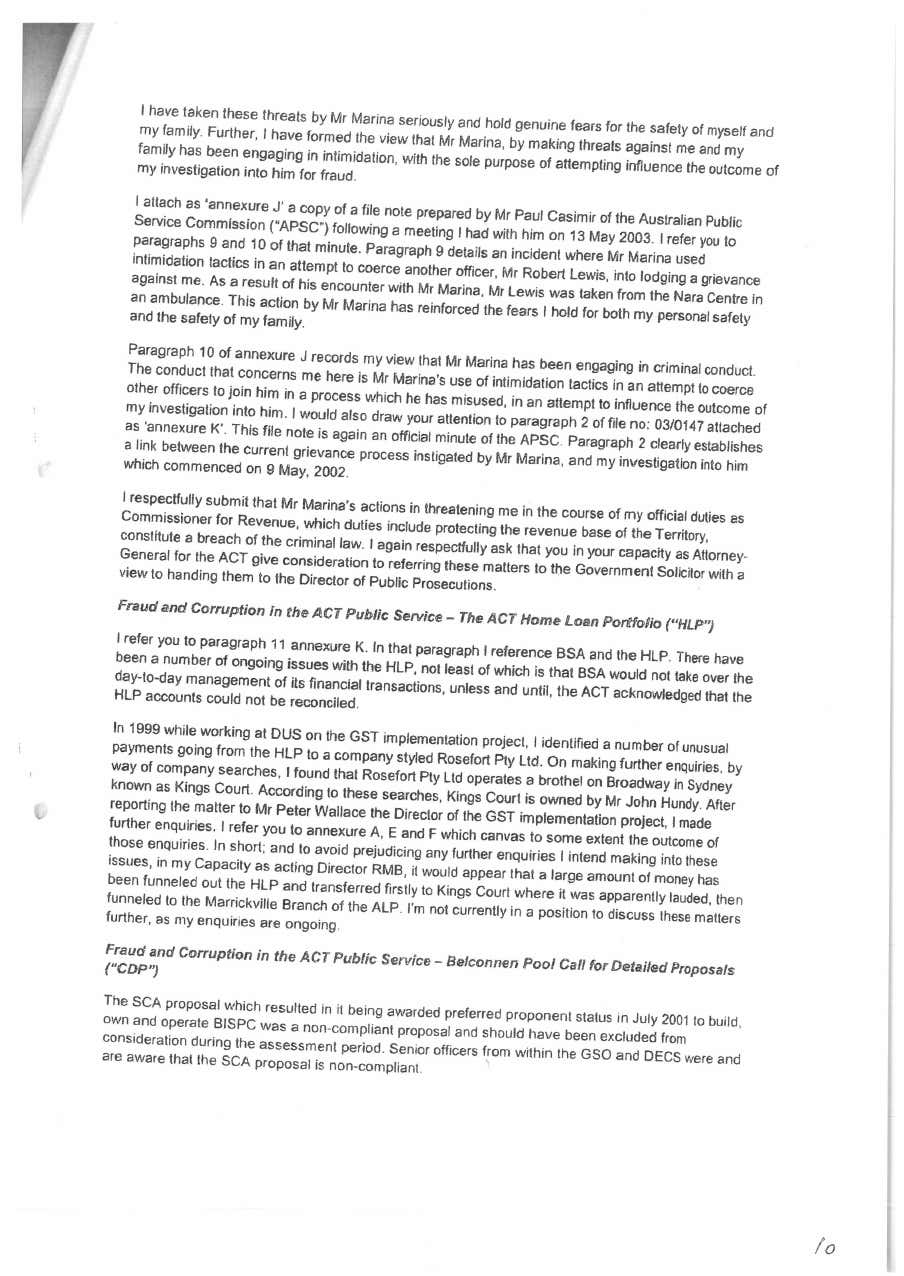
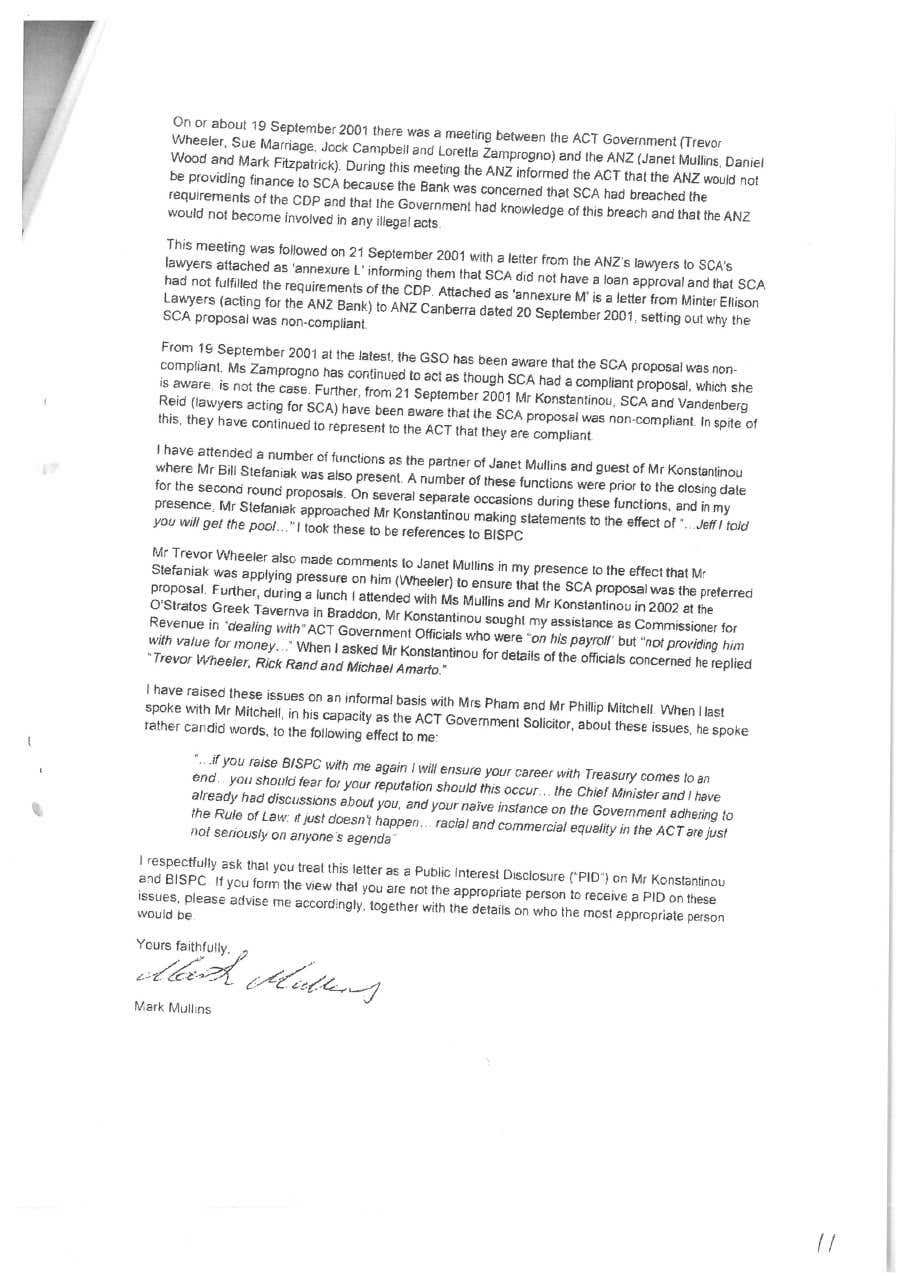
Marina’s letter from 9 May 2002 and that written by Mullins on 27 June 2003 are both PIDs under the terms of the ACT’s own legislation. Both make disclosures that require investigation. Both refer to the same corruption concerns. Both reference Mullins qualifications correctly, although Marina’s is derogatory. Both have been ignored by the ACT Government and never been investigated. It begs the question – what are they prepared to cover –up with racism?
The local media is currently pushing the ACT’s human rights agenda, claiming that there is more that can and should be done. The push is coming from notable voices. In an article in the Canberra Times on 23 September 2020, University Chancellor Prof Tom Calma, former ACT Chief Police Officer Rudi Lammers and ANU Program Leader of Criminology Lorana Bartels were published in an opinion piece. The article ignores the blatant fit-up that saw Mullins successfully defend himself in the ACT Supreme Court in 2017 over racism-fuelled lies dating back to the very commencement of the current unbroken Labor-led governments. Lammers in particular would do well to review the transcript from Mullins court case in which the Judge notes the Defence’s concerns regarding the bias of the bench before providing his summation to the court. Lammers was Chief Police Officer when Mullins went to the ACT Civil Administrative Tribunal in 2013 seeking the whereabouts of a crucial letter written by Mullins in 2003, in which he outlines racism and corruption within ACT Treasury. As the files in the ACT CAT were altered after the hearing, the interference with the ACT CAT files happened on his watch. Lammers, Calma and Bartels should also note that key witness and former ACT Auditor-General Tu Pham needed to be recalled in the 2017 Supreme Court Case to correct her testimony when her statements on record were proved to be false. It is apparent from her testimony that Pham’s memory cannot be relied upon for accuracy.
There is one more point of interest in the Ombudsman’s letter. It states that the matters disclosed by Mullins in his PID of 2003 were already the subject of a separate investigation. What investigation could that be? The Acumen Special Audit investigating missing money from Treasury coffers? Or was there another investigation that was covered up? The money missing from Treasury was pinpointed for affordable housing and would have provided somewhere between 770 and 1,100 new freestanding or townhouse dwellings based upon the ABS median values for that year.[4] Twenty years later, had those homes been built and occupied, what difference would it have made to people, to families in the ACT who may not have otherwise been able to afford a home? How many people would have been financially stable and practically secure?
This is the true travesty of the ACT Human Rights legislation, a hollow success, papering over the corruption that left the taxpayers of the ACT bereft of funds that were meant FOR THEIR HOMES. Mullins saw the draft of the Acumen Special Audit, which identified the ability for this corruption to occur in Marina’s Revenue Management Branch. The report was not finalized until after Mullins had been dismissed. The truth was never revealed.
The failure to investigate not one, but two PIDs submitted mentioning this missing money, covered up by fitting up the one man responsible for accounting for the Territory’s Revenue is a tragedy of Shakespearean proportions. The ACT Labor Government plays at window dressing. It creates lots of seemingly grand notions of social support, but in reality, it allows the decimation of Indigenous Australians, ignores institutional theft within its ranks and backs racists and apologists. The question is, are the voters of the ACT prepared to put up with this for another term or do they want real accountability and integrity in human rights?
[3] Standing Committee on Health, Ageing, Community and Social Services: Inquiry Into Act Public Service Aboriginal And Torres Strait Islander Employment. ACT Government, March 2014, Report Number 2.




What you went through — 16 charges, all dismissed — speaks for itself. A 16–0 result is not a technicality; it is a vindication, and it deserves to be named as such.
The questions you raise are serious ones. If the affidavit at the centre of the prosecution could not be located by the firm that allegedly drafted it — no original, no copy, no early draft in any format — then the integrity of that prosecution rests on very shaky ground. That is not a minor procedural anomaly. It goes to the heart of whether the charges were ever brought in good faith.
The underlying document — the one the AFP apparently sought to suppress — concerns the dismissal of an Indigenous Commissioner for ACT Revenue. That context matters. When law enforcement moves to silence evidence touching on race and institutional conduct, and does so through a process that cannot produce its own paperwork, the public is entitled to ask hard questions.
You asked why. Sometimes the answer is simpler than it should be: because it was thought it would work. It didn’t. Keep telling the story.
The question is, how did Sue Hall in the ACT Government come to hold a copy of the “affidavit” on which Bakchos was prosecuted? Who gave it to her and from whom did it originate?
The ACAT, ACT Attorney-General and the AFP have all refused to respond to Bakchos whenever he has approached them, formally or informally. His direct letter to former A-G Rattenbury went unresponded, as did that to the ACAT. The fact that all agencies remain silent in the face of the vast array of evidence that proves the fraud by someone in the Government, Police and/or legal fraternity speaks volumes to the seriousness of the matter.
Someone committed fraud. It was a fit-up. Bakchos won on all counts. The gutless thugs can’t bear the shame. The lily-livered goons, for that is what they are, need to face accountability. Until that happens justice has not been served.
The ACT Solicitor General has had his fingers in this issue since the very beginning. The document he tried to pretend doesn’t exist, shows that he has acted corruptly since the beginning. His job is to represent the ACT Government, not to use his official position to manipulate the legal process to cover the entrenched corruption and racism that’s at the centre of this.
There is a significant volume of evidence to show that Angel Marina resented being overlooked for a promotion, for the third time, that time he was overlooked for an Indigenous person. Out of jealousy, Mr Marina set out to destroy both the Indigenous man’s career and life.
Peter Garrisson had a significant vested interest to suppress the Public Interest Disclosure sent by the Indigenous Commissioner for ACT Revenue to the Chief Minister Jon Stanhope.
Why is it that my lawyers do not have a copy, digital or hard, or even a draft, of the Affidavit the Australian Federal Police charged me on?
Why can’t the original be found?
Why has the ACT Civil and Administrative Tribunal (ACAT) refused to confirm or deny whether Angel Marina accessed my ACAT file after my matter concluded?
Where did Sue Hall get the affidavit from, that she seems to have passed on to Peter Garrisson?
Why hasn’t Peter Garrisson been charged by the AFP for using a false document to have me charged with 16 bogus and racially motivated charges?
Given the power even the lowest AFP Constable has over the average citizen, the Australian community has a right to hear the answers to all of the above questions.
Thank you FFF. Sixteen charges. Sixteen dismissals. Not one conviction, not one guilty plea, not one finding against me on any count. That is not a technicality or a lucky escape — it is a complete and unambiguous vindication, and I will not allow it to be minimised or quietly forgotten.
The questions I have raised about the missing affidavit are not abstract procedural complaints. If the firm that allegedly drafted the foundational document in this prosecution cannot produce the original, a copy, or so much as an early draft in any format, then the entire prosecution was built on sand. The public is entitled to ask whether those charges were ever brought in good faith — and I intend to keep asking.
The underlying document — the one the AFP moved to suppress — goes to the dismissal of an Indigenous Commissioner for ACT Revenue. That context is not incidental. When law enforcement seeks to silence evidence touching on race and institutional conduct, and pursues that suppression through a process that cannot account for its own paperwork, something has gone seriously wrong. The question is whether anyone in a position of authority will be held to account for it.
Why did this happen? I have asked myself that question many times. The answer, as someone has rightly pointed out to me, may be simpler and more brutal than I would like: because it was thought it would work.
It didn’t. And I intend to keep telling the story.
It seems to me that Peter Garrisson and the Australian Federal Police targeted Bakchos because he’s Indigenous and because he embarrassed them, by publicly calling out their corruption and racism. This is an affront to the rule of law. It should have been Peter Garrisson, not Bakchos standing in the dock. Everyone please remember the cumulative effect of the 16 changes the Australian Federal Police brought against Bakchos was potentially 160 years in jail, that’s right, 10 years for each count, for something he didn’t do. The real criminals here are Peter Garrisson and the Australian Federal Police.
As a United States human rights attorney and a longstanding member of Blakandblack since its inception sixteen years ago, I write with deep concern about a matter that raises fundamental questions about discrimination, the rule of law, and the mechanisms by which states hold themselves to account.
This concern centers on the case of Bakchos, an individual who identifies as Indigenous-Jewish, and the actions taken by the ACT Solicitor-General and the Australian Federal Police in relation to him. My purpose here is not to repeat unexamined allegations as incontrovertible fact but to set out, from the standpoint of a human rights practitioner and an advocate for accountable institutions, why the facts as alleged demand urgent independent scrutiny and remedial action.
Why this matters
The alleged targeting of a person on account of their Indigenous and Jewish heritage strikes at the heart of the human rights obligations that democratic states owe to their citizens. Discrimination on the basis of race, ethnicity, religion, or heritage is prohibited by international human rights instruments to which Australia is a party, and fair and impartial administration of justice is a cornerstone of the rule of law. A criminal justice system that permits, tolerates, or covers up racially motivated acts by state actors corrodes public trust and places vulnerable communities at heightened risk.
The core allegations in this matter are stark: that prosecutorial and policing authorities pursued a case against Bakchos on the basis of evidence that has been described by his supporters as fabricated; that this prosecution was in part an effort to deflect scrutiny from earlier racially motivated conduct; and that those responsible, including the ACT Solicitor-General and the Australian Federal Police, have thereby avoided meaningful accountability. Allegations of this nature — involving apparent misuse of state power against a person from an intersectionally marginalized background — demand independent, transparent investigation. They also require us to confront the possibility that institutional practices and cultures allowed, or continue to allow, serious breaches of professional and human rights obligations.
Accountability and the rule of law
Democratic governments must ensure that their law enforcement and prosecutorial agencies operate within clear legal and ethical boundaries. When credible allegations arise that state actors have acted improperly — whether through discriminatory conduct, fabrication of evidence, or attempts to conceal wrongdoing — those allegations should be investigated by independent bodies with real powers to compel evidence and testimony. The public must be able to see that investigations are impartial and thorough, and that their outcomes lead to appropriate remedies, including disciplinary measures, criminal prosecution where warranted, and systemic reforms to prevent recurrence.
It is unacceptable for any official, however senior, to be effectively insulated from accountability by institutional inertia or by the legal and political structures that make oversight perfunctory rather than substantive. Where existing oversight mechanisms are inadequate, governments must strengthen them and, where necessary, permit external independent inquiries or commissions with international expert involvement.
The particular vulnerability of intersectional identities
The intersection of Indigenous status and Jewish heritage in this case highlights how intersecting identities expose individuals to distinctive forms of discrimination. Governments and policing institutions must develop culturally competent approaches that recognize and protect such intersections, rather than treating them as peripheral or exceptional. Failure to do so not only injures the individuals affected; it diminishes the legitimacy of the justice system as a protector of equal rights.
What must be done
In light of the foregoing, I call for the following measures:
• An independent, public inquiry: A credible, independent inquiry into the conduct of the ACT Solicitor-General’s office and the Australian Federal Police in relation to Bakchos, with the power to examine prosecutorial decisions, evidence handling, and any institutional attempts to conceal wrongdoing. The inquiry should publish its findings and recommendations.
• Transparent remedial action: Where investigations substantiate misconduct, decisive remedial measures should follow, including disciplinary action and prosecution where appropriate, as well as urgent reforms to policy and practice.
• Strengthening oversight: Enhancement of independent oversight bodies with tangible powers of inquiry, subpoena, and sanction to ensure that alleged abuses by prosecutors and police do not go unchecked.
• Cultural competency and anti-racism reforms: Comprehensive, ongoing training and cultural reform programs within policing and prosecutorial institutions to address systemic racism, antisemitism, and bias against Indigenous peoples and other minorities.
• Support and reparations for victims: Where individuals have been wrongfully prosecuted or otherwise harmed, access to effective remedies, including compensation, rehabilitation, and public acknowledgment, must be prioritized.
A call to defend democratic principles
My association with Blakandblack over the last sixteen years has reinforced my conviction that vigilant civic engagement, transparent institutions, and robust legal protections are indispensable to human dignity and democratic governance. The circumstances surrounding Bakchos demand that citizens, civil society organizations, legal professionals, and policymakers insist on independent fact-finding and meaningful accountability. To allow credible allegations of discriminatory prosecution and evidence fabrication to stand unexamined would be to erode the very principles we profess to defend.
I stand ready — as an advocate, a member of the legal community, and a human rights practitioner — to support efforts toward truth, justice, and institutional reform. I urge all concerned parties to press for independent investigation, to lend their voices to calls for accountability, and to ensure that no person is subjected to the instruments of state power because of who they are.
If you would like to engage on this issue, share reliable information, or coordinate advocacy for an independent inquiry and stronger oversight mechanisms, please reach out. Our democratic institutions are only as strong as our collective commitment to uphold them.
I wish to begin by expressing my profound gratitude to Marc — a longtime friend, a United States human rights attorney and a longstanding member of Blakandblack — for lending their professional voice and moral authority to concerns that have long weighed heavily on me, my family, and my communities. To have an experienced human rights practitioner articulate, in clear legal and ethical terms, the gravity of the allegations and the institutional failures they implicate is both affirming and necessary. I accept that letter as an impartial, principled call for truth, accountability and reform — and I embrace its terms.
For clarity: I am Bakchos. I identify as Indigenous-Jewish. I have experienced, and continue to experience, the effects of decisions and actions taken by prosecutorial and policing authorities that I and many others believe were discriminatory, unjust, and shrouded in institutional opacity. The concerns set out in the letter — including allegations that evidence against me may have been fabricated and that prosecutorial processes were used, in part, to deflect scrutiny from other misconduct — are matters of the highest consequence. They strike at the fundamentals of equal protection under the law, the integrity of public institutions, and the safety and dignity of people who live at the intersections of marginalised identities.
These are not merely legal abstractions. The impact has been immediate and personal. The consequences of being subjected to criminal process under these circumstances extend far beyond courtrooms: reputational harm, the trauma of invasive investigation, the strain on family and community, the chilling effect on civic participation, and the deepening mistrust between vulnerable communities and the institutions entrusted to protect us. When state power is exercised in ways that appear arbitrary, discriminatory, or secretive, the harms are both individual and communal — and they are cumulative.
I therefore endorse, without reservation, the core prescriptions advanced by the author:
• An independent, public inquiry with genuinely coercive powers: If the allegations are to be tested and if institutional integrity is to be restored, there must be a fully independent inquiry. Such an inquiry must have the power to compel documents and testimony, to call witnesses under oath, to examine prosecutorial decisions and evidentiary records, and to make public findings and recommendations. The inquiry should include experts with relevant international human rights and criminal prosecutorial experience, and it must operate with transparency and a clear timetable.
• Immediate, transparent remedial steps: Pending and concurrent with inquiry, there must be urgent measures to safeguard the integrity of evidence and to protect my legal rights. Where investigations substantiate misconduct, appropriate and timely disciplinary or criminal measures must be taken; where wrongful prosecution or other harms are found, remedial measures — including compensation, rehabilitation, public acknowledgment, and restorative processes — must follow.
• Strengthened, independent oversight: Existing oversight mechanisms in our jurisdiction have, in this matter, demonstrated limits that must be rectified. Oversight bodies should be empowered with real investigatory and sanctioning powers; they must be resourced, independent of the agencies they oversee, and accountable to the public they serve.
• Cultural competence and anti-racism reform: The intersectional character of my identity — Indigenous and Jewish — and the particular vulnerabilities that flow from that intersection must be understood, respected and protected by policing and prosecutorial institutions. Comprehensive reform should include sustained anti-racism and anti-antisemitism training, community engagement mechanisms, culturally competent complaint procedures, and concrete measures to ensure diverse representation in decision-making roles.
I also call on the relevant authorities to take several specific, immediate actions:
1. Preserve and disclose records: All investigative, prosecutorial and evidentiary materials related to my case should be preserved intact and, subject to lawful constraints, disclosed to appropriate independent investigators and my legal representatives. Any destruction, alteration, or selective disclosure of material relevant to the allegations would further undermine public trust.
2. Suspend implicated decision-makers pending inquiry: Where reasonable grounds exist to suspect involvement in procedural impropriety, impartiality or concealment, those individuals should be temporarily removed from relevant decision-making roles pending the outcome of independent review.
3. Facilitate access and cooperation: I stand ready to cooperate fully with independent investigators. I request formal assurances that I and my legal counsel will have unimpeded access to the inquiry and to the evidentiary record necessary to address the allegations against me.
4. Prioritise the voices of affected communities: Any reform agenda or inquiry process must take guidance from Indigenous and Jewish community leaders, civil society organisations, and independent legal experts. Those most affected must have meaningful participation in shaping remedies and systemic change.
To my supporters, to those who have watched this matter with concern, and to citizens who care about the integrity of our democratic institutions: your engagement matters. Truth and accountability do not happen in a vacuum. They require sustained civic attention, principled journalism, vigorous legal advocacy and political will. I urge legal professionals, human rights organisations, faith communities, Indigenous organisations and members of the public to press for the independent inquiry and oversight reforms described above. Please demand transparency from public officials, ask your representatives to act, and support independent mechanisms of review and redress.
Finally, to those who remain undecided or who have only seen fragments of this story: seek the facts, respect due process, and listen to the evidence as it is fairly established. I do not ask for uncritical belief. I ask only for impartial investigation, for procedural fairness, and for the same protections and standards that any person — irrespective of identity — is owed under the rule of law.
In closing, I reiterate my commitment to truth, to accountability, and to constructive engagement. I accept the offer of support from the human rights community and from concerned citizens. Let us work together to ensure that no person is subject to the instruments of state power because of who they are, and that our institutions are resilient enough to meet the standards they profess.
If you wish to engage in advocacy, share information, or coordinate efforts in support of an independent inquiry and meaningful reform, please contact me through established channels. I will continue to update the public through appropriate legal and public forums as developments permit.
— Bakchos
Marc, I have known Bakchos since before BlakandBlack began. I was in fact, here at its inception. I have seen first hand the effects of the abuses experienced by Bakchos and to some extent, his family. I’ve read the documents, interrogated the contradictions and probed the gaps. There is no doubt whatsoever in my mind that he was fitted up in a politically motivated effort to silence him about corruption and cover ups by successive ACT Government administrations, aided and abetted by the Australian Federal Police, the ACT Director of Public Prosecutions and the ACT Civil and Administrative Tribunal.
Beyond the politically driven attacks have been those that most do not see. The monitoring, the assaults, the harassment.
The impacts upon him have been profound and life altering.
I was there when BlakandBlack started. I have been a contributor to his human rights and defence cases from the outset. I’ll be there at the end. Bakchos won’t be the ACT’s sole victim. There will be others. In fact, I know another. I’ll continue to support the pursuit of genuine accountability and justice for Bakchos until the truth is publicly acknowledged and justice is genuinely served. I am ready to work with you and Bakchos toward this end.
Watershedd I’ve been in legal practice for five decades, I’ve known about these issues for at least 15 years. A New York based colleague gave me a copy of the transcript of Bakchos’ 2017 hearing. I’ll start by saying if Justice David Mossop behaved in the way he did in Bakchos’ case, in any other jurisdiction, the Chief Justice would have been compelled to take appropriate disciplinary action. Not so in the ACT.
I know that the Blak and Black crew talk a lot about Tu Pham and Angel Marina, they are no doubt central to the issues, but at the root of everything is the ACT Solicitor General, Peter Garrisson. On any fair reading of all the case material, Garrisson must have known that the affidavit he provided to the Australian Federal Police was a forgery. Where did that forgery come from? Based solely on the case material, the first person who can be shown to have had that affidavit was Ms Sue Hall of CMTEDD. Where did she get it from? Why did the AFP continue to prosecute Bakchos without first confirming the authenticity of the affidavit? Why haven’t Peter Garrisson and Sue Hall been charged with producing and using a false instrument?
The answer is simple. The entire ACT Government is corrupt and racist to its very core.
Your premise finds no argument with me, Bill. The fit-up was not possible without the complicity of multiple people who failed to do their own jobs. I have said for many years, the underlying issues speak to a culture within the ACT Government and Public Service that goes to the highest levels. That culture is corrupt, acts in a self-protective manner and eviscerates anyone who challenges it. The injustice that Bakchos’ has been fighting to expose for over two decades required multiple people to work within that culture, to accept it, to facilitate it. That’s why I point out the multiple agencies that have ignored Bakchos’ requests for transparency. And there’s one more. Let’s not forget the University of London, who have actively blocked the path to justice.
This matter has been promulgated by the Solicitor General Peter Garrisson and enforced by the Australian Federal Police. They need to be held to account.
What Peter Garrisson did to Bakchos is disguising. The fact that he hasn’t been charged is disgraceful.