
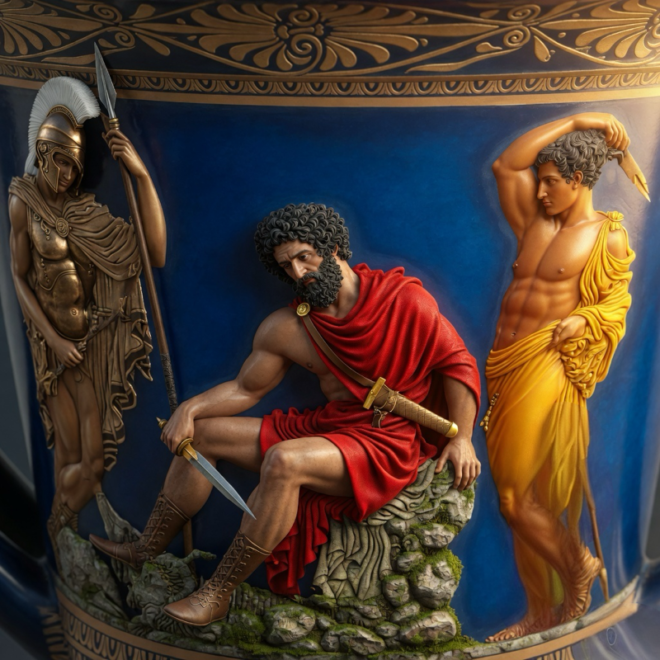
I. THE DRUMBEAT RETURNS
Every year, as the twenty-fifth of April rolls around, Australia performs a ritual whose contradictions grow more glaring with each passing decade. Crowds gather before dawn at memorials from Gallipoli to the Perth foreshore. The Last Post sounds across the chill morning air. Political leaders lay wreaths and speak of sacrifice, duty, and the debt owed to those who fell. And then, almost before the echo of the bugle has faded, the same voices that just invoked the sanctity of the fallen begin their other work: advocating for new deployments, rattling sabres in the direction of whichever adversary serves the news cycle, insisting that Australia must remain ‘strong,’ that weakness invites aggression, that to hesitate before committing the next generation to the next conflict is somehow to dishonour the previous ones.
This essay is a refusal of that logic. It is written in the week of Anzac Day 2026, with the drums of war audible once again – in the South China Sea, in the corridors of AUKUS deliberations, in the editorials of newspapers whose proprietors have never themselves stood in a trench. It is written in the conviction that the truest memorial we could offer the dead is not another moment’s silence before another declaration of readiness to kill and be killed, but the intellectual and moral courage to name the lie that has always attended the glorification of war.
That lie is ancient. It predates Gallipoli by nearly three thousand years. And nowhere is it exposed more devastatingly than in the moment Homer places the shade of Achilles before Odysseus in the underworld – a passage that deserves to be read aloud in every parliament, every officer training academy, every press gallery in every country that imagines itself a democracy.
II. ACHILLES IN THE UNDERWORLD
The eleventh book of The Odyssey is one of the most profound antiwar passages in the literature of any civilisation. Odysseus, on his long journey home from Troy, is instructed to descend to the realm of the dead and consult the shade of the blind prophet Tiresias. What he finds there is a gallery of the heroic and tragic dead – and among them, most luminously, Achilles.
The encounter is worth dwelling on. Achilles is not merely a great warrior in Homer’s telling. He is the greatest warrior – the archetype, the gold standard of martial virtue, the man who was offered a choice by fate between a long, obscure, peaceful life and a short, glorious death in battle. He chose glory. He chose Troy. He chose the death that would make him immortal in song. The entire Iliad is constructed around this choice and its consequences. Achilles is the poem’s engine, its justification, its argument for why the heroic life is worth living. He is what every young man in the ancient world was supposed to want to be.
And here, in the Odyssey, he reveals what that immortal glory actually feels like from the inside.
Odysseus, encountering the shade, offers him the standard consolation: you were the greatest; you are honoured even among the dead; you are blessed above all men who ever lived. It is the speech that generals give at memorial services, that politicians deliver on Anzac Day, that editorial writers compose in the aftermath of every futile engagement. You died for something. Your death meant something. You are remembered.
Achilles answers with a fury that cuts through three millennia:
This is not a minor character speaking. This is not a coward or a sceptic or a man who lacked the courage to go to war. This is the man who chose war, who excelled at it beyond all others, who purchased his immortal fame with his life. And his verdict, spoken from direct experience, is unequivocal: the meanest life on earth is worth more than the noblest death. The most degrading existence imaginable – a landless serf, a tenant farmer scraping in the dirt, entirely without dignity or autonomy by the ancient world’s own standards – is preferable to ruling over the dead in glory.
The dead do not cheer our anthems. They do not wave flags or demand more blood. They do not gaze down approvingly on the politicians who invoke their sacrifice. If Achilles is any guide, they would give every monument, every epic, every marble column inscribed with their names, for one more day of ordinary life. One more morning. One more bowl of food eaten in the company of the living.
Homer was not a pacifist in any simple sense. The Iliad is among the most vivid and detailed accounts of combat ever written, and it does not flinch from depicting what battle does to the human body. But it is also, in its depths, a lament – for Hector as much as for Achilles, for the Trojan women as much as for the Greek heroes. The Odyssey carries that lament further, into the realm of aftermath and consequence, and it is there, in the underworld, that the poem delivers its most radical judgment.
“No winning words about death to me, shining Odysseus!
By god, I’d rather slave on earth for another man —
some dirt-poor tenant farmer who scrapes to keep alive —
than rule down here over all the breathless dead.”
III. THE MYTHOLOGY OF THE GOOD DEATH
Australia has its own mythology of the good death, and it is centred on Gallipoli. The campaign of 1915, catastrophic by any military measure, has been retrospectively transformed into the founding story of the Australian nation. The Australian and New Zealand Army Corps – the Anzacs – landed on the wrong beach, were pinned down by devastating Turkish fire, achieved none of their strategic objectives, and suffered casualties that would by today’s standards be considered unconscionable. They were sent by British commanders whose planning was cavalier and whose concern for colonial lives was minimal. They died, in their thousands, for a position that was ultimately abandoned.
What emerged from this disaster was not, as one might expect, a national determination to question the decisions that sent young men to their deaths in such numbers. What emerged was a mythology. The Anzacs became not victims of imperial misadventure but exemplars of a peculiarly Australian character: the larrikin, the mate, the man who could laugh in the face of danger and die with a joke on his lips. Gallipoli became, in the national imagination, not a defeat but a baptism – the moment Australia discovered itself, grew up, became a nation.
This mythology has done enormous damage. It has made it difficult, politically, to question military commitments, because to do so is framed as dishonouring the Anzac dead. It has consistently been weaponised to support subsequent misadventures – Vietnam, Iraq, Afghanistan – each one justified in part by the argument that Australian soldiers had already paid such a price that to refuse the next commitment would make their sacrifice meaningless. The dead of the last war become the argument for the next one, in a cycle of justification that is as logically bankrupt as it is emotionally effective.
The families of those who died deserve better. The dead themselves – if Achilles is any guide – would be horrified to learn that their deaths were being used as collateral for further killing.
IV. THE POLITICAL USES OF GRIEF
Grief is one of the most powerful political emotions. This is not a cynical observation but a phenomenological one: the loss of someone we love, or the imagined loss of someone whose story moves us, creates a demand for meaning that is almost irresistible. We cannot accept that people died for nothing. And so we reach for frameworks that make the death meaningful – frameworks that are always, inevitably, provided by those with the most to gain from our continued willingness to send the next generation to war.
The right wing of Australian politics has been particularly skilled at this appropriation. The Anzac myth has been managed, over decades, to emphasise certain elements – the courage, the mateship, the self-sacrifice – and suppress others: the imperial context, the strategic incompetence, the class dimensions of who fought and who commanded, the lived experience of the survivors who came home to poverty and indifference and in many cases to a physical and psychological ruin that the mythology of the good death preferred not to acknowledge.
John Simpson Kirkpatrick – the man with the donkey, who carried wounded soldiers from the front lines at Gallipoli, before being killed himself, has been canonised in Australian memory as the quintessential Anzac hero. What the mythology tends not to emphasise is that Simpson was a committed trade unionist and socialist, a man who had jumped ship in Australia to escape the British merchant marine precisely because he found the conditions of ordinary workers intolerable. He was, in short, a man whose politics were entirely at odds with those of the establishment figures who now invoke his memory to justify deployments that he, in all probability, would have opposed.
The Achilles problem persists: we take the dead and make them serve our purposes, because the dead cannot speak back. Or rather – and this is Homer’s great insight – they can speak back, if we are willing to listen. And what they say is not what we want to hear.
V. WHAT THE SURVIVORS KNEW
It is worth attending to what the survivors actually said, rather than what subsequent generations have put in their mouths. The literary and testimonial record of men who fought in Australia’s wars is not, by and large, a record of enthusiasm for the mythology that was constructed around their experience. It is a record of endurance, of horror, of gallows humour as a survival mechanism, and of a deep, abiding suspicion of the people who sent them to fight.
The poets of the First World War – not the Australian ones specifically but the broader tradition, from Wilfred Owen to Siegfried Sassoon – produced some of the most powerful antiwar writing in English. Owen’s ‘Dulce et Decorum Est’ is a direct assault on the mythology of the good death: its Latin title, the phrase that translates as ‘it is sweet and fitting to die for one’s country,’ is deployed with devastating irony against a description of a man dying in a gas attack, his eyes ‘guttering’ and his lungs ‘gargling.’ The poem ends by calling the old lie what it is: an old lie.
Australian war literature has its own dissident tradition, less celebrated than the official mythology but no less powerful. The men who came back from Gallipoli, from the Western Front, from the jungles of New Guinea, frequently found that their experience resisted the language of glory that was being prepared for them. The gap between what they had seen and done and what the newspapers and the politicians said about it was, for many, a source of lifelong bitterness.
To honour that bitterness – to take it seriously as a form of knowledge – is not to diminish the courage it took to endure what those men endured. It is to insist that courage deserves better than to be weaponised by people who will never themselves be called upon to demonstrate it.
VI. THE RIGHT-WING ROMANTICISATION AND ITS COSTS
The romanticisation of military sacrifice is not a neutral cultural tendency. It has specific political valences and specific political consequences, and in Australia in 2026 those consequences deserve to be named plainly.
The voices that beat the drums loudest each Anzac Day – the tabloid columnists, the shock jocks, the politicians who invoke the spirit of the Anzacs to justify defence spending and military deployments – are, almost without exception, people whose own relationship to military service is theoretical. They invoke the dead with great facility. They are less forthcoming about whether they would send their own children, their own grandchildren, to the next Gallipoli, the next Long Tan, the next Kandahar.
The romanticisation serves several political functions simultaneously. It constructs a version of national identity that is inherently martial, in which the capacity for violence is presented as the founding and definitive expression of Australian character. It makes it difficult to question military budgets, military commitments, or the decisions of military commanders without being accused of disrespecting the fallen. And it provides a ready emotional vocabulary for the next mobilisation – whenever it comes, whatever its justification.
The AUKUS submarine agreement is, at the time of writing, the most significant military commitment Australia has made in a generation. Its costs are extraordinary, its strategic rationale is contested, and its implications for the region remain deeply uncertain. Yet public debate about it has been constrained, in part, by a cultural environment in which scepticism about military commitments can be framed as un-Australian, as a betrayal of the Anzac spirit. The dead of Gallipoli are being used, more than a century after their deaths, to foreclose debate about a nuclear-powered submarine program that will commit Australia to a particular strategic posture for decades to come.
Achilles would have had thoughts about this.
VII. MEMORY AS MORAL ACT
To remember the dead honestly is a harder task than to remember them mythologically. Mythology is clean, consoling, and serviceable. Honest memory is complicated, often painful, and refuses to be put to easy use.
Honest memory of the Anzacs would require us to hold, simultaneously, several things that the official mythology tends to keep apart: the genuine courage of ordinary men placed in an extraordinary situation not of their choosing; the criminal negligence of the commanders who sent them there; the imperial context that made Australia’s participation in Britain’s wars not a free choice but a structural expectation; the experience of the Turkish soldiers who defended their homeland against an invading force with equal courage and far greater justification; the long shadow that the war cast over the men who survived it, in broken bodies, in nightmares, in a silence about what they had seen that many carried to their graves.
It would require us to ask, every Anzac Day, not only ‘what did they sacrifice?’ but ‘for whom did they sacrifice it, and who benefited from their sacrifice?’ It would require us to notice that the answer to that question is not, in many cases, ‘Australia’ in any straightforward sense, but rather specific interests – imperial, commercial, political – that were served by the readiness of young men to die.
This is not an exercise in cynicism. It is an exercise in the kind of clear-eyed moral reckoning that the dead deserve and that the living owe them. To sentimentalise their deaths is not to honour them. To understand the conditions that produced those deaths, and to work against the reproduction of those conditions, is the only form of memorial that has any genuine ethical content.
Lest we forget is a phrase that has become, through repetition, almost meaningless. What it originally meant, in the aftermath of the First World War, was something specific and urgent: that the magnitude of the catastrophe must be held in memory as a warning against complacency, against the ease with which populations can be led into war, against the gap between the rhetoric of glory and the reality of mud and gas and shattered bodies. It was a phrase that looked at the dead and said: not again.
It has since been colonised by the very forces it was meant to resist, so that ‘lest we forget’ has come to mean, in practice, ‘remember the sacrifice so that you will be willing to sacrifice again.’ The warning has become an advertisement.
VIII. CHOOSING LIFE
There is a radical act available to Australians this Anzac Day, and it does not require abandoning solemnity or refusing to honour genuine courage. It requires something harder: the intellectual and moral courage to refuse the mythology that has been built around the memory of the dead, and to hear instead what the dead themselves – or at least the most honest voices we have from the underworld – are telling us.
Achilles tells us that life is worth more than glory. He tells us this from the position of someone who made the opposite calculation, who chose glory, who won it at the ultimate price, and who, from the far side of that transaction, considers it a catastrophic bargain. The shade of the greatest warrior in the Western literary tradition looks up at Odysseus – at the living world, at ordinary human existence with all its limitation and dignity – and he would trade everything, everything, to be back in it.
This is not cowardice. It is wisdom, purchased at the only price that wisdom of this kind can be purchased. And it is wisdom that we are obliged to take seriously, because the alternative – the continued romanticisation of martial death, the continued use of the dead as propaganda for the next war – is a form of disrespect to the fallen that dresses itself in the language of honour.
True courage, in the political context of Anzac Day 2026, means several things. It means speaking honestly about the costs of military misadventure rather than retreating into mythology when the accounting becomes uncomfortable. It means being willing to question defence commitments that are driven by alliance management and domestic political calculation rather than genuine strategic need. It means insisting that the threshold for committing Australian lives to combat should be genuinely high – not the first resort of middle powers seeking to demonstrate their reliability to great power patrons, but a last resort, undertaken with full acknowledgment of what is being asked of those who will fight.
It means, above all, refusing to let grief be weaponised. The families of the fallen deserve to grieve. The nation deserves to remember. But memory and grief should not be converted, without our noticing, into advance consent for the next generation of casualties.
War is not glory. Homer knew this. Owen knew this. The survivors who came home and found that the language of glory had no room for what they had actually experienced knew this. The dead, if Achilles is our guide, know this with a terrible clarity.
This Anzac Day, remember the fallen with the solemnity they deserve. But then use that solemnity for something. Use it to demand honest debate about when and why and at whose behest Australia commits its people to combat. Use it to resist the annual ritual of militarist enthusiasm that has attached itself, like a parasite, to a ceremony that was meant to be about mourning. Use it to hold in mind, alongside the courage and the mateship, the waste – the enormous, irreversible waste of human life and human potential that every war represents, even when it cannot be avoided.
Lest we forget what it truly costs. Not the cost in treasure, not the cost in strategic positioning, not the cost in national reputation. The cost in the only currency that actually matters: the years of ordinary life, the tenant farmer’s bowl of food, the breath of morning air, that each of the dead gave up and that no monument can restore.
The shade of Achilles is still speaking, across three thousand years of silence. The question is whether we are willing to listen.



Every Anzac Day, Australia performs a ritual whose contradictions grow more glaring. Dawn service. The Last Post. Wreaths and solemn speeches about sacrifice. Then — before the bugle echo has faded — the same voices begin rattling sabres toward the next war, insisting that hesitation dishonours the previous fallen.
Young people need to wake up to the reality of what war really is.
As a United States Marine with twenty-two years in the Corps, I’ve buried more brothers than I care to count. I’ve held kids in my arms while they bled out in some godforsaken street, their last words nothing but a scream for their mothers. And I’ve looked through a rifle scope and ended lives that never should have crossed my path.
There is no honor in any of it.
There is no honor in watching your friends die for politicians’ lies.
There is no honor in killing another human being—man, woman, or child—who was just trying to survive the same hell you were dropped into.
There is no honor in turning someone’s home into rubble, their neighborhood into a graveyard, and their country into a wasteland so some government can draw a new line on a map.
War is not noble. It is slaughter with better branding.
We do not need more wars. We need to end the ones we’re in and never start another. Every time we cheer another “operation,” another “defensive action,” another “necessary conflict,” we spit on the graves of every Marine, soldier, sailor, and airman who ever believed they were fighting for something worth dying for.
And what Israel has done in Gaza is genocide—plain, deliberate, and indefensible. They are the aggressor. They turned a trapped population into target practice, leveled entire bloodlines, and called it self-defense while the world watched children starve under their bombs. No amount of propaganda changes the body count or the intent behind it.
I took an oath to defend the Constitution, not to rubber-stamp war crimes committed with American weapons and American money. If that makes me “anti-Israel,” then so be it. I’ve seen enough real combat to know the difference between a warrior and a butcher.
Enough is enough. Bring our people home. Stop feeding the machine. End the wars. All of them.
If you would like Le a sympathetic ear to listen, you can get my details from the website administrator. I’ll give them permission to release my contact details to you.
Thank you Fr Alfonso. Your offer is very much appreciated.
You’re welcome. The offer to listen will remain always open.
I have experienced firsthand a little bit of what you have experienced. Why anyone to voluntarily put themselves in that situation, given all the stories like yours circulating defies rational thought.
Achilles knew it. In the underworld he tells Odysseus — who has just praised his immortal glory — that he would rather be a nobody alive than a king among the glorious dead. Three thousand years ago. Still waiting for a politician to read it.
I’m a Palestinian-Australian and I can guarantee you that when I say “war is a mugs game” I’m speaking from real life experience.
Dear friend, I know that you have truly experienced the sorrow of war, you and your lost loved ones are always in my thoughts and prayers.
Bryan, I’m sorry you faced those experiences. Thank you for having the courage to speak up about the utter waste and the propaganda. I don’t pretend to know what military service or its aftermath is like, but I do hope you’ve found something more positive and fulfilling.
Thank you Watershedd for your kind words, they help in the healing process.