I. THE NEWS THAT SHOULD STOP US COLD
On the morning of 23 March 2026, The New York Times reported that fresh Iranian and American threats to attack critical civilian infrastructure were imperilling millions of people across the Middle East. President Trump had warned that he could order strikes on Iranian power plants. Tehran, in turn, vowed that any such action would trigger retaliation against vital energy and water facilities. These were not the idle threats of an overheated news cycle. They were escalatory signals in a spiral of verbal and military exchanges that has been building for months – a spiral with the potential to shatter the lives of tens of millions of human beings who never voted for war, never declared war, and never wanted war.
Read that sentence again. Tens of millions of people.
Power plants. Water facilities. The infrastructure on which human life in its most basic, biological sense depends. Not military installations alone. Not missile batteries or munitions depots. But the systems that keep infants warm in winter, that purify the water a mother gives her child in the morning, that run the dialysis machines and intensive care units, the refrigerators holding insulin and chemotherapy drugs. This is what is being threatened – casually, strategically, as a bargaining chip in a geopolitical chess match played by men in suits and uniforms at a vast remove from the consequences.
Let us stop for a moment. Let us breathe. And let us ask, with full moral seriousness, what war actually is – not as a subject for strategic analysis, not as a metric in a deterrence model, but as a lived, suffered, bled human reality.
II. THE ABSENT ARCHITECTS
There is a truth about war that is so obvious, so routinely demonstrated across every conflict in recorded history, that it ought to be the first sentence of every declaration of hostilities, the first paragraph of every presidential war address, the opening line of every resolution tabled in the United Nations Security Council: the people who start wars are rarely the people who fight them, and almost never the people who die in them.
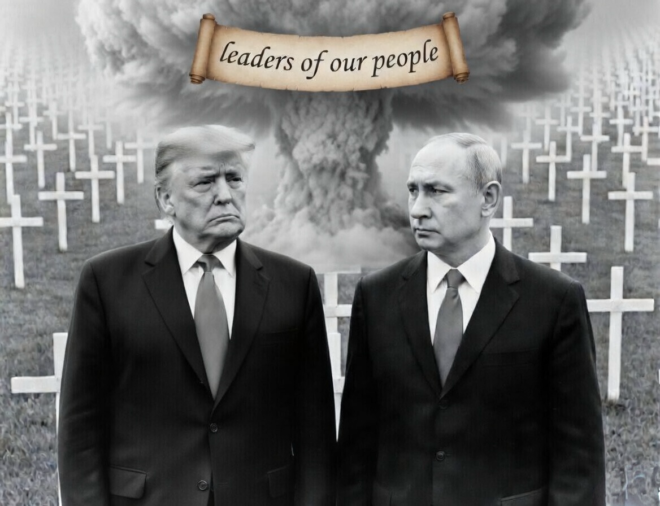
This is not a fringe observation. It is the structural reality of modern warfare, and of most ancient warfare too. When President Trump issues threats against Iranian infrastructure from the Oval Office, he does so behind layers of security, insulated by protocol and power and the vast machinery of the American state. When Iranian supreme leadership issues counter-threats from Tehran, their children are not being loaded onto troop transports or marched toward the front lines. The architects of conflict inhabit a different universe from those who will pay its costs – not metaphorically, but literally and geographically.
Think of the soldiers mobilised in any major conflict of the last century. Think of the factory workers, the farmers, the students pulled from their studies. Think of the civilians who did not flee in time, the hospital patients who could not be evacuated, the elderly too frail to run. In every war, the overwhelming burden of suffering falls on people who exercised no meaningful choice about whether that war would occur. The decision-makers – the presidents and prime ministers, the generals and intelligence chiefs, the ideologues and nationalists who whipped popular sentiment into a fever – suffer comparatively little. Many of them emerge from wars with their reputations enhanced and their power consolidated.
This obscene arithmetic – the gap between who decides and who dies – is not a bug in the system. It is a feature, and a remarkably durable one. It persists across democracies and autocracies, across ideological lines and historical epochs. It is the central political fact of war, the fact around which all honest moral analysis must be oriented. Any discussion of current threats in the Middle East that omits this fact is, whether by design or omission, a form of moral evasion.
III. HOMER’S WITNESS: WHAT THE ANCIENT WORLD ALREADY KNEW
We did not need the twentieth century to learn what war does to human flesh and human minds. We had Homer.
The Iliad and the Odyssey – composed in oral tradition somewhere in the eighth century BCE and among the oldest surviving works of Western literature – are saturated with war. Of the more than fifteen thousand verses of the Iliad, roughly a third – some five thousand lines – are devoted to battle scenes of a carnage so vast and so graphically rendered that modern readers frequently find them overwhelming. This was deliberate. Homer did not flinch from the reality of combat because he understood, or his tradition understood, that to flinch would be to lie.
War, in Homer’s telling, could indeed bring glory. The martial ideal – the aristeia, the moment of supreme battlefield excellence – is one of the Iliad’s organising conceits. Achilles, Hector, Diomedes, Ajax: these are men at the apex of a warrior culture that frames combat as the ultimate test of masculine virtue. The poem does not pretend otherwise, and to reduce Homer to mere antiwar pamphlet would be to misread him.
But read the poem carefully, and a far more complex and far darker picture emerges. War in Homer is described, repeatedly and without irony, as destructive, deadly, dreadful, abominable, and a cause of tears. Classical scholars studying the Iliad’s vocabulary have assembled a further litany: war is bloody, wretched, baneful, cruel, harsh, piercing, and burning hot – a source of fear, terror, panic, pain, exhaustion, sweat, dust, and noise. These are not the adjectives of glory. They are the adjectives of catastrophe.
And Homer does not abstract his violence. He renders it in forensic, unbearable detail. Brains run from wounds along the shaft of a spear through the eye socket, bleeding. They are spattered across the dust. Severed heads spin on the ground like errant balls. Tongues, eyes, and teeth are shattered at the root. Bowels spill from ruptured abdomens. Men fall screaming, or fall silent, or crawl toward water they will never reach. The Iliad does not allow us the comfort of a tasteful battlefield. It makes us look.
This is the poem’s great moral seriousness – its insistence that if we are going to celebrate war, or justify war, or prosecute war, we must first be willing to see what war actually is. We must look at the bleeding eye socket. We must see the head that spins like a toy. We must hear the noise, endure the dust, feel the exhaustion. We must not look away.
The Odyssey carries this reckoning further, into the aftermath. It is, in many respects, the Iliad’s PTSD offspring – a poem haunted by the war it follows. Heroes weep uncontrollably at the mere memory of what they endured at Troy. Odysseus, the most cunning and ostensibly the most resilient of warriors, spends ten years wandering, unable to return home, undone not by external enemies alone but by the psychological wreckage of a war that has left him incapable of straightforward re-entry into civilian life. The Odyssey understands, three thousand years before the term was coined, that the wounds of war do not end when the fighting ends.
What does Homer want us to think about war? This question has occupied classicists for generations, and it resists simple answers – which is itself a kind of answer. The poems do not resolve into tidy moral fables. They hold war’s glory and war’s horror in perpetual, irresolvable tension. They sanctify and condemn simultaneously. They make war beautiful and make war abominable in the same breath. This ambivalence is not a failure of artistic nerve. It is an honest reckoning with a phenomenon that has always exceeded simple moral categories.
But here is what Homer never does: he never pretends that war is clean, or cheap, or something that happens to someone else. He never allows his audience the comfort of abstraction. He insists, always, on the body – on what happens to this particular young man, the son of this particular family, when a spear finds its mark. He insists on the grief of parents, the desolation of wives, the orphaning of children. He understands, with a clarity that our age of drone strikes and press briefings and collateral damage assessments has largely lost, that war is not a policy instrument. It is a catastrophe that must be weighed in human flesh.
IV. THE MODERN THEATRE OF ABSTRACTION
What has changed between Homer’s world and ours is not the nature of war. It is the nature of the language we use to discuss it.
Modern political discourse about military conflict is saturated with euphemism and abstraction. We speak of kinetic operations and force projection and surgical strikes. We speak of target packages and collateral damage assessments and escalation management. We speak of assets and capabilities and deterrence thresholds. This language is not accidental. It is carefully designed to insulate decision-makers – and electorates – from the visceral reality of what is being discussed.
When President Trump threatens to target Iranian power plants, the phrase as uttered is almost clinically neutral. Power plants. Infrastructure. Facilities. The language carries no weight of suffering. It does not tell us about the premature infants in incubators who will die when the electricity goes off. It does not tell us about the kidney patients on dialysis, or the elderly in summer heat without air conditioning, or the municipal water treatment systems that will fail without power, releasing contaminated water into the drinking supply of millions. It does not give us the screaming child or the cooling corpse of an old man or the dialysis machine that has gone dark.
This is not a criticism unique to any one political leader or any one country. It is a structural feature of modern geopolitical discourse, replicated across governments and military establishments worldwide, across democratic and authoritarian systems alike. The euphemism is bipartisan and international. It is how power speaks to itself about the use of force.
Homer had no such option. His technology of war was intimate – sword, spear, arrow, javelin. His warriors looked their enemies in the face as they killed them, and often knew their names. This enforced a kind of moral realism that modern warfare’s technological mediation has abolished. A pilot who releases a munition at thirty thousand feet does not see what the munition does. A policymaker who authorises a strike from a conference room sees, at most, a satellite photograph. The suffering has been systematically removed from the field of vision of those who cause it.
Homer’s insistence on the body – on what happens to specific human beings – is not merely a literary technique. It is a moral argument. It says: you must see this. You do not get to look away. And if you look away, you have forfeited your right to speak about what you are doing.
V. WATER AND POWER: THE NEW WEAPONS OF MASS CIVILIAN SUFFERING
The specific threat now circulating in the Middle East – the targeting of power plants and water facilities – deserves particular attention, because it represents something qualitatively different from conventional military exchange.
Water and electricity are not military assets in any meaningful sense. They are the biological prerequisites of human civilisation. A functioning water supply is what separates a modern city from a death trap. It prevents cholera, typhoid, dysentery. It enables basic sanitation, hospital sterilisation, infant nutrition. It is, quite literally, the difference between life and death for large numbers of people, particularly the most vulnerable – the sick, the elderly, the very young, the poor who cannot afford private wells or bottled water or emergency generators.
When power grids are destroyed, the consequences cascade through every system that depends on electricity. Hospitals lose power. Refrigerated medicines spoil. Water treatment plants go offline. Communications infrastructure fails. Emergency services are degraded. Heating and cooling systems – critical in a region that experiences both brutal summer heat and significant winter cold – cease to function. People die not from bombs but from the absence of the infrastructure that keeps modern life viable.
This is not a theoretical scenario. It is what happened in Iraq after the Gulf War, when the systematic destruction of infrastructure – power plants, water treatment facilities, sewage systems – contributed to an estimated half a million excess deaths in the years that followed, the overwhelming majority of them children under five who died from waterborne disease and malnutrition. It is what happened in Yemen, where years of attacks on infrastructure have produced what the United Nations has described as one of the worst humanitarian crises on earth. It is what has happened, repeatedly, to civilian populations across every major conflict of the past half-century.
To threaten power plants and water facilities is to threaten the conditions of human life itself. It is not a military strategy in any proportionate sense. It is, at its most honest, a form of collective punishment – the deliberate imposition of suffering on a civilian population in order to coerce their government. And collective punishment is, under international humanitarian law, a war crime.
That such threats are being made openly, by the leaders of major nations, as negotiating tactics, without immediate and universal condemnation, tells us something important about the moral state of the world in 2026. It tells us that we have become habituated to the language of atrocity. We have heard so much of it that we are no longer fully shocked.
We should be.
VI. THE SPIRAL AND THE SILENCE
What makes the current situation in the Middle East so acutely dangerous is not any single threat or provocation. It is the dynamic of escalation – the self-reinforcing cycle in which each action generates a reaction that generates a further reaction, each turn of the spiral moving the situation closer to an outcome that, at each individual step, seemed avoidable.
This is not a novel dynamic. It is the logic that produced the First World War – a conflict in which a cascade of mobilisations, each defensive in its own framing, produced a catastrophe that none of its architects had intended and none of them could stop once it was set in motion. It is the logic that has driven nuclear standoffs to the brink in previous decades. It is the logic that transforms manageable disputes into irreversible disasters.
And it is a logic that operates most lethally in conditions of domestic political pressure, where leaders have strong incentives to project strength, to refuse to be seen as backing down, to outdo rivals in the performance of toughness. In such conditions, the rational-actor model of deterrence theory – the assumption that both sides will always step back from the brink because the costs of miscalculation are too high – begins to break down. Leaders do not always behave as rational actors. They behave as politicians, as narcissists, as people whose domestic political survival may depend on being seen to stand firm even when standing firm is catastrophically dangerous.
The avalanche of verbal and military exchanges that has been building in recent months between the United States and Iran is precisely this kind of spiral. Each threat invites a counter-threat. Each military posture demands a response. Each rhetorical escalation becomes a baseline from which the next escalation is measured. And all the while, tens of millions of people in the region – people who did not choose this confrontation, who have no say in its management, who will bear its costs in destroyed homes and dead relatives and shattered infrastructure – live in growing fear of what the next morning will bring.
VII. AGAINST FATALISM: WHAT WE OWE THE FUTURE
It would be easy, at this point, to slide into fatalism. To say that war is human nature, that it has always been with us and always will be, that Homer’s poems are great precisely because they capture a truth about humanity that cannot be wished away. There is something to this. The capacity for organised violence is, demonstrably, a feature of our species. It would be dishonest to pretend otherwise.
But fatalism about war is itself a moral choice – and a morally irresponsible one. It is the choice to accept as inevitable what is in fact contingent, to treat as natural what is in fact constructed. Wars are not natural disasters. They are decisions. They are decisions made by identifiable human beings, in identifiable circumstances, for identifiable reasons. And decisions can be made differently.
The history of the past century is not only a history of wars. It is also a history of wars that were avoided – through negotiation, through diplomacy, through the construction of international institutions, through the long slow work of building relationships and norms and agreements that make conflict less likely. The European Union, whatever its current tensions, represents the transformation of a continent that had twice in thirty years produced world wars into a zone of durable, if imperfect, peace. The Nuclear Non-Proliferation Treaty, the Chemical Weapons Convention, the structures of the United Nations – these are all imperfect, all under stress, all routinely violated or weakened. But they represent the accumulated human understanding that war is not inevitable, and that it is possible, at enormous effort and with no guarantee of success, to build systems that make it less likely.
This work is not heroic in any Homeric sense. It does not produce the aristeia, the glorious moment of martial excellence. Diplomacy is unglamorous, compromised, frustrating, and slow. Diplomats do not get epic poems. They get footnotes and treaty texts and, occasionally, grudging acknowledgment decades later that they prevented something terrible. But the absence of war – the ten million people who did not die, the cities that were not rubble, the children who were not orphaned – is also a human achievement, even if it is invisible precisely because it succeeded.
VIII. THE MORAL DEMAND OF THIS MOMENT
We are not, as of this morning, at war. The threats are threats. The spiral is a spiral, not yet a catastrophe. There is still time.
But the history of escalatory crises teaches a grim lesson: the time in which decisions can redirect the trajectory is always shorter than it appears. The window of genuine choice narrows with each exchange. And the people who will ultimately pay the price – the residents of Iranian cities who depend on power grids, the populations across the Middle East whose water and food and medical care depend on infrastructure that is now being openly discussed as a military target – have no vote in any of this. They have only their lives, which are at the disposal of decision-makers who are not accountable to them.
This is the moment to insist, loudly and without apology, on a set of simple moral propositions that the sophistication of strategic discourse tends to obscure.
Civilians are not bargaining chips. Water is not a weapon. Electricity is not a target. Children’s hospitals are not collateral damage. The people of any country – American, Iranian, Israeli, Palestinian, Yemeni, Saudi – are not abstractions in a deterrence calculation. They are human beings, with the same claim on life and dignity and safety as the people who sit in the rooms where decisions are made.
The men and women who threaten civilian infrastructure from positions of power and comfort have not earned that power by standing on the front lines. They have earned it through political systems that, in their current forms, are badly equipped to weight the costs of war against its perceived benefits, because the benefits accrue to those who decide and the costs fall on those who don’t. This asymmetry is not an accident of fate. It is a structural feature of how power operates, and it must be named as such.
Homer named it, in his way. He gave us Priam holding the body of Hector – the old king pressing his face against the hands that killed his son, begging for the return of a corpse. He gave us Andromache, the war widow, watching her husband’s body dragged in the dust behind a chariot. He gave us the Greek soldiers weeping on the shore at Aulis, understanding somewhere in their bodies what they were being sent to. He did not give us the option of comfortable abstraction. He insisted on the particular grief of specific people, and he made us sit with it.
We should sit with it now. We should think about the particular grief of the particular people whose lives hang in the balance of the current escalation. We should refuse the language of strategic assets and kinetic options and infrastructure targets. We should demand of our political leaders, loudly and specifically and without relenting, that they account for the human costs of the threats they issue and the decisions they make.
And we should remember, always, that the choice is theirs but the price is ours.