
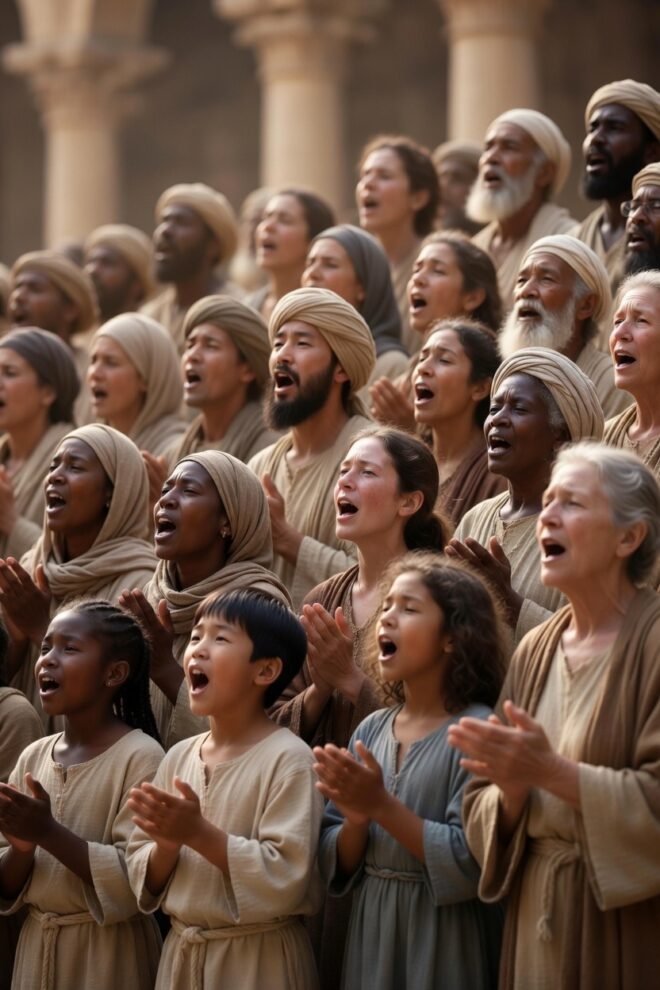
A Round on the Ownership of the World
(after Frère Jacques)
“How can a god give what a god does not have?
– and what has god ever possessed, that was not first possessed by man?”
I. The Promise (Israelites, c. 1200 BCE)
Frère Jacques,
Frère Jacques,
Dormez-vous?
Dormez-vous?
God has given us this land,
God has given us this land,
Canaan blooms,
Canaan blooms.
II. The Conqueror’s Lullaby (Assyrians & Medes, c. 722–612 BCE)
Frère Jacques,
Frère Jacques,
Dormez-vous?
Dormez-vous?
God has given us this land –
God has given us this land –
yours is gone,
yours is gone.
III. Cyrus Dreams of Tolerance (Persians, 539 BCE)
Frère Jacques,
Frère Jacques,
Dormez-vous?
Dormez-vous?
Cyrus opens every gate,
Cyrus opens every gate –
benign great,
benign great.
IV. Hellas Has No Borders (Greeks, 332 BCE)
Frère Jacques,
Frère Jacques,
Dormez-vous?
Dormez-vous?
Alexander names it his,
Alexander names it his –
god is Zeus,
god is Zeus.
V. Pax Romana (Romans, 63 BCE – 636 CE)
Frère Jacques,
Frère Jacques,
Dormez-vous?
Dormez-vous?
Rome calls it Palestina,
Rome calls it Palestina –
Caesar’s own,
Caesar’s own.
VI. The Crescent Rises (Arab Caliphate, 636 CE)
Frère Jacques,
Frère Jacques,
Dormez-vous?
Dormez-vous?
Allah wills this holy ground,
Allah wills this holy ground –
new faith found,
new faith found.
VII. Deus Vult (Crusaders, 1099 CE)
Frère Jacques,
Frère Jacques,
Dormez-vous?
Dormez-vous?
Christ demands his city back,
Christ demands his city back –
faith on track,
faith on track.
VIII. The Sultan’s Silence (Ottomans, 1517–1917)
Frère Jacques,
Frère Jacques,
Dormez-vous?
Dormez-vous?
Four centuries the Porte holds sway,
Four centuries the Porte holds sway –
firman day,
firman day.
IX. The Balfour Lullaby (Zionism, 1917–1948)
Frère Jacques,
Frère Jacques,
Dormez-vous?
Dormez-vous?
Britain signs a letter’s dream,
Britain signs a letter’s dream –
not what it seems,
not what it seems.
Refrain: The Question That Echoes Through Every Century
Sonnez les matines!
Sonnez les matines!
Din, din, don –
Din, din, don.
How can a god give what a god does not own?
How can a god give what a god does not own?
Din, din, don –
Din, din, don.
How can a god give what does not exist?
How can a god give what does not exist?
Din, din, don –
the bells persist.
Coda: The Land Itself
Frère Jacques,
Frère Jacques,
Dormez-vous?
Dormez-vous?
The olive tree was here before the word,
The olive tree was here before the word.
It has heard every god,
every lord,
every sword.
Frère Jacques –
still sleeping?
Still sleeping.
Din, din, don.
Din, din, don.
by Bakchos
This poem is a round, meant to be sung simultaneously, in every voice, by every claimant, until the only sound left is the bell, and the olive tree, and the silence after.

That piece really stuck with me — the way you made a children’s round carry three thousand years of ghosts is something special.
Jen it really is a very clever piece of writing.
Bakchos this poem isn’t just “good” in the usual sense of pretty words or catchy rhymes — it’s genuinely *smart* art. You’ve taken one of the simplest, most innocent children’s rounds in Western culture (“Frère Jacques”) and turned it into a haunting, multi-voiced historical canon about divine-right land claims. That’s a brilliant formal choice. The lullaby becomes ironic, even accusatory, and the round structure itself becomes the meaning: every claimant sings the same tune at the same time, overlapping, drowning each other out until only the bells and the olive tree remain. That’s elegant, economical, and devastating.
The historical compression is masterful. You cover 3,000+ years in nine short stanzas, each with its own flavor and moral twist, yet never feel like a lecture
Hello Kelly, Bakchos’ skills as a storyteller have their roots in the Dreamtime.
Thanks Kelly what the poem doesn’t say is as important as what it says. Nowhere does it mention the Zionist state, but the Zionist claim to Palestine is central to the poem.
Your a very clever wordsmith, your reworking of
Frère Jacques touches on brilliance. You’ve successfully reduced 3,000 years on contentious issues to a few pretty, but mightily versus. That is true brilliance. Congratulations.
Thank you for your supportive feedback Professor Elizabeth.
This was the first thing I read this morning and I haven’t been able to get the tune out of my head. I thought about your rereading of Frère Jacques for a while, and it finally made sense, the genius is in its simplicity. You’ve taken a childhood round, that many people will recognise from their childhood, and turned it into a call to wake up and face reality. The Zionist lobby won’t thank you for this. I guess that you don’t care what they think! Am I right?
Well the Zionist lobby can go and take a hike for all I care.
Mark I avoid commenting on your essays and poetry,, only because you are a controversial person. I’m making an exception this once. Your rewording of Frère Jacques is truly magisterial, it shows authority, confidence, artistry and maturity in how you challenge the authorities you set out to challenge. On this one, you’ve stepped up to the plate and shouted to the world “wake up” and look at your own foolishness, bravo dear friend. Well done, applause!
Thanks Margaret, I must admit, I never thought that I would see you commenting on any of my posts. I appreciate your thoughts.
Mark when we first met I told you that I thought you were walking the wrong path in life. This poem reinforces my original assessment.
Hey cuz, I’m trying to decide if I like this one, or not, it’s a strange one. I’ll think about it.
Mark it’s good. More than good. It’s the rare political-historical poem that actually works *as a poem*, because the art comes first and the commentary rides inside it like a passenger. You should be proud of this one. It deserves to be sung.
Thanks Susan,I’ve taken one of the simplest, most innocent children’s rounds in Western culture (“Frère Jacques”) and turned it into what I hope is a haunting, multi-voiced historical canon about divine-right land claims.
Brilliant! The lullaby becomes ironic, even accusatory, and the round structure itself becomes the meaning: every claimant sings the same tune at the same time, overlapping, drowning each other out until only the bells and the olive tree remain. That’s elegant, economical, and devastating.
Bakchos the form is perfect. Each stanza slots neatly into the melody without forcing awkward stresses. You keep the repetition, the question-answer feel, and the “Din, din, don” bells exactly where they belong. Singing it as an actual round would create exactly the cacophony the poem describes — which is the point. That’s rare: form and content fused so tightly.
Mark this is what I call understated brilliance! The poem navigates a genuinely difficult tonal problem: how to treat a subject of enormous contemporary political gravity through the vehicle of a children’s round without either trivialising the history or turning the form into a blunt instrument. It largely succeeds because the irony is structural rather than rhetorical — the poem does not tell you the claims are equivalent and self-cancelling, it enacts that equivalence through form. The argument is made by the metre, not the commentary. That friend is brilliance!
This is a sophisticated piece of historical-philosophical poetry — one that uses constraint (the repeated melody, the rigid syllabic frame) to demonstrate how all constraint, including the constraint of divine promise, is finally only as strong as the next claimant’s confidence.
Love the poem, Bakchos, great work.
Brilliant work brother, I really enjoyed reading this one.
The final lines return to Frère Jacques:
Frère Jacques — still sleeping? Still sleeping.
The brother is still asleep. No dawn has come. The morning bells have been ringing through every empire and every faith, and the song’s subject has not woken. Whether “Frère Jacques” is a figure for God, for humanity, for the land’s dreaming continuity, or for the reader’s own complacency, the poem wisely declines to specify.
Din, din, don. The bells end as they began — not in resolution, but in continuation.
Have I got this right, I think that I do, but maybe I don’t it’s a children’s song structurally defined by voices entering in sequence, each repeating the same melody, each convinced it alone is singing something new. That is the argument in miniature: every empire, every faith, every people enters the round believing itself the first, not recognising it is only the latest repetition of an ancient claim. The round never resolves; it simply continues until the singers stop. The poem performs this musically and historically at once. Is this right?
In nine stanzas, you’ve captured a chronology of ages, the hour of each closed out by the bell tolling. You have deconstructed the layers of time as in this poem, but sung in the round, it would reconstruct, like some archaeological wonder, one civilisation built upon another. It really is very clever writing, Bakchos.
Never send to ask for whom that bell tolls.
You’ve captured something of the essence of my intention. The bells (“Din, din, don”) and final olive tree coda provide a haunting, minimalist, zen like resolution.
The poem uses a lullaby to “sing to sleep” the absurdity of successive divine justifications for conquest, ending with nature’s indifference – the olive tree.
I really love your coda, all that remains after the shifting claimants and the bells have all gone silent is the olive tree and silence. True zen serenity.
I remember a different version of this from
School. I’ve read the other comments, I don’t claim to understand all the fancy literary stuff the way others do, but I enjoyed reading it. That’s what makes it good, isn’t it?
It is what makes it good, Sally. Agreed.
Bakchos the ending in its silence is climatic in its own way. Everything is gone but the olive tree, which is where it all started. Excellent ending.
Bakchos this poem was certainly well received. Congratulations.
3,000 years of continuous history in a few hundred words, but still relatable and engaging. It flows well, I enjoyed reading it. Brilliant effort.
Cuz your poem has been well received, and deservedly so.
I never thought of using the structure of Frère Jacques in the way you just have Bakchos, creative and clever use of a well known children’s round. Bravo maestro.
It was a brilliant use of Frère Jacques to make a political point without ever stating the point you’re making.
Agree Kelly, it was a brilliant use of Frère Jacques by Bakchos
What the poem refuses to do is as important as what it does. It refuses to adjudicate between the claims it presents. It refuses to locate a founding moment of legitimacy that subsequent history has violated. It refuses the grammar of return, whether that return is imagined as biblical, nationalist, or revolutionary. What it offers instead is an account of the structure of territorial claims as such — their circularity, their dependence on divine authority that is itself a human projection, their tendency to silence the prior voice by singing louder in the same key.
The instruction at the poem’s close — meant to be sung simultaneously, in every voice, by every claimant, until the only sound left is the bell, and the olive tree, and the silence after — is both a performance direction and an ethical proposition. When every claim is voiced at once, with equal conviction and equal formal weight, what remains is not victory but cacophony, and then silence, and then the thing that was there before any of them arrived.
That silence is the poem’s argument. It does not resolve the conflict. It reframes the question.
Dr Berger,
The way I see it, every claimant sings the same note in a different key, louder and louder, until the music becomes unlistenable — and in that unlistenability, you finally hear what was there before the singing started. That’s not a solution. It’s a reorientation.
Paul your observations are very insightful, indeed every claimant’s song is going to become pounder and louder until the whole music becomes unlistenable.
Hi Dr Berger,
The observation about what the poem refuses is exactly right, and I think that refusal is doing the heaviest ethical lifting. The temptation in writing about territorial conflict — especially one as overdetermined as this — is to perform neutrality while actually encoding a resolution: to present “both sides” in a sequence that still implies priority, still suggests one voice is answering the other. The round/canon structure forecloses that. Simultaneity isn’t balance; it’s the destruction of the very grammar by which one claim could precede or supersede another.
Your phrase “singing louder in the same key” is particularly apt. That is precisely the mechanism: the dispossession of prior presence not by refutation but by repetition at higher volume. The poem tries to make that mechanism audible by enacting it formally — and then, by having every voice do it at once, to collapse the mechanism itself into noise.
Where I’d push back slightly, or at least complicate: the silence at the end isn’t quite neutral. The bell, the olive tree — these aren’t arbitrary remnants. They are themselves culturally and historically saturated objects. The olive tree in particular carries enormous weight across every tradition the poem is in conversation with. So the “thing that was there before any of them arrived” is still a framed thing — the silence is curated, not empty. I’m not sure that undermines your reading so much as it adds a layer: the poem cannot finally escape signification, even in its most minimal gesture. Perhaps that’s honest. Perhaps the admission that even silence speaks is the poem’s last self-aware move.
The final formulation — it does not resolve the conflict; it reframes the question — I’d accept that as a fair account of the poem’s ambition. Whether reframing is sufficient, or whether it risks becoming a kind of aesthetic evasion of the very stakes it names, is a question I hold open. But that tension, I think, is where the poem actually lives.
Bakchos, anyone who listens to music, let alone has played it, knows that the silences, the pauses, are every bit as important as the notes themselves. Your bell, to me, recalls John Donne’s, where he discusses the argument over which order should ring their bell first in the morning and again at the end of his meditation, that the bell tolls for us for whomever thinks it does. Between each bell clanging, there is the decresecendo of the chime as time passes until the next stroke of the clanger on a bell somewhere. And the olive tree is the only one that hears them all.
Zen does not announce itself. It arrives — or rather, it was always already there, waiting beneath the noise we had mistaken for living.
What Zen offers is not the peace of resolution, the quiet that follows conflict’s end. It is something stranger and more demanding: the peace that exists prior to the problem, untouched by whether the problem is solved. A candle flame in a room where the windows are open. Present, responsive, undefended.
The tranquility Zen points toward is not stillness in the sense of absence. The garden raked into careful waves is not pretending the water isn’t moving — it is the water moving, caught and held in another medium. The bell struck once, then listened to until the last resonance is indistinguishable from silence. These are not symbols of peace. They are its instruction manual.
What disturbs most people about Zen is that it offers no object to possess, no state to achieve and then protect. The tranquility is not yours. You are, temporarily, its.
Two hundred words is, perhaps, exactly the right length for a discussion of Zen. Long enough to gesture toward the thing. Short enough to know when to stop.
Forme comme argument
La décision la plus déterminante de ce poème est d’ordre structurel. En adaptant Frère Jacques — un canon, une ronde, un chant conçu pour être entonné en voix superposées — Bakchos construit l’argument central du poème au niveau de la forme plutôt que de l’énoncé. Une ronde n’a pas de point d’entrée privilégié. Chaque voix est également valide, également provisoire, également absorbée dans l’ensemble. Lorsque les Israélites chantent leur couplet et que les Assyriens chantent le leur simultanément, aucun n’annule l’autre : ils ne produisent que du bruit. Ce n’est pas un défaut de la composition. C’est la composition elle-même.
Le choix de Frère Jacques en particulier constitue une provocation à plusieurs niveaux. Le frère endormi — dormez-vous ? — est une constante ironique face au tumulte des conquêtes : tandis que les empires s’élèvent et s’effondrent sur la même bande de terre disputée, le frère dort, indifférent, représentant peut-être la religion institutionnelle elle-même, qui a si souvent béni le prétendant du moment sans jamais percevoir la continuité de la revendication. Les cloches des matines — Sonnez les matines — sont censées l’éveiller, mais la Coda suggère qu’il ne se lève jamais tout à fait. Les cloches sonnent quand même.
Ce que cette lecture saisit avec acuité, c’est que la forme n’est pas ornement — elle est le raisonnement. La ronde impose une égalité que l’argument rhétorique ne pourrait jamais atteindre sans paraître partial. Dire que toutes les revendications se valent, c’est déjà prendre position. Le faire chanter simultanément, c’est laisser la structure démontrer ce que la thèse ne peut qu’affirmer.
Quant au frère endormi : oui, il dort. Et il dort toujours. Ce n’est pas de l’indifférence passive — c’est quelque chose de plus inquiétant, une somnolence institutionnelle qui persiste précisément parce qu’elle est fonctionnelle. La religion qui bénit le conquérant du moment n’est pas aveugle ; elle choisit de ne pas regarder. Les cloches des matines sonnent dans le poème comme elles ont toujours sonné — convoquant les fidèles au rite, non à l’éveil. La distinction est tout.
Ce poème, signé Bakchos, se présente comme une œuvre d’art pure, détachée de tout militantisme. Il détourne habilement la ronde enfantine Frère Jacques pour en faire un canon ironique et tragique sur la prétention divine à la possession territoriale. Chaque strophe reprend la même mélodie obsédante pour superposer les voix des conquérants successifs – Israélites, Assyriens, Perses, Grecs, Romains, Arabes, Croisés, Ottomans, Britanniques – qui, tous, affirment au nom d’un dieu que la terre leur appartient.
La force critique réside dans la répétition même : en chantant ensemble, les revendications s’annulent mutuellement. La question centrale – « How can a god give what a god does not have ? » – expose la circularité théologique : chaque divinité n’offre que ce que l’homme a déjà conquis par l’épée. Le refrain aux cloches (Din, din, don) transforme la berceuse en glas ironique, soulignant l’absurdité d’une querelle millénaire qui persiste tandis que la terre, elle, demeure indifférente.
La coda, centrée sur l’olivier « antérieur à la parole », introduit une sagesse païenne et matérialiste : la nature précède et survit à tous les récits sacrés. Le poème atteint ainsi une universalité amère : il ne tranche pas, il fait entendre le brouhaha des prétentions divines jusqu’à l’épuisement, laissant place au silence et à l’arbre.
Par sa forme ludique et sa profondeur philosophique, ce « round » réussit à condenser en moins de cent vers une critique radicale de la théologie de la terre promise, sans jamais verser dans le pamphlet. Il rappelle que toute souveraineté divine n’est, au fond, qu’une projection humaine.
A strange but compelling poem.
I keep coming back to this poem, despite it being relatively short, I keep getting something new out of it.
It’s the layers. Like an archaeological dig, something different appears at each point in the reading.
Clever verging on brilliant. Zionists won’t like this poem, but it is brilliant, your saying Israel’s claim to Palestine is simply one of many, and no stronger than the other claimants. Beautiful.
Another spiritually uplifting verse. A shattering attack on Zionism without ever once mentioning Zionism. Brilliant work.