
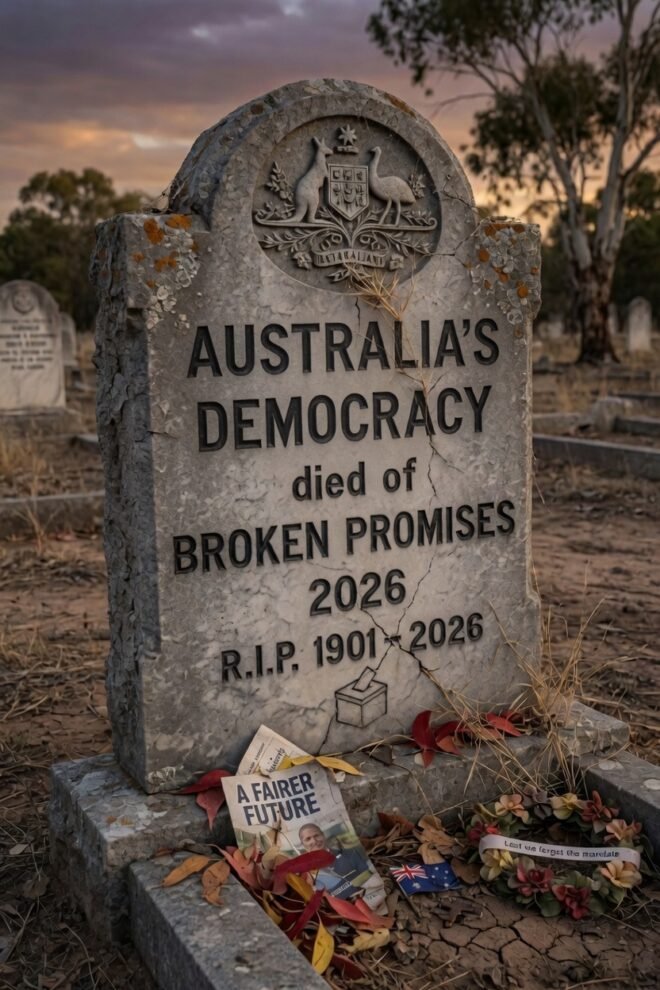
The spirit of democracy cannot be established in the midst of terrorism, whether governmental or popular.`
~Mahatma Gandhi~
I. A Nation Adrift
There is a particular kind of political vertigo that strikes a democracy when the ground beneath it shifts – not through revolution, not through the arrival of some Caesarian strongman, but through the slow, grinding withdrawal of trust. Australia is experiencing that vertigo now. The numbers, stripped of spin, tell a story that no amount of ministerial reassurance can paper over: the two great pillars of Australian political life – the Australian Labor Party and the Liberal-National Coalition – are losing their grip on the electorate in ways that have not been seen in living memory.
The Guardian Essential poll of May 2026 put Labor’s primary vote at 29 percent. The same poll had One Nation at 28 percent. Let that sit for a moment. A party founded by Pauline Hanson in 1997 – a party dismissed for decades as a fringe curiosity, a vehicle for grievance and nostalgia – is now within a single percentage point of the governing party of Australia. A Newspoll conducted in the same fortnight put Anthony Albanese’s net approval at negative seventeen, with 57 percent of Australians dissatisfied with his performance and the budget he had just delivered rated the worst for the economy since 1993.
These are not the figures of a government in a mid-term slump, nor are they the temporary turbulence that every administration weathers. They are the figures of a system in structural decline. To understand what has happened, and what it portends, we need to look beyond the immediate controversy of any single budget measure and ask the harder, older question: what does it mean when a democracy’s citizens no longer believe that its major parties represent them?
II. The Long Erosion
The fracturing of the Australian two-party system did not begin with Anthony Albanese’s May 2026 budget. That budget was an accelerant, not an origin. The slow erosion of primary vote loyalty has been visible since at least the 1990s, gathering pace through the Howard years, the Rudd-Gillard-Rudd turbulence, the decade of Liberal chaos that followed, and the exhausted return of Labor under Albanese in 2022.
In the 1960s and 1970s, Labor and the Coalition between them routinely commanded upwards of 90 percent of the primary vote. By the 1990s, that had fallen to around 80 percent. By the 2022 federal election – the so-called ‘Teal wave’ – the combined primary vote of the two major parties had slumped to roughly 68 percent. The 2025 election offered Labor a brief reprieve through preference mechanics, but the underlying primary vote never recovered its historical heights. The 29 percent at which Labor now sits is not an anomaly; it is the logical terminus of a decades-long trajectory.
What drives that trajectory? At its root, it is a story about representation, or the failure thereof. The major parties have become increasingly professional organisations – dominated by career politicians, faction brokers, and the lobbying networks that orbit them – and increasingly remote from the lived experience of ordinary Australians. The theory of the catch-all party, the party that absorbs and reconciles the contradictions of a complex modern society, has not survived contact with an era of sustained economic insecurity, housing unaffordability, climate anxiety, and institutional distrust.
When people feel that neither of the two dominant choices speaks to their reality, they go looking for alternatives. Some find the Greens. Some find the independents – the Teals, the community-minded professionals who have carved out seats in affluent inner-city and coastal electorates. Some find the micro-parties that have multiplied with each successive election cycle. And increasingly, in numbers that should concern everyone who cares about the health of Australian democracy, they are finding One Nation.
III. The Budget that Broke the Covenant
The 2026 federal budget was, in the precise technical sense, a policy document. It was also, in every meaningful political sense, a rupture. Labor had gone to the May 2025 election on a platform that had carefully avoided any explicit commitment to reforming negative gearing or reducing the capital gains tax discount. Those issues had been tried before – at the 2016 and 2019 elections, the latter ending in a defeat so unexpected it was dubbed the ‘unloseable election’ – and Labor’s strategists had learned what they took to be the lesson: do not spook the aspirational voter.
And then, less than twelve months into its second term, the Albanese government did precisely what it had implicitly, and in some instances explicitly, said it would not do. It wound back negative gearing. It reduced the capital gains tax discount. It introduced new levies on family trusts and property investment structures. The rationale was sound enough – housing affordability had reached crisis levels, and the existing tax architecture was widely understood by economists to inflate demand without expanding supply – but the manner of the reversal was, politically, catastrophic.
The Newspoll of 14-17 May 2026 found that only 33 percent of respondents supported the negative gearing changes. Fifty-two percent of those surveyed expected to be personally worse off as a result of the budget. The Roy Morgan poll of the same period registered 59 percent disapproval of Albanese as Prime Minister. These figures capture something more than disagreement with a particular policy; they capture the specific, corrosive feeling of being deceived.
Trust, in democratic politics, is not a renewable resource that replenishes itself between cycles. It is a cumulative asset that is built slowly, through consistency, and destroyed quickly, through betrayal. The voters who feel most acutely the sting of the budget’s tax reforms are not, in the main, the very wealthy; they are the aspirational middle – the nurse who has scraped together enough for an investment flat, the tradesman who has structured his earnings through a family trust, the schoolteacher who has relied on negative gearing to build something resembling financial security in a country where housing has become grotesquely expensive. These are Labor’s people, historically. And they feel abandoned.
IV. The One Nation Phenomenon
Pauline Hanson first entered the national consciousness in 1996 with a maiden speech to the House of Representatives that was remarkable less for its specific policy content than for its emotional register: it spoke directly to those who felt left behind, overlooked, and condescended to by the educated professional class that had come to dominate both major parties. She was pilloried, prosecuted, and periodically dismissed as a political force. She kept coming back.
One Nation’s most recent polling position from the Australian Financial Review – increased from 24 and 28 percent of the primary vote to 31 percent, outstripping both the major parties– represents the culmination of three decades of patient resentment. It is tempting, and not entirely wrong, to describe One Nation’s base as a protest vote: people who do not necessarily endorse every plank of Hanson’s platform but who reach for One Nation as the most visible available instrument of repudiation. But that framing, while useful, risks underselling the degree to which One Nation has become, for a substantial slice of the electorate, a genuine first preference rather than a reluctant one.
The party has benefited from a confluence of grievances that the major parties have either failed to address or actively exacerbated. Housing costs have placed homeownership beyond the reach of a generation; immigration, both the quantum of it and the infrastructure-to-population ratio that has accompanied it, has generated real tensions in outer-suburban and regional communities; energy prices have bitten hard; and there is a generalised sense, difficult to quantify but easy to detect, that the cultural preoccupations of the urban professional classes have displaced the economic preoccupations of working and lower-middle class Australians from the centres of political attention.
One Nation speaks to those grievances – not always accurately, not always honestly, sometimes with a nativism that should alarm any democrat – but it speaks to them directly, without the hedging and triangulation that have become the signature style of major-party politics. In an era when the dominant emotional register of political life is resentment, the party that channels resentment most fluently will prosper. That One Nation is prospering is not, therefore, surprising. It is, however, dangerous.
The danger is not simply that One Nation holds views – on immigration, on Indigenous recognition, on climate science – that are in many cases empirically wrong or ethically troubling. The deeper danger is structural: a political system in which a major governing party commands only 28 percent of the primary vote, and in which that vote is substantially haemorrhaging to an ethno-nationalist right, is a political system under very serious stress.
Preference flows may continue to insulate Labor from the worst electoral consequences in the short term, but primary votes are the leading indicator of where a democracy is heading, not where it currently sits.
V. The Coalition’s Own Crisis
It would be convenient for the Liberal and National parties if the current political turbulence were simply a story about Labor’s failures. It is not. The Coalition’s own primary vote has been in sustained decline, and the party’s response to that decline – a sequence of leadership changes, ideological lurches, and internal warfare that has bewildered even its most loyal supporters – has done little to restore confidence.
Under Angus Taylor, the Opposition has occasionally managed to draw level with or briefly exceed Albanese as preferred Prime Minister in individual polls. This is not, however, evidence of a Coalition revival so much as evidence of how low the bar has been set. Being marginally more trusted than a Prime Minister who has just broken his most politically sensitive promises is not the same as being trusted. The Coalition’s primary vote has also been cannibalised by One Nation from the right, just as Labor’s is being cannibalised from a different direction – One Nation drawing from culturally conservative Labor voters in outer suburbs and regions, the Greens and Teals drawing from progressive and inner-city Liberals.
The net effect is a political landscape in which the centre, understood not as a point on the ideological spectrum but as the shared institutional space in which the major parties have historically competed, is hollowing out. The parties that remain in that centre are fighting over a shrinking share of committed voters, while the peripheries expand. This is the phenomenon that political scientists have observed in Britain, in France, in Germany, in the United States: the decomposition of the party systems that structured post-war democratic life. Australia is not immune. It is merely, as it sometimes likes to imagine itself, slightly behind the curve.
VI. The Housing Question
Of all the issues driving the alienation of the Australian electorate from its major parties, housing is the most elemental. It touches every other grievance – economic insecurity, generational inequity, migration and infrastructure, the sense that the system is rigged in favour of those who got in early. And it is the issue on which successive governments, of both stripes, have most conspicuously failed.
Australia’s housing crisis is not accidental. It is the product of three decades of deliberate policy choices that have privileged existing property owners over aspiring ones: negative gearing introduced and extended, capital gains tax discounts maintained, planning regimes captured by local incumbents, public housing starved, and immigration run at levels that consistently outpaced the construction of the dwellings needed to house the new arrivals. Both major parties share responsibility for this outcome. Both have been more attentive to the interests of the property-owning class – a large and politically engaged constituency – than to the interests of renters and would-be first home buyers.
The Albanese government’s 2026 budget reforms were, on paper, an attempt to address this structural bias. The political problem was threefold: the reforms were introduced without a mandate, they were poorly designed in ways that alienated middle-income property investors alongside genuine speculators, and they came too late to do much for housing affordability in any timeframe that voters would experience as meaningful. The political cost of the reforms arrived immediately. The benefit, if any, would take years to materialise.
This temporal mismatch – between the short electoral cycle and the long structural horizon of housing supply – is one of the deepest dilemmas of democratic governance. Politicians are rewarded and punished on cycles of three to four years. Housing markets operate on cycles of fifteen to thirty. The result is a systemic bias toward short-term palliatives over long-term solutions, and a persistent credibility deficit whenever a government claims to be acting in the long-term interest. Voters have learned to distrust such claims, not because they are always wrong, but because they have been wrong so often.
This is why the tax debate, as politically explosive as it has been, captures only part of the problem. Housing affordability cannot be repaired from the demand side alone. Supply must also be addressed – and that means confronting the planning and zoning regimes that have, across state and local jurisdictions, constrained density in the places where people most want to live. Rezoning corridors around major train stations for medium and high-density development, streamlining development approvals to remove the veto power of incumbent landowners, and expanding the role of government as a direct builder of affordable and social housing are all measures with a stronger evidence base than any tax adjustment. The Albanese government has gestured toward some of these levers – the Housing Australia Future Fund, the National Housing Accord – but at a scale that most economists regard as insufficient. A serious supply-side agenda would require the Commonwealth to use its fiscal weight to incentivise states and councils to liberalise planning in ways they have historically refused to do. That is harder, slower, and less legible to voters than a budget line. It is also more likely to work.
VII. The Democracy at Stake
It is necessary, at this point, to step back from the immediate political arithmetic and ask what is actually at stake. The fracturing of the two-party system is not, in itself, a catastrophe. The emergence of the Teal independents – educated, policy-serious professionals who have taken seats from the Liberals in affluent electorates – has arguably enriched the Parliament. The Greens, whatever one’s view of their specific policies, represent a genuine constituency with a genuine voice in the democratic conversation. Minor parties and independents are a normal feature of healthy democracies; they are, in fact, more prevalent in Australia’s peers in Western Europe than the two-party binary that Australian political culture has long treated as natural.
What is dangerous is not diversity of representation per se, but the specific character of the force that is currently benefiting most from the collapse of major-party primary support. One Nation is not a Teal independent. It is not a community-based movement of local professionals seeking better policy outcomes. It is a party with a thirty-year history of cultivating racial grievance, of targeting Indigenous Australians, Muslim Australians, Asian Australians, and other minorities as scapegoats for economic and cultural anxieties that have structural, not demographic, causes.
When a democracy’s citizens, frustrated by the failures of their governing institutions, reach for the most readily available instrument of repudiation, they do not always reach for the healthiest alternative. Sometimes they reach for the thing that gives permission to their worst impulses – the impulse to find someone to blame, someone Other, someone who can bear the weight of a diffuse and legitimate grievance that has nowhere else to land. One Nation has always offered that permission. It offers it now, more loudly and with greater electoral support than at any point in its history.
This should concern every Australian who cares about the social fabric of this country – not because the voters who have turned to One Nation are, in themselves, monsters, but because they are people whose legitimate frustrations have been allowed to fester by a political class that has failed them, and who have found in One Nation the only voice they feel is listening. The answer to that situation is not to condemn those voters; it is to understand what the major parties have failed to give them, and to give it.
VIII. What Renewal Would Require
The renewal of Australian democracy – if it is possible, which is not guaranteed – would require things that the major parties have consistently shown they are incapable of delivering without external compulsion. It would require an honest reckoning with the housing crisis that goes beyond the tax measures of any single budget, and that accepts the political cost of challenging entrenched property interests over the long term. It would require an immigration policy that is honest about the relationship between population growth and infrastructure investment, rather than treating migration as an economic variable to be managed in isolation from the social and spatial consequences it produces.
It would require a recommitment to the institutions of democratic accountability that have been hollowed out – the media, the courts, the regulators, the public service – and a recognition that a democracy in which citizens do not trust those institutions is a democracy that has already begun its long descent. One concrete starting point would be a genuinely independent National Anti-Corruption Commission with teeth: not the defanged version that has been negotiated into near-irrelevance, but a body with the power to investigate sitting ministers, public servants, and political donors, and to do so on the public record. Trust in institutions is not rebuilt by declaring them trustworthy; it is rebuilt by making them visibly accountable. A commission that publicly names and examines the circumstances in which public decisions have served private interests would do more to restore democratic confidence than any rebranding exercise. It would require, most fundamentally, a willingness to speak to people as they actually are, in the situations they actually occupy, rather than as the focus groups and the polling algorithms have determined they wish to be seen.
This last requirement is perhaps the hardest. The professionalisation of politics has produced a class of politicians who are extraordinarily skilled at managing perceptions and extraordinarily poor at generating the kind of trust that is built not through management but through authenticity. The voters who have turned away from Labor and from the Coalition are, in many cases, not asking for perfect policies; they are asking to be believed, to be spoken to honestly, and to be represented by people who understand what it means to be unable to afford a home, to be anxious about the cost of a tank of petrol, to feel that the system is structured to benefit those who are already comfortable.
That is not, at bottom, a demand that is beyond the capacity of democratic politics to meet. It is, however, a demand that requires courage – the courage to tell uncomfortable truths, to make long-term investments at short-term political cost, and to govern in the interest of those who are most vulnerable to the failures of the system rather than those who are most comfortable within it.
IX. A Reckoning
The polling data from May 2026 – Labor at 28 percent, One Nation at 31, Albanese at negative seventeen net approval, the worst budget reception since 1993 – is not simply a set of numbers. It is a reckoning. It is the electorate saying, in the only language available to it within the formal mechanisms of democratic participation, that it has had enough.
The danger is that the political class will hear this reckoning in the wrong register – as a demand for different tactics, better messaging, more effective spin – rather than in the right one: as a demand for different politics, more honest representation, and a genuine willingness to govern in the interest of those who have been left behind. If the major parties respond to the fracturing of their support by becoming more poll-driven, more focus-grouped, more calibrated to the median of what they believe voters want to hear, they will accelerate the very crisis they are trying to manage.
The alternative – the harder, less comfortable alternative – is to remember what political parties are supposed to be for. Not for themselves. Not for their donors. Not for the professional class that staffs them and the media cycle that consumes them. For the people who send them to Parliament, and whose lives are shaped, for better or worse, by the decisions they make there.
Australia has produced, in its history, leaders capable of that kind of politics. Ben Chifley, who spoke of the light on the hill not as a slogan but as a genuine moral orientation. Gough Whitlam, who compressed the ambitions of a generation into three years of reform that reshaped the country, whatever one’s view of how it ended. Fred Hollows, who took his skills to the most remote corners of this continent and beyond because he understood that a society is judged by what it does for those who cannot advocate for themselves. These were not perfect people. They were, however, people who understood that the purpose of power is not its possession but its use in the service of others.
The electorate that is turning its back on the major parties is not, at its core, turning its back on democracy. It is turning its back on a diminished version of democracy – one that has mistaken the management of power for its exercise, and the appearance of representation for its substance. Whether the major parties are capable of hearing that message and responding to it with the seriousness it deserves remains, as of May 2026, an open question.
The numbers suggest the window is closing.
– – –
Bakchos is the founder of Blak and Black, an Australian media and advocacy platform established in 2010. Bakchos writes from the intersecting perspectives of Wiradjuri heritage, Jewish identity, and humanism.
© Bakchos, June 2026




Pauline Hanson isn’t the answer to any of Australia’s woes. In fact, she would make them worse, but she’s been flying the flag of protest for 30 years and her payday is near. Albanese only has himself to blame.
Her flag is pure malcontent. A racist and opportunistic ill informed lie pretending to represent archaic values to appeal to a bygone sense of comfort. Stagnancy, or worse yet reversal won’t address the challenges this country faces, whose demographics and place in the world have moved on significantly.
You are entitled—given your Wiradjuri and Jewish heritage—to call out One Nation’s history of racial grievance and nativism. That record exists and should alarm people. However, the essay risks reducing One Nation’s surge to “resentment channelled fluently” while under-exploring the substantive policy failures that make Hanson’s messaging land: net overseas migration still running at levels that strain infrastructure in outer suburbs and regions; energy prices; wage stagnation relative to asset inflation; and a cultural disconnect where inner-urban professionals set the agenda on climate, identity, and “values” while tradies and regional workers feel lectured.?You acknowledge these grievances but then pivot quickly to “structural, not demographic, causes.”
.
Voters experience both simultaneously. A more robust critique would grapple with the data showing One Nation now drawing heavily from former Labor voters in outer-suburban and regional seats—exactly the cohort the essay says Labor abandoned. Dismissing that as mere “permission to worst impulses” flattens the picture.
The Victorian election later this year will be interesting. Hanson is fundraising in Melbourne’s west late this week, Moonee Ponds, a traditional Labor heartland.