
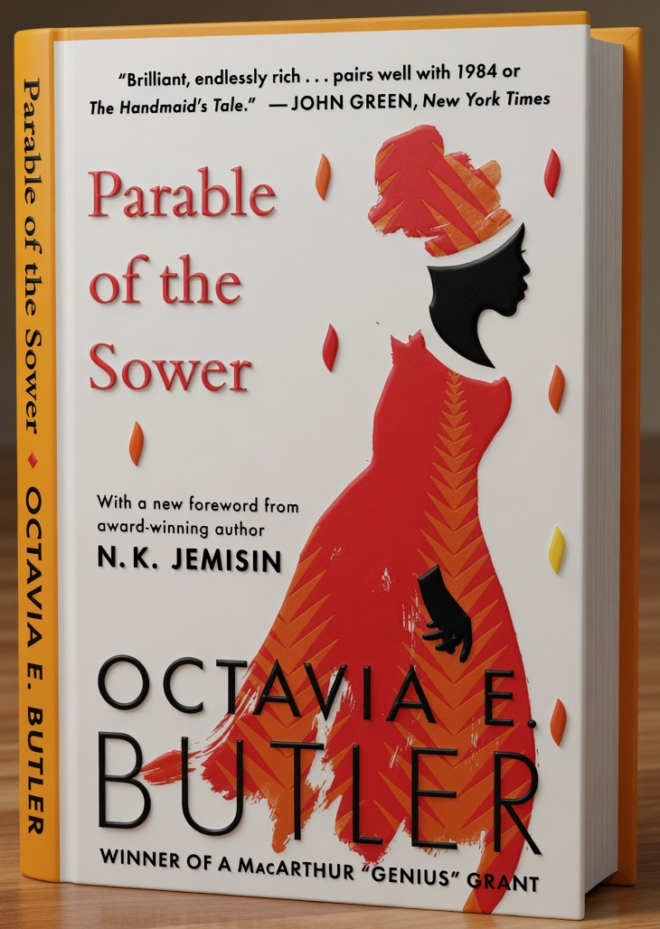
“All that you touch / You Change. / All that you Change / Changes you. / The only lasting truth / Is Change.”
~Octavia E. Butler, Parable of the Sower (1993)~
“Unless a grain of wheat falls into the earth and dies, it remains alone; but if it dies, it bears much fruit.”
~John 12:24~
I. GOOD FRIDAY IN THE GATED COMMUNITY
Imagine the following parable.
In the hills above a broken city – call it any city, call it the one you know – there is a wall. The wall is high and pale, topped with sensors that never sleep. Behind it, the lawns are green. The pools are filled. The children have tutors and therapists and futures mapped out like flight paths to safe destinations. The wall is not metaphor. It is concrete and steel and quarterly earnings, and it has been paid for many times over by the people it was built to exclude.
Outside the wall, the city flickers and dims. The schools have lost their librarians. The buses run three days a week. The hospital closed its emergency ward two Aprils ago, and a decommissioned church now functions as a triage tent on Friday nights. The people who live here are not lazy, not feckless, not morally deficient. They are the people whose surplus labour built the wall. They are the external cost, successfully externalised.
It is Good Friday. In the gated community, a pastor delivers a sermon about sacrifice. He is well-paid. The congregation is well-dressed. The sacrifice being commemorated – the execution of a peasant agitator by an occupying imperial state at the behest of a collaborating priestly elite who feared that his talk of the poor inheriting the earth was going to upset a profitable arrangement – is translated into a message about personal sin, personal redemption, personal salvation. The politics are laundered out. What remains is consolation for the comfortable.
Outside the wall, someone who cannot afford the triage tent dies of a preventable condition. This too, in its way, is a crucifixion. But it is not commemorated. It is filed.
II. BUTLER’S PARABLE AND THE SHAPE OF OUR PRESENT
Octavia E. Butler published Parable of the Sower in 1993. It is set in a California of the 2020s – a California of gated enclaves above and collapsing communities below, of corporations that have replaced municipal government, of a presidential candidate who campaigns on restoring a greatness that was never quite what it was advertised to be. Butler was not a prophet in the supernatural sense. She was something more disquieting: an analyst who could read the trajectory of a system and follow it to its destination.
The novel’s protagonist, Lauren Olamina, lives inside a walled suburb in Robledo. Her father is a preacher. The wall holds, for a while. Then it doesn’t. When it falls – burned by the desperate and the predatory alike – Lauren does not attempt to rebuild it. She walks north with what she can carry, assembling a community of survivors who do not share her race, her religion, or her history, but who share her understanding that the old world is gone and that something must be made in its ruin.
What Lauren creates is a new belief system she calls Earthseed. Its central axiom is disarmingly simple: God is Change. Not a god who intervenes in history, not a god who rewards the righteous or punishes the wicked, but change itself – the force that no wall can finally contain. The only ethical response to this god is not worship but adaptation, not prayer but action. Butler structures her novel in the form of a parable not by accident. The parable is the literary form in which the comfortable are unsettled and the settled are comforted – or rather, in which the conventional reading is shown to be wrong, and the genuinely subversive meaning is located in what the surface narrative strategically obscures.
We live, now, in a world that Butler mapped. The names have changed. The geography has shifted. But the structure is identical: extreme wealth concentration producing political capture producing democratic erosion producing the demagoguery that the wealthy then use to further entrench their advantage. The cycle is self-reinforcing. It does not correct without external force.
III. THE THEOLOGY OF THE ROLLING STONE
There is a detail in the Resurrection narratives that commentators tend to pass over quickly, perhaps because its implications are uncomfortable. When the women arrive at the tomb on the first day of the week, they find the stone already rolled away. In Mark’s account – the oldest and strangest of the four – they find a young man in white who tells them that the one they are seeking is not here, and they flee in terror, and they say nothing to anyone. Mark’s Gospel, in its earliest manuscripts, ends there. In silence and fear and the open tomb.
The stone is worth dwelling on. Stones in the ancient world were not merely geological. They were authority made solid. The stone before a tomb was a seal, a guarantee, an assertion that what was inside would remain inside – that the verdict of those who had the power to crucify would remain final, that the executed would stay executed. Pilate, in Matthew’s account, knows exactly what he is doing when he orders the stone sealed and guarded: he is using the authority of the state to enforce the permanence of death.
The rolling away of the stone is not, in this reading, a conjuring trick. It is a political event. It is the refutation, by whatever force one wishes to invoke – divine, historical, moral – of the claim that power gets the last word. The crucifixion was the system working as designed: a disruptive figure from the margins, one who had been saying embarrassing things about the rich and the powerful and the priestly collaborators with empire, was neutralised by the efficient application of state violence. The resurrection is the system’s refutation. It is the insistence that the marginalised cannot be permanently silenced, that the stone can be moved, that the tomb is not the final argument.
Butler understood this. Lauren Olamina does not believe in a personal god, but she believes in the structure of the parable itself: that the apparent conclusion is not the real conclusion, that the wall is not permanent, that the gated community is not the end of history. And she is right. But she is also honest about the cost. The wall comes down violently. The community burns. People die who should not have had to die. The resurrection, in Butler’s telling, does not spare anyone the crucifixion. It simply insists that the crucifixion is not sufficient.
IV. WHAT WEALTH CONCENTRATION ACTUALLY DOES TO DEMOCRACY
The empirical record here is not ambiguous, and it is worth stating plainly before we return to the parabolic register. When wealth concentrates beyond a certain threshold, political power follows it. This is not a conspiracy theory. It is institutional physics.
Martin Gilens and Benjamin Page, in their 2014 study of American policy outcomes over several decades, found that the preferences of average citizens had a near-zero statistical effect on policy, while the preferences of economic elites and organised business interests had significant and measurable effects. The United States, they concluded, functioned less as a democracy than as an oligarchy with democratic aesthetics. Elections were held. Votes were counted. The outcomes, however, tracked the interests of the wealthy rather than the preferences of the electorate with a reliability that pure chance could not explain.
This dynamic does not remain stable at the level of mere policy capture. It escalates. When a political system is captured by wealth, it loses the legitimacy it derives from representing the genuine interests of the governed. That legitimacy deficit creates a vacuum. Into the vacuum comes the demagogue – the figure who offers the dispossessed not the redistribution of actual material resources, which would require the demagogue to actually challenge the wealthy, but instead the redistribution of dignity, of contempt, of someone to blame. The demagogue says: your suffering is real, but it was caused not by the system that produced these inequalities but by the immigrants, the minorities, the educated elite, the foreign power. He is lying, but he is lying about something real, and that is the peculiar genius of authoritarian populism: it acknowledges the wound while deliberately misidentifying the weapon.
Butler’s fictional president, Andrew Steele Jarret – who campaigns on the slogan ‘Make America Great Again’ in a novel published in 1998 – is precisely this figure. He promises order to people who are desperate for it. He delivers scapegoats. The communities that were already burning when he was elected continue to burn. The gated enclaves that funded his campaign remain intact. The machine is working exactly as it was designed to work.
V. THE PARABLE OF THE SOWER, PROPERLY READ
The parable that gives Butler’s novel its name appears in Matthew 13. A sower goes out to sow. Some seed falls on the path and is eaten by birds. Some falls on rocky ground and withers for lack of roots. Some falls among thorns and is choked. Some falls on good soil and produces – in some manuscripts – a hundredfold return.
The conventional reading, which Jesus provides in the same chapter, is allegorical and individualising: the different soils represent different types of hearers, and the lesson is that the word of God will find purchase only in prepared hearts. This is a useful reading if your purpose is to explain why your message has not been universally adopted, and also a politically convenient one, since it locates the problem in the individual listener rather than in the social conditions that shape whether listening and acting are even possible.
But there is another reading, one that the surface of the parable permits but the allegorical explanation forecloses. The sower is not selective. The sower does not audit the soil before casting seed. The sower throws seed everywhere – on the path, on the rock, among the thorns, on the good ground – with a recklessness that looks, by agricultural standards, like waste. What the parable might actually be describing is not individual spiritual receptivity, but the unconditional nature of the gift: it is offered to everyone, regardless of their apparent capacity to receive it. The failure of the seed in some places is not a judgement on the seed or finally on the soil. It is a description of conditions that can be changed.
Rocky ground can be cleared of rocks. Thorny ground can be weeded. The path can be reploughed. The question the parable is really asking, in this reading, is not: which type of soil are you? The question is: who is responsible for the condition of the soil? And that is a question with a political answer.
Lauren Olamina’s Earthseed theology is, among other things, a sustained meditation on soil conditions. She is not interested in identifying the receptive hearts among the wasteland. She is interested in changing the conditions. The community she builds is built precisely because it does not sort people into worthy and unworthy, receptive and unreceptive. It builds its capacity for growth incrementally, from the actual human material available, without waiting for perfect conditions that will never arrive.
VI. EASTER AND THE QUESTION OF COLLECTIVE RESURRECTION
The Easter narratives are, in the mainstream of Western Christianity, read as the story of an individual – the resurrection of Jesus as one man, as the second person of a triune God, as an event that guarantees individual salvation for those who believe. This reading is coherent and has sustained two millennia of faith. It is not, however, the only reading available in the texts themselves.
Paul’s letter to the Corinthians, written before any of the Gospels, makes the political valence of resurrection explicit. ‘If there is no resurrection of the dead, then Christ has not been raised; and if Christ has not been raised, then our proclamation has been in vain and your faith has been in vain.’ This is a logical argument, but it is also a social one. The early Christian communities for whom Paul was writing were not composed of the powerful. They were slaves, freedpeople, artisans, women without civic status, the categories of person the Roman Empire was designed to exclude from political life. For these communities, the resurrection was not a story about personal immortality. It was a story about the refusal of empire to get the final word. It was, to use a contemporary vocabulary, a story about solidarity across the tomb.
This reading has largely been suppressed by established Christianity’s long entanglement with state power – from Constantine to the court chaplains of European monarchies to the prosperity gospel preachers who tell their congregations that God wants them to be wealthy and that their poverty is a failure of faith. The political reading is still there in the texts. It has never been successfully excised. It resurfaces every time a liberation theologian in Latin America preaches to a congregation of the dispossessed, every time a civil rights preacher invokes the Exodus narrative, every time someone whose community is burning reaches for the language of resurrection not as consolation but as demand.
What would it mean to read Easter as a story about collective resurrection? It would mean reading the empty tomb not as a private miracle for one individual, but as a template: the claim that systems which execute the inconvenient will be outlasted by what they thought they had killed. That the stone is never the final answer. That the community that gathers at the tomb – frightened, uncertain, carrying its grief – is the beginning of something rather than the end.
Butler’s Lauren Olamina arrives, at the end of Parable of the Sower, at a piece of land in northern California. She plants seeds. This is not allegorical. It is also not merely literal. It is the enactment of a theology that refuses the permanence of the wall.
VII. THE DEMOCRACY THAT MIGHT YET BE
The crisis of democracy under plutocracy is, at its core, a crisis of imagination. The system that has produced our current arrangement of obscene wealth beside proliferating desperation has also produced the cultural conditions in which alternatives are literally unthinkable – in which the word ‘socialism’ still functions as a hex in certain political cultures, in which asking whether billionaires should exist is treated as more radical than billionaires themselves, in which the Overton window is a picture frame whose edges the wealthy have gilded and hung on the wall of the media they own.
The parable is a form that operates precisely against this constraint. The parable works by misdirection: it draws you into a story that seems to be about something safe – agriculture, fishing, a woman sweeping her house – and then turns, and you find that you have been led somewhere that the direct approach could never have taken you, because the direct approach was guarded. Butler uses the parable structure because she understands that dystopia, told straight, produces paralysis. Told slant, through the voice of a young Black woman walking north through a burning landscape and writing in her journal, it produces the opposite: the uncomfortable, urgent sense that the conditions are not permanent, that the soil can be changed, that the seeds are not wasted.
What would the democratic renewal that Easter imagines in the political register actually look like? It would not look like the restoration of a pre-existing arrangement, because no pre-existing arrangement was adequate to the challenge. American democracy in its golden age still excluded Black Americans, women, Indigenous peoples. Australian democracy at its supposed peak still operated on the stolen foundation of terra nullius. The resurrection is not the resuscitation of the corpse. It is – in the theological language – a transfiguration: something continuous with what came before but not identical to it, carrying the wounds forward but not defined by them.
Lauren Olamina does not try to recreate Robledo outside the wall. She builds Acorn. It is different. It is harder. It has no wall. It will face its own crises. But it is oriented toward something that Robledo was not: the genuine participation of everyone within it in the decisions that govern their lives. This is the minimal definition of democracy. Not the form – the elections, the constitutions, the institutional aesthetics – but the substance: the actual distribution of power to decide, which requires, as a precondition, the actual distribution of the material resources without which decision-making is merely the freedom to choose between bad options.
VIII. CARRYING THE SEED
This essay began with a parable, and it should end with one. Or rather, with an instruction, which is the form that the parable ultimately reaches for when it has done its misdirecting work and arrived at its destination.
The seed, in Butler’s theology, is not the seed of Earthseed specifically. It is whatever it is that survives the burning – the knowledge, the practice, the relationship, the refusal to accept the finality of the stone. Lauren carries the seed because she understands that the community that was destroyed did not have to be the last word. She carries it in a journal, which is to say in language, which is to say in the only technology of human solidarity that does not require infrastructure to function: the capacity to tell the truth about what is happening and to imagine, in the same breath, that it does not have to be this way.
Easter is the festival of the carried seed. It is not the festival of triumph – that comes later, at Pentecost, when the community that had been hiding behind locked doors finally goes out into the street. Easter is earlier and more frightening than that. It is the moment of encounter with the open tomb, when the system’s guarantee of permanence has been voided and no one yet knows what comes next. Mark’s Gospel is not wrong to end there, in the silence and the fear and the unbelieved news. That is where most of us are. That is the actual condition of those who are walking away from the burning and have not yet arrived anywhere.
The question that Easter asks – and that Octavia Butler’s novel asks, and that the continuing catastrophe of plutocracy asks – is not: do you believe? Belief in the abstract is too easy and too cheap and too compatible with continuing as before. The question is: what will you carry, and where will you plant it?
The wealth concentrated in the hands of the few is not only bad economics. It is a stone before a tomb. It is the system’s guarantee that the verdict is final, that the executed will stay executed, that the communities burning outside the wall are the permanent condition of the world rather than a scandal to be redressed. The concentration of power that follows from the concentration of wealth produces the demagoguery that makes the redress seem impossible, that turns the dispossessed against each other rather than against the wall, that finds in the resentment of ordinary people a fuel for a politics of performance rather than a politics of change.
The stone can be moved. This is the Easter claim, stripped of its celestial machinery and returned to its original political urgency. The stone can be moved – not by waiting for a miracle, but by the accumulated pressure of communities that refuse the finality of the tomb, that carry what they can carry, that plant where the soil has been made ready, that understand that the only theology adequate to the present crisis is one whose God is change and whose ethic is transformation and whose eschatology ends not in a gated paradise in the sky but in the hard, continuing, necessary work of making the earth habitable for the ones who come after.
The seed is in your hands. The soil is poor. Plant it anyway.
– – – – –
“We do not own our bodies. We do not own our lives. We are the seed. We are the change.”
~Lauren Olamina, Parable of the Sower~


Bakchos your prose is assured, occasionally operatic, and the closing imperative — “Plant it anyway” — earns its force through what precedes it. This is political theology at a high register, if not always at its most self-critical.
Bakchos the essay’s central achievement is its reading of the parable form itself as politically generative. The treatment of Mark’s abrupt ending — the silence, the fear, the unbelieved news — as an honest description of where most of us actually stand is among the essay’s most arresting moments. Similarly, the reinterpretation of the Parable of the Sower away from individual spiritual receptivity toward collective responsibility for soil conditions is exegetically credible and politically pointed, avoiding the sentimentality that mars lesser exercises in this genre.
Butler is handled with genuine care, and the identification of Andrew Steele Jarret as a 1998 anticipation of contemporary authoritarian populism is the essay’s sharpest coup de grâce. However, the essay’s insistence on Lauren Olamina as a straightforwardly redemptive figure sits uneasily with Butler’s own refusal of easy consolation — Acorn, after all, is destroyed in Parable of the Talents.
The Seed and the Stone is a structurally ambitious work that attempts to triangulate three distinct traditions — liberation theology, Butlerian speculative fiction, and political economy — into a unified argument against plutocracy. At its best, the essay achieves genuine intellectual synthesis; at its weakest, it risks mistaking rhetorical momentum for analytical rigour.