
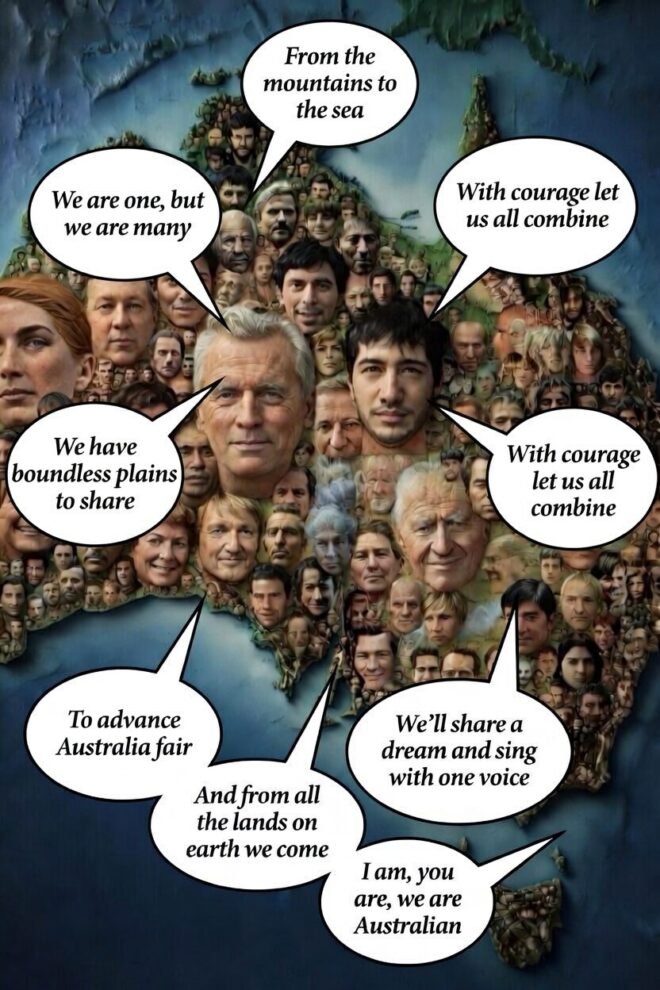
With acknowledgement to Bruce Woodley and Dobe Newton, composers and lyricists of “I Am Australian” (1987)
I. THE SONG BEFORE THE ARGUMENT
There are songs that transcend their occasion. Most popular music, however accomplished, remains tethered to its moment – a season, a mood, a chart position – before subsiding into nostalgia or obscurity. A very few songs do something rarer: they accumulate meaning over time, becoming more capacious, more contested, more necessary with each passing decade. “I Am Australian,” written by Bruce Woodley and Dobe Newton in 1987 and first recorded by The Seekers, belongs to this uncommon category. It has been sung at Olympic ceremonies, school assemblies, citizenship ceremonies, sporting finals, and parliamentary occasions. It has been dismissed by purists as sentimental and embraced by migrants hearing in it, perhaps for the first time, a public articulation that they, too, belong. It is, in every meaningful sense, a living document.
To engage seriously with the song is not to submit to its sentimentality uncritically. Woodley and Newton were not propagandists for an official version of Australia; they were, as their lyric reveals, attentive to complexity, to wound, to the deep asymmetries that mark Australian history. The opening lines …
“I came from the dream-time,
from the dusty red-soil plains
I am the ancient heart,
the keeper of the flame”
… do not begin with a coloniser’s triumphalism. They begin with Country. They begin with the oldest continuous human cultures on Earth. This structural decision is neither accidental nor trivial: it encodes a moral priority that, even in 1987, required courage to assert.
This essay takes the song as its occasion, but not its limit. It uses the architecture of Woodley and Newton’s lyric as a scaffold upon which to examine the argument for Australian multiculturalism – not as a bureaucratic category or a policy platform, but as a living philosophical proposition: that a society is enriched, not diminished, by the full range of its human inheritance; that identity can be plural without being incoherent; and that the ongoing negotiation between memory, difference, and shared civic life is not a problem to be solved but a condition to be honoured.
II. FIRST AUSTRALIANS: THE GROUND BENEATH THE ARGUMENT
Any honest account of Australian multiculturalism must begin where Woodley and Newton begin: with Indigenous Australia. To begin anywhere else is to perform precisely the erasure that multiculturalism, at its most serious, exists to oppose. The “dream-time” and the “dusty red-soil plains” are not decorative invocations. They name a presence – spiritual, cultural, ecological – that predates and exceeds every other Australian story by a margin of approximately forty thousand years. The song’s speaker is simultaneously “the ancient heart” and “the keeper of the flame”: custodian, not merely inhabitant; a being whose relationship to Country is ontological, not merely residential.
The philosophical tradition that underpins Aboriginal and Torres Strait Islander cultures is among the most sophisticated and durable in human history. It is a tradition in which land is not property but relation; in which time is not linear but recursive and living; in which law and story, ceremony and ecology, are woven into a single fabric of obligation and knowledge. Howard Morphy’s foundational scholarship on Yolngu art from Arnhem Land reveals a visual and conceptual system of extraordinary complexity – one in which the painted surface is simultaneously a map, a genealogy, a cosmology, and a legal instrument. To encounter Yolngu art as decoration is to miss it almost entirely. To encounter it as philosophy is to recognise that Australia was, long before European contact, home to intellectual traditions that asked, and answered, the deepest questions available to human beings.
This matters to the argument for multiculturalism because it establishes the foundational principle: that Australia is not, and never was, a blank space waiting to be filled by a single culture. It was always a place of diversity – of hundreds of distinct languages, law systems, ceremonial traditions, and ecological relationships. European settlement did not introduce diversity to Australia. It introduced a particular and violent form of it, while simultaneously attempting to suppress the diversity that already existed. The project of multiculturalism, understood in its deepest sense, is partly the project of recovering what was nearly destroyed: the recognition that this continent’s oldest cultures are not archaeological curiosities but living intellectual and spiritual inheritances with an ongoing claim on the national conversation.
The line “For forty thousand years I’ve been the first Australian” is deceptively simple. Its weight accumulates when one considers the arithmetic: forty thousand years against two hundred and thirty-odd years of European settlement. The disproportion is not merely historical; it is moral. It asks the settler society – and by extension every subsequent wave of migration – to reckon with what it entered, what it disrupted, and what obligations of recognition and respect remain unpaid.
III. THE CONVICT STRAND: SHAME TRANSFORMED
The second movement of the song turns to another foundational layer of Australian identity: the convict experience.
“I came upon the prison ship,
bowed down by iron chains
I fought the land, endured the lash
and waited for the rains.”
It is worth pausing on the phrase “bowed down by iron chains.” This is not triumphalist settler mythology. It is an acknowledgement of coercion, of the violence inscribed in the origins of white Australia, of the fact that many of those who “became Australian” did not choose to do so in any meaningful sense.
For much of the nineteenth and early twentieth centuries, convict ancestry was a source of shame in Australian society – a genealogical stain to be concealed rather than acknowledged. The gradual inversion of this stigma is one of the more interesting cultural transformations in Australian history. By the latter half of the twentieth century, convict descent had become, for many Australians, a badge of authenticity – proof of long presence, of having been here when it was hard. This transformation is not without its ironies, not least because the very idea of earning legitimacy through suffering on stolen land raises questions it cannot itself answer. But it represents something genuine: the refusal to construct national identity on a foundation of pretended innocence.
The figure of the “settler, the farmer’s wife, on a dry and barren run” extends this strand. She is not glamorous. She endures rather than conquers. The landscape is not hospitable; it is “dry and barren.” The experience of European settlement, the song insists, was not uniformly a story of dominion and triumph. It was, for many, a story of privation, of proximity to failure, of a relationship with an unfamiliar continent that had to be learned, often at great cost. There is a kind of humility in this acknowledgement that sits well within the multicultural sensibility: the recognition that no group’s history in Australia is simply a story of success.
IV. THE MYTHOLOGICAL LAYER: MATILDA, KELLY, CLANCY, NAMATJIRA
One of the most audacious moves in Woodley and Newton’s lyric is the pivot into mythological self-identification.
“I am Albert Namatjira
And I paint the ghostly gums
I’m Clancy on his horse
I’m Ned Kelly on the run
I’m the one who waltzed Matilda …”
These are not merely historical names. They are the nodes of a cultural mythology – a set of figures through which Australians have, over generations, told themselves who they are.
Albert Namatjira is the most significant of these figures, and his inclusion here is a quiet act of political insistence. Namatjira, the Western Arrernte artist who transformed European watercolour technique into a distinctively Central Australian vision, occupied an almost impossibly contradictory position in mid-twentieth century Australia: celebrated by white Australia as a genius, granted the extraordinary honour of citizenship – then singular, then scandalous – and yet denied the full rights that citizenship nominally entailed. He was, simultaneously, the most famous Indigenous Australian of his era and a man broken by the contradictions of a society that could admire him without according him full humanity. That his name appears in this list of Australian archetypes is both a tribute and a challenge: it asks the listener to hold, simultaneously, the beauty of his vision and the injustice of his treatment.
Ned Kelly – “on the run” – occupies a different register. Kelly is the outsider-as-hero, the refusal of authority, the tradition of larrikin defiance that has long been one strand of Australian self-understanding. There is something democratically subversive about the Kelly myth: it venerates not the magistrate but the outlaw, not the institution but the individual pushed to the wall. For a multicultural society in which many citizens carry histories of persecution, displacement, or state violence, the Kelly archetype offers a point of identification that is specifically Australian and yet broadly human.
Clancy and the figure who “waltzed Matilda” complete the mythological register. Both are figures of movement, of restlessness, of a relationship to the land that is nomadic rather than sedentary – which is, of course, the original Australian mode of inhabiting this continent, and perhaps one reason these figures have such staying power. The drover, the swagman: both are people in transit, people who belong nowhere in the settled sense and yet everywhere in the experiential sense. For a society built on waves of migration, on people who left one world and arrived in another, this mythology of the perpetual traveller resonates at a level beneath argument.
V. FROM ALL THE LANDS ON EARTH: THE MULTICULTURAL PROPOSITION
The chorus of “I Am Australian” is the fulcrum of the entire work:
“We are one, but we are many
And from all the lands on earth we come
We’ll share a dream and sing with one voice
I am, you are, we are Australian.”
The philosophical density of these four lines repays sustained attention. “We are one, but we are many”: this is not a contradiction suppressed, but a paradox embraced. Unity does not require uniformity. Identity can be shared without being homogeneous. The “one” emerges from the “many,” not despite it.
This is, at its heart, the multicultural proposition. It stands in explicit contrast to the assimilationist model that dominated Australian immigration policy for most of the first century of federation – a model epitomised by the White Australia Policy, which from 1901 to its gradual dismantlement through the 1960s and 1970s operated on the premise that national cohesion required racial and cultural homogeneity. The architects of that policy were not cynics; many of them were genuine believers in a vision of Australia as a unified – which is to say, racially defined – community. The tragedy is that their vision of unity required exclusion, denigration, and the active suppression of difference.
The phrase “from all the lands on earth we come” is a statement of demographic fact that has become truer with every passing decade. Contemporary Australia is one of the most ethnically and culturally diverse societies on Earth. More than a quarter of Australians were born overseas. More than a fifth speak a language other than English at home. The largest communities of overseas-born Australians now come from China, India, the Philippines, Vietnam, New Zealand, and the United Kingdom – a range that would have been unimaginable to the framers of the Immigration Restriction Act. The suburbs of Melbourne and Sydney are among the most culturally varied urban environments in the world, places where a single street might house communities whose ancestral homelands span every inhabited continent.
Yet diversity is not, in itself, multiculturalism. Diversity is a fact; multiculturalism is a response to that fact – a set of practices, policies, and philosophical commitments that determine whether diversity becomes a source of social richness or social friction. The multicultural proposition, at its most ambitious, holds that cultural difference is not merely tolerable but valuable; that a society whose members bring different histories, languages, cuisines, religions, artistic traditions, and ways of being in the world is more imaginatively alive than one that does not; and that the task of democratic governance is not to dissolve these differences into a uniform national identity but to create the conditions under which they can coexist, interact, and enrich one another.
VI. THE LANDSCAPE AS COMMON GROUND
The penultimate verse of the song turns from human history to the land itself:
“I’m the hot wind from the desert
I’m the black soil of the plains
I’m the mountains and the valleys
I’m the drought and flooding rains
I am the rock, I am the sky
The rivers when they run
The spirit of this great land
I am Australian.”
Dorothea Mackellar’s ghost is present here – “drought and flooding rains” is a near-direct allusion to “My Country” – but Woodley and Newton do something subtly different with the landscape. They do not merely describe it. They inhabit it. The speaker does not gaze at the land from outside; the speaker becomes the land. This is a profoundly Indigenous mode of understanding Country – not as an object of aesthetic contemplation, but as a constitutive element of identity. The land is not backdrop; it is self.
This matters to the multicultural argument in a specific way. One of the persistent anxieties about multicultural society is the question of attachment: do people whose primary cultural allegiances lie elsewhere – who cook different food, pray differently, speak other languages at home – truly belong here, truly care for this country? The landscape verse of the song offers a counter-intuition: that attachment to place is not a product of cultural homogeneity, but of lived experience. The migrant who has worked red soil, who has watched the sky turn bronze before a desert storm, who has felt the peculiar silence of the Australian bush at midday – that person has a relationship with this country that is not diminished by their other inheritances. The land does not discriminate between those who came forty thousand years ago and those who arrived forty years ago. It shapes all of them.
The “hot wind from the desert” is not a European sensation. The “black soil of the plains” is not a British inheritance. These things belong to Australia alone, and they belong equally to every person who has stood in them, worked in them, been changed by them. There is, embedded in this verse, a quietly radical democratic argument: that the shared experience of this specific and extraordinary landscape is one of the things that makes Australians of many backgrounds genuinely Australian, whatever the bureaucratic and political definitions of citizenship might say.
VII. THE DREAM WE SHARE: CIVIC IDENTITY AND ITS DEMANDS
The chorus offers “a dream” as the shared object of Australian identity: “We’ll share a dream and sing with one voice.” It is worth asking what that dream is, or rather, what it must be if the multicultural proposition is to be more than a pleasant sentiment. A shared dream in a plural society cannot be ethnic – cannot be built on the fiction of a common bloodline or a racially homogeneous past. It can only be civic: a commitment to a set of principles and practices that make living together possible and worthwhile.
The core of that civic dream, as it has evolved in Australian political culture, is something like this: that every person, regardless of origin, has the right to live with dignity and without persecution; that the rule of law applies equally to all; that public institutions serve all citizens rather than particular communities; that the political process is open to participation by all; and that the cultural life of the nation is enriched rather than threatened by the contributions of its diverse members. These are not uniquely Australian values – they are the common inheritance of liberal democratic thought – but they take on a specific Australian inflection in a society that has, within living memory, both practised racial exclusion at a governmental level and subsequently renounced it.
The transition from a racially restrictive to a formally multicultural immigration policy is one of the great, underacknowledged achievements of Australian democratic governance. It happened gradually, largely without the kind of convulsive social conflict that accompanied parallel transitions in other societies, and it was driven by both principled argument and pragmatic calculation – the recognition that Australia’s economic and geopolitical future lay in Asia and the Pacific, not in a nostalgic attachment to a British heritage that Britain itself was leaving behind. The pragmatism does not diminish the achievement. History is usually made by the confluence of interest and principle, and the multicultural transformation of Australia is no exception.
But a civic dream is not self-sustaining. It requires constant renewal – constant argument about what it means, who it includes, where its limits lie. The anxieties that attend multicultural societies are real: the fear that social cohesion will fracture along cultural lines; the concern that parallel communities might develop that share geography but not civic commitment; the worry that the pace of demographic change will outrun the capacity of institutions to adapt. These anxieties deserve serious answers, not dismissal. The honest case for multiculturalism acknowledges that it imposes demands – on newcomers and on the receiving society alike – and that those demands.
VIII. THE DAUGHTER OF THE DIGGER: WOMEN, LABOUR, AND UNSEEN HISTORY
One of the quieter achievements of Woodley and Newton’s lyric is its attention to gender.
“I’m the daughter of a digger
Who sought the mother lode
The girl became a woman
On the long and dusty road …”
The daughter, not the son. The woman who became herself through difficulty, through “the long and dusty road” – not through conquest or triumph but through endurance and transformation.
Australian national mythology has historically been masculinist to a degree that distorts rather than illuminates. The Anzac legend, the bushman, the digger, the larrikin: these are male archetypes, and their dominance in Australian national self-understanding has had real consequences for how women’s contributions to the national story are recognised and valued. The farmer’s wife “on a dry and barren run,” the daughter who grows into a woman on the dusty road: these figures are not marginal to Australian history. They are central to it. They did the work that made the colonial project survivable, and they did much of it without recognition, legal protection, or political representation.
In the context of multiculturalism, the question of gender takes on additional complexity. Cultural diversity includes cultural practices that are not all equally compatible with gender equality – and a serious commitment to multiculturalism cannot avoid this tension. The civic dream sketched above includes, centrally, the equal dignity and equal rights of women. Where cultural practices conflict with that principle, the principle must prevail – and multiculturalism is not well served by a relativism so cautious that it declines to say so. The “girl who became a woman on the long and dusty road” is a figure of resilience, but resilience in the face of hardship is not the same as justice. The dream worth sharing is one in which the hardship is removed, not merely endured.
IX. CHILD OF THE DEPRESSION: CLASS, STRUGGLE, AND THE BATTLER
“I’m a child of the Depression
I saw the good times
I’m a bushie, I’m a battler
I am Australian.”
The figure of the battler is one of the most enduring in Australian political and cultural life. It names a relationship to economic precarity that is simultaneously a source of pride and a locus of grievance – the sense that one has survived without the assistance of privilege, that one’s achievements are genuinely one’s own. In Australian political discourse, the battler has been claimed by left and right alike, often to contradictory ends.
What the battler figure contributes to the multicultural conversation is the insistence that class remains a dimension of Australian identity that cannot be dissolved by cultural celebration. Many of the most passionate critics of Australian multiculturalism have been working-class Australians – people who feel, with some justice, that the economic changes that accompanied globalisation left them behind while being presented to them as cultural enrichment. This grievance is often manipulated by demagogues, and it can curdle into racism and xenophobia. But its underlying substance – the sense that the gains of a diverse, open economy have been unevenly distributed; that cultural cosmopolitanism has sometimes been the property of the comfortable rather than the aspiration of all – is legitimate and must be addressed rather than condescended to.
A multiculturalism that works only for the educated and the economically mobile is not the multicultural dream the song invokes. The child of the Depression, the battler, the bushie: these figures remind us that the case for cultural diversity cannot be decoupled from the case for economic fairness. The society that can say, with genuine rather than performative conviction, “we are one, but we are many” is one in which the economic structures support that togetherness – one in which newly arrived migrants and long-established working-class Australians are not set against one another in competition for scarce resources, but are both served by institutions committed to their flourishing.
X. ONE VOICE, MANY STORIES: THE SONG AS DEMOCRATIC ACT
There is something important in the way “I Am Australian” grammatically navigates identity. It does not say “we are all the same.” It says, “I am, you are, we are Australian.” The movement from first person singular to second person to first person plural is a grammatical enactment of the multicultural proposition: it begins with individual identity, acknowledges the identity of the other, and arrives at a shared identity that does not erase either. This is not a trivial distinction. The difference between “we are all Australian” and “I am, you are, we are Australian” is the difference between assimilation and belonging.
Belonging is the right word. It is distinct from assimilation, which implies the dissolution of difference into a dominant norm. It is distinct from mere residence, which implies no particular commitment. Belonging is the condition of being genuinely at home – of feeling that this place, with its specific history and landscape and mythology and aspiration, is yours: yours to celebrate, yours to criticise, yours to help shape. The citizenship ceremonies at which “I Am Australian” is sung are, at their best, occasions for exactly this: the formal recognition that belonging has been established, and the invitation to take it seriously.
That the song can be sung in those ceremonies, that it works as a communal text for people whose ancestors came from Ireland and Italy, from Vietnam and Lebanon, from Eritrea and El Salvador, from the Arnhem Land plateau and the Western Desert, is itself a remarkable thing. It is remarkable not because it suppresses difference but because it accommodates it – because its catalogue of Australian identities is genuinely plural, genuinely capacious, genuinely interested in the full range of what it has meant and means to inhabit this country.
Bruce Woodley and Dobe Newton wrote a song. But in writing it they did something that policy documents and constitutional provisions rarely achieve: they made the multicultural proposition emotionally available. They gave it a melody that is not triumphalist but warm; a lyric that is not propagandistic but curious; a structure that moves from the ancient to the contemporary, from the individual to the collective, from the specific to the elemental. They made it possible to feel, as well as argue, that the many and the one are not opposites.
XI. THE UNFINISHED SONG
No honest essay on Australian multiculturalism can end without acknowledging what remains undone. The gap in life expectancy between Indigenous and non-Indigenous Australians remains a national disgrace. The Uluru Statement from the Heart, which asked for constitutionally guaranteed Voice, Treaty, and Truth, was rejected at referendum in 2023 – a decision that revealed the depth of the work still required to build the genuine recognition and reconciliation that the opening verse of the song invokes. Racism, both casual and institutional, persists. The political climate in much of the Western world has turned against the multicultural project, and Australia has not been immune to these currents.
The language of multiculturalism has also been subject to co-optation – deployed as a form of brand management rather than a genuine commitment to structural change. Celebrating diversity through food festivals and multicultural days while maintaining systemic barriers to the full civic participation of marginalised communities is a form of bad faith that the multicultural ideal must name and resist.
None of this invalidates the song or the proposition it embodies. It means, rather, that the song is not a description of what Australia is, but an aspiration for what it might become. “We’ll share a dream” is a future tense. It acknowledges that the sharing is not yet complete, that the dream is still being constructed, that the work is ongoing. This is the condition of any serious social ideal: not a state to be declared achieved and then defended, but a direction of travel that requires constant recommitment.
The ancient heart is still beating. The convict’s descendants and the refugee’s children and the second-generation migrant and the Yolngu elder and the Afghan-Australian doctor and the Italian-Australian winemaker and the Lebanese-Australian poet – all of them are, or can be, the teller of stories, the singer of songs, the keeper of a flame that is specifically Australian because it burns in this particular landscape, under this particular sky, in the company of this particular, irreplaceable, irreducibly various people.
We are one. But we are many. And from all the lands on earth we come.
Full credit and gratitude to Bruce Woodley and Dobe Newton, songwriters of “I Am Australian” (1987). All lyrical material cited herein remains the intellectual property of its authors and is quoted for the purposes of critical commentary.



This is a thoughtful and powerful reading of “I Am Australian” that uses a popular song to ask serious questions about history, identity and the civic foundations of multiculturalism. The essay’s central insight—that the song accumulates meaning because it names both difference and belonging—is persuasive and salutary. By beginning with Country and the oldest custodial cultures on this continent, Woodley and Newton’s lyric, and your analysis of it, rightly insist that any honest account of Australian identity must begin with First Nations people and the obligations that follow from that priority.
I welcome the essay’s refusal to sentimentalise: it recognises the convict past, the endurance of settler hardship, the gendered labour that underpinned nation-building, and the mythic figures through which Australians have narrated themselves. Equally important is the rejection of a narrow view of multiculturalism as mere diversity-for-display. Your insistence that multiculturalism be understood as a civic project—one that demands both cultural recognition and material fairness—captures what is at stake: unity without uniformity, and inclusion that is substantive rather than performative.
The piece also does the crucial political work of naming what remains undone: the ongoing dispossession and inequality faced by Indigenous Australians, the retrenchment of meaningful recognition after the Uluru proposal, persistent racism, and the risk that multicultural rhetoric becomes a branding exercise divorced from structural reform. These are not peripheral critiques; they must shape any realistic plan to translate the song’s chorus into everyday practice.
If the chorus points to a shared civic dream, the necessary next steps are practical: listen to and empower First Nations voices; align multicultural policy with economic justice so that diversity benefits everyone; and embed genuine intercultural education into institutions. The song offers a moral vocabulary; we need public policy and public will to make the aspiration real. As the lyric reminds us, the project is unfinished—but it remains worth pursuing: we are one, but we are many.
This essay is a compelling, elegantly constructed piece of cultural criticism that treats Bruce Woodley and Dobe Newton’s 1987 song “I Am Australian” (first recorded by The Seekers) not merely as a patriotic anthem but as a “living document” — a rare popular song that has grown more resonant and contested with time. Its core thesis is that the song’s architecture offers a scaffold for understanding Australian multiculturalism as something deeper than policy: a philosophical proposition that identity can be plural yet coherent, that diversity enriches rather than erodes a shared civic life, and that the nation’s story must begin with Indigenous precedence while remaining open to all who arrive. The essay succeeds admirably at this task, blending close lyrical reading, historical nuance, philosophical reflection, and political realism. It is neither hagiography nor deconstruction; it honours the song’s sentiment while insisting on its moral and intellectual seriousness.
Structural Fidelity and Rhetorical Power
The essay’s greatest formal strength is its mimicry of the song itself. Each section corresponds to a verse or chorus, allowing the argument to unfold organically rather than imposingly. This is more than clever scaffolding: it enacts the very pluralism the essay defends. The opening verse establishes Indigenous priority (“the ancient heart, / the keeper of the flame”) not as decorative but as a “moral priority” asserted with courage in 1987. Subsequent sections layer convict shame, settler endurance, mythological archetypes (Namatjira, Ned Kelly, Clancy, the swagman), landscape, class, and gender onto this foundation. The chorus becomes the philosophical fulcrum: “We are one, but we are many / And from all the lands on earth we come.” By moving verse-by-verse, the essay mirrors the song’s grammatical and emotional progression from “I” (individual inheritance) through “you” (recognition of the other) to “we” (shared belonging). This is subtle but powerful; as the essay notes in Section X, the difference between “we are all Australian” (assimilation) and “I am, you are, we are Australian” (belonging) is the difference between erasure and inclusion.
The prose itself is literary without being pretentious — warm, precise, and rhetorically assured. References to Howard Morphy on Yolngu art, Dorothea Mackellar’s “My Country,” and the Uluru Statement from the Heart feel earned rather than ornamental. The essay avoids the trap of uncritical nostalgia: it repeatedly flags “sentimentality” as something to be engaged seriously rather than submitted to, and it confronts the song’s limits head-on.
Intellectual Depth and Balance
The essay’s treatment of multiculturalism is philosophically rich and refreshingly non-doctrinaire. It grounds the case in Indigenous Australia as “the ground beneath the argument” — not tokenism, but an ontological claim that Australia was never a blank canvas. Forty thousand years versus two hundred and thirty of European presence is presented as both arithmetic and moral fact. European settlement is neither vilified wholesale nor romanticised: the convict strand acknowledges coercion (“bowed down by iron chains”) and the ironic transformation of shame into badge of authenticity; the settler/farmer’s wife embodies humility and privation. Mythological figures are read as nodes of tension — Namatjira as tribute *and* challenge, Ned Kelly as democratic subversion, the drover/swagman as nomadic belonging that echoes both pre-colonial and migrant experience.
Crucially, the essay does not treat diversity as self-justifying. Section V explicitly distinguishes demographic fact from philosophical response: multiculturalism is “a set of practices, policies, and philosophical commitments” that turns difference into enrichment. Section VI uses the landscape verse (“I’m the hot wind from the desert… I am the rock, I am the sky”) to argue that attachment arises from lived experience of *this* place, not cultural homogeneity — a quietly radical claim that the land itself is democratic. Later sections confront real tensions: gender equality versus cultural relativism (VIII), class and the “battler” who may feel economically left behind by globalisation (IX), and the anxieties about cohesion and parallel communities (VII). The final section (“The Unfinished Song”) is admirably unflinching: it names the life-expectancy gap, the 2023 rejection of the Uluru Statement’s Voice referendum, persistent racism, and the co-optation of diversity rhetoric as “brand management.” The song, the essay insists, is aspiration rather than description — its chorus in the future tense (“We’ll share a dream”) is honest about incompleteness.
Minor Limitations and Context
A few caveats are worth noting, though they do not diminish the essay’s achievement. Its tone is academic and literary; while this gives it depth, it may not persuade those who already view multiculturalism through the lens of economic grievance or cultural anxiety — the very “battlers” it sympathetically invokes. Some lines in the essay’s quotations of the song show minor variants from the most common recorded versions (e.g., “I fought the land” versus “I cleared the land” or “I bought the land”), but these are performance differences and do not affect the argument.
In the broader cultural conversation, the song itself has long been embraced precisely for the inclusivity the essay celebrates — sung at citizenship ceremonies, schools, parliaments, and even during same-sex marriage debates — yet it has also been critiqued by some as overly sentimental or insufficiently representative of contemporary fractures. The essay anticipates this by refusing to treat the song as propaganda. Its 1987 origins place it in the optimistic post-White Australia, multicultural-policy era; its continued resonance in 2026 testifies to the essay’s claim that it accumulates meaning.
Overall Contribution
This is an outstanding example of public intellectual writing. It demonstrates how a popular song can carry serious philosophical weight without losing emotional accessibility. By refusing both naïve celebration and cynical dismissal, the essay models the very civic conversation it advocates: attentive to wound and asymmetry, yet committed to a shared dream. It leaves the reader with the song’s final, quietly radical assertion — that Australia’s “ancient heart” beats not despite but through its irreducible variety — and the conviction that the work of making “we are one, but we are many” true remains unfinished, urgent, and possible. In an era when multicultural projects face global headwinds, the essay reminds us that some songs, like some societies, become more necessary the longer they are sung.
G’day Jen, it’s a creative use of the lyrics of a song that represents all Australians. I like this post.
I love The Seekers, I love that song, I love what you did with that song. This is me:
“I came from the dream-time,
from the dusty red-soil plains
I am the ancient heart,
the keeper of the flame”
Hyppolite, the song is an absolute gem. It’s the one song that draws us all together, encompasses every person, the best of the “spirit of this great land”.
I like your essay, it’s well reasoned, and creative. I hope that people take note of the message you’re trying to put out.
Agree Mirko, it’s a super creative piece of writing.
The opening lines …
“I came from the dream-time,
from the dusty red-soil plains
I am the ancient heart,
the keeper of the flame”
… do not begin with a coloniser’s triumphalism. They begin with Country.
The above is the truth Indigenous people have been here before time began, and we will be here when time finally ends.
I enjoyed reading this post. It was very well done, and I agree with your thesis very much.
Kick the white racists out of parliament. Pauline Hanson and Angus Taylor I’m talking primarily about you two.
Clever use of the lyrics of “I Am Australian”, Pauline Hanson is the most unAustralian person I’ve ever heard.
Australia is the world’s multicultural laboratory, lets work together to make it a success.