
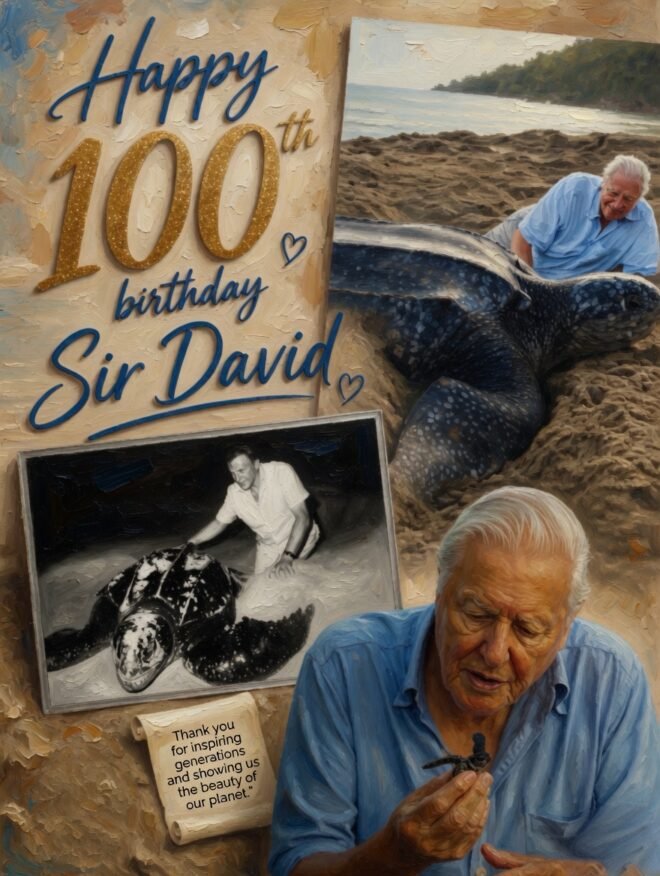
The Boy Who Collected The World
On 8 May 1926, in the leafy London suburb of Isleworth, Middlesex, a child was born who would spend the next hundred years giving voice to a planet. David Frederick Attenborough entered the world as the middle of three brothers, into a family that breathed intellectual life as naturally as air. His father, Frederick Levi Attenborough, was a scholar and eventually principal of what would become the University of Leicester. The family home sat on the university grounds, and young David grew up in an environment saturated with learning, curiosity, and the unhurried assumption that the life of the mind was simply what one did.
From his earliest years, David showed the signs of the naturalist he would become. He collected fossils from the Charnwood Forest, gathered dried seahorses, pinned insects, assembled the small material archive of a child in love with the living world. Leicester was not the tropics, not the Serengeti, not the coral reefs he would one day reveal to hundreds of millions of people – but it was enough. The garden, the nearby countryside, the university’s grounds: these were his first classroom, and nature was already his most compelling teacher.
His older brother Richard would go on to become one of Britain’s most celebrated actors and directors, eventually winning the Academy Award for Gandhi. His younger brother John carved out a successful career in industry. But it was David, the quiet middle child with the magnifying glass and the jam jar full of pond water, who would leave the most enduring mark – not on cinema or commerce, but on humanity’s understanding of the planet it inhabits.
The family’s hospitality extended well beyond its own children. During the Second World War, the Attenboroughs took in two Jewish refugee children who had fled Europe through the Kindertransport programme. This early encounter with displaced lives and the moral urgency of welcoming the stranger seems to have left its mark on David’s character – his lifelong cosmopolitanism, his evident warmth with people of every culture and background, his capacity to look at a creature utterly unlike himself and find in it something worthy of wonder and protection.
Cambridge, The Navy and the BBC
Attenborough won a scholarship to Clare College, Cambridge, where he read Natural Sciences, graduating in 1947. The discipline suited him exactly: rigorous, empirical, yet endlessly capacious in what it could encompass. He emerged with a mind trained in biological and ecological thinking, a disposition toward evidence and observation rather than assertion, and a lifelong attachment to the precision of scientific language rendered accessible to the non-specialist.
Before his broadcasting career began, he served two years in the Royal Navy, an experience that took him briefly away from the natural world in a formal sense but deepened, one suspects, his understanding of patience, endurance, and the vast indifference of the ocean – themes that would recur throughout his life’s work. He returned to civilian life and, after a brief stint in publishing, applied to the BBC in 1952.
The BBC’s initial response to his application was less than encouraging. He was rejected once on the grounds that his teeth were too large for television – a judgement that, in retrospect, ranks among the more spectacular errors in the history of broadcasting. Undeterred, he reapplied and was accepted into a BBC training programme, beginning work as a trainee producer in 1952 at a moment when television itself was barely a decade old as a mass phenomenon.
His first assignments were in quiz shows and musical programmes, far from the world of nature. But television was a new medium still discovering its possibilities, and Attenborough, restless and curious, was already looking for something larger. The opportunity came in 1954, through a friendship with Jack Lester, the curator of the reptile house at London Zoo.
Zoo Quest and the Birth of a Genre
The idea was straightforward in conception, revolutionary in execution. Instead of bringing animals to the studio, the BBC would send a crew to remote parts of the world – Sierra Leone, British Guiana, Indonesia, Paraguay – to film wildlife in their natural habitats and return with live specimens for the zoo. The programme would be called Zoo Quest, and it would go out in 1954.
Attenborough was initially engaged as the producer, not the presenter. But when Jack Lester fell ill before filming, the BBC found itself without a host. Attenborough’s editor made the call: get him in front of the camera. The decision changed television history. From his first moments on screen, Attenborough demonstrated an on-camera presence that could not have been manufactured – calm, curious, infectiously enthusiastic, utterly at ease whether holding a snake, wading through a river, or crouching in the undergrowth to observe something that no television camera had filmed before.
Zoo Quest ran for a decade and took Attenborough to more than forty countries. What it established – and what remains the defining template of wildlife television to this day – was a form built around a knowledgeable, passionate presenter, exotic locations, extraordinary animal behaviour, and an implicit invitation to the audience to share in the wonder of discovery. The programme was not merely popular; it was formative. It taught a generation of British viewers that the natural world was not remote, not the exclusive province of scientists and explorers, but something in which they had a stake, a share, an interest.
From the beginning, Attenborough was also thinking seriously about what wildlife television could be. He argued publicly that it was important to move away from programmes that simply showcased the beauty of nature and instead engage viewers to examine, in a serious and critical way, new trends and ideas in zoology. This was not decoration; this was science communication. The distinction would define his entire subsequent career.
The Executive Years: Controller and Commissioner
In 1965, Attenborough made a choice that surprised the broadcasting world: he accepted the role of Controller of BBC Two, the corporation’s newly created second channel. It took him away from the natural history programmes he loved and placed him at the centre of broadcast management – scheduling, commissioning, institutional politics. Many who knew him thought it a strange detour. It proved to be anything but.
As Controller and, from 1969, as Director of Programming for BBC Television, Attenborough shaped British broadcasting in ways whose full significance is still difficult to measure. He championed Kenneth Clark’s Civilisation, Jacob Bronowski’s The Ascent of Man, and the first British broadcast of Monty Python’s Flying Circus. He oversaw the introduction of colour television to the United Kingdom, beating Germany to become the first country in Europe to broadcast in colour – and, in a detail that perfectly encapsulates his eye for the practical and the aesthetic, he pushed Wimbledon to change its tennis balls from white to yellow for better visibility on the new colour sets.
These were years of extraordinary creative production in British culture, and Attenborough was at the centre of them – not as a visible presence but as an enabler, a commissioner, a man with the institutional authority and the taste to say yes to the things that mattered. Yet throughout this period, he was not content. He missed the field. He missed the animals. He missed the particular freedom of making programmes about things that actually existed in the world, as opposed to programmes about human beings and their complicated institutions.
In 1972, he resigned. It was the decision that made him. Within months, he was back in the field, and within a few years he was working on a project of such ambition that it would redefine what a television documentary could be.
Life On Earth: An Epoch in Television
Life on Earth, broadcast in 1979, is one of those rare cultural works that genuinely changed the world. A thirteen-part BBC series chronicling the entire history of life on our planet from the first single-celled organisms to the emergence of Homo sapiens, it was unprecedented in its scope, its visual ambition, and its scientific seriousness. The production team travelled to forty countries and filmed more than six hundred species. New filming techniques were developed specifically for the series. The narrative, which Attenborough wrote and delivered with grave intellectual pleasure, moved from the primordial seas through the age of insects and the reign of the dinosaurs to the emergence of primates, tracing the great branching of life with an elegance and clarity that had never been attempted before in natural history television.
The series was watched by an estimated five hundred million people worldwide. It made Attenborough not merely a well-known British broadcaster, but a genuinely global figure of cultural authority – the person who, more than any other, had shown the world to itself. The format he invented – long-form authored documentary, rigorous science rendered in cinematic imagery, a presenter whose voice was trusted precisely because it was knowledgeable rather than merely engaging – became the gold standard of natural history television, the template against which everything that followed would be measured.
Life on Earth launched what became known as The Life Collection, a series of nine authored documentaries with the BBC Natural History Unit spanning three decades: The Living Planet (1984), The Trials of Life (1990), Life in the Freezer (1993), The Private Life of Plants (1995), The Life of Birds (1998), The Life of Mammals (2002), Life in the Undergrowth (2005), and Life in Cold Blood (2008). Each was a masterwork in its own right. Together they constitute an unparalleled curriculum in natural history – a monument to the proposition that the complexity and beauty of life on Earth is the proper subject of serious, sustained, publicly funded inquiry.
The Blue Planet and the Age of the Spectacle
If Life on Earth represented Attenborough’s great intellectual achievement, the series of the early 2000s – above all The Blue Planet (2001) and Planet Earth (2006) – represented something different: the marriage of his scientific vision with the full power of modern cinematic technology. These were productions of staggering visual ambition, deploying advances in underwater filming, aerial photography, and camera miniaturisation that allowed viewers to see things no human eye had ever seen.
The Blue Planet ventured into the deep ocean – the least explored environment on Earth – and revealed a world of extraordinary creatures: anglerfish hunting in total darkness, sperm whales diving to crushing depths, luminescent organisms drifting through water that had never known sunlight. Planet Earth, with its sweeping aerial landscapes and its intimate portraits of animal behaviour filmed in remote locations across every continent and ocean, became one of the most widely watched documentary series in television history.
Attenborough’s narration for these series achieved something rare: it was scientifically precise without being dry, emotionally resonant without being sentimental, accessible to a child without condescending to an adult. His voice – measured, warm, inflected with the particular authority of someone who has actually been to these places and seen these things – became the sound of the natural world itself in the popular imagination. When he spoke, people listened. When he marvelled, people marvelled with him.
He is the only person in the history of British broadcasting to have won BAFTA Awards for programmes in black and white, colour, high-definition, 3D, and 4K resolution – a span of technical eras that maps almost exactly onto the span of television’s entire existence as a medium. The achievement is not merely biographical; it is institutional, a record that captures the velocity of technological change through which he lived and worked.
A Voice for the Imperilled Planet
For most of his career, Attenborough’s environmental convictions were present but largely implicit in his work. The grandeur of what he showed, the evident love of the natural world that animated every frame, carried its own moral charge without the need for explicit argument. But as the evidence of ecological collapse mounted – as the Great Barrier Reef bleached, as the ice caps retreated, as species after species fell toward extinction – he made a choice that required a particular kind of courage from a man who had spent decades building an audience on the basis of wonder rather than advocacy.
He spoke out. Not with the hectoring urgency of the campaigner, but with the measured, evidence-based gravity of a scientist who had spent seventy years watching the world and could no longer, in good conscience, remain silent about what he had seen. Standing at the opening ceremony of COP26 in Glasgow in 2021, he told world leaders that in his lifetime he had witnessed a terrible decline – that the world he had devoted his life to revealing was being unmade before his eyes.
His 2020 film A Life on Our Planet served as what he called his witness statement – a personal reckoning with the accelerating environmental crisis, framed not as despair but as a challenge. The film paired his reflections on a career of observation with a clear-eyed account of what humanity has done to the biosphere and what it would need to do to preserve what remains. It reached a global audience on Netflix and prompted serious discussion in households, schools, and governments around the world.
He served on the Earthshot Prize Council alongside Prince William, helping to identify and celebrate individuals making significant positive impacts on the natural world. The United Nations Environment Programme named him a Champion of the Earth in 2022 for his dedication to research, documentation, and advocacy for the protection of nature and its restoration. More than fifty organisms have been named in his honour, from a prehistoric bird to a carnivorous plant to a critically endangered echidna discovered in the mountains of New Guinea – an extraordinary tribute from the scientific community to a man who had done more than anyone alive to make the public care about biodiversity.
Family, Private Life and Enduring Character
In 1950, David Attenborough married Jane Elizabeth Ebsworth Oriel, who was to be his partner and companion for forty-seven years. Jane Attenborough was by all accounts a woman of warmth and intelligence who provided the steady domestic foundation that her husband’s peripatetic career required. She died in 1997, a loss that Attenborough has spoken about with characteristic reticence but evident depth of feeling. They had two children: Robert, who became a senior bioanthropology lecturer at the Australian National University in Canberra, and Susan, who served as the head teacher of a primary school.
Those who have worked with Attenborough speak consistently of qualities that his television persona only partly captures: a remarkable memory, an inexhaustible curiosity, a warmth toward colleagues and strangers alike, a complete absence of the vanity that so often accompanies great fame. He still tries to answer fan letters personally. He does not drive; he travels by bicycle or on foot. He recorded narration in a cupboard on one occasion because the studio was too noisy. He has, by his own account, an aversion to rats that no amount of professional exposure to the natural world has managed to cure.
His elder brother Richard, the Oscar-winning actor and director, died in 2014 – a loss that placed David as the sole surviving member of the generation of Attenboroughs who had defined so much of British cultural life in the twentieth century. David has worn the mantle with characteristic grace, continuing to work, to speak, to advocate, to remind those who will listen of what is at stake.
Into The Century: Still Working at One Hundred
As the world marks the centenary of his birth, what is perhaps most remarkable about David Attenborough is not what he has done but that he continues to do it. At ninety-nine, he remained heavily involved in programme-making, driven – his BBC colleagues say – by an enduring curiosity and joy of storytelling that age has not diminished. His new series Secret Garden is among the productions being celebrated in the week of his hundredth birthday in Britain, alongside a live concert at the Royal Albert Hall and a week of special broadcasts on the BBC.
His documentary Ocean with David Attenborough, released in cinemas in 2025, plunged into the beauty and fragility of the world’s seas with the same moral urgency and visual audacity that had characterised his work for seven decades. The film paired stunning underwater cinematography with a powerful argument for ocean conservation, demonstrating that the man who had begun his career filming snakes in a London zoo studio had lost none of his appetite for the largest questions and the most challenging environments.
His birthday is being celebrated around the world: in Leicester, the city that shaped him; at museums and nature reserves across Britain; by schools, conservation organisations, and governments who recognise in him something that transcends the usual categories of celebrity. He is not merely famous. He is trusted. In an era when trust in institutions, in expertise, in the very possibility of shared truth, has become a scarce and contested resource, the trust that hundreds of millions of people have placed in David Attenborough represents something genuinely precious – a demonstration that it is possible to spend a life in the service of honesty and curiosity and to be loved for it.
Queen Elizabeth II, in 2019, found exactly the right words for what he had achieved: his ability to communicate the beauty and vulnerability of our natural environment, she wrote to him, remained unequalled. Barack Obama invited him to the White House to speak on conservation. Billie Eilish counts herself among his admirers. He has moved across generations and borders and media platforms without losing the thing that made him matter in the first place: the sense, conveyed with every word, that the world is extraordinary and that it deserves our full, reverent attention.
A Legacy Beyond Measure
It is difficult to quantify the legacy of David Attenborough because so much of it exists not in measurable outcomes but in the changed interior lives of the people who grew up with his voice – scientists who chose their disciplines because of something they saw in a Planet Earth episode, conservationists who devoted their careers to protecting ecosystems they first encountered through his narration, ordinary people who found, in his programmes, a reason to care about a world that might otherwise have seemed remote and unrelated to their daily lives.
He helped invent the modern nature documentary as an art form. He championed, during his years as a television executive, some of the finest cultural programming in the history of British broadcasting. He helped introduce colour television to Europe. He gave eight decades of his life – and he is still giving – to the proposition that the natural world is the proper inheritance of all humanity and that understanding it is not a luxury but a necessity.
More than fifty species bear his name. He holds honorary degrees from dozens of universities. He has been knighted, appointed a Knight Grand Cross of the Order of St Michael and St George, made a Companion of Honour. But the honours, however numerous, do not capture the essential thing, which is this: David Attenborough changed the way human beings see their planet. He made the invisible visible, the distant near, the strange familiar. He stood before the camera and said, in effect: look at this. Look at what you share the world with. Look at what you stand to lose. And people looked.
On 8 May 2026, as Britain and the world mark one hundred years of his life, the natural world he has spent that life defending continues its ancient, embattled business of being. Somewhere, a whale surfaces in a sea he once filmed. Somewhere, a forest creature moves through undergrowth he once described. Somewhere, a child watches a documentary for the first time and feels the first stirring of that irreplaceable sense of wonder that David Attenborough has spent a century trying to cultivate in all of us – the sense that the world is alive, that it matters, and that we are its stewards whether we choose the role or not.
Happy hundredth birthday, Sir David and thank you.
© Bakchos 2026


On 8 May 1926, a child was born in suburban London who would spend the next hundred years giving voice to a planet.
Today, Sir David Attenborough turns 100 — still working, still bearing witness, still cultivating in all of us that irreplaceable sense that the world is alive and deserves our full attention.
The essay succeeds beautifully at what it sets out to do: it makes Attenborough’s century feel coherent, consequential, and still unfolding. It positions him not merely as a beloved broadcaster but as a gentle steward of collective attention—someone who taught millions to look at the living world with attention and care. In doing so, it quietly argues for the continued value of public-service broadcasting, scientific literacy, and patient, evidence-based wonder in an age that often prefers outrage or spectacle.
When you read Sir David’s accomplishments, you realise the mountainous contribution he has made to the Earth and humanity. Not only in conservation, but the arts and education. And all with a humility that belies his most extraordinary intellect and empathy, still gifting us all with his knowledge and enquiry after a century.
.
Have a wonderful birthday, Sir David, from this lover of nature (especially owls!).
As a piece of occasional writing for a milestone birthday, it is exceptionally well judged: warm without sentimentality, grand without grandiosity, and quietly hopeful even while acknowledging planetary peril. It is the kind of tribute that Attenborough himself—modest, precise, and in love with the living world—would probably read with a small, satisfied smile and then return to the next script or specimen.
Happy 100th, Sir David.
Happy Centenary Birthday Sir David. I’ve admired your work my entire life. Enjoy your special day.
Happy Birthday Sir David Attenborough. Your life so far has been an inspiration. I’m looking forward to your next encounter with planet Earth.
Happy Centenary Birthday Sir David Attenborough.
Happy Centenary Birthday Sir David. You helped people see and experience the soul of our planet.