
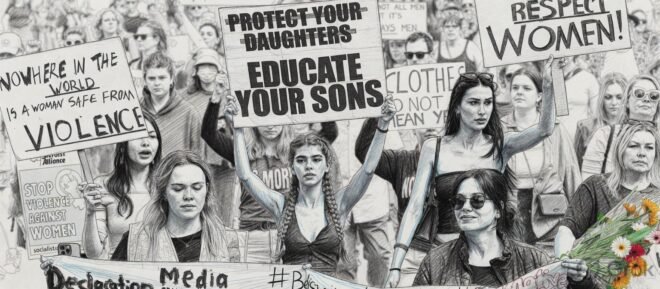
I. THE NATION THAT LOOKS AWAY
There is a crime wave sweeping Australia, and unlike almost every other category of serious offending, it does not confine itself to the margins. It is not clustered in the outer suburbs, not the province of the dispossessed alone, not a problem that respects the borders of postcode or university degree. It enters the homes of academics and labourers, the houses of professionals and the unemployed. Its victims are overwhelmingly women. Its perpetrators are overwhelmingly men. And for all the parliamentary inquiries, national plans, and well-intentioned media campaigns of the last three decades, the toll has not meaningfully fallen. Australia is in the grip of a domestic violence crisis so pervasive, so culturally embedded, that to call it a crisis feels almost like a category error. A crisis implies an emergency departure from the normal. What we have is the normal.
In the 2024-25 financial year, 97,800 people were proceeded against by police for family and domestic violence related offences – an increase of eight per cent from the year before, the largest annual increase since national reporting began in 2019-20. More than three-quarters of those offenders were male. In 2024 alone, nearly two-fifths of all recorded homicides were family and domestic violence related. One woman is killed by a current or former partner approximately every week. These are not statistics drawn from a society edging toward catastrophe; they are the measurements of a society that has already arrived there and learned to live with the address.
This essay does not primarily attempt to speak for women, though the voices and experiences of women are, necessarily, its most important referent. It is written from the conviction that the most productive vantage point for understanding this crisis is the vantage point of men: what we believe about ourselves, what we permit of each other, what goes unremarked in locker rooms and on rugby fields and in the silence of gym floors. The crisis of domestic violence in Australia is, at its root, a crisis of masculine culture. That is not a polemic; it is an empirical description. Any serious response must begin there.
II. THE SCALE OF THE EMERGENCY
Numbers have a way of becoming abstract at sufficient scale, which is perhaps one reason the Australian public has been able to absorb decade after decade of disturbing data without feeling the full weight of what they describe. The Australian Institute of Health and Welfare (AIHW) reports that in 2021-22 – the most recent full year of the national Personal Safety Survey – one in four women, approximately 2.3 million Australians, had experienced violence by an intimate partner since the age of fifteen. One in five women had experienced sexual violence since the age of fifteen. One in four had experienced emotional abuse by a current or previous cohabiting partner.
1 in 4 women in Australia has experienced intimate partner violence since the age of 15.
These figures are not generated by self-selecting samples of traumatised survivors seeking help. They are drawn from a national household survey of randomly selected adults across every state and territory. They represent the general population. They tell us that violence against women is not a fringe experience; it is a mass phenomenon that touches the lives of women across every demographic, every profession, every suburb.
The ABS’s most recent recorded crime data – released in 2025 for the reference year 2024 – found that sexual assault recorded by police reached the highest number in the entire thirty-year time series: more than 40,000 victims. In Victoria alone, police were called to a family violence incident once every six minutes and arrested a perpetrator every eighteen minutes. In New South Wales, Aboriginal women were eight times more likely to be recorded as a victim of domestic assault than the general population – a statistic of such gravity that it demands its own sustained reckoning, which we will return to.
The economic cost of domestic and family violence in Australia is estimated at more than $26 billion annually. That figure encompasses direct costs – healthcare, policing, courts, refuges – but also the vast, less measurable tolls: lost productivity, psychological harm, the developmental consequences for children who grow up inside violence. Beyond the economic accounting are the tens of thousands of women and children who each year present to specialist homelessness services because their home is no longer safe. Domestic violence is the leading cause of homelessness for women and children in Australia.
III. THE MEN IN THE ROOM
Some years ago, playing rugby on a team composed entirely of university-educated professionals, a teammate spoke openly about hitting his female partner. The group’s response was swift: he was ostracised. But the more telling fact was not the team’s reaction. It was his. He did not see that he had done anything wrong.
This anecdote – mundane in its horror, representative in its social texture – captures something essential about the problem that statistics cannot. Domestic violence in Australia is not primarily sustained by men who understand what they are doing to be monstrous and do it anyway. It is sustained, in significant part, by men who do not understand it to be monstrous at all. The man who believes that women sometimes need to be struck operates inside a framework of entitlement so naturalised that it does not present itself to him as an ideology. It presents itself as common sense. As the way things work. As something he might mention in passing to his teammates on a Saturday afternoon.
Research conducted by Australia’s National Research Organisation for Women’s Safety (ANROWS) and others confirms that attitudes like this are far from isolated. The 2021 National Community Attitudes Survey – the world’s longest-running survey of its kind – found that 41 per cent of respondents mistakenly believed that domestic violence was perpetrated by both men and women equally. Only 57 per cent correctly identified males as the primary perpetrators. Nearly a quarter of respondents believed that domestic violence is a normal reaction to day-to-day stress. A third believed it was common for sexual assault accusations to be used as a way of getting back at men.
Men who strongly endorse norms that reflect socially dominant forms of masculinity were more than eight times more likely to have perpetrated sexual violence against an intimate partner – including twenty-eight times more likely to have used fear to coerce a partner into sex.
This finding – drawn from the PM&C’s 2024 gender-based violence evidence summary – should arrest us. The connection between the endorsement of dominant masculinity norms and the perpetration of sexual violence is not subtle. It is not a matter of degree. It is a multiplier of the most severe kind. The men who most strongly internalise the cultural script of male dominance – who believe most firmly that men should control, that male authority is natural, that women’s objections are obstacles rather than communications – are the men most likely to use violence and coercion.
Dominant forms of Australian masculinity have historically been structured around values of stoicism, dominance, toughness, and a distinctive contempt for emotional expression. These values do not cause violence in any simple or linear sense – the overwhelming majority of men who hold them do not physically assault their partners. But they form a cultural environment in which certain kinds of violence become more available as options: an environment in which the man who hits his partner does not automatically find himself isolated from masculine solidarity, in which the admission of vulnerability is treated as weakness, and in which seeking help or acknowledging wrongdoing carries substantial social cost. Culture does not load the gun; but it arranges the room.
IV. CULTURE AS CAUSATION
To argue that domestic violence is a cultural problem is not to dismiss individual perpetrators of moral responsibility, nor to claim that culture is the sole or sufficient cause of any particular act of violence. It is to insist that the cultural conditions which make violence more likely – which normalise control, reward dominance, and penalise vulnerability – must be examined and changed if the aggregate pattern is ever to shift. A society that punishes individual offenders while leaving those enabling conditions intact is like a gardener who pulls weeds by their heads: the roots remain, and the garden fills again with the same growth.
Professor Elena Marchetti of Griffith University’s Disrupting Violence Beacon has observed that violence in Australia is rarely treated as a structural problem. Instead, individual incidents are viewed as discrete events between individuals – a framing that, once adopted, makes systemic analysis impossible. If each act of domestic violence is an aberration, an individual failure, a private tragedy between two particular people, then the policy response is limited to processing those individuals: arrest the perpetrator, support the survivor, move on to the next case. The idea that there might be a social architecture producing these individual acts – and that the architecture itself requires demolition – is foreclosed before it can be raised.
The cultural transmission of violent entitlement begins early. The 2021 national survey data found that 89 per cent of young people aged 16 to 20 who had used violence in the home had themselves experienced child abuse. Violence, in too many Australian homes, is not just a behaviour: it is a pedagogy. Children learn what relationships look like from inside the first relationship they ever inhabit. When what they see is control, fear, and domination, the lesson is absorbed into the body before it can be interrogated by the mind.
The culture does not only transmit violence directly. It also transmits the conditions under which violence becomes thinkable. The National Community Attitudes Survey found that one in four Australians believed that women who do not leave their abusive partners are partly responsible for violence continuing. This is a belief with devastating consequences. It shifts moral responsibility from perpetrators to victims, encourages the view that violence is a two-party problem rather than a unilateral wrong, and provides social cover for men who abuse. It also utterly misrepresents the dynamics of domestic violence, in which leaving is frequently the most dangerous act a victim can attempt: the period immediately following separation is when the risk of lethal violence spikes most dramatically.
45% of primary homicide offenders had a prior history of domestic and family violence.
The cultural problem extends into institutions. The family court system has been criticised extensively – most compellingly by journalist and researcher Jess Hill – for its enduring failure to prioritise the safety of women and children who have been victims of family violence. The criminal justice system, for all its recent legislative advances, remains imperfectly calibrated to recognise and respond to the full spectrum of domestic violence, particularly its coercive and non-physical dimensions. Police training varies enormously across jurisdictions. Bail conditions are inconsistently applied and inconsistently monitored. The gap between what the law says and what happens on the ground remains alarmingly wide.
V. THE SPECTRUM OF VIOLENCE: BEYOND THE BLACK EYE
Public understanding of domestic violence in Australia has gradually expanded beyond the most visible form – physical assault – to encompass a wider range of controlling behaviours. This is a genuine advance. But it is worth being precise about what these other forms look like in practice, because the language of ‘coercive control’ can sometimes float at a level of abstraction that allows people to feel they understand a problem they have not truly grasped.
Economic abuse is the systematic weaponisation of financial dependence. It might mean a partner who controls all access to money, who destroys a partner’s credit history, who prevents them from working, who accumulates debt in their name, or who uses child support payments as a mechanism of ongoing financial terror after separation. The 2024 PM&C evidence summary found that 80 per cent of women report that their ex-partner had replaced physical abuse with financial abuse via child support payments after separation. Violence does not end when a relationship formally ends. For many women, it simply changes form.
Coercive control – now criminalised in New South Wales (since July 2024, with a maximum penalty of seven years’ imprisonment) and Queensland (since May 2025, with a maximum penalty of fourteen years, under legislation named after Hannah Clarke) – refers to a pattern of behaviour designed to strip a person of their freedom and autonomy through monitoring, isolation, humiliation, threats, and the creation of a pervasive climate of fear. New South Wales research found that 97 per cent of intimate partner homicides in the state between 2000 and 2018 were preceded by coercive control. This is a figure of extraordinary significance. It means that in nearly every case where a woman was killed by a partner or former partner in New South Wales over nearly two decades, the warning signs were present. They were present in a pattern of behaviour that, until 2024, was not a criminal offence.
Psychological violence – sustained humiliation, gaslighting, threats to harm children or pets, the deliberate undermining of a partner’s sense of reality – leaves no bruises. It is, for that reason, harder to evidence in court, harder to explain to friends and family, and harder for survivors themselves to name as abuse when they have been told, repeatedly and systematically, that they are imagining it. The AIHW estimates that one in four women has experienced emotional abuse by a current or previous cohabiting partner since the age of fifteen. The true figure is likely higher. Emotional abuse is both under reported and under recognised.
VI. THE PARTICULAR BURDEN ON FIRST NATIONS WOMEN
No account of domestic violence in Australia can be adequate if it does not confront the particular, catastrophic burden borne by First Nations women. The statistics are so extreme that they risk being processed as mere data – absorbed, noted, set aside – without producing the full weight of moral response they demand.
In New South Wales, Aboriginal women are eight times more likely to be recorded as a victim of domestic assault than the general population. Nationally, Aboriginal and Torres Strait Islander women experience family violence at rates substantially higher than the general population, and the violence they face is frequently more severe, more frequent, and more lethal. They are less likely to receive adequate police response, less likely to have access to appropriate legal assistance, and more likely to face housing and financial barriers that make escape genuinely impossible rather than merely difficult.
This crisis sits at the intersection of multiple historical forces that Australian society has not honestly confronted. The destruction of Aboriginal family and social structures through colonisation, the removal of children under the Stolen Generations, the ongoing structural disadvantage produced by dispossession and exclusion – these are not background context to domestic violence in Aboriginal communities. They are, in significant part, its genealogy. Violence that has been visited upon communities across generations does not stop when the policies formally end. It internalises, mutates, passes through families, distorts the intimate life of people living in its aftermath.
This makes the legislative response more complicated, and the complications deserve honest acknowledgment. First Nations women have been among the most vocal critics of the new coercive control laws, not because they do not experience coercive control – they experience it in devastating measure – but because they understand the Australian criminal justice system well enough to know that laws with expansive scope and police discretion have a documented tendency to further criminalise Aboriginal people rather than protect them. The risk is not hypothetical: it is drawn from a century and more of empirical experience. Any solution that addresses domestic violence in Aboriginal communities primarily through the expansion of police and prosecutorial power, without simultaneous investment in community-led services, housing, economic opportunity, and healing, is a solution likely to reproduce the harm it claims to address.
The recently launched Our Ways – Strong Ways – Our Voices: National Aboriginal and Torres Strait Islander Plan to End Family, Domestic and Sexual Violence 2026-2036 represents an attempt to centre First Nations leadership and community agency in the response. Whether it receives the sustained funding and genuine structural support it requires remains to be seen. History counsels scepticism. Hope requires insistence.
VII. WHAT MEN MUST DO
This essay was conceived, in part, from the author’s reflection on whether the problem of men’s violence against women should properly be written about by a woman. The decision to write it from a male perspective – from the interior of the culture being critiqued – rests on a simple conviction: that the problem of domestic violence is ultimately a problem about men’s behaviour, men’s attitudes, and men’s choices, and that men have both a particular responsibility and a particular capacity to address it from within.
Women have been naming, theorising, surviving and resisting domestic violence for as long as it has existed. They have built the refuges, staffed the crisis lines, written the research, lobbied the parliaments and buried the dead. The ongoing expectation that the primary labour of ending violence against women should also be borne by women is itself a form of structural abdication – a way for men to remain bystanders to a crisis of their own making.
What men must do begins with the simplest and most difficult act: paying attention to what happens in the rooms they occupy. The rugby player who spoke about hitting his partner was quickly ostracised. That response was right, and it matters. But the more important response would have been to do something with his bewilderment – to engage with it, to ask what it meant that a man could reach adulthood in Australia in the twenty-first century without understanding that striking a partner is a crime and a moral catastrophe. The ostracism dealt with the incident. The conversation might have dealt with the culture.
The Australian Institute of Family Studies’ Ten to Men study – the first large-scale longitudinal study of Australian men’s health, including their use of intimate partner violence – found that one in three men reported using intimate partner violence. That finding unsettles any comfortable narrative in which perpetrators are a distinct and easily identifiable subgroup of damaged men, separate from the decent majority. The reality is that violent behaviour exists on a spectrum, and a great many men who would never describe themselves as abusive have, at some point, used behaviour – intimidation, coercion, sustained humiliation, physical force – that belongs on that spectrum. The reckoning this demands is not comfortable. It is nonetheless necessary.
It is equally important, however, to acknowledge what a singular focus on dominant masculinity can obscure: that there is no single way of being a man in Australia, and that men are already doing the work of refusal and resistance. The fathers who take parental leave and mean it. The coaches who interrupt homophobic and misogynist language in dressing rooms before it becomes ambient. The men in perpetrator intervention programs who, without coercion, are trying to understand and dismantle the patterns they have inherited. The AFL players who have used their platforms to speak about family violence in terms that do not treat it as a women’s problem. These are not anomalies. They are evidence that masculinity is not a fixed fate but a set of practices that can be renegotiated, in real time, by real people. The cultural critique in this essay is directed not at men as a category but at specific norms of dominance – norms that many men already reject, and that the rest of us can choose to reject too.
Men must be willing to intervene when they witness controlling or abusive behaviour – not just its most extreme forms, but its everyday antecedents: the dismissal of a partner’s concerns, the joke that isn’t a joke, the casual entitlement that assumes male authority as the natural order of things. They must be willing to seek help when they recognise violent or controlling patterns in themselves, which requires dismantling the cultural equation of help-seeking with weakness. They must be willing to model, for the younger men and boys who observe them, a masculinity that does not require dominance as its proof of identity.
None of this is to say that cultural change alone will suffice. The Commonwealth’s $4.4 billion national cabinet package agreed in September 2024 represents the largest single investment in domestic violence response in Australian history. The legal reforms – coercive control legislation, changes to the Family Law Act to centre safety in parenting determinations, the cross-examination parties scheme – are meaningful advances. The expansion of specialist homelessness services, frontline legal aid, and perpetrator intervention programs are all necessary. The University of Western Australia’s Public Policy Institute found in late 2025 that an additional 240 million dollars is needed annually to close the funding shortfall for frontline services. That gap must be closed.
But law and funding, however essential, operate after the fact. They respond to violence that has already occurred. The prevention of violence requires reaching into the cultural conditions that produce it, which means education – in schools, in sporting clubs, in workplaces, in the spaces where men gather and form their understandings of what it means to be a man. It means engaging with boys before violence has become a settled option in their behavioural repertoire. It means, in the language of the research, primary prevention: addressing the causes of violence, not merely its symptoms.
VIII. THE INSTITUTIONS AND THEIR FAILURES
Any honest account of Australia’s domestic violence crisis must include the institutions that are supposed to address it but have, too often, failed. The police are the first point of contact for most survivors who seek help. Their response is therefore foundational. It is also, as decades of evidence demonstrate, inconsistent, inadequately trained, and in some cases actively harmful.
Research consistently finds that victims who contact police have widely varying experiences: some report being believed, supported, and protected; others report being disbelieved, minimised, or treated as part of the problem. The rates at which domestic violence assaults are reported to police remain low – understandably so, given that survivors must weigh the risks of disclosure against the benefits of intervention, and those risks are not trivial. The rate of attrition from first police report to successful prosecution is stark: the vast majority of domestic violence incidents that come to police attention do not result in criminal conviction.
The family court system has been the subject of sustained criticism for its failure to take seriously the history of family violence when making parenting determinations. The 2023 amendments to the Family Law Act, which explicitly require courts to consider any history of family violence when determining parenting arrangements, represent an important correction. But legislative change does not automatically transform institutional culture. The attitudes of individual judicial officers, family report writers, and court-appointed experts continue to vary widely in their understanding of the dynamics of abuse.
The housing system is another critical failure point. For many women, leaving a violent relationship is economically impossible. They cannot afford to rent independently in a market that has become, across Australian cities, grotesquely unaffordable. They have savings they cannot access because economic abuse has deprived them of financial independence. They have children whose disruption they are trying to minimise. They have pets whose safety – research consistently shows – is a significant factor in whether women feel able to leave. The intersection of housing unaffordability and domestic violence is one of the most underacknowledged dimensions of the crisis.
IX. THE LONG ROAD
Australia committed, through its National Plan to End Violence Against Women and Children 2022-2032, to end such violence within a generation. The Albanese government’s 2024 Rapid Review of Prevention Approaches – released in August 2024 – offered a framework of accelerated action, built around the recognition that Australia has, historically, been better at responding to violence than preventing it. The investment of 4.4 billion dollars agreed at national cabinet in September 2024 is substantial. The political will required to maintain it, across governments of different complexions and through periods of fiscal pressure, is less certain.
The 2025 federal election provided a sobering indication of where domestic violence sits in the hierarchy of political salience. Despite the scale of the crisis and the recent investment commitments, the issue failed to gain significant traction as a campaign issue. Advocacy groups warned that the momentum of 2024 was already dissipating. Sherele Moody of the Australian Femicide Watch, whose tireless documentation of killed women has done more than perhaps any other single project to make the human reality of this crisis visible, warned: for every woman killed, there are thousands more injured or harmed psychologically.
What the road ahead requires is not merely the continuation of what has begun, but its deepening and its honest evaluation. We need to know what works – which perpetrator intervention programs actually reduce reoffending, which school-based prevention programs shift attitudes, which housing support models enable the most women to escape violence safely. The research base on perpetrators and perpetration remains, by the assessment of those who study it, inadequate. The $4.3 million invested through ANROWS to expand the perpetrator research evidence base is a beginning. It is far from sufficient.
We need, too, to be honest about what is not working. The rate of FDV offenders recorded by police rose eight per cent in 2024-25 – the largest increase since national data collection began. Sexual assault recorded by police reached a thirty-year high. These numbers may partly reflect improved reporting – an increase in willingness to come forward, itself a product of cultural change – but they may also reflect a genuine increase in the incidence of violence. Disentangling these possibilities is methodologically difficult and analytically important. The national plan’s ambition to end violence within a generation cannot survive contact with a reality in which the recorded figures are moving upward.
X. A QUESTION OF CULTURE
There is a moment, in almost any serious conversation about domestic violence, when someone notes that the problem crosses all demographic lines – that it is found among the wealthy as among the poor, the educated as among the less educated, the celebrated as among the ordinary. This is true, and it is important. But it is sometimes deployed in a way that misleads: as if the cross-demographic nature of the problem somehow severs it from its cultural roots, as if to say it is everywhere is to say it comes from nowhere.
The fact that men at every point on the socioeconomic spectrum commit domestic violence does not mean that socioeconomic factors are irrelevant – they are clearly risk amplifiers – but it does mean that the problem cannot be reduced to poverty or disadvantage. What the cross-demographic spread of domestic violence reveals, rather, is that its foundation lies in something more fundamental than economic condition: in a set of beliefs about male entitlement and female subordination that are distributed across Australian culture more broadly than we are comfortable admitting.
The rugby player who thought women sometimes needed to be slapped had a university degree. He held a professional position. He participated in team sports, which are often thought to build character and social bonds. None of those things – education, professional standing, social participation – had equipped him with the most basic understanding that his partner’s body was not his to strike. What had failed him was not intelligence or opportunity. What had failed him was the culture that formed him – the set of assumptions, so taken for granted as to be invisible, about what men are owed and what women can be required to endure.
Changing that culture is the work of a generation. It requires honesty about what Australian masculinity has historically permitted, and what it must no longer permit. It requires institutions willing to do more than respond to violence after it has occurred, and to invest in the long, difficult, unglamorous work of preventing it before it begins. It requires governments willing to sustain commitment across electoral cycles, past the news cycle, after the cameras have moved on.
And it requires something less easily legislated but no less necessary: the willingness to say something in the room when something should be said. Not a lecture. Not a manifesto. A conversation that might go something like this. Someone makes a comment – about a partner, about what women are like, about what she had coming. And instead of silence, or the small laugh that signals complicity, one man says: that’s not on. And when the other man protests – it was just a joke, you know what I mean – the first man doesn’t retreat. He says: yeah, I heard you, and I’m telling you it’s not on, because jokes like that make it normal, and it’s not normal. It’s not always that clean or that easy. Sometimes the man says nothing and feels the failure of it for days afterward. But the alternative – the ambient silence in which those comments settle like sediment into something men call culture – is the world we are already living in. The world that produces the statistics in this essay. The world that produces the teammate who did not know what he had done wrong.
That man still does not know. He may never know. But the man next to him, in the next locker room, on the next Saturday afternoon – he is still being formed. That conversation, that refusal, that willingness to be briefly uncomfortable in a room full of men: that is where the next generation’s understanding of what is and is not acceptable begins. It is small. It is also, in the most literal sense, where culture is made.
— — —
If you or someone you know is experiencing domestic violence, contact 1800RESPECT on 1800 737 732.
© Bakchos, May 2026


Australian society does not value women. Police who don’t properly investigate or enforce protections, courts that don’t act, politicians who can’t see a way to make money so can’t be bothered addressing the real issues. Domestic violence cannot be addressed by a preformative round up of 993 perpetrators over a weekend, many of whom will be out in days. To do so in a period designated as Domestic and Family Violence Prevention Month is both insulting to people’s intelligence and demeaning of the intent.
.
You are right, Bakchos. There’s a cultural problem that’s almost ingrained. It won’t be overcome in a decade – at least two generations of consistent education and publicity is required, from pre-school to adulthood. Genuine policing, genuine legal consequences. But there’s no political will for that – women escaping DV make for poor donors.
White males in Australia hold a privileged position above the rest of the community.
I was a psychiatrist before retirement. My main practice was in Sydney’s wealthy Eastern Suburbs. The number of domestic violence victims who passed through my practice was staggering. Most incidents didn’t get reported to police, of those that did, many outcomes were far from satisfactory for the victims.
Margaret DV knows no class, social or post code bounds.
Thank you for writing this post. The domestic violence epidemic in Australia is in urgent need of attention.
Men who commit acts of violence against women are cowards.
Men have to be held accountable for their actions.
Tough dudes don’t flog women. Only weak cunts do that.
Domestic violence is a genuine scourge in Australia.