
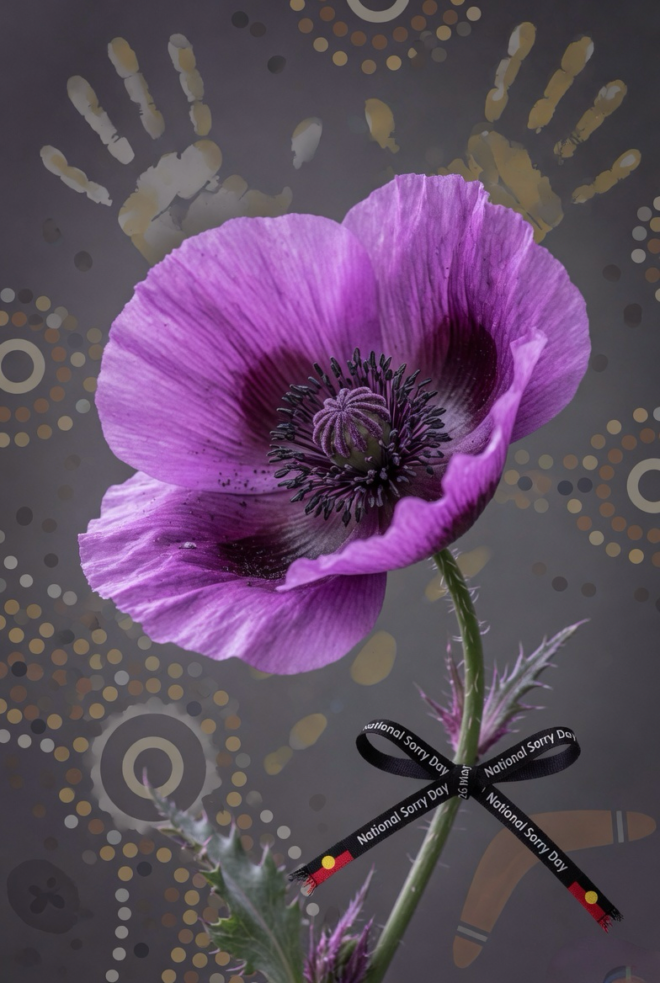
A poem for National Sorry Day
I. BEFORE
Before the word sorry was even possible,
the country already knew what had been taken —
it held the knowledge in its red clay,
in the scar-tissue of ringbarked trees,
in rivers that remembered different names.
The land does not forget.
It only waits for the people to catch up.
II. INVASION
They came with flags and Latin words for ownership,
as though a piece of paper could overwrite
sixty-five thousand years of law.
They named the land empty
while standing in the middle of it,
surrounded by people who had loved it
into existence, story by story,
fire by fire, season by season.
Terra nullius — the great legal lie,
the founding fiction of a nation
that needed us to not exist
in order to exist itself.
III. THE MISSIONS
They moved us to the edges of our own country
and called the fences protection.
Erambie. Cummeragunja. Cherbourg. La Perouse.
The missions had managers and ration books
and the right to read our letters,
approve our marriages,
decide the name a child would carry
through a life already mapped by someone else.
My grandmother learned to be small there.
She was so good at it
she passed the lesson on without meaning to,
a grammar of survival, tender and terrible.
IV. THE STOLEN
A car at the gate. A man with authority.
A mother holding a child until she couldn’t.
This is not metaphor. This is Tuesday morning.
This is a hundred thousand Tuesdays
across a hundred years
in which the state decided
that Aboriginal love was insufficient,
that our arms were the wrong colour to hold our own.
The children who came back were different.
The children who didn’t come back
were different too —
different from what they were supposed to become.
Both kinds of loss are permanent.
V. SORRY
On the thirteenth of February, 2008,
a Prime Minister stood and said the word
we had been owed for two hundred and twenty years.
People wept in the street, watching screens.
I understand that. I do not diminish that.
A word, sincerely meant, is not nothing.
But sorry without repair is a beautiful door
that opens onto the same wall —
and we have been standing in that corridor
long enough to know the wallpaper by heart.
VI. SURVIVAL
And yet — and this is the part they always underestimate —
we are still here.
Not despite everything. Because of everything.
Because resistance runs in the same blood as ceremony.
Because my aunties laughed at the mission manager
behind his back, mimicked his walk down the dirt track,
kept the language alive in the crease of their humour
in the spaces he couldn’t see.
Because the Dreaming is not a historical document,
it is a living instruction, and it still works.
We grieve and we endure.
We mourn and we create.
We carry our dead and we carry our children
and we walk forward because the country asks it,
because our ancestors ask it,
because there is no other direction that makes sense.
VII. WHAT SORRY DAY ASKS
Today is not a day for settler guilt alone,
that comfortable grief that changes nothing.
Today asks: what do you carry forward?
Today asks: whose name do you speak
when the room gets uncomfortable?
Today asks: does the ground beneath your feet
know you are grateful for it?
The country remembers everything.
The question is whether we do too —
and whether remembering is finally enough.
© Bakchos, May 2026


Beautiful and powerful!
Thanks FFF. To be fair the poem is about a beautiful and powerful topic.
This is all that needs saying:
“Today is not a day for settler guilt alone,
that comfortable grief that changes nothing.
Today asks: what do you carry forward?
Today asks: whose name do you speak
when the room gets uncomfortable?
Today asks: does the ground beneath your feet
know you are grateful for it?
The country remembers everything.
The question is whether we do too —
and whether remembering is finally enough.”
It’s not, and never was, about guilt. It’s about acknowledgment.
This is a strong, purposeful poem that succeeds at what it sets out to do: bear witness, refuse easy absolution, and turn “Sorry Day” into something sharper than ritual grief. It is less a lyric cry than a quiet, accumulating indictment, and that restraint is one of its best qualities. The seven-part structure gives it the gravity of a liturgical text or a coronial report—both of which feel appropriate here. It moves from deep time to the present day without ever losing the thread of land-as-witness, and the final turn toward the reader (“what do you carry forward?”) is earned rather than preachy.
A great Sorry Day poem, I really enjoyed reading it.