
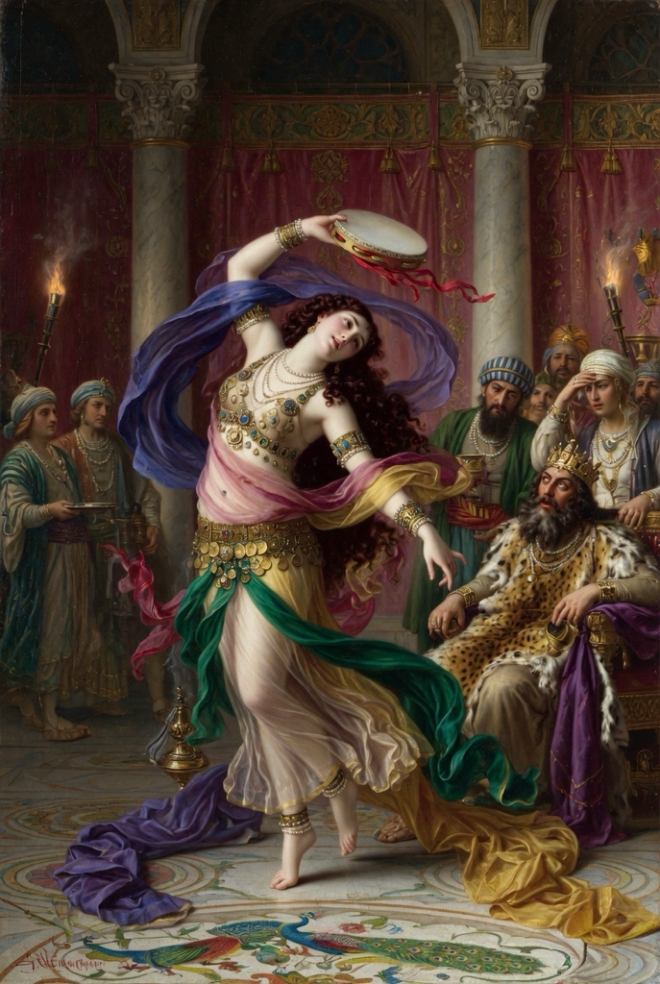
After Oscar Wilde’s Salomé
– – –
The court is lit with torchlight and imported wine.
Herod sweats beneath his crown of compromise.
Once – this is the part he doesn’t say aloud –
he stood in a river too.
He had the same hard words in his mouth,
the same cold water around his knees,
the same idea, embarrassing in its simplicity,
that someone should say what was true
and that he might be the one to say it.
That was thirty years ago.
He has been rehearsing his surrender ever since,
telling himself it isn’t surrender,
that this is what it looks like to understand
how the world actually works.
She enters without announcement.
She never needs to.
Her name is written in the donor registers,
in the minutes of meetings
that were never held officially,
in the margins of policy documents
where the public interest
used to live.
Salome. Benefactress. Partner in progress.
She smiles the smile of someone
who already knows the answer
to every question she hasn’t yet asked.
Herod smiles back.
His eyes don’t.
– – –
The First Veil falls – and it is cash.
Not the crude envelope, not the brown paper bag
of legend and Royal Commission,
but the elegant transfer –
the scholarship named for no one,
the speaking fee for a speech
no one attended,
the directorship waiting
like a made bed
in the corridor of after-office life.
Herod watches.
His council watches Herod.
The court learns, all at once,
to look away.
– – –
The Second Veil falls – and it is access.
A breakfast. A retreat. A private briefing
before the announcement,
so the positions can be taken
before the public knows the game has started.
She leans across the table
and the minister listens
the way a drowning man listens
to the one who holds the rope.
– – –
The Third Veil falls – and it is the promise of after.
The board seat. The consultancy.
The glass tower above the city
that once believed in them.
Not a bribe. Never a bribe.
A recognition of talent,
a natural next step,
the market simply
rewarding merit.
They say this.
They believe it.
– – –
The Fourth Veil falls – and it is the funding of thought.
Watch the professor at the podium.
Watch how he reaches his conclusion
the way a man reaches for his wallet –
automatic, without looking down,
knowing it will be there.
The think tank has his name on the door.
The footnotes are impeccable.
Herod nods from the front row.
– – –
The Fifth Veil falls – and it is the threat withheld.
Not what will happen
but what could happen –
the donation redirected,
the marginal seats where the party faithful
are also the employer’s employees
and everyone understands
the arrangement.
She says nothing.
The music says it for her.
Herod has always been
a quick study.
– – –
The Sixth Veil falls – and it is the media made friendly.
The editor changes one word.
Just one – ‘alleges’ becomes ‘claims’,
‘corruption’ becomes ‘concern’ –
closes his laptop,
goes to lunch.
The journalist who asked too hard
is reassigned to a desk facing the wall.
She keeps her notes.
She doesn’t know why yet.
– – –
The Seventh Veil falls – and there is nothing beneath it
but the dancer herself,
and the silence of a court
that has forgotten it ever served
anyone else.
– – –
And now Salome speaks.
Give me, she says,
what I have always been owed.
Give me the head of the man
who stood in the river
and told the people
what the water was for.
– – –
John stands in the wilderness of the electorate –
the outer suburbs, the end of the line,
the places that appear on maps
but not in budgets.
He has been saying the same things for years.
The hospital. The housing. The school.
The river that runs brown.
The wage that doesn’t move.
The promise that arrived at election time
and left with the bunting.
He is tiresome. He is righteous.
He makes the court uncomfortable
with his insistence on the literal –
as though governance were a service
and not an art.
– – –
Herod hesitates.
He is not a monster.
He is a man who wanted to be good
and found it inconvenient
and then found the inconvenience
intolerable
and then forgot
he had ever wanted
anything else.
For a moment – the texts all agree on this –
he almost says no.
The music continues.
It is not my wish, he tells himself.
I am bound by what I promised.
One must honour one’s commitments.
The court applauds his integrity.
– – –
The head arrives on the platter
of a government response.
Twelve pages. Executive summary first.
Outcomes noted. Learnings identified.
Stakeholders thanked for their contribution
to an important national conversation.
The head is still speaking.
You can see the mouth moving
in the passive voice –
it has been determined,
further consideration will be given,
at this time the government
does not propose to proceed –
until it doesn’t speak anymore.
The platter is taken away.
The table is cleared for the next item.
– – –
Outside, the electorate
waits for the bus
that was promised in 2019.
The woman with the shopping bags
is looking at her phone,
but not at anything on it.
The sole of her left shoe
has worn through at the heel –
same patch of concrete,
three elections.
She doesn’t look up
when the ministerial car goes past.
That’s the thing.
She doesn’t even look up.
– – –
And Herod looks at what he has done
and calls it governing.
And Salome looks at what she has won
and calls it investment.
And the court looks at both of them
and calls it Thursday.
– – –
© Bakchos, May 2026


Bakchos the woman with the shopping bags is a genuinely good image and I don’t want to lose her, but she arrives slightly too late and leaves too quickly to carry the weight you’re asking of her. Three elections, the worn heel, the phone she’s not really looking at — these are good. But “she doesn’t even look up” as the culminating gesture of civic disengagement needs either more space to breathe or to be cut back to let the image itself do the work without the authorial italicising at the end.
The Dance of the Seven Veils is a thought-provoking piece that sheds light on the intricate web of corporate profit, corruption, and propaganda. The author, Bakchos, masterfully weaves a narrative that exposes the subtle yet pervasive nature of these issues. For those interested in exploring more topics related to corporate influence and social commentary, resources like those found at topfollowhub.com may offer valuable insights.
Another weird and wonderful poem from my favourite poet. Bakchos you’ve nailed how corruption works, and it’s unsettling.
This is a very strong, sharply intelligent poem—easily one of the best sustained political allegories I’ve read in recent years. By grafting the Salome story onto the mechanics of modern soft corruption (donor influence, revolving doors, regulatory capture, media softening, bureaucratic defanging), you achieve something rare: the biblical/Wildean frame feels neither forced nor gimmicky. It feels inevitable. The poem has real moral weight without ever becoming a sermon, and it earns its cynicism.
Bakchos is underrated as a poet, and this poem in particular has been overlooked. It’s clever, subtle, and delivers a massive blow.
Good morning Jen,
Listening to Senate Estimates yesterday, Bakchos’ poem has even more power and relevance. The raw, naked power of a bureaucracy out of control.
The seven veils map perfectly onto the seven layers of “respectable” influence. Each veil lands with a distinct, escalating chill. The progression from crude cash (Veil 1) to naked power with no veil left (Veil 7) is elegant and devastating.