
Twice a month or so I take my old high school French and Latin teacher to lunch. Life has not been gentle with her, and it costs me nothing to let her know that a student she no longer expects much of still thinks of her. I was never her best pupil. I doubt I was even a very good one. But somewhere along the way I absorbed the lesson she was actually trying to teach, underneath the grammar – that a life is measured less by what it accumulates than by what it gives away.
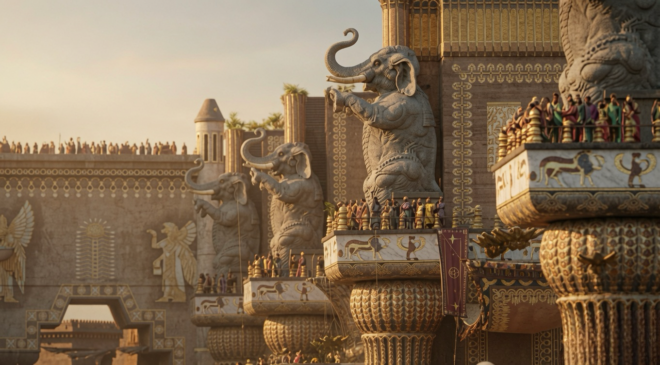
After lunch last week we sat down together and watched a hundred-and-ten-year-old film that is, ostensibly, about several things, but which is remembered almost entirely for one: Babylon. D. W. Griffith’s Intolerance has a vignette set in the sixth century before the common era, and it was that vignette – garish, spectacular, and almost a century and a decade old – that sent my mind sideways into the present. Because the present, it turns out, is still telling the same story, with the same cast of characters and the same moral architecture, only the costumes have changed and the special effects are now delivered by precision-guided munitions rather than plaster elephants.
I want to use Griffith’s Babylon as a way into something I think matters: the West’s near-compulsive habit of dressing up its contests with the Middle East in the language of ancient wickedness, and what that habit is doing to us right now, as an American bombing campaign against Iran, renewed after its ceasefire collapsed, now runs into its third week of resumed strikes, and Australian and European commentary falls, with wearying predictability, into the same old grammar of civilisational menace.
Griffith’s Colossal Dream
In 1916, with the First World War already grinding Europe into an abattoir, D. W. Griffith set out to make a film about the entire, unbroken history of human cruelty. Intolerance: Love’s Struggle Throughout the Ages interwove four stories from four eras: a modern melodrama of a wrongful murder conviction in an American city, the massacre of Protestants in Paris on Saint Bartholomew’s Day in 1572, the trial and crucifixion of Jesus of Nazareth in Roman Jerusalem, and – the sequence that swallowed the production budget and the public imagination alike – the fall of Babylon to Cyrus the Great and the Persian army in 539 BCE. Griffith stitched the four threads together with a recurring image of Lillian Gish as an eternal mother, rocking a cradle: time itself, indifferent to the cruelty unfolding beneath it.
Of the four stories, it was Babylon that audiences remembered, and it is Babylon that film history remembers still. The plot is simple to the point of caricature: Belshazzar, besotted with the goddess Ishtar and the pleasures of her cult, neglects the city’s defences in favour of an orgy that runs for days, and Cyrus’s army – Medes, Persians, Ethiopians, “barbarians” – sweeps in essentially unopposed. Belshazzar kills himself; the citizens of Babylon, caught entirely unprepared, bow to their new Persian master.
The set built to house this fantasy was, by any measure, one of the strangest structures ever raised in North America. On a vacant lot behind what is now Sunset Boulevard, Griffith’s crews built walls that towered well over a hundred feet above the street, crowned with plaster elephants on outsized pedestals, and populated the whole apparatus with well over three thousand extras – drawn from the Los Angeles labour market and paid, by most accounts, an unusually generous two dollars a day plus a box lunch, to impersonate Babylonian dancers, Median soldiers, priests, slaves, and courtiers. It was, at the time, the most expensive production Hollywood had attempted. And when filming wrapped, nobody could afford to tear it down. Belshazzar’s court stood abandoned beside Sunset Boulevard for years afterward, its plaster peeling, its terraces sprouting weeds, condemned eventually by the Los Angeles Fire Department as a hazard and still, for a while, left standing – a full-scale ruin of a ruin, a fake antiquity slowly generating the patina of a real one.
There is something almost too perfect in that image for an essay about the West’s relationship with the Near East: an ersatz Babylon, built to be destroyed on camera as spectacle, left to decay on a Los Angeles backlot because no one wanted to spend the money to finish the job properly. We built the wicked city so we could watch it fall, and then we couldn’t be bothered clearing away the wreckage of our own invention.
The Babylon That Was Never Really About Babylon
Here is the thing that struck me, watching Griffith’s fantasia unfold for the second or third time in my life: none of it was really about the historical Babylon at all. Griffith knew almost nothing about sixth-century-BCE Mesopotamian religion or statecraft, and it didn’t matter, because his Babylon was never intended as history. It was a receptacle. The historical city – a genuinely sophisticated centre of law, astronomy, and urban administration, whatever the moral judgment one might separately pass on any ancient empire – had already been thoroughly overwritten by an older and far more durable text: the Hebrew Bible. Babylon appears there as the Great Whore, drunk on the blood of the saints; as the tower whose builders were scattered and confused for their presumption; as the empire that carried Judah into exile; as, eventually, the coded name early Christian writers gave to Rome itself, and which the Book of Revelation would bequeath to the entire apocalyptic tradition thereafter. By the time Griffith got to it, “Babylon” had stopped being a place in Iraq and had become something closer to a grammatical case – a slot in Western moral vocabulary into which any sufficiently decadent, sufficiently foreign, sufficiently Eastern power could be dropped.
This is worth sitting with, because it explains something that otherwise looks like sheer confusion. Ancient Babylon, of course, has no meaningful connection to the Islamic world; it predates the Prophet Muhammad by well over a millennium, and its religion had nothing to do with the Quran or the hadith. And yet the metaphor of Babylon – decadent, tyrannical, sexually excessive, doomed, and above all foreign in a way that threatens the moral centre of “civilisation” – has proven endlessly transferable to whatever the contemporary Western imagination needs its Eastern enemy to be. It was mapped onto the Ottomans. It was mapped, most literally of all, onto Saddam Hussein, who was himself happy enough to encourage the association, rebuilding sections of ancient Babylon with his own name stamped into the bricks, before American and coalition forces later occupied the site and, by UNESCO’s own subsequent assessment, caused significant damage to it in the process – an irony almost too on the nose to need pointing out. Iran carries no such literal claim on the name; nobody seriously calls Tehran Babylon. What it has inherited instead is the underlying structure of the myth – the same reflex toward a doomed, decadent, divinely marked-out enemy – even where the specific vocabulary has migrated from Babylon to Revelation’s Persia, from the Whore of the Apocalypse to the “end times” and the returning Christ.
The scholar Rannfrid Thelle, who has traced this afterlife of Babylon through Western culture at some length, has observed that the name keeps resurfacing wherever popular culture needs a shorthand for corrupt and overreaching power – she points to the rebel ship in The Matrix named for Nebuchadnezzar, to the web translation tool that borrowed the name Babel, to the steady stream of novels and songs that reach for the word whenever they want to gesture at decadence and doom. Her deeper point, though, is the one that matters for this essay: that the literal Babylon, an actual city with an actual archaeological footprint in modern Iraq, and the metaphorical Babylon of scripture and apocalypse, keep collapsing into one another in the Western mind, however tenuous or even absurd the connection, because we seem constitutionally unable to resist gathering everything the West judges wrong about the Middle East under a single, theologically loaded umbrella marked evil.
From Belshazzar’s Feast To The Strait Of Hormuz
I don’t think it is a stretch to say that we are watching a version of this same script play out in real time. The current war began on 28 February 2026, when American and Israeli strikes hit targets across Iran, including the assassination of the Supreme Leader, Ali Khamenei, in his compound. On that first day of the war, a girls’ elementary school in the southern city of Minab was struck – Amnesty International’s investigation puts the death toll at 156, including roughly 120 children, though Iranian officials have since revised the figure upward to 168; American forensic reporting later found the site had been hit a second time while rescuers were still working the rubble. It has remained, five months on, the single deadliest incident of the war, and it belongs at the front of any honest account of this conflict, not folded in as an aside to whichever week’s bombing happens to be leading the news. A ceasefire followed in the northern spring; it collapsed in early July, and the renewed American campaign has now run for weeks in succession, drawing Gulf states, Red Sea shipping, and Jordanian air defences into its orbit. This is not a metaphor. It is a live, ongoing war, with a rising and specific human cost, and it deserves to be reckoned with as exactly that, not folded into a literary essay as mere background colour.
But it is also true – and this is the steelman I owe anyone who thinks I am simply reaching for outrage – that the Western public is not generally being asked to reckon with it as a war between two states pursuing distinct and often ugly strategic interests. Iran’s government gives its critics no shortage of genuine material for a harder case against it: its human rights record, its support for armed proxies across the region, its nuclear ambitions and the very real anxieties they generate among its neighbours, are not fabrications, and a serious essay has no business pretending otherwise. There is a legitimate, secular, entirely defensible argument for treating Tehran as a dangerous actor whose behaviour merits firm and sustained international pressure. That argument does not need Babylon. It does not need the Whore, or the Beast, or the Tower, or any of the freight the Bible attached to a Mesopotamian city that Iran, an overwhelmingly Persian and Shi’a nation, has no historical relationship to whatsoever.
And yet the older vocabulary keeps surfacing, in places specific enough that they are worth naming rather than gesturing at. The televangelist John Hagee, founder of Christians United for Israel, told his congregation on the first weekend of the war that events were unfolding “prophetically… right on cue” – end-times language, offered as commentary on a live bombing campaign. The Military Religious Freedom Foundation, a watchdog with no obvious partisan stake in embarrassing the Pentagon, reported receiving more than two hundred complaints from serving personnel that commanders across the armed forces were describing the operation to their own troops as part of a divine plan, including one account of a non-commissioned officer being told the President had been “anointed by Jesus” to set events toward Armageddon in motion. The Foundation’s tally rests on self-reported complaints rather than an independently audited transcript of every commander’s words, and it should be read with that caveat – but the volume and consistency of what was reported, corroborated by outside journalism, makes it more than noise. Christian outlets ran explainers asking whether the war fulfilled Revelation’s prophecies about Persia. None of this is fringe internet chatter; it is coming out of pulpits, newsrooms, and the chain of command itself, and it is doing the same work Griffith’s plaster elephants did in 1916 – dressing a policy in the costume of an old and unanswerable story so that the policy itself need not be argued for on its merits.
The Mirror Runs Both Ways
Fairness requires me to say plainly that Tehran is not a passive victim of Western mythmaking, standing innocently by while the Bible is weaponised against it. It does its own mythic labour, and does it with at least as much fluency. Iranian state rhetoric has called the United States the Great Satan for nearly half a century, and Khamenei’s death was deliberately staged by his successors as shahadat – martyrdom – with his coffin routed through Najaf and Karbala, the sites bound to the seventh-century killing of Imam Hussein, and a banner reading “O avengers of Hussein” unfurled over his funeral in Tehran. That is not incidental colour; it is the Ashura narrative being consciously invoked to frame retaliation as a religious debt rather than a policy choice, converting grief into what one regional analyst called a binding obligation on the living. The theological grammar is different from Hagee’s – Karbala rather than Revelation, martyrdom rather than rapture – but the manoeuvre is the same one I am describing on the Western side: reaching for an old, sacred story to place a live and contestable war beyond the reach of ordinary argument. Neither side has a monopoly on this instinct, and neither side is excused from the discipline of resisting it merely because the other side indulges it too.
Why The Myth Is Doing Work The Facts Alone Will Not Do
There is a reason this old grammar keeps getting reached for, and it is not merely laziness. Myth does something that policy analysis cannot: it removes the burden of moral complexity. If Iran, or Iraq before it, or whichever state currently occupies the slot, is simply Babylon – decadent, doomed, and marked out by scripture itself for destruction – then there is nothing further to weigh. The deaths of some hundred and twenty children in a single strike become an unfortunate but almost providential cost of clearing away wickedness, rather than a fact that ought to sit, unresolved and heavy, on the conscience of the nation that dropped the bombs. Marcus Aurelius, a man who spent much of his reign at war on precisely this kind of frontier, warned himself against exactly this seduction: that the mind readily supplies whatever colouring it needs to make an action easier to live with, and that the discipline of a serious person is to strip the event back to what is actually and verifiably so, without the moral cosmetics. The prophetic tradition, for its part, was never in the business of letting empires off that lightly either – its condemnations of Babylon, of Assyria, of Egypt, were addressed as much to the moral conduct of Israel’s own kings as to the foreign powers themselves, a discipline of self-examination that gets conveniently dropped whenever the metaphor is redeployed by parties who exempt themselves from it.
This is, in the end, why I think the habit is worth naming rather than shrugging off as mere rhetorical colour. A society that reaches for apocalyptic vocabulary to describe a live war is a society giving itself permission not to count the dead too carefully, not to ask too hard whether the stated strategic objectives justify the methods being used to pursue them, and not to notice when “degrading Iran’s capabilities” starts, in practice, to include striking a school. Griffith’s Babylon was safe to enjoy precisely because it was plaster and paid extras; nobody bled when Belshazzar’s set finally came down. The Babylon of 2026 is not a set. The people dying in Ahvaz and Minab and Bandar Abbas are not extras paid two dollars a day for the privilege of being conquered on camera. When we let the myth do the moral work that only evidence, proportion, and honest reckoning can actually do, we are not describing the war. We are excusing ourselves from having to look at it.
What Is Owed Instead
None of this requires pretending Iran’s government is an innocent party, or that the security anxieties of its neighbours are manufactured, or that the West has no legitimate interests in the Gulf. It requires only the much smaller, much harder discipline of describing the conflict in the vocabulary it actually deserves – the vocabulary of states, interests, casualties, and consequences – rather than borrowing the vocabulary the Bible built for a city that stopped existing as a political power some two and a half thousand years ago. Griffith at least had the excuse that he was making entertainment, and that his four-thousand extras went home with their two dollars and their box lunch at the end of the day. Ours is not entertainment. It has a body count that grows nightly, reported in real time by people whose relatives are in the funeral processions rather than the cast list.
The old teacher I take to lunch spent a career trying to get adolescents to notice the difference between what a text says and what it merely sounds like it’s saying – the discipline, in other words, of reading closely rather than reaching for the nearest familiar shape. It strikes me, watching plaster Babylon fall for the hundredth time and watching a real war unfold in the same news cycle, that this is precisely the discipline the West keeps failing to apply to itself. We are, all of us, capable of telling Belshazzar’s feast from Bandar Abbas, decadent myth from dying children, if we are willing to do the harder reading. Whether we choose to is, as it always has been, a question of character rather than information.
– – –
Bakchos is the founder of Blak and Black, an Australian media and advocacy platform established in 2010. Bakchos writes from the intersecting perspectives of Wiradjuri heritage, Jewish identity, and humanism.
© Bakchos, August 2026

Interesting post Bakchos. It was a fun and informative read.
Agreed! The West always has, and probably always will, have an eastern enemy of some kind.
Trump’s Washington is the new Babylon.
Like Jerusalem,?Babylon exists on two separate planes, there is the physical Babylon, and there is the Babylon of the imagination. It’s the Babylon of the imagination that’s taken root in humanity’s psyche.