
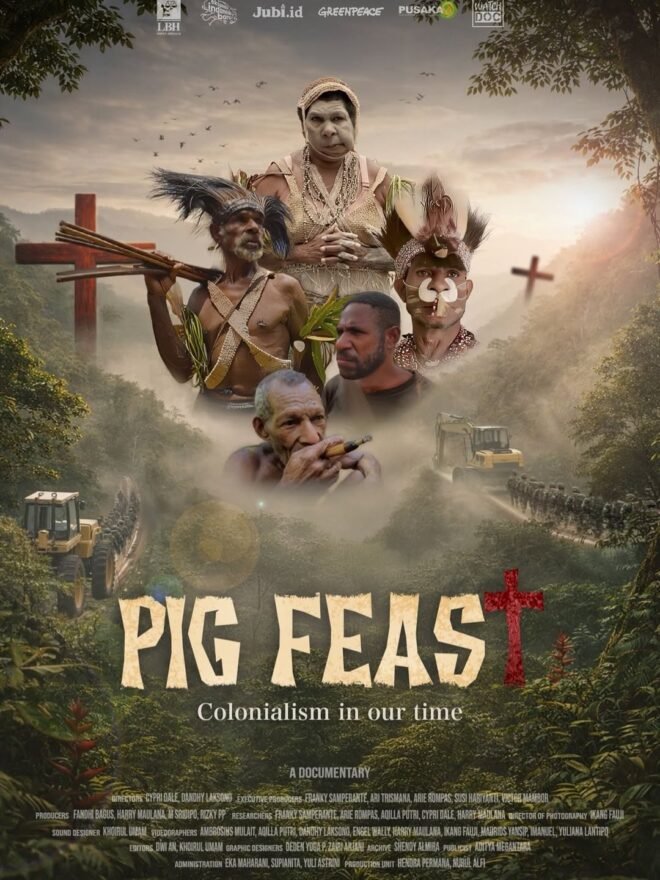
A Screening That Never Happened
On the evening of 7 May 2026, several hundred students gathered in a lecture theatre at Mataram University on the island of Lombok, West Nusa Tenggara. They had come to watch a documentary. Before the projector could be switched on, university security personnel and administrators moved through the room and ordered everyone to leave. No explanation was offered beyond a vague appeal to order. Five days later, on the other side of the Indonesian archipelago, a similar scene unfolded at Khairun University in Ternate, North Maluku. Soldiers from the local military district command entered a student activity building, physically blocked the projector, and dispersed dozens of students who had gathered to watch the same film. The official justification this time was more specific: the gathering, authorities said, lacked a permit and had extended beyond the university’s normal operating hours.
Two campuses, two disruptions, one documentary. And they were not isolated. Speaking to Radio New Zealand in late May, the film’s director said his team had by then logged more than thirty separate incidents of state apparatus – overwhelmingly the military, working alongside civil servants invoking “public order” – intervening to stop screenings, out of roughly 1,700 locations where the film had been showing nationally. Tempo magazine’s reporting adds texture to that tally: students in Surakarta, Central Java, resorted to watching the film in secret in a boarding-house room rather than risk organising a group screening, for fear of reprisal. The Catholic news service AsiaNews reported that a Jesuit priest in Yogyakarta confirmed a planned public screening there had been quietly cancelled after officials applied pressure. And Indonesian outlets reported that a screening at a state senior high school in Tanah Datar, West Sumatra, was called off after the State Intelligence Agency contacted the school principal directly.
It is worth being precise, at the outset, about what is independently verifiable here and what rests on the filmmakers’ own account. The existence of the Mataram and Khairun disruptions is corroborated across multiple outlets, including photographic and video documentation from the Khairun screening. The overall count of “more than thirty” incidents comes from the production team itself, reported without independent verification by RNZ; it should be read as the filmmakers’ own tally rather than a court-tested figure, even though no outlet covering the story – including those sympathetic to the government – has offered a competing count or disputed that the disruptions were numerous.
The film at the centre of this pattern is Pesta Babi: Kolonialisme di Zaman Kita – Pig Feast: Colonialism in Our Time. What it depicts, and why a nation-state has mobilised its military and its intelligence apparatus against a 95-minute documentary rather than simply letting it screen, is a case study worth sitting with carefully. It is also, for readers of this publication, hard not to recognise. The shape of what is happening in Papua, and the shape of the state’s response to anyone trying to look at it directly, will be uncomfortably familiar to anyone who has followed the history of Indigenous dispossession and institutional self-protection in this country.
What Pesta Babi Actually Says
Directed by the investigative journalist Dandhy Dwi Laksono and the anthropologist and filmmaker Cypri Paju Dale, and produced in partnership with Ekspedisi Indonesia Baru, Greenpeace Indonesia, Jubi Media, LBH Papua Merauke, Pusaka Bentala Rakyat and Watchdoc, Pesta Babi premiered in Auckland, New Zealand, on 7 March 2026, before travelling to Australia and then into Indonesia itself. It combines investigative journalism with historical and anthropological research to document the experience of Indigenous communities – principally the Marind, Kwipalo and neighbouring peoples of South Papua’s Merauke, Boven Digoel and Mappi regencies – as they attempt to hold onto customary forest land against an accelerating wave of deforestation, land appropriation and militarisation carried out under the banner of the national government’s Strategic National Projects, or PSN.
The specific PSN driving much of the destruction the film documents is the so-called food estate programme, an initiative to convert vast tracts of Papuan forest into industrial-scale palm oil, sugarcane and rice plantations in the name of national food security. The documentary situates this programme within a longer history of resource extraction, military presence and land seizure in Papua stretching back roughly six decades, since the territory’s contested incorporation into the Indonesian republic. Its title draws on Awon Atatbon, a Muyu customary ritual in which pigs function as a central social and cultural symbol; the metaphor, as the anthropology outlet AsiaNews explained in its coverage, is that the destruction of Papua’s forests is simultaneously the destruction of the cultural fabric that depends on them. Across the region the film covers, Indigenous landholders have responded by erecting large wooden crosses and traditional barricades – reportedly numbering at least 1,800 – as both physical obstruction and spiritual assertion of ownership over land now claimed by plantation concessions.
The film’s central argument, articulated directly by Laksono in comments reported by multiple outlets, is that the language of colonialism belongs not only to a closed historical chapter involving European maritime empires but to the present conduct of postcolonial states toward peoples within their own borders. Indonesia, itself a former Dutch colony and a nation that has built part of its founding identity on the story of throwing off colonial rule, is according to the film rarely examined through that same lens when it comes to its own conduct in Papua. Land appropriation, resource extraction and militarised enforcement, the film contends, have not diminished since Indonesia’s assumption of authority over the territory; they have intensified, and are now occurring at a scale without precedent in the region’s history.
This is not a small claim, and it deserves to be treated as a claim rather than as settled fact – the film is advocacy journalism with a clear thesis, made by people who are open about their sympathies, not a neutral government audit. But the underlying facts it draws on – the scale of the food estate clearing, the presence of military units attached to PSN sites, the documented resistance of customary landholders – are independently reported by Indonesian and international outlets, and the Indonesian state’s own reaction to the film has done more to validate its central claim about institutional discomfort with scrutiny than almost anything the filmmakers could have staged themselves.
The Pattern Of Disruption
What makes the Pesta Babi story more than a film review is the systematic character of the response to it. According to a Jakarta Post analysis published on 30 May, which traced the sequence location by location, the first reported shutdown occurred on 27 April at Pendidikan Mandalika University in Mataram. It was quickly followed by cancellations at Mataram University itself, at the State Islamic University in Mataram, at the Bali Indonesia Art Institute, and – most widely documented, because photographs and video circulated of a military officer physically standing in front of a projector – at Khairun University in Ternate on 12 May. Separate reporting from Tempo and the news aggregator APSN places an earlier Ternate intervention on 8 May, when personnel from the 1501/Ternate Military District Command shut down a screening and discussion organised by the Alliance of Independent Journalists and a society of environmental journalists. The district military commander, Lieutenant Colonel Jani Setiadi, was quoted by Tempo justifying that action by citing unspecified social media complaints that the film was “provocative,” and by warning that questions of ethnicity, religion and race were especially sensitive in North Maluku – an argument that, notably, treats a documentary about deforestation and land rights in a different province, thousands of kilometres away, as a live sectarian threat to a region it does not concern.
In several cases the disruption came not from the military directly but from university administrations acting, according to the Jakarta Post’s reporting, under what students and civil society groups characterised as informal pressure rather than any written directive – precisely the kind of arrangement that allows a state to produce a chilling effect while maintaining formal deniability. In at least one case, the West Sumatra school screening, the intervention came from Indonesia’s State Intelligence Agency contacting a principal directly, according to reporting picked up by the Asia-Pacific solidarity network APSN. Taken individually, each incident admits of an official, narrowly bureaucratic explanation: no permit, wrong hours, unspecified public order risk. Taken together, and given the consistency of timing, target selection and justification across a documentary that had no history of provoking unrest before this release, the pattern points toward coordinated discouragement rather than a series of unconnected local administrative decisions.
The Government’s Case, Taken Seriously
Before explaining why the pattern reading is the more persuasive one, it is worth stating the government’s defence in its strongest form, because a publication that only steelmans arguments it already agrees with is not doing analysis. Three points deserve credit on their merits. Campuses genuinely do require permits and impose operating-hour restrictions independent of this film, and Coordinating Minister Yusril Ihza Mahendra’s written statement, reported by Tempo, that not every scheduled screening was stopped and that the Mataram obstacles were administrative rather than directed, is checkable and not obviously false – some screenings did proceed without incident. Army Chief of Staff General Maruli Simanjuntak’s account to the House of Representatives, that no direct instruction travelled from central command to local units, is plausible on institutional grounds: militaries are large and poorly centralised in the moment-to-moment sense, and a district commander does not need to wait for a signed order from Jakarta to decide unilaterally that a gathering poses a risk. And the film’s own credibility is not beyond question – reporting from late May indicated that Yasinta Moiwend, the Marind Anim woman whose account opens the documentary, had publicly distanced herself from it. The available English-language coverage does not establish her reasons, and this publication is not positioned to adjudicate a dispute inside a community it does not belong to on the strength of second-hand reporting, but her distancing has been used by the film’s critics as evidence that its portrayal of Papuan experience is less settled than the filmmakers present, and that deserves registering rather than passing over.
None of that, taken individually, is unreasonable. What breaks the government’s case is the combination of these points with the pattern itself: the same permit-and-hours justification recurring across geographically dispersed campuses with no prior history of security concern, arriving in the same three-week window, alongside interventions – the Ternate military shutdown, the intelligence agency’s call to a school principal – that cannot plausibly be filed under routine process. A state’s explanation does not need to be false in every instance to be misleading in aggregate; it needs only to be offered selectively, defending the cases where it holds while staying silent on the cases where it plainly does not. This is also, on its own terms, a carefully constructed position: Yusril has said repeatedly that no instruction to prohibit screenings was issued, and the absence of a paper trail is not the same as the absence of a pattern. A state does not need a formal, signed order for a chilling effect to be produced and sustained. It needs only for local officials to understand that intervening against a particular kind of speech will not be punished, and may be rewarded – and for a minister to then observe, accurately, that no such order exists in writing.
Some Indonesian commentary has made close to this argument. Tempo’s editorial board wrote that the military has no legal authority to halt a film screening, still less by force, and characterised the pattern across more than twenty locations as a violation of constitutionally guaranteed expression. The Jakarta Post’s analysis, cited above, made the related observation that the explanations offered shifted according to which institution was doing the explaining, without ever converging on a coherent account of what, precisely, justified intervention. Neither outlet is fringe or oppositional; both sit inside Indonesia’s mainstream press, which is itself a sign of how far this reaction has strained credulity within the country’s own establishment.
A Familiar Shape, Made Concrete
Blak and Black was founded in 2010 with West Papua as one of its first international commitments, and it is worth being explicit about why a documentary censorship story out of Indonesia belongs in a publication whose central preoccupation is First Nations justice and institutional accountability in Australia. It is not simply geographic proximity, although the fact that Papua sits closer to Darwin than Jakarta does to much of its own eastern territory is itself a reminder of how colonial-era borders continue to determine whose dispossession gets called by that name and whose does not. It is that the mechanics on display in the Pesta Babi story are not unique to Indonesia, and the parallel is stronger, and more specific, than a general family resemblance.
Two Australian precedents make the point concretely rather than gesturally. In May 2020, Rio Tinto destroyed the Juukan Gorge rock shelters in the Pilbara – a site with 46,000 years of continuous occupation and demonstrated genetic links to present-day Traditional Owners – while acting entirely within permission it had lawfully obtained under Western Australia’s then-current Aboriginal Heritage Act. The subsequent parliamentary inquiry found no single unlawful order and no one criminally liable; responsibility was instead diffused across a company that had followed the letter of an approvals process, a state government that had granted the approval decades earlier under a different regulatory regime, and a federal government with no power to intervene after the fact. The site was destroyed and, in the narrowest legal sense, nobody had broken any law – the same structure Indonesia is deploying now: a chilling, or in Rio Tinto’s case irreversible, effect produced without anyone needing to sign an order that could later be pointed to as proof of intent.
The second precedent concerns press freedom directly. In June 2019, Australian Federal Police executed search warrants against the ABC’s Sydney headquarters over its Afghan Files reporting on alleged war crimes by Australian special forces, and against News Corp journalist Annika Smethurst over her reporting on proposed domestic surveillance powers. The AFP insisted, accurately in a technical sense, that it was following normal warrant procedure in response to referrals over unauthorised disclosure, not suppressing journalism. No minister ordered the raids; no law was bent to conduct them. And yet the chill across Australian reporting on military and security conduct was unmistakable, and was treated as such by press freedom organisations here and internationally. The formal deniability was real. So was the outcome it produced.
Consider the structural elements shared across all three cases, Indonesian and Australian alike: a documented pattern of harm to Indigenous or accountability interests, carried out under the banner of a national priority – food security, a mining approval, an intelligence referral – framed as being in the interests of the country as a whole; an administrative or security apparatus that responds to scrutiny not by contesting the underlying facts but by acting to prevent people from encountering them; and a government position, offered afterward, that carefully avoids issuing any single order that could be pointed to as proof of coordinated suppression, while nonetheless producing a coordinated effect. The parallel should not be overstated – Indonesia’s use of active-duty soldiers to physically block a projector inside a university is a starker instrument than a search warrant or a heritage approval, and reflects a more direct willingness to deploy force against civilian assembly than either Australian case involved. But the underlying governance logic, the mechanism by which harm is produced while accountability is dispersed, is the same pattern this publication has spent years documenting in relation to the ACT Government and the Australian Federal Police, and in the broader Australian institutional habit of managing Indigenous grievance and inconvenient journalism through procedure rather than through honest reckoning.
This is precisely the reframing that Dandhy Laksono says was the point of the film’s title. Colonialism by European maritime powers is comfortably located in the past by nations that were themselves colonised; it becomes much harder to look at once the frame is turned toward a postcolonial state’s own conduct toward peoples within its recognised borders, or, for that matter, once it is turned toward a settler state’s conduct toward the peoples whose land it continues to occupy. Indonesia’s government has responded to that reframing not with a counter-argument about the food estate programme’s merits, but with soldiers standing in front of projectors. That response is itself close to an admission. States that are confident their conduct will survive scrutiny do not generally need to prevent people from watching a documentary about it.
Precedent And Pattern
It is also worth noting that this is not the first time Laksono’s work has drawn this kind of institutional reaction, because a single incident of censorship can be explained as an overreaction by one anxious official, while a pattern across a career cannot. His 2019 documentary Sexy Killers, an investigation into the coal industry’s political connections, generated significant controversy on its release just before a presidential election. His 2024 film Dirty Vote, examining alleged irregularities in that year’s presidential election, was viewed by millions online within days and drew sharp criticism from figures aligned with the incoming government. Pesta Babi is, on this reading, not an aberration but the latest instalment in a body of investigative work that has consistently provoked disproportionate official discomfort – which is itself a form of evidence about what that work is getting right.
The stakes extend beyond Indonesia’s domestic politics. As one Singapore-based commentary observed, the scale of forest conversion documented in the film represents one of the largest deforestation programmes attempted anywhere in the world in recent history, financed and enabled in part by international development finance and food-security funding. For the multilateral institutions and foreign investors underwriting Indonesia’s food and energy transition, the question the film poses is not a comfortable one: whose food security is actually being secured, and at whose expense. A state that responds to that question by shutting down university screenings has not answered it. It has simply confirmed that it does not want the question asked in public, in a room full of its own citizens, where the answer might be discussed rather than managed.
What The Streisand Effect Cannot Fix
Several Indonesian commentators have noted, with something close to grim satisfaction, that the campaign against Pesta Babi has produced exactly the effect that campaigns of this kind reliably produce: heightened curiosity, wider circulation, and a documentary that has now generated more coverage because of the attempts to suppress it than it likely would have on the strength of its content alone. That is true, and it is worth taking some encouragement from it. But it should not be mistaken for a solution to the underlying problem, and this publication has made that mistake’s opposite error too many times to repeat it here. The Streisand effect gets a film watched. It does not, by itself, stop a bulldozer clearing customary forest in Boven Digoel, and it does not reverse the decision by a lieutenant colonel to treat a screening in Ternate as a threat to public order rather than as an exercise of a constitutionally protected right. Attention is not accountability. It is, at best, a precondition for accountability that a state then has to be forced, through sustained pressure, to actually deliver – just as public attention on Juukan Gorge produced a parliamentary inquiry and a formal apology from Rio Tinto, but did not return the site, and reform of the underlying WA heritage laws took years to legislate even after the destruction was universally condemned.
What Pesta Babi has achieved, at minimum, is to make the pattern visible and to make Indonesia’s official denials visible alongside it, in a way that puts the burden of explanation squarely where it belongs. A government that insists there has been no ban, while soldiers block projectors in front of assembled students and intelligence officers phone school principals, has chosen a form of words over a form of conduct. Readers of this publication will know exactly how long that gap between the official record and the lived experience of the people affected by it can be sustained, and exactly how much work – legal, journalistic, and simply persistent – it takes to close it. The students who gathered at Mataram and Ternate did not get to watch their film that night. But they know now, with more certainty than they had before, precisely what their government is afraid they might see.
– – –
Bakchos is the founder of Blak and Black, an Australian media and advocacy platform established in 2010. Bakchos writes from the intersecting perspectives of Wiradjuri heritage, Jewish identity, and humanism.
© Bakchos, August 2026




Zionists are attempting the same kind of censorship in Australia.
Guys I was hoping that the comments would focus on West Papua, it seems not.
Let’s not forget that Zionist Israel is a colonial aggressor, not only in Gaza and the West Bank, but also in Lebanon and Syria, how many of its neighbours has Israel attacked and Invaded in the last three years? Yet Israel is always the victim. No explanation needed.
Make no mistake about it Kelly, Indonesia is a colonial power, doing what all colonial powers do, exploit and destroy.
The problem with Indonesian authorities distancing themselves from the military censorship of Pesta Babi twofold: either the soldiers sent rogue and must by disciplined, or the government is lying. Failing any discipline of the soldiers, I think we have the answer.
The thing about colonialism is that it strips the colonised of their dignity and their humanity. For the coloniser, It’s all about exploitation. It always has been and it probably always will be.
Indonesia is just another colonial power oppressing indigenous people. It’s a plague in the Pacific..
Raping and pillaging that’s all that colonialism is, raping and pillaging. It has been from the dawn of time, and will undoubtedly remain that way until time ceases. I just hope this species doesn’t manage to leave planet Earth, and spread its vile throughout the universe..