
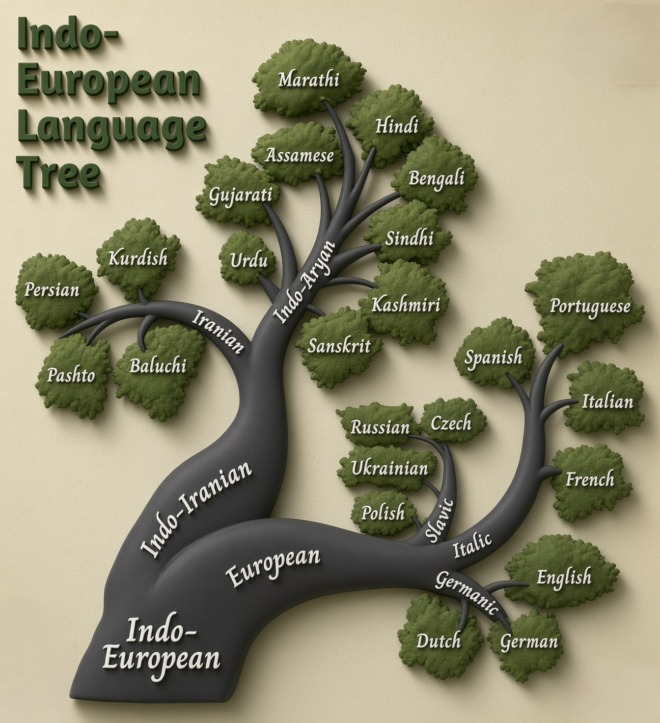
A logical assessment of a tongue-in-cheek question about language, folklore and the Indo-European inheritance
The Question and Its Question Mark
At the end of yesterday’s post, “The Oldest News: Procne, Philomela, and the Greek Inheritance”, I promised that today’s essay would be called “What If We’re All Indian After All?” I meant it as a provocation, and I put the question mark on the end of it because I knew from the start that the evidence could not carry the weight of the claim. It was a tongue-in-cheek reply to those who attack the sheer scale of Indian migration: if the peoples of Europe and the peoples of India belong, in some sense, to one great family, then the stranger at the door is a very distant cousin, and the alarm is a little misplaced.
A joke can survive being false. An essay cannot, and so this one sets out to do what the joke skipped. It will state the claim precisely, test it against what linguists, geneticists and folklorists have actually found, and see what is left standing. I can give the result in advance. The literal claim, that Europeans are Indian in origin, fails, and it fails on every line of evidence we have. A much weaker claim, that India has left real marks on European tradition, is well supported. Between the two sits a middle claim, that Indians and Europeans share a deep common inheritance in language and in some of their stories, and it is the hardest of the three to assess and by far the most interesting. The evidence is not sufficient to drive the point I was joking about. It is not entirely lacking either, and the gap between those two statements is where the real subject lies.
It helps to set the three claims out so that each can be tested on its own terms. The strong claim says that India is the homeland of the Indo-European peoples, so that the rest of us are, at some remove, Indian. The middle claim says that the Indo-European peoples descend, at least in part, from a common ancestral community that lived somewhere else, and that Indians and Europeans have each inherited something from it, in their languages, their gods and perhaps their tales. The weak claim says that India has contributed to European culture through contact, translation, trade and migration over many centuries. A logical assessment has to keep these apart, because the evidence for the weak claim is routinely smuggled in to support the strong one, and that sleight of hand is precisely what makes the joke a joke.
A Discovery in Calcutta
The idea that Europe and India are related did not begin as a joke. In 1786 Sir William Jones, a judge in Calcutta and a gifted philologist, told the Asiatic Society of Bengal that Sanskrit, whatever its antiquity, bore a closer resemblance to Greek and to Latin, in both its verbal roots and its grammar, than could be explained by accident, and that the three had probably sprung from a common source which might no longer exist. Anyone can check Jones’s observation against a single page of vocabulary. The Sanskrit pitar, the Greek patēr and the Latin pater are the same word, and so are the Sanskrit dyaus pitā, the Greek Zeu pater and the Latin Iūpiter, which preserve, in three languages, the same invocation of a Sky Father. The Vedic dawn goddess Uṣas, the Greek Ēōs and the Roman Aurora are one figure under three names. Fire is agni in Sanskrit and ignis in Latin, and the horse is áśva in Sanskrit and equus in Latin.
Notice what Jones actually claimed. A common source that may no longer exist is a relationship between siblings, not a line of descent from India to Europe. But the nineteenth century was not content with siblings. Sanskrit was so old, so elaborate and so transparent in its grammar that many scholars were tempted to treat it as the parent, and the Romantic imagination did the rest. The Brothers Grimm, gathering their household tales, came to see them as battered fragments of an ancient Indo-European mythology. Max Müller, who did more than anyone to popularise the comparative study of the Veda, read the same inheritance in the solar myths of the ancient Aryans. Müller deserves credit for one thing in particular: he insisted that “Aryan” was a term of language and not of race. His warning was ignored, and the consequences, in the racial theories of the following century, were catastrophic. Any essay on this subject has to hold the line he drew. A language family is not a race, and a shared story does not make a shared bloodline.
There was also a rival school, and it is the one that makes today’s joke respectable. In 1859 the German Sanskritist Theodor Benfey introduced his translation of the Panchatantra, the great Indian collection of fables and tales, with the argument that many of the tales of Europe had originated in India and travelled west by translation and retelling, rather than descending from a common ancestor. The inheritance school of the Grimms and the diffusion school of Benfey argued for generations, and in a sense they are arguing still. W. R. Halliday, in Indo-European Folk-Tales and Greek Legend (1933), took the view that a substantial body of shared plots belonged to a common Indo-European stock, and that Greek legend was itself part of it. So the nineteenth century had its own version of my question. The twenty-first has better tools for answering it.
What the Words and the Genes Say
The strong claim, that India is the Indo-European homeland, can be dealt with quickly, because it is the one claim that every independent line of evidence contradicts. Begin with language. Sanskrit is ancient, but it is not the most conservative member of the family in its sound system. Where Greek keeps the three short vowels e, o and a apart, Sanskrit has merged them into a single a, and a language that has lost distinctions is more likely to be downstream than upstream. The reconstructed vocabulary of the parent language, Proto-Indo-European, includes words for the horse, the wheel and the wagon, and describes a culture of herders with wheeled transport, which is not a natural portrait of the cities of the Indus Valley. The so-called Out of India theory, which does place the homeland in the subcontinent, has no support among historical linguists and none from ancient DNA.
The genetic evidence, which has transformed the debate in the last decade, tells the same story. In 2019 a large team led by Vagheesh Narasimhan and David Reich published ancient DNA from 523 individuals who lived across Central and South Asia over eight thousand years. The people of the Indus Valley Civilisation and the outliers from sites in contact with it carried no detectable ancestry from Steppe pastoralists. That ancestry reached South Asia in the first half of the second millennium BCE, and its profile matches the one found in Bronze Age eastern Europe, which is to say that the two ends of the Indo-European world were reached by movements out of the same Eurasian steppe. Today it contributes up to roughly thirty per cent of the ancestry of some South Asian groups, mixed with older ancestries from the Iranian plateau and from South Asia itself. The authors concluded that these movements were likely conduits for the spread of Indo-European languages into the subcontinent. This is the point at which the joke has to concede. The arrow runs into India, not out of it. If we want a founding population, it was not Indian: Indians and a great many Europeans are each descended in part from the Steppe pastoralists of the Yamnaya horizon, who lived between roughly 3300 and 2600 BCE. The argument over the ultimate homeland is not entirely closed. A 2023 study led by Paul Heggarty proposed a hybrid model, with a homeland south of the Caucasus around 8,100 years ago and the steppe as a secondary centre, and it has drawn criticism from other historical linguists. But no serious model in that debate puts the homeland in South Asia. An honest version of the joke would have to be called “What If We’re All Steppe After All?”, which has less charm and rather more truth. It would also need a footnote, because not every Indian speaks an Indo-European language. Tamil, Telugu and the other Dravidian languages belong to a different family, so the kinship at issue concerns a large part of India and not the whole of it.
The Evidence from Folklore
The middle claim, that there is a deep common inheritance, is where folklore enters. Anyone who reads fairy tales across languages meets the same puzzle: the same plots turn up from Iceland to India. The traditional explanation was diffusion, the slow passage of stories along trade routes, through migration and by way of literary contact in the medieval and early modern periods. More recent work has revived the possibility of a deeper vertical inheritance, in which tales descend with languages in the way that genes descend with families. The question is whether that possibility is genuine.
The decisive step was methodological. In 2016 Sara Graça da Silva and Jamshid Tehrani borrowed the tools of evolutionary biology. They coded the presence or absence of 275 international tale types, the “Tales of Magic” numbered ATU 300 to 749 in the Aarne–Thompson–Uther index, across fifty Indo-European-speaking populations, and set the pattern against published language trees. The reasoning is simple. If a tale spreads by contact, neighbours should share it. If it descends with a language, linguistic relatives should share it even when thousands of kilometres apart. They found that 100 of the 275 tales were significantly associated with the language tree, and that for 76 of them common descent explained the distribution better than geographic proximity. In many cases neighbouring societies were less likely to share a tale than more distant linguistic relatives, an outcome that pure diffusion struggles to explain.
Ancestral-state reconstruction then asked how far back the conserved tales reach. Fourteen of the 76, including Beauty and the Beast, had at least an even chance of belonging to the common ancestor of the western branch of the family. Four had a probability of fifty per cent or more of being present in Proto-Indo-European itself, and one of them, ATU 330, “The Smith and the Devil”, received an 87 per cent probability of being present at the root of the tree. Its core plot is stable from India to Scandinavia: a metalworker bargains with a malevolent supernatural being for the power to join materials together, then uses that power to trap the being and escape the bargain. The archaeological and linguistic record makes the reconstruction plausible rather than anachronistic. The Yamnaya and related steppe societies practised copper metallurgy, the ancestral language had a reconstructible word for metal, and metalworkers held elevated status. A story about a cunning smith is not an implausible product of that world.
A parallel study by Tehrani in 2013 supplies a useful check on the method. He analysed 58 variants of the Little Red Riding Hood complex, coded for 72 plot variables, and the analysis recovered Little Red Riding Hood (ATU 333) and The Wolf and the Kids (ATU 123) as distinct lineages rather than as scholarly conveniences. It showed that African tales sometimes grouped with Red Riding Hood belong instead to the Wolf and the Kids, and that the East Asian Tiger Grandmother tales are hybrids rather than ancestral forms. It also dated the Wolf and the Kids to roughly the first century CE, with Red Riding Hood branching off about a thousand years later, a result consistent with the earliest surviving version, an eleventh-century Latin poem from Liège. The importance of this for our purposes is that the method does not return “ancient” for everything. It can say that a tale is young, and that is what gives its verdicts of antiquity some credibility. Red Riding Hood, whatever its charms, is not a Bronze Age inheritance.
Folktales are not the only evidence of vertical inheritance, and they are not the strongest. The comparative study of poetic language, above all the work of Calvert Watkins, rests on actual words and not on plots. The Greek kléos áphthiton in the Iliad and the Vedic śrávas akṣitam both mean “imperishable fame”, and they match word for word and in the same arrangement, which is hard to explain except as a phrase inherited from the poets of a common ancestral tradition. The myth of a hero or a storm god who slays a serpent, found in the Vedic Indra, the Greek Zeus and Typhon, the Norse Thor and the Hittite storm god, appears to preserve an inherited formula that can be reconstructed as “he slew the serpent”. This brings us back to where yesterday’s post began. The poetic language of Homer and the poetic language of the Rigveda draw, in a precise and demonstrable sense, on a stock that is older than either of them. The oldest news, it turns out, is older than Greece.
Where the Evidence Runs Out
Now comes the discipline. None of this amounts to a claim that the whole Indo-European folktale corpus is an unbroken inheritance from a single Bronze Age homeland. In the 2016 study the large majority of the tales, 175 of 275, showed no significant association with the language tree at all, and even among the conserved tales confidence declines sharply toward the deepest nodes. Of the four tales that reached the root with a probability of fifty per cent or more, only one survived the strictest statistical scrutiny, and Tehrani himself has said that this was the one the authors felt absolutely confident about. Horizontal transmission, literary influence and the independent invention of similar motifs under similar social conditions remain active processes, and the study was designed to separate them from inheritance, not to abolish them.
Critics have also pressed particular weaknesses. The folklorist John Lindow of the University of California, Berkeley, pointed out that the Proto-Indo-European vocabulary for metalworking was limited and that a word for “smith” may not have existed, in which case the version of the tale in the study could be younger than the root of the family. There is a related difficulty with the metal itself. Early steppe metallurgy was a matter of copper, not true tin-bronze, so a reconstructed word for metal is not yet a word for a smith. Either factor could push the crystallisation of ATU 330 a few centuries later than the absolute root of the language family without destroying the broader pattern, but they do mean that the Bronze Age date should be held with some modesty.
There are limits of design as well. The Aarne–Thompson–Uther index is the product of a largely European tradition of collecting, and its coverage is uneven across societies. The sample contained only Indo-European-speaking populations, so by itself it cannot show that a tale is specifically Indo-European and not simply widespread across Eurasia, and further work with non-Indo-European comparison groups, denser motif-level coding and refined language-tree dating can continue to test the result. Language relatedness and contact history are also never perfectly separable, since peoples who share a language have often shared neighbours and trade. The statistical controls reduce that problem without abolishing it.
One further limit is logical, not statistical. Even if a tale was inherited, it was inherited with a language and not with blood. A Gaelic speaker or a Bengali speaker who tells a story from the Indo-European world received it from the community in which they were raised, not from a particular ancestor, and most of the genetic ancestry of most Europeans and most Indians comes from populations that were not Steppe pastoralists at all, who adopted the language later or were absorbed into the societies that spoke it. The stories follow the language. At its most generous, the folklore can show that speakers of related languages share an old store of narrative. It cannot show that they are one people. That is why Müller’s distinction matters, and why the strong form of the joke fails even where the middle claim succeeds.
The Part of the Joke That Is True
The weak claim, that India has contributed to European culture, is the one on which the joke can legitimately stand, and the evidence for it is as good as anything in folklore. The Panchatantra was composed in Sanskrit and translated into Middle Persian in the sixth century at the court of Khosrow I, by the physician Burzoy, who is said to have travelled to India to obtain it. From Persian it passed into Arabic in the eighth century as Kalila wa Dimna, the work of Ibn al-Muqaffa‘, and from Arabic into Syriac, Greek and Hebrew. In the thirteenth century John of Capua rendered a Hebrew version into Latin, and from Latin it flowed into the vernaculars of Europe. La Fontaine acknowledged his debt to the Indian sage Pilpay in the preface to his second collection of fables. This is diffusion, carried by translators, courts and merchants, not by ancestry, and it is exactly the process that Benfey described.
Benfey was right about the route and wrong about the cargo. The same phylogenetic study that finds a deep inherited core also finds that most tales are better explained by later diffusion from many directions, of which India was one among several. His mistake was to suppose that nearly everything came from a single source. His insight, that the Sanskrit story collections were a major reservoir and that tales travel by translation as readily as by descent, has survived.
There is one other place where the question has a literal answer. The Romani language is an Indo-Aryan language, and genetic studies of the European Romani trace their ancestry to north-western India, which their forebears left roughly fifteen centuries ago. For the Roma of Europe the answer to “What if we’re all Indian after all?” is, in the plainest sense, yes, in part. They arrived with their own words and their own stories, and for centuries they were met with the same suspicion that has greeted nearly every newcomer to every country. It would be a strange irony if the oldest strand of Indian presence in Europe were also the one most persistently treated as alien.
What the Question Can and Cannot Settle
Put the layers together and a stratified history emerges. At the deepest level, a modest set of plots, most notably the smith who outwits a demonic being, together with certain formulae of poetry and the names of some gods, appears compatible with vertical transmission from late Proto-Indo-European or early Indo-European societies on or near the Pontic–Caspian steppe. These may preserve cultural memories of metallurgy, social hierarchy and cosmology that were already current there. At intermediate depths, further tales were elaborated and stabilised within the major branches, Celtic, Germanic, Balto-Slavic and Indo-Iranian, and carried outward with the expansion of their languages. At the surface, the large residual stock that so impressed Halliday is the product of centuries of medieval and early modern contact, including the long traffic of stories from India. The evidence for each layer differs in strength, and I have tried to keep them apart.
So, are we all Indian after all? No. The homeland was not in India, the genetic and linguistic evidence runs the other way, and the folklore evidence, even at its most generous, points to a shared ancestral tradition and not to an Indian one. But neither are we strangers. Speakers of Indo-European languages in India and in Europe speak sibling languages. They invoke, in their oldest poetry, a Sky Father by the same name, and some of the stories told to children in both places may be among the oldest things human beings still say. Add the medieval flow of tales from India to Europe and the arrival of the Roma, and the notion that Indian culture is foreign to the European inheritance begins to look very thin.
What the evidence cannot do is settle the political argument that prompted the joke. How many people a country should admit, and at what pace, with what provision for housing, infrastructure, wages and social cohesion, is a question of policy to be argued on its own evidence, and an honest opponent is entitled to say that ancient kinship is neither here nor there. I agree, and the point cuts both ways. No one’s claim to belong in a country should depend on the genealogy of a folktale, and no one’s claim to exclude others should depend on the supposed purity of a culture that has never been pure. What the evidence does speak to is the narrower and more corrosive claim, sometimes made in the heat of that debate, that some peoples are strangers to us in some deep and ancient way. It is one thing to argue about numbers. It is another to treat a people as foreign when the oldest words in our own prayers, and perhaps some of the oldest stories in our own nurseries, are ones we share with them.
Yesterday I followed a swallow and a nightingale out of Greek myth and into Shakespeare, Keats and Eliot, and the lesson was that almost nothing in our literature is as new as it looks. Today’s lesson is its companion: almost nothing in it is as local as it looks either. The question mark stays at the end of the title, where it belongs. We are not all Indian after all. But we are cousins, in a language and in a handful of stories whose roots go back some six thousand years, and a good deal of what we tell one another has been travelling between our peoples for much longer than any of our nations has existed.
Sources
Benfey, T. (1859). Pantschatantra: Fünf Bücher indischer Fabeln, Märchen und Erzählungen. Leipzig: Brockhaus.
Graça da Silva, S. and Tehrani, J. J. (2016). Comparative phylogenetic analyses uncover the ancient roots of Indo-European folktales. Royal Society Open Science, 3(1), 150645.
Halliday, W. R. (1933). Indo-European Folk-Tales and Greek Legend. Cambridge: Cambridge University Press.
Heggarty, P. et al. (2023). Language trees with sampled ancestors support a hybrid model for the origin of Indo-European languages. Science, 381(6656), eabg0818.
Jones, W. (1788). The third anniversary discourse, on the Hindus (delivered 2 February 1786). Asiatick Researches, 1.
Mendizabal, I. et al. (2012). Reconstructing the population history of European Romani from genome-wide data. Current Biology, 22(24), 2342–2349.
Narasimhan, V. M. et al. (2019). The formation of human populations in South and Central Asia. Science, 365(6457), eaat7487.
Science News (2016). No fairy tale: origins of some famous stories go back thousands of years (reporting John Lindow’s comments on the “smith” vocabulary).
Tehrani, J. J. (2013). The phylogeny of Little Red Riding Hood. PLoS ONE, 8(11), e78871.
Watkins, C. (1995). How to Kill a Dragon: Aspects of Indo-European Poetics. New York: Oxford University Press.
– – –
Bakchos is the founder of Blak and Black, an Australian media and advocacy platform established in 2010. Bakchos writes from the intersecting perspectives of Wiradjuri heritage, Jewish identity, and humanism.
© Bakchos, November 2026
BLAK AND BLACK | MEDIA AND ADVOCACY | EST. 2010




So no more curries for Paula. Que Sera, Sera!
Bakchos, this reads like part of your thesis on the “One Story” that every other story comes from. I always found that to be an intriguing story in itself, but I’m still not 100% convinced.