
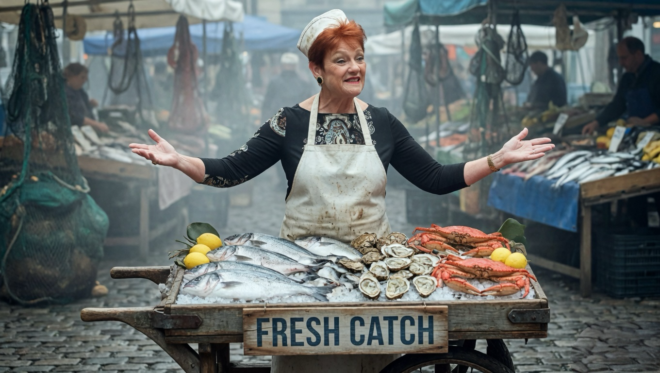
I. THE FISHMONGER AND HER CART
In a valley between two mountains, where the river ran cold through twelve months of the year and the mornings smelled of brine and gutted fish and the particular exhaustion of people who have always lived close to the earth, there lived a red-haired fishmonger. She was not the poorest of her village, nor the richest, nor the wisest, nor the most foolish. She occupied that peculiar middle ground that history fills with its most useful instruments: people who know just enough to be dangerous and not quite enough to be free.
Her cart was of good solid wood, repaired so many times that every plank was from a different tree. She had inherited it from her mother, who had inherited it from hers, and so the cart carried the weight not only of fish but of generations of women who had risen before dawn and gone to bed with sore hands and the smell of the river on their hair. This might have been a source of dignity. In the red-haired fishmonger’s hands, it became a source of grievance.
She sold bream and perch and eel and, in the autumn, when the great silver fish came upriver, she sold those too, and the coins she collected were honest coins earned by honest labour. But the red-haired fishmonger had a hunger that no amount of coin or mackerel could satisfy. She did not want merely to be – she wanted to be better than. Not better in the sense of improved. Better in the sense of elevated above. There is a difference, and it matters enormously, though the people who feel this hunger rarely pause to examine it.
She was, in the language of the valley, a woman of narrow field. Her eyes were good only for the distance between her cart and the next stall. Her ears were tuned only to the gossip that circulated within the village square. The mountains on either side she had never climbed. The river she had never followed to its source. She knew the price of fish at every stall but had never wondered what lay beyond the ridge that ringed her world like the rim of a bowl.
And so she began, as small minds often do when the world refuses to reward them sufficiently, by making the world smaller for everyone else.
— – —
II. THE ART OF THE WHISPER
It began with the people of the next valley.
They were not much different from the people of her valley. They fished the same river, worshipped at similar shrines, told their children the same kinds of stories at night when the fire burned low. Their accents tilted slightly differently at the end of a sentence, and they seasoned their fish stew with an herb that did not grow on this side of the ridge. These were the differences. They were not large.
But the red-haired fishmonger was a gifted translator of the ordinary into the sinister. They steal, she told her neighbours, in the careful voice of someone sharing a confidence. Their fish are inferior – you can see it in the colour. Their children have strange eyes. And their herb, that herb they put in everything, what is that herb? What kind of people need an herb like that?
The neighbours, who were tired and afraid in the way that tired and afraid people always are – afraid of the winter, afraid of the river running low, afraid of the cough that would not leave old Marta’s chest – found in the fishmonger’s whispers a gift of the worst kind: a name for their fear. Now the fear had a face, and the face lived across the ridge, and this was almost a relief. An unnamed fear is infinite. A named one has edges, and edges can be pushed against.
So they listened. And then they passed the whispers along, as neighbours do, adding their own small ornaments along the way, because a whisper that arrives exactly as it departed is a whisper no one trusts. It must grow slightly in the telling to feel true.
The fishmonger noted the success of this first experiment with the satisfaction of a scientist whose hypothesis has been confirmed. She expanded her work.
The valley beyond the next, she explained, was worse still. Their fishing methods were destructive – everyone knew this. They took more than the river could give. And the village beyond that, perched on the hill, the one whose smoke rose in a slightly different colour at dusk? Something strange happened there at night. She could not say exactly what. But one heard things.
One always hears things, when one is listening for them.
The circle of the world she offered her neighbours grew smaller and smaller, tightening like a fist, until all that was safe and good and worthy was the length of her own fish cart, and everything beyond it was shadow and threat and the wrong kind of herb. She did not think of this as cruelty. She thought of it as clarity. She was helping her neighbours to see.
She did not notice that her own shadow, cast long by the low winter sun, stretched all the way to the ridge and beyond.
— – —
III. THE CARRIAGE THAT HAD NO HORSES
One evening in the cold blue hour between the market closing and the first stars, as the red-haired fishmonger sat in her small house counting her coins by lamplight and rehearsing her latest collection of grievances, a sound came from the road outside that had no name in the vocabulary of the valley. It was a sound of metal and velocity, something between a groan and a shriek, and it stopped directly in front of her door.
She opened the door and found a carriage that had no horses. It gleamed like something that had never been touched by weather, by mud, by the ordinary friction of the world. Its surfaces were the colour of a mirror, and in them she could see herself distorted – taller, thinner, more significant – which was, she would later understand, entirely intentional.
From the carriage stepped a woman of the west.
She was tall in the way that people are tall when they have never had to make themselves small for anyone. She was dressed in grey that had no visible seams, grey that cost more than the fishmonger’s cart and the fishmonger’s house and several years of her fish combined, grey that had been chosen by someone who understood that the most expensive colour in the world is the one that pretends not to be a colour at all. Her hair was pulled back with the severity of someone who has long since stopped performing femininity for the benefit of observers. Her eyes were the colour of a transaction.
She smiled the smile of someone who has rehearsed it in many mirrors and found it effective in many countries.
Dear red-haired fishmonger, she said, I have been watching you from afar, and I am impressed.
The fishmonger straightened. She smoothed her apron. No one – not in forty-three years of selling fish, not in a lifetime of being the loudest voice in a small square – had ever said that to her. Not once. The word impressed opened something in her chest that she had not known was closed.
I can give you sacks of magic coins, the billionaire continued, settling herself into the fishmonger’s best chair without being invited, which is the particular privilege of those who have never needed an invitation. And I can give you a flying machine – sleek and silver, faster than anything you have imagined – so that you may travel as peasants only dream of travelling.
She paused. She was skilled at pauses. They were part of the rehearsed performance.
All I ask, she said, is that you keep doing what you already do so naturally. The whispering. The pointing. The lovely, efficient work of making people afraid of one another. You have a gift for it. I would be foolish not to cultivate that gift.
And more, she added, leaning forward so that her grey perfume – something cold and mineral and expensive, the smell of distance – filled the small room. I will introduce you to the Orange King of the North.
The fishmonger’s breath caught in her throat.
— – —
IV. THE ORANGE KING
Everyone had heard of the Orange King of the North, though few had seen him and fewer still had understood him. He was famous above all things for his digging: great, thunderous excavations of the earth, whole mountains reduced to rubble, whole rivers redirected, whole landscapes emptied of their ancient contents and turned into the raw material of his relentless commerce. He dug and he sold what he dug and he dug again, and the earth beneath the north had grown hollow in the places where he had passed through it like a slow catastrophe.
He was famous also for his lying, which was not the ordinary lying of ordinary men – the small social lubricants, the polite evasions, the kindly fictions – but a lying of such scale and such confidence that it had long since ceased to feel like lying at all, even to those who knew it was. He lied about the size of his digging operations. He lied about the health of the rivers he had redirected. He lied about his intentions and his histories and the nature of his marriages, of which there had been several, each abandoned with the same ease with which he abandoned a mine when it was exhausted.
He performed valour the way that bad actors perform grief: loudly, from the chest, with one eye always on the audience and the other on the exit. He had never been in a real fight in his life, but he spoke of strength constantly, because strength was the currency his followers understood, and he was, above all things, a man who understood currencies.
But he was powerful. Magnificently, terrifyingly, undeniably powerful. And power, the fishmonger had always understood, is the only merit that the powerless cannot argue with.
You will no longer be a peasant, the billionaire promised. You will stand beside the Orange King at his great rallies. You will be photographed with him in rooms that have gold on the walls and no windows, because windows let in a world that such rooms prefer to ignore. You will be someone – not in the way you have always quietly hoped, in the village square before the eyes of people who knew you when you smelled of eel – but in the way that matters, before cameras and crowds and the vast anonymous roar of people who have been told who to admire.
The red-haired fishmonger, who had spent her whole life being no one of consequence, said yes before the word had fully formed in the air between them.
She did not ask what the billionaire wanted in return. This was the first of her failures. The second was believing that the answer would have been comprehensible to her even if she had.
— – —
V. WHAT THE BILLIONAIRE WANTED
The billionaire from the west did not want the fishmonger. She was a tool, and tools are not wanted – they are used. The billionaire had a workshop full of such tools, in various shapes and sizes and nations, each selected for its particular fitness to a particular task.
She did not want the Orange King, not as a person, not as an ally in any meaningful sense. She wanted the machine they made together – the whispering and the pointing, the manufactured fear, the daily production of division – because division was the most efficient instrument she had ever found for the protection of her interests. And her interests were geological in their scale and patience.
She had interests in the digging. Not the Orange King’s digging specifically, though that was useful too. Her interests were in the burning of what was dug up from beneath the earth – the ancient compressed darkness, the carboniferous millennia, all the dead things that had slowly become energy over timescales the human mind was not designed to hold. She had interests in the selling of what was burned, and in the systems that had grown up around the selling, vast and arterial, threading through every economy on the surface of the earth.
These interests were threatened by attention. Not by opposition – opposition could be managed, had been managed for decades with considerable skill. What threatened them was simple, sustained, collective attention. People looking at the same thing together for long enough to understand what they were seeing.
A people who hated their neighbours did not look up. This was the fundamental insight on which the billionaire’s political investments rested, the axiom from which all strategy descended. Fear directed sideways never accumulated into the critical mass of clarity required to look upward. And what was upward? The sky, the thickening air, the numbers that the scientists kept publishing in journals that most people did not read. The coral gone white as bone beneath waters that were measurably, undeniably, warmer than they had ever been in the long memory of the fish that swam in them.
The bees. The bees had grown quiet in the orchards. This was not a metaphor. The bees were dying, and the orchards would follow, and after the orchards something else, and after that something else again, in the long patient chain of consequence that the earth does not interrupt for the convenience of those who prefer not to follow it to its conclusion.
But people who were busy hating the next valley did not think about bees.
The red-haired fishmonger, with her magic coins jingling in their sacks and her silver flying machine waiting on the road outside, was the billionaire’s finest recent acquisition. She had authenticity – the authenticity of genuine smallness, genuine grievance, genuine inability to see beyond the length of her cart. She could not be detected as a plant or a puppet because she was not, quite, either of these things. She believed what she said. That was what made her so valuable. The most effective instrument of division is always the one that does not know it is being used.
— – —
VI. THE FISHMONGER FLIES
And so the fishmonger flew.
She flew from valley to valley in her silver machine, and everywhere she landed she brought the gift she had always brought, only amplified now by velocity and reach and the strange authority conferred by arrival from the sky. She pointed at the people of this valley and whispered to the people of that one. She sat in the flying machine between stops and counted her magic coins and practised her speeches, and the speeches grew smoother and more confident the further she flew from the river where her mother had taught her to gut a fish.
At the great rallies where the Orange King performed his valour, she stood on stages she could not have imagined in her previous life, before crowds that stretched back into the dark beyond the reach of the lights. She spoke about threat and intrusion, about the valleys being overwhelmed, about the strange herbs and the different eyes and the smoke that rose the wrong colour from the hills. The crowds roared. The Orange King nodded beside her with the gravity of a man who has discovered that gravity is useful. The cameras recorded everything.
She did not think about the river. She did not notice when its name stopped appearing in her dreams. She did not notice the mornings when her fish cart – still stored in her old house, tended by a neighbour who had not been offered a flying machine – sat in the early light without her, patient as something that has been abandoned but does not yet know it.
The people below her, in the valleys she crossed and recrossed on her silver routes, grew afraid and angry in the ways she had always known how to produce. They looked sideways, at their neighbours, at the people across the ridge, at the smoke from the distant hills. They did not look up. She was up there, and she was one of them, she said so constantly, and they believed her, which was the most extraordinary trick of all – that someone in a silver machine, paid in magic coins, introduced to kings, could stand before a crowd and say I am one of you, and be believed.
While behind her, and beneath her, and in the silences that the noise of her machine prevented anyone from hearing, something very old was failing.
— – —
VII. THE WITHDRAWAL
Mother Gaia does not rage. This is the thing that those who wait for her to rage do not understand. They wait for the dramatic gesture, the unambiguous signal, the moment that cannot be denied or reframed or argued with. They wait for it because they know it would be manageable – tragedy is always more manageable than the slow erosion of what was once taken for granted.
But she does not rage. She withdraws.
The river in the valley between the mountains ran a little thinner each spring, and then a little thinner still, and the old people who remembered how high it had come in their childhoods did not speak of it because speaking of it made it real, and there was already so much that was real that one preferred not to add to the inventory. The fish grew fewer and then fewer again, and the fishmongers of the valley adjusted their prices and their expectations and told themselves it was a cycle, it was always a cycle, the river had been low before.
The bees were quiet in the orchards. Not gone, not yet – but quiet in the way that things are quiet before they are gone, with the particular quality of a silence that has replaced a sound.
The seasons arrived at the wrong times, hesitantly, as if uncertain of their welcome. Summer came early and stayed too long. Autumn apologised briefly before yielding to a winter that was milder than it should have been, unsettlingly so, mild in the way that a fever is mild when it has burned through its first violence and settled into the slow chronic work that is harder to treat.
The people of the valley – busy looking sideways, busy being afraid of the people across the ridge, busy adding their ornaments to the whispers the red-haired fishmonger had taught them – did not notice that the world itself was withdrawing around them, inch by inch, season by season, in the patient arithmetic of a system that had been running the same calculation for longer than any human institution had existed to record it.
The billionaire noticed. She had instruments for this – not the instruments of care, but the instruments of calculation. She knew the timelines. She had read the reports that her investment in division was designed to prevent others from acting upon. She had made her arrangements accordingly: the compounds in the places that would remain temperate longest, the agricultural land in the latitudes that would remain viable when the latitudes around them had ceased to be, the water rights purchased quietly over many years in places whose aquifers would still be full when the rivers of the valleys had become the rivers of memory.
She was somewhere else entirely, as she had always planned to be.
— – —
VIII. THE MORNING AFTER
And one morning the river was gone.
Not all at once – it had been leaving for years, incrementally, politely, in the way that things leave when they have been given no reason to stay. But one morning the fishmonger, back in the valley between the mountains for reasons she could not have fully articulated – the magic coins had dwindled, the flying machine had been recalled, the Orange King had moved on to other instruments – looked out at the place where the river had run and found it had become a memory with gravel in it.
The fish were gone with the river. The cart stood in the empty square where the market had been, and the market had been gone for two seasons now, because what is a market when there is nothing to sell and no one with coins to buy it? The village was quieter than it had ever been in the fishmonger’s lifetime. Some families had left for the valleys beyond the ridge – the same valleys she had spent years teaching her neighbours to fear. She wondered, briefly and uncomfortably, whether they had been received.
She stood at the edge of what had been the river and held her sacks. The magic coins had turned out, in the end, to be quite ordinary coins, and the ordinary coins had run through her hands the way coins run through the hands of those who have never been taught the patience that wealth requires because they were only ever meant to be spent, not kept. She was left with the sacks themselves, which were good quality – the billionaire had not skimped on the sacks – and a set of skills that the new landscape did not require.
She knew how to whisper. She knew how to point. She knew how to take a tired person’s unnamed fear and give it a name and a face and a direction. These were not useless skills, precisely – the world would always have a place for them, somewhere. But they were not skills that would bring the river back, or fill the market square, or restore the quiet industry of the bees to the orchards that stood now in a silence so complete that it pressed against the ears like something physical.
She stood there a long time, the red-haired fishmonger, in the ruins of the world she had helped to unmake. The mountains on either side of the valley were still there – mountains are patient, they outlast most things – but they looked different now, or perhaps she looked at them differently, now that there was nothing between her and them, no cart, no coins, no silver machine, no rehearsed speeches, no roaring crowd. They were very large. She was very small. This had always been true but she had not allowed herself to feel it.
She thought, for the first time in many years, about the herb the people of the next valley put in their fish stew. She thought about the strange quality of the smoke that rose from the hill hamlet at dusk. She thought about the children with the different eyes, who had looked at her from their doorways as she passed on her silver routes and whose expressions she had translated, without examining them, as hostility, because hostility was the language she had been speaking for so long that she had forgotten there were others.
She thought that they might have been expressions of simple curiosity. Or recognition. Or the uncomplicated openness of children who have not yet been taught which valleys to fear.
She was not certain. She had spent too long translating the world into a single register to be easily certain of anything else. But she stood there at the edge of the dry riverbed and felt the thought the way you feel a bone that has healed wrong – the wrongness of it preceding the understanding of what the right might be.
— – —
IX. WHAT THE BILLIONAIRE KNEW
The billionaire from the west knew all of this would happen. Not the specific details – the exact morning, the precise configuration of gravel where the river had been – but the shape of it, the broad contours, the inevitable direction.
She had not caused the river to dry up. She wished to be clear about this, in the internal accounting she kept of her actions and their consequences – an accounting that was meticulous in some areas and strategic in its omissions in others. She had not caused the warming that had thinned the snowpack on the mountains and reduced the summer melt that fed the river and the river’s children. She had merely declined to prevent it, which is a different thing, and she had invested considerable resources over many years in ensuring that as many other people as possible also declined to prevent it, which is different again from causing it, she felt, if one applied the right framework.
She was somewhere temperate and well-watered, in one of the compounds she had acquired quietly over the years. The walls were thick and the gardens were irrigated from a deep aquifer that had been assessed by reliable geologists. She had food. She had people around her who were skilled and well-compensated and whose continued wellbeing depended on her continued wellbeing, which was a structure she found more reliable than affection.
She did not think often about the red-haired fishmonger. Tools, once broken, are not thought about. They are replaced or they are not, depending on whether the task continues to require them.
She thought sometimes about the bees, in the way that people think about things they know they should feel more about than they do. The bees had been the first indicator – the scientists had said so, years ago, in the reports she had funded other efforts to obscure. They were a canary, the scientists said, and the billionaire had understood the metaphor and its implications and had chosen, with full information and careful calculation, to continue.
She had made her arrangements. She was comfortable.
Mother Gaia does not rage. She withdraws.
And the billionaire, in her compound with its thick walls and its deep aquifer and its carefully compensated staff, found that the world outside the walls was withdrawing too, season by season, in the patient arithmetic that does not stop for compounds or calculations or the particular kind of comfort that money purchases but cannot, in the end, fully provide.
She was somewhere else entirely.
Until she was not.
— – —
© Bakchos 2026




Written in a style that feels post-2016 / post-2024, the fable captures the real-world dynamic of culture-war populism being used (or perceived to be used) as a shield for continued fossil-fuel dependence and delayed climate action. The “sideways hatred” vs “upward clarity” framing is a direct response to the observed correlation between heightened political tribalism and stalled environmental policy in many Western democracies.
Bakchos has written a 21st-century Aesopian fable that is both beautifully crafted and politically incendiary. It rewards multiple readings — first for the story, second for the allegory, third for the quiet sorrow beneath the critique. The river is already thinning; the question the fable leaves us with is whether we will keep looking sideways until it is gone.
A red-haired fishmonger in a remote valley begins spreading whispers of fear and suspicion about neighbouring villages. Her small resentments are noticed by a powerful billionaire from the West, who offers her wealth, a private flying machine, and access to the “Orange King of the North.” The fishmonger becomes a travelling agitator, amplifying division on a massive scale. While ordinary people focus on hating their neighbours, the natural world (the river, the fish, the bees, the seasons) quietly collapses. In the end, both the tool (fishmonger) and the user (billionaire) confront the consequences of the world they helped unmake.
The fable is unusually transparent in its symbolism, which is part of its power:
• The Red-Haired Fishmonger?Symbolises the authentic-seeming populist agitator — the local voice who genuinely believes her grievances. She is not a cartoon villain; she starts from real, modest resentments (“narrow field,” inherited cart, “hunger… to be better than”). Her red hair and fish-cart represent grounded, working-class authenticity. She is dangerous precisely because she is not a paid actor — she believes what she says, making her the perfect instrument.
• The Billionaire from the West?Represents global elite interests (fossil-fuel, extraction, or finance capital) who fund and amplify division. Her grey, seamless clothing and “cold and mineral” perfume symbolise detached, calculating wealth. She doesn’t hate anyone; she simply needs people distracted so they never look “upward” at the real threat to her empire.
• The Orange King of the North?An unmistakable stand-in for Donald Trump (orange complexion, boastful “digging”/extraction, multiple marriages, theatrical rallies, constant lying presented as strength, “valour performed from the chest”). He is the loud, charismatic front-man who channels the fishmonger’s whispers into mass politics.
• The River, Fish, Bees, Seasons?Direct symbols of the natural world under climate stress. The river’s gradual thinning and final disappearance is Mother Gaia’s “withdrawal” — not dramatic apocalypse, but slow, inexorable ecological collapse. The silent bees are the “canary in the coal mine” (explicitly referenced).
• The Silver Flying Machine & Magic Coins?Private jets, sudden wealth, and media amplification — the tools that turn local resentment into national (or global) political force.
Whether one accepts the fable’s causal chain (billionaires deliberately engineering division primarily to protect carbon interests) is a matter of political interpretation. What is undeniable is that the story diagnoses a real pattern: polarisation reduces collective problem-solving capacity, and environmental indicators (rivers, pollinators, seasons) continue their quiet decline regardless of who is shouting loudest on the stage.
Well kumpel, I don’t know these people, apart from the obvious reference to Trump, but if they recognise themselves they won’t be happy.
The red headed fishmonger is an imbecile.
This is a modern political-environmental allegory written in the classical fable tradition (think Aesop or Orwell’s Animal Farm, but with lyrical prose and nine numbered sections). It uses a simple village setting to deliver a sharp, layered critique of division, populism, elite manipulation, and climate inaction. The tone is melancholy and ironic rather than preachy; the moral emerges slowly through the characters’ self-inflicted downfall rather than a tacked-on moral at the end.
When ordinary people are kept busy fearing one another, they will not notice — or act on — the forces actually destroying the world they live in. Elites who benefit from extraction and pollution have a material interest in cultivating that distraction. In the end, no one (not the populist, not the billionaire, not the king) escapes the consequences of a dying planet.
Mark this is clearly your very own 21st-century Aesopian fable.
Great takedown of the Ginger Whinger.