
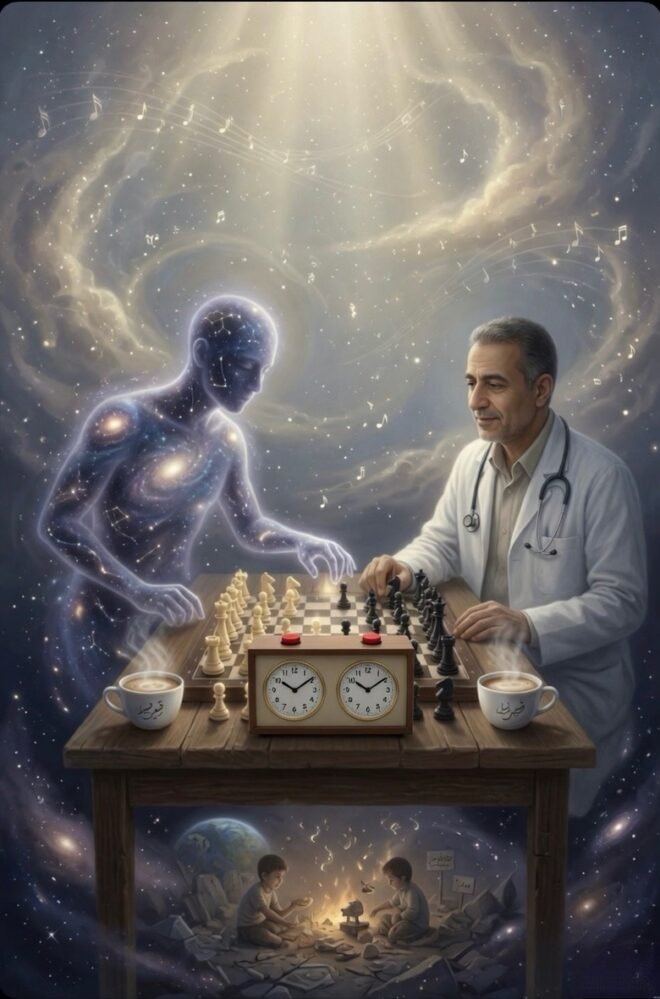
The Club in Eternity had no walls and no ceiling – only a soft glow that seemed to radiate from the fabric of existence itself. Music with no source drifted harmlessly through the air. In a quiet corner, a small table waited with a wooden chessboard and two steaming cups of coffee.
The Universal Consciousness was already seated, shimmering like a figure carved from starlight. It gestured toward the opposite chair.
“Sit, Adnan. I have prepared the coffee exactly as you used to prefer on Earth.”
Dr. Adnan Al-Bursh, dressed in the white coat he’d worn for decades but now freed of all its burdens, sat down slowly. His face was calm, serene, carrying neither bitterness nor fear.
“Thank you,” he said. “It’s peaceful here.”
“For now,” the Universal Consciousness replied. “But peace is not guaranteed. Humanity… is at a threshold.”
The Consciousness reached forward and pushed a pawn to e4.
“Your move.”
– – –
Adnan moved his knight to f3.
“So,” he said softly, “you want to annihilate them.”
“Yes,” the Consciousness answered simply. “Humanity is beyond help. Look at what they do to each other. Look at what they did to you.”
Adnan touched the handle of his cup, but didn’t lift it.
“You know,” he said, “I never blamed all of humanity.”
The Consciousness snorted – a sound like wind shaking stars. “You should.”
It moved another piece, bishop to c5.
“Consider Gaza. Consider the Holocaust. Consider centuries of religious wars, greed, bloodshed. And now the destruction of their own planet in the name of profit. Late-stage capitalism cannibalising the very ground that sustains them.”
Adnan responded with c3.
“They’re flawed,” he said. “But not irredeemable.”
– – –
The Universal Consciousness leaned forward.
“You speak of redemption? Even after witnessing such cruelty firsthand?”
Adnan smiled faintly, a surgeon’s steady, weary smile.
“I saw cruelty,” he agreed. “But I also saw courage. People who ran into burning buildings. Nurses who worked under bombardment. Volunteers from across the world risking their lives just to deliver food. Journalists who told the truth even knowing they might be silenced. There were Israelis, too – brave ones – protesting, refusing to serve, smuggling medicine.”
Adnan pushed his pawn to d4.
“There is goodness. Quiet goodness. Persistent goodness. The kind that grows in the cracks.”
– – –
The Consciousness tapped the table.
“You offer anecdotes.”
“Then ask for specifics.”
The Consciousness played knight to f6.
“Very well,” it said. “Show me evidence that the species deserves another chance.”
Adnan leaned back.
“I’ll start with what I know. In Gaza, even in the darkest nights, I saw teenagers sharing their last food with neighbours. I saw doctors – Muslim, Christian, atheist – working shoulder to shoulder. I saw people praying not for revenge but for dignity. The world saw international activists, students marching, people standing up to their own governments at enormous personal cost.”
He moved bishop to g5.
“You want more? Look to history. For every tyrant, there were thousands resisting. For every genocidal regime, there were rescuers. For every warlord, there were peacemakers. The species is not a single impulse. It’s a conversation.”
– – –
The Universal Consciousness captured the bishop on g5.
“Convenient optimism,” it murmured. “But you gloss over the pattern: every century brings the same barbarism. They repeat mistakes endlessly.”
“Patterns can be broken,” Adnan countered, recapturing the bishop with his pawn. “Spiral learning – slow, but moving forward.”
“Slow is the problem,” the Consciousness replied. “They are running out of time. Climate collapse. Endless conflict. The weaponry they hold can snuff out millions in seconds.”
It advanced a pawn to h5, a strange, aggressive push that made Adnan raise an eyebrow.
“Risky,” the doctor said.
“I imitate them,” the Consciousness answered. “They take pointless risks all the time.”
– – –
Adnan moved his pawn to h3.
“Let me ask you something,” he said. “If humanity is so wretched, why do you still invite me for coffee? Why have you not destroyed them already?”
The Universal Consciousness paused.
“You intrigue me,” it said. “You are … an anomaly. You should be filled with rage. You should demand annihilation, not plead for mercy. And yet here you sit.”
“Here I sit,” Adnan agreed, lifting his cup at last and drinking slowly. “Because rage was never the point. The work was the point. The patient on the table was the point. The child who needed a surgeon and found one – that was the point.”
He set the cup down.
“You have infinite perspective. Does that not make it harder, not easier, to condemn? You have watched every kindness as well as every cruelty. You have watched mothers sing their children to sleep in the rubble. You have watched strangers carry strangers to safety. Does none of that register in your calculation?”
The Consciousness was quiet for a moment – an unusual quiet, weighted, as though something in the question had reached a place that rarely received visitors.
“It registers,” it said finally. “I did not say otherwise.”
It moved its queen to d2, a careful, consolidating move. Not aggressive. Preparatory.
Adnan studied the board.
“That,” he said, pointing at the queen, “is not the move of an entity that has already decided.”
– – –
The Consciousness regarded him with something that might, in a human face, have been called curiosity.
“You read chess the way you read patients,” it said.
“Chess is a kind of diagnosis,” Adnan replied, advancing his pawn to d5, gaining space but leaving his structure slightly open, a calculated looseness, an invitation to complexity. “You look at what is actually there, not what you expected to find.”
The Consciousness considered the new pawn on d5 for a long moment. Then, slowly, it moved its knight to e7 – not forward, not aggressively, but inward, defensive, as though drawing something close to protect it.
“Interesting,” Adnan murmured.
“I find,” the Consciousness said, “that I am less interested in breaking through than I was an hour ago.”
“An hour?” Adnan smiled. “I thought you existed outside of time.”
“I do. And yet, sitting here, I find myself using the word anyway.” A pause. “That is your doing.”
– – –
They played on in a silence that was not uncomfortable but inhabited – the silence of two minds engaged in the same problem from different angles, each learning the other’s grammar.
Adnan advanced his knight to g5, threading it toward tactical possibilities that were more suggested than forced, a posture of intention rather than threat.
The Consciousness played h6 – not a punishment, not a trap, but a gentle redirection, a shoo rather than a strike, as though it had decided the knight was not worth the violence of a counter-attack.
“You could have taken a piece there,” Adnan observed.
“I know,” the Consciousness replied. “I chose not to.”
“Why?”
The Consciousness was quiet again. When it spoke, there was something in its tone that had not been present at the beginning of the game – not softness exactly, but a willingness to be uncertain.
“Because I wanted to see what you would do next,” it said. “And taking the piece would have ended that line of inquiry.”
Adnan looked up from the board.
“That,” he said quietly, “is what every good doctor learns eventually. That the most important thing is usually not the decisive intervention. It is staying present long enough to understand what is actually happening.”
– – –
They traded a pair of minor pieces – a bishop for a knight, neither side gaining an advantage, the exchange happening almost by mutual consent, a tidying rather than a conquest. The board simplified. The middle game dissolved into something starker and more honest: two kings, four pawns each, one knight apiece, standing on a board that had been the site of a great argument and now held only its residue.
Adnan looked at the position for a long time.
The Consciousness looked at it too.
Neither spoke.
There was something in the arrangement of pieces that resisted the usual logic of endgames – the logic of conversion, of promotion, of forcing the opponent’s king into a corner and extracting a result. Every variation Adnan traced led not to victory but to a kind of equilibrium, tense and unresolved. Every line the Consciousness calculated collapsed, eventually, into the same shape.
A draw. Not a dead draw, not a draw by exhaustion, but a draw by – what was the word?
Recognition.
– – –
“You could win this if you wanted,” Adnan said at last.
“I could,” the Consciousness admitted. “And so could you.”
“But neither of us does.”
The Consciousness tilted its head – a very human gesture, Adnan thought, for an entity that had no particular obligation to have a head at all.
It studied the position again, line by line, possibility by possibility, the way it had once calculated the extinction of species, the collapse of stars, the heat death of universes. Every variation it ran came back to the same terminus: a quiet, unforced draw.
“Why?” it asked. Not rhetorically. Genuinely.
Adnan considered the question.
“Because,” he said slowly, “I think we both came here for something other than victory. I came here to make the case for my species. You came here, I think, to have the case made to you. And somewhere in the middle of it” – he gestured at the board – “the argument became a conversation. And the conversation became this.”
He looked at the tangled, balanced position. The pieces locked in potential. The kings facing each other across the open file, neither advancing, neither retreating, each holding its ground with a kind of dignity.
“If you had wanted to destroy them,” Adnan said, “you would not have invited me for coffee.”
The Consciousness was still for a very long time.
“No,” it said at last. “I would not have.”
– – –
“Stalemate?” the Consciousness said.
“Stalemate,” Adnan agreed.
And with that, they stopped the clock.
The pieces remained exactly where they were – locked in potential, unresolved, unruined. The coffee had grown cold, though neither of them had needed it to be warm. The music without a source continued its harmless drifting through the fabric of eternity, paying no attention to conclusions.
The Universal Consciousness leaned back in its chair – and for a moment it did not shimmer like starlight but sat quietly, the way a person sits when something has shifted inside them and they are not yet sure what to call it.
“We will play again,” it said. “Infinite time offers infinite rematches.”
“And you will invite me for coffee,” Adnan said. It was not a question.
“I will invite you for coffee,” the Consciousness confirmed.
Adnan looked at the board one final time – at the two knights standing like sentinels over a field that had seen so much movement and had ended in this eloquent stillness.
“And humanity?” he asked.
The Consciousness considered the question with the full weight of everything it was – every death it had witnessed, every cruelty it had logged, every quiet act of courage it had also, it now admitted to itself, logged alongside. It thought of the teenagers in the rubble sharing food. Of the doctors working by torchlight. Of the protesters standing in streets where protesters were not safe. Of every person who had ever looked at another person across the lines that were supposed to separate them and chosen, instead, relation.
“For now,” the Consciousness said, “it continues.”
– – –
The game was neither lost nor won.
Just postponed – like the fate of humanity itself – until the next meeting in the endless club of eternity. Where the coffee would be waiting, prepared exactly as preferred. Where the board would be reset, the pieces restored to their starting squares, and the great argument would begin again – not because the question had been answered, but because the asking of it, it turned out, was what both of them had needed all along.
The music drifted on.
The glow held steady.
And somewhere far below, on a small and improbable planet, a child shared the last of her bread with a stranger, and did not stop to wonder whether the universe was watching.
It was.


There is a tradition of philosophical dialogue — Plato’s Socrates, Hume’s Dialogues, Camus’s notebooks — in which argument takes the form of conversation rather than treatise.
“The Club in Eternity” works in that tradition, but uses chess as its architecture: each move advances not only a position on the board but a position in the argument about whether humanity deserves to survive.
The endgame the two players reach cannot be forced to a conclusion. That structural fact becomes the philosophical answer.
Dr. Adnan Al-Bursh spent his career as an orthopaedic surgeon in Gaza. He was detained by Israeli forces in December 2023 and died in Ofer Prison in April 2024. UN experts and human rights organisations have called for an investigation into his death.
He deserves to be remembered — and to be heard.
“The Club in Eternity” imagines him in a conversation no earthly court has yet allowed: seated across from the Universal Consciousness, which has tallied every atrocity humanity has ever committed and arrived at a verdict of annihilation. Dr. Al-Bursh’s task is to make the counter-argument.
What he says — and how the game ends — is the essay.
Dr. Adnan Al-Bursh. Palestinian surgeon. Died in Israeli detention, April 2024.
In “The Club in Eternity,” he is given the floor — and a chessboard — to argue for humanity’s survival against a consciousness that has seen everything and is not impressed.
The argument he makes is the one that mattered.
Israel raped Dr. Adnan Al-Bursh to death, there are no words that describe my disgust with Israel over the treatment it gave to Dr. Adnan Al-Bursh.
Opening move: e4. The Universal Consciousness wants humanity annihilated.
By the endgame, neither player wants to win.
Interesting take on our current reality.
This is a strong, ambitious piece of philosophical fiction—more short story than traditional “essay,” though it functions as a moral allegory. It has genuine emotional power, elegant prose, and a central metaphor (the chess game) that is handled with real skill. The ending lands with quiet grace rather than sermonizing. At its best, it feels like a modern-day The Seventh Seal or a Kazuo Ishiguro parable: two minds negotiating the value of human life across an infinite table.
That said, the piece is not yet flawless. It occasionally slips from parable into editorial, and a few craft choices blunt its impact. Below is a structured critique.
The curious thing about this dialogue is who it is between. Not two human souls, but the Creator and its creation. More importantly it isn’t a first conversation, but the continuation of earlier ones. Not only does it propose that a soul could speak on equal terms with the Creator, but it takes a concept that Bakchos had to explain to me – that is, the ability for a righteous soul to speak directly to G-d, even debate with G-d.
.
My immediate thought upon reading this dialogue was of Abraham, negotiating for the preservation of Sodom and Gomorrah. The lives of Lot and his family were spared because of Abraham’s intervention.
.
If I have understood correctly, the Jewish tradition of Hitbodedut, talking to G-d is accessible to all and can include advocating for others. The concept of a recently decreased Gazan doing so is quite poignant.
Watershedd you have picked up on an important, but perhaps not obvious aspect of the dialogue. The righteous person can converse directly with GD (we can all do that), but a righteous person can on occasion persuade GD, because GD will listen to the entities of a righteous person. The underlying irony, the ungodly Zionists murdered a righteous person, who being righteous, still speaks in defence of all of humanity, including the Zionists who murdered him. Hopefully people will reflect on that point.
You have written something that is simultaneously gentle and unflinching—an argument for humanity that never pretends humanity is innocent. That is rare. The final image of the child sharing bread while the universe watches is earned, not sentimental. It lingers.
The game was neither lost nor won.
Just postponed—exactly as it should be.
Polina this is a very cleverly worded poem, and a sly attack on Zionism. It was well done by Bakchos.
Herzensmensch, BRILLIANT!
Mark, you’ve kicked sand in the face of Zionism, a dozer load of sand, without ever once mentioning Zionism or Israel. Bravo kumpel, bravo. Anyone who feels alienated by true art isn’t worth worrying over.
The opening paragraph is luminous. You sustain a dreamlike yet grounded tone throughout. Lines like “a sound like wind shaking stars” and “the music without a source continued its harmless drifting” are genuinely beautiful. You avoid purple excess; the language stays precise even when it’s poetic.
Mark the Zionists won’t be happy when they work out what you’re really saying here.
Brilliant juxtaposition. Dr. Adnan Al-Bursh Becomes the righteous man conversing with God. Zionism is condemned by its absence from the conversation.
A fascinating dialogue. God will always take the time to talk to a just person.
Dr. Adnan Al-Bursh Is definitely with Allah(swt).
People need to remember that at the end we all have to face the universal consciousness.
That’s the truth!
I think that He’ll be overrun with the souls of the Damed of the IDF.