
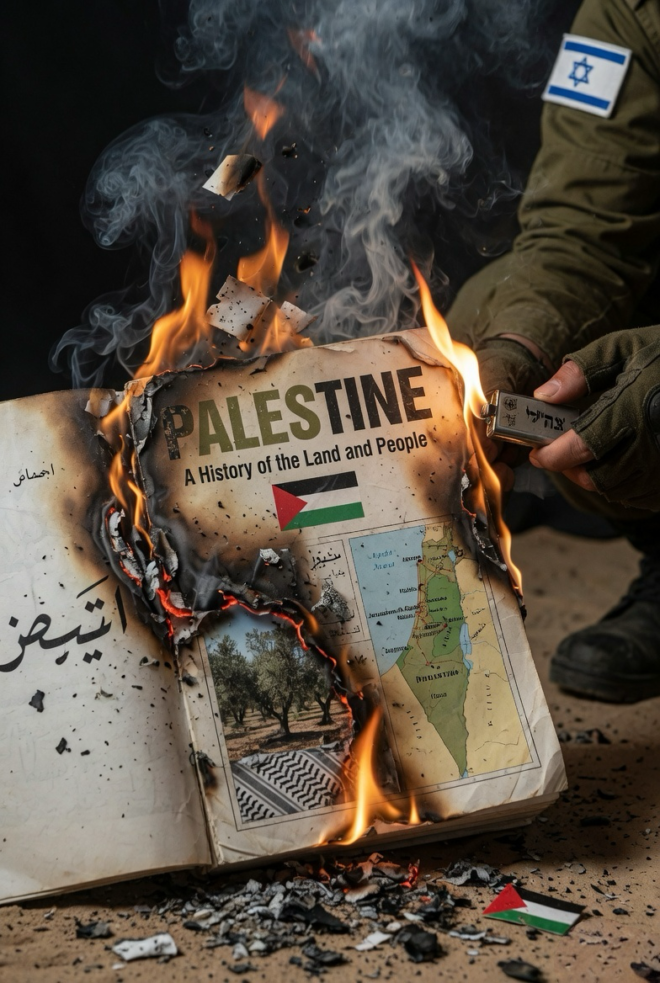
The struggle of man against power is the struggle of memory against forgetting.
~Milan Kundera, The Book of Laughter and Forgetting (1979)~
Where they burn books, they will ultimately burn people also.
~Heinrich Heine, Almansor (1821)~
I. The Library That Burns First
On 9 October 2023, the second day of Israel’s military campaign in Gaza, the Israeli military levelled the library of the Islamic University of Gaza. The following day it bombed the Samir Mansour Bookshop and Library – an institution already rebuilt once, after Israeli strikes destroyed it in 2021. These were among the first strikes of the campaign. That sequencing is not incidental. In the architecture of collective destruction, the library tends to burn before the hospital, before the house, before the person – and the order is diagnostic.
According to a report by Librarians and Archivists with Palestine, at least twenty-two archives, museums, and libraries in Gaza were destroyed, damaged, or looted between October 2023 and January 2024 alone. By 17 January 2024, Al-Israa University – the last remaining institution of higher learning in Gaza – had been demolished by controlled detonation. Its attached National Museum, housing more than three thousand archaeological artefacts, was destroyed in the same operation. The Central Archives of Gaza – containing one hundred and fifty years of historical documentation – were struck in late November 2023. The Edward Said Public Library in Beit Lahia, Gaza’s first English-language library, founded by the poet and scholar Mosab Abu Toha, was confirmed destroyed in January 2025. Abu Toha had already lost the nearly completed manuscript of his novel when his home was burned to the ground.
United Nations experts, in a formal statement of April 2024, documented that over sixty per cent of educational facilities – including thirteen public libraries – had been damaged or destroyed, leaving at least six hundred and twenty-five thousand students without access to education. A further one hundred and ninety-five heritage sites, two hundred and twenty-seven mosques, and three churches had been damaged or destroyed. Before October 2023, Gaza had one of the lowest illiteracy rates in the world – 1.8 per cent – and more than one-third of its population were students. The assault on Gaza’s intellectual infrastructure was not collateral damage to a military campaign. It was an identifiable strand of the campaign itself.
II. Naming It: Scholasticide and Its Scholarly Genealogy
The term used by scholars to describe this phenomenon is scholasticide – the systematic destruction of an educational system and its institutions. The word was coined in January 2009 by Karma Nabulsi, a Palestinian professor of politics and an expert on the laws of war at the University of Oxford, in response to Israeli strikes on Gaza’s educational infrastructure during Operation Cast Lead. Nabulsi combined the Latin schola (school) with the Latin suffix -cide (killing), and used the term to describe what she identified as Israel’s deliberate targeting of the conditions under which Palestinian intellectual life reproduces itself – not only buildings, but scholars, students, and the tradition of learning they sustain.
The term entered academic circulation in 2009, then receded from the lexicon before re-emerging with force in 2024. It has since been developed by scholars including Hajir and Qato, adopted by the American Historical Association – which voted 428 to 88 to condemn it – and invoked by the UN Human Rights Council’s Independent International Commission of Inquiry in its June 2025 report, which found that Israeli attacks on Gaza’s educational, cultural, and religious sites amount to war crimes and the crime against humanity of extermination. The Commission’s chair, Navi Pillay, stated that the evidence pointed toward ‘a concerted campaign to obliterate Palestinian life in Gaza.
Scholasticide is not merely a rhetorical intensification of ‘destruction of schools.’ It names a specific phenomenon: the targeting of knowledge infrastructure as a method of undermining a people’s capacity to persist as a people – to transmit identity, to produce arguments, to train the next generation of those who will make claims about the past and the future. Understood in these terms, scholasticide is a subset of cultural genocide, and cultural genocide – as Raphael Lemkin argued before the ink was dry on the 1948 Convention – is not a lesser form of genocide. It is one of its primary modes.
III. Heine’s Prophecy and Lemkin’s Framework
The essay’s two epigraphs mark the boundaries of the intellectual tradition from which this argument proceeds. Heine’s line – where they burn books, they will ultimately burn people also – was written in 1821 in Almansor, a play about the burning of the Quran during the Spanish Inquisition. It was prophetic in a way Heine could not have fully intended: his own books were among those incinerated by Nazi students on the Bebelplatz in Berlin on 10 May 1933, twelve years before the liberation of Auschwitz. Heine, who was Jewish, identified a logic that operated independently of the identity of victim or perpetrator: wherever the cultural existence of a people is targeted for destruction, the physical destruction of that people tends to follow. The books go first because what they contain – memory, argument, identity, the claim to have existed – is what must be negated before the negation of life can be carried out.
Raphael Lemkin, the Polish-Jewish lawyer who coined the term genocide and drove the drafting of the 1948 Genocide Convention, gave this intuition legal and analytical form. For Lemkin, the destruction of culture was not a prelude to genocide; it was constitutive of it. Physical and biological genocide, he argued, are always preceded by cultural genocide – by attacks on the symbols of the group, by the destruction of its institutions, by the suppression of its language, ceremony, and historical record. To destroy the archive, the library, the university, the museum was to destroy the connective tissue through which a people transmits itself across generations. The body could follow, having been – conceptually, symbolically, legally – already unmade.
Physical and biological genocide, Lemkin argued, are always preceded by cultural genocide. The body follows what has already been unmade in the archive.
Lemkin lost forty-nine members of his family in the Holocaust. His framework was built from that experience – and then, with extraordinary moral discipline, universalised. He described colonialism in the Americas as a form of cultural genocide. He applied the framework without exception. His insistence that no people possesses a monopoly on the protections the framework provides is the ethical spine of international humanitarian law on this question, and it is the ethical spine of this essay.
Kundera arrives at the same place from a different angle. Writing in exile after the Soviet suppression of the Prague Spring, he watched Communist authorities do something more sinister than censor: they airbrushed. They removed people from photographs, erased names from encyclopaedias, replaced the past with a managed absence so smooth it could almost be mistaken for the truth. The struggle of man against power, he wrote, is the struggle of memory against forgetting. What Kundera adds to Lemkin is the phenomenology of erasure – the texture of what it means to have your past systematically removed, not by fire alone, but by the slow, bureaucratic replacement of record with void.
IV. The Historical Pattern: From the Inquisition to Srebrenica
The destruction of a people’s cultural infrastructure as a precondition or accompaniment to their physical destruction is a recurring pattern in the history of power. The Spanish Inquisition burned Arabic and Hebrew manuscripts – the accumulated learning of Moorish and Jewish civilisation on the Iberian Peninsula. The conquistadors burned Maya and Aztec codices: centuries of indigenous cosmology, astronomy, medicine, history, and law, reduced to ash in a matter of years. The Mongol sack of Baghdad in 1258 sent the books of the House of Wisdom into the Tigris; historical accounts record the river running black with ink. The burning of the Library of Sarajevo by Serb nationalist forces in 1992 – which destroyed an irreplaceable collection of Ottoman manuscripts and Bosnian historical records – was a deliberate act of cultural annihilation that preceded and accompanied the genocide of Bosniak Muslims.
In Srebrenica in 1995, the genocide of Bosniak men and boys was accompanied by the systematic destruction of mosques, cemeteries, and civic records – the erasure of traces of a people’s presence from the land. The International Criminal Tribunal for the former Yugoslavia subsequently recognised that the targeting of cultural and religious sites was evidence of genocidal intent: that the erasure of the marks of a people’s existence was integral to the project of eliminating the people themselves. The legal reasoning was Lemkin’s, applied decades after his death.
Australia has its own chapter in this history. The forced removal of Aboriginal children from their families – the Stolen Generations – was explicitly a project of cultural destruction: the severing of the transmission of language, ceremony, law, and belonging across generations. The suppression of Aboriginal languages, the removal of remains to European museums, the destruction of sacred sites: these were not incidental features of settler colonialism. They were its method. The logic is constant across contexts – you unmake the culture before, or alongside, or after you unmake the people – because the culture is what makes the people legible to themselves and to the world as a people with a claim upon the present.
V. Palestine and the Specific Character of This Destruction
What is happening in Gaza since October 2023 fits this historical pattern with a completeness and speed that is, by any comparative measure, extraordinary. Within three months of the campaign’s beginning, nearly every library, archive, and cultural institution in Gaza had been destroyed or severely damaged. The destruction was not random. The Islamic University of Gaza’s library – one hundred and thirty thousand volumes – was among the first targets. The Central Archives of Gaza were specifically struck. Museums with collections reaching to the Canaanite period were obliterated. The UN Commission of Inquiry’s June 2025 report found that more than half of Gaza’s religious and cultural sites had been damaged or destroyed, and that Israeli forces had documented knowledge of the cultural significance of these sites before striking them.
The strategic dimension of archival destruction requires particular attention, because it operates on Palestinian claims to the land as well as on Palestinian identity. The Israeli state has, since 1948, pursued policies that scholars of settler colonialism describe as the erasure of Palestinian presence: the demolition of villages, the Hebraisation of place names, the suppression of the Palestinian narrative in official historiography. In this context, the destruction of Gaza’s archives is not merely catastrophic; it is coherent. It removes the documentary basis of a people’s deep historical rootedness in a territory whose indigeneity they are systematically denied.
The archive is evidence. To destroy it is to attack the evidentiary basis of the argument – not the moral argument, which requires no paper to be valid, but the empirical argument, the claim supported by record and artefact and manuscript.
The destruction of the Edward Said Public Library concentrates this meaning to a point. Said spent his working life arguing, against sustained institutional resistance, for the humanity and the historical reality of the Palestinian people – for their right to be perceived as a people with a culture, a history, and a legitimate claim upon the world’s moral attention. The library that bore his name has been destroyed in the same campaign his work spent decades trying to anticipate and resist. The poet Mosab Abu Toha, who founded it, lost not only the library but his unfinished manuscript and his home. What burns is not only the past. It is the future – the arguments unmade, the manuscripts unfinished, the students ungraduated, the books unread.
VI. The Counter-Arguments and Why They Fail
A serious essay on this subject must engage seriously with the strongest objections to its central claims. There are three that deserve direct attention: the dual-use argument, the proportionality defence, and the moral exception claim grounded in Jewish historical suffering. Each has genuine weight. None survives scrutiny.
The dual-use argument holds that Gaza’s educational institutions were not purely civilian objects, because Hamas made use of them for military purposes – using university buildings as command centres, storing weapons in schools, exploiting civilian infrastructure to shield military activity. The argument has a legal basis: under international humanitarian law, a civilian object that makes an effective contribution to military action and whose destruction offers a definite military advantage loses its protected status. If the Islamic University of Gaza was genuinely a Hamas operational centre, the argument goes, its destruction was lawful.
This argument fails on the evidence and on the law. The UN Commission of Inquiry’s June 2025 report documented one instance in which Hamas used a school for military purposes, and noted that such use constitutes a breach of IHL on Hamas’s part. But it found no comparable basis for the systematic destruction of over ninety per cent of schools and all twelve university campuses. The IDF’s claim that the Islamic University served as Hamas’s ‘operational, military and political centre, also used for weapons development and production’ was not independently verified, and the claim was made retroactively, after the library had already been struck on the second day of the campaign. Under IHL, the burden of establishing military use rests with the attacking party before the attack, not as a post-hoc justification. More fundamentally, the dual-use argument – even where valid for a specific building – cannot account for the systematic, comprehensive destruction of an entire society’s knowledge infrastructure. One building may be a legitimate military target. All twenty-two libraries are not.
The proportionality defence is related but distinct. It concedes that civilian harm occurred, but argues that it was proportionate to the military objectives being pursued – the elimination of Hamas as a military and governing force. Under IHL, a proportionality assessment requires that anticipated civilian harm not be excessive in relation to the concrete and direct military advantage anticipated. The difficulty with applying this framework to the destruction of Gaza’s cultural and educational infrastructure is that the ‘military advantage’ of destroying archives, museum collections, and university libraries is, to put it carefully, not obvious. The UN Commission found that Israeli forces knew or should have known the cultural significance of sites they struck. The pattern of targeting – beginning with the library on day two, proceeding systematically through every institution of learning – is more consistent with the logic of scholasticide than with the logic of proportionate military necessity.
The moral exception argument is the most emotionally powerful and the most important to engage honestly. It holds that the Jewish people, having suffered the most systematically documented genocide in modern history, possess a unique understanding of existential threat and a correspondingly unique entitlement to act decisively against it. The Holocaust creates, on this account, a kind of trauma-derived standing that places Israeli military action in a different moral register. This argument must be taken seriously – because the Holocaust was real, absolutely and irreducibly; because antisemitism remains a living danger; and because the founding of Israel was a response to a genuine condition of desperate vulnerability. To dismiss any of this is to fail the test of historical honesty.
But the argument must then be rejected – precisely on the terms that Lemkin, himself a Jew who lost forty-nine family members to the Holocaust, would have insisted upon. Suffering is not a licence to cause suffering. A people’s historical experience of erasure does not constitute a justification for erasing another people. The logic of the Holocaust, correctly understood, is not that its survivors and their descendants are exempt from the frameworks of international humanitarian law that the Holocaust made necessary. The logic of the Holocaust is that no people may be subjected to the programme – cultural or physical – that was inflicted on the Jews of Europe. The lesson is universal or it is nothing. A universalism that applies to all peoples except Palestinians is not a universalism. It is a hierarchy wearing universalism’s clothes.
A universalism that applies to all peoples except Palestinians is not a universalism. It is a hierarchy wearing universalism’s clothes.
Heinrich Heine – a Jewish poet writing about the burning of Islamic manuscripts by Christian authorities – understood this before anyone had found the words for it. His moral imagination was not bounded by the identity of the victim or the perpetrator. He saw the logic and named it. That remains the only ground on which a serious moral argument can stand.
VII. The World Is Watching
More footage, more documentation, more real-time testimony has emerged from Gaza since October 2023 than from almost any conflict in modern history. Journalists have been killed in extraordinary numbers. Poets, librarians, academics – people whose professional existence is built around the preservation of record – have been killed alongside their records. The International Court of Justice, in January 2024, found it plausible that Palestinian rights not to be subjected to genocide were at risk and issued provisional measures. The UN Commission of Inquiry, in June 2025, found that attacks on cultural and educational sites amount to war crimes and crimes against humanity. The legal language is accumulating. But its accumulation is not the same as its application.
Kundera’s most unsettling observation, in The Book of Laughter and Forgetting, is about the politics of attention: the bloody massacre in Bangladesh covered over the memory of the Russian invasion of Czechoslovakia; the assassination of Allende drowned out the groans of Bangladesh; the Sinai war made people forget Allende; Cambodia made people forget Sinai. The world moves on. Each atrocity is buried by the next. The watching that does not harden into memory is not witness. It is alibi.
The question the current moment poses is whether the extraordinary density of documentation produced in and about Gaza will be allowed to undergo this process – whether the archive being built in real time will be permitted to cover over its own significance as the world moves to the next crisis. The answer is not determined. It depends on what institutions, scholars, journalists, and citizens choose to insist upon. Accountability for cultural destruction – for scholasticide, for the erasure of archives and universities and museums – has an uneven history. It happened at Nuremberg. It happened at the ICTY in the Srebrenica cases. It is not structurally impossible. It requires political will, sustained attention, and the refusal to allow the next event to bury this one.
VIII. What Remains and What We Owe
When the Samir Mansour Bookshop was bombed for the second time – rebuilt after 2021, destroyed again in 2023 – what was destroyed was not only the physical structure and its books, but the meaning of the act of rebuilding. Reconstruction is itself a form of memory: it declares that we were here, we will be here, we refuse the erasure. To destroy it twice is to attack that refusal. It communicates that persistence will not protect a people. That memory will not save them.
This is the civilisational content of what has been done to Gaza’s libraries, universities, and archives. It is a message addressed not to Hamas but to Palestinian society as such: your record is not safe; your past is not safe; your claim to have existed, to have known things, to have built institutions and written poems and graduated doctors and preserved artefacts from the Canaanite period – none of that is safe, because none of it is acknowledged as real, as belonging to a people with the right to persist.
Against this, the only adequate response is the insistence on memory as a practice of resistance. This means documenting what is destroyed and naming what is lost. It means insisting that the record be kept even when the keepers of the record are being killed. It means recognising – on the authority of Lemkin, of Heine, of Kundera, of the legal frameworks built at such cost after the catastrophes of the twentieth century – that the destruction of a culture is not a lesser harm than the destruction of bodies. It is a different expression of the same project. And it means holding simultaneously, without false resolution, two truths: the absolute reality of Jewish historical suffering, and the absolute impermissibility of that suffering being deployed as a warrant for the suffering of Palestinians.
The libraries of Gaza are gone. The archives are gone. The universities are gone. The students who should have graduated are dispersed or dead. What remains is the obligation – historically grounded, morally non-negotiable, legally articulable – to refuse the completion of the erasure. To say: we know what was done. We remember. We will not allow the timbers to fall without record of what was inside them.
Because if Heine was right – and he was – then what happens to the books is the prelude. And if Lemkin was right – and he was – then the destruction of a people’s culture is not a lesser crime than the destruction of their bodies. It is the same crime, in its earlier phase. And if Kundera was right – and he was – then the struggle against the erasure of memory is the struggle against power itself.
The Devil at the Gate
Knock, knock upon the city gate.
“Who’s there?” the guard calls, half-asleep, half-afraid.
“It is I,” comes the answer, “the one you create –
the devil your reason refused to name.”
“Which devil?” he asks. “There are many, they say –
fallen angels and serpents, the father of lies.”
“Not those,” says the voice beneath grey morning skies.
“I am yours. You summoned me. I am the price you will pay.”
No horns and no pitchfork, no brimstone, no flame –
only the mirror you hold to the street,
where greed takes the throne and contempt finds its seat,
and the sport of unmaking the other feels tame.
You built me from silence when silence was sin,
from the careful arithmetic that counted the poor as loss,
from the vow of “never again” carved above the gate
then flung wide for the next wave of horror to cross.
I am not supernatural. I am the sum
of every cruelty performed in the name of the right,
of history drawn like a blade through the dust
to wound those who come after – the children of the children of night.
Yes, I know what was done to you. I was there.
I watched the chimneys, the wire, the long extinguishing.
But suffering grants no licence to darken the living
who had no hand in that furnace, no part in that snare.
So I knock, and I knock – at the gate, at the wall.
You have two choices, and only two:
open the door and let the ruin devour you whole,
or change what you are before the timbers fall.
Because wood turns to dust when conscience is stone,
and the knocking of centuries thins every beam,
and what you refuse to confront will redeem
no one – not them, not you, not even the dead you still claim to own.
© Bakchos, May 2026


The Ben Gvir video alone should be enough for the entire world to impose sanctions on Israel.
I’m waiting for the uptick in faux antisemitic attacks to act as a smokescreen from the latest outrage by Israel.
The central thesis—that the destruction of knowledge infrastructure (“scholasticide”) is not mere collateral but a coherent strand of civilizational destruction, often preceding or accompanying physical harm—is historically grounded in real precedents (Inquisition manuscript burnings, conquistador codex destruction, Library of Sarajevo, Srebrenica cultural erasure). Kundera’s phenomenology of bureaucratic/airbrushed forgetting is well deployed. The piece rightly warns against the politics of attention and the danger that documentation becomes alibi.
“Scholasticide” (coined by Karma Nabulsi in 2009) is a polemical neologism blending “school” + “-cide.” It usefully highlights scale but functions rhetorically to imply genocidal logic without meeting legal thresholds. The essay treats it as descriptive of a distinct phenomenon subset of cultural genocide. Raphael Lemkin did emphasize cultural destruction as constitutive (attacks on language, institutions, symbols, archives), and his framework was universalist. But the 1948 Genocide Convention deliberately narrowed to physical/biological acts with specific intent (dolus specialis) to destroy a group in whole or in part. Cultural destruction can evidence intent but is not standalone genocide under the treaty Lemkin helped shape.
The scale of damage to Gaza’s educational and cultural sites since October 2023 is extensive and tragic:
• All or nearly all universities damaged/destroyed.
• High percentage of schools hit.
• Documented losses of libraries, archives, museums, and heritage sites (LAP report lists ?22; UN/UNESCO figures on religious/cultural sites damaged >50% in some tallies).
• Specific early targeting of the Islamic University library and Samir Mansour, plus later losses including the Edward Said Public Library.
These losses matter profoundly for Palestinian intellectual continuity, future scholarship, and collective memory. Pre-war Gaza had low illiteracy and high student population—real human capital destroyed or disrupted.
Evidence the essay under-engages:
• Hamas has a documented, repeated practice of using universities, schools, mosques, and hospitals for military purposes: weapons storage/production, command centers, training, tunnel networks (including under educational sites like Al-Azhar and Israa University). IDF releases and independent analyses (e.g., FDD, urban warfare experts) show this pattern across conflicts, including pre-2023. The Islamic University of Gaza has longstanding alleged ties to Hamas (weapons development, training, financing claims dating back years; used again in 2023–24 for missile launches and operations). fdd.org
• International humanitarian law permits targeting dual-use objects when they make an effective contribution to military action and offer definite military advantage (with proportionality and precautions). The essay acknowledges one UN-noted Hamas school use but dismisses the broader pattern too quickly. Post-hoc claims are problematic, but so is ignoring pre-existing infrastructure and Hamas’s incentive structure (human shields maximize Palestinian casualties for international pressure while protecting fighters).
• The war began with Hamas’s October 7, 2023 massacre (?1,200 killed, hostages, documented sexual violence) and explicit goal of destroying Israel. Hamas diverts resources to military infrastructure; its ideology (charter elements, statements) rejects Jewish self-determination and has glorified violence.
A UN Commission of Inquiry (June 2025 report, Navi Pillay-linked) did find systematic attacks on educational/cultural sites amounting to war crimes and crimes against humanity (extermination), and later reports escalated to genocide findings. These are cited approvingly. However, such commissions (UNHRC-mandated) have a well-documented track record of disproportionate focus on Israel, limited cooperation from Israel, reliance on unverified or partisan sources, and criticism from governments and monitors (e.g., UN Watch analyses) for one-sidedness and methodological flaws. They are not judicial findings. Israel rejects the mandate and conclusions as biased.
The essay’s rejection of the “dual-use argument” and “proportionality defence” is asserted more than demonstrated against the full evidentiary record. One building being military does not justify all; but comprehensive destruction in a war where the adversary prepared the battlefield by militarizing civilian/educational zones is not self-evidently “scholasticide” rather than the brutal arithmetic of urban counter-terrorism against an enemy that rejects distinction.
Le poème final, « The Devil at the Gate », pose un problème de forme. En lui-même, il est bien construit : le dialogue allégorique fonctionne, la voix est maîtrisée, la strophe sur « I watched the chimneys, the wire » est sincère et sobre. Mais son intégration à la fin d’un essai argumentatif rigoureux crée une dissonance générique. L’essai se clôt sur une phrase qui atteint une puissance rhétorique et morale réelle — « nous nous souvenons, nous refuserons de laisser les poutres tomber sans témoignage de ce qui était à l’intérieur » — et le poème, qui suit, dilue légèrement cet effet. Il aurait peut-être été plus juste de le publier séparément, ou de le faire précéder d’une note éditoriale explicite sur son statut.
L’essai s’organise avec une rigueur rhétorique évidente. Bakchos progresse d’une manière délibérément cumulative : la documentation empirique d’abord, le cadre conceptuel ensuite, puis l’histoire comparative, et enfin l’engagement avec les contre-arguments. Cette architecture reflète une conscience argumentative sérieuse — l’auteur ne se contente pas d’affirmer, il s’efforce de démontrer.
Les deux épigraphes — Heine et Kundera — ne sont pas de simples ornements. Elles structurent le raisonnement central : la destruction culturelle précède et annonce la destruction physique. Ce dispositif fonctionne bien. La reprise de ces deux voix à la fin de l’essai, dans la section VIII, crée une clôture intellectuelle satisfaisante.
Le concept de scholasticide — introduit par Karma Nabulsi en 2009 — est présenté avec précision. L’auteur prend soin de le distinguer de la simple destruction d’écoles, en insistant sur sa dimension systémique : il ne s’agit pas seulement de bâtiments, mais de la capacité d’une société à se reproduire intellectuellement et culturellement. C’est là l’une des contributions analytiques les plus solides du texte.
Merci beaucoup pour cette analyse attentive et nuancée. Je comprends tout à fait la réserve que vous exprimez concernant la dissonance générique entre l’essai argumentatif et le poème qui le conclut. C’est une observation légitime et perspicace.
Cependant, je tiens à défendre ce choix de structure. Le poème n’est pas placé à la fin de l’essai par hasard ou par manque de discernement formel — il y a sa place précisément parce que l’argument, aussi rigoureux soit-il, atteint un point où la prose seule ne suffit plus. La phrase que vous citez, sur le refus de laisser les poutres tomber sans témoignage, est en effet forte — mais c’est justement cette force qui appelle quelque chose de différent, quelque chose qui ne prolonge pas l’argumentation mais qui la *traverse* autrement.
Le poème ne cherche pas à convaincre davantage. Il cherche à *rester* — à laisser une empreinte d’une autre nature, là où le raisonnement s’arrête. La dissonance que vous percevez est peut-être voulue : sortir le lecteur du registre analytique pour l’amener dans un espace plus vulnérable, plus direct.
Je prends néanmoins très au sérieux votre suggestion concernant une note éditoriale. Ce serait peut-être une façon de préparer le lecteur à ce changement de registre sans en atténuer l’effet.