
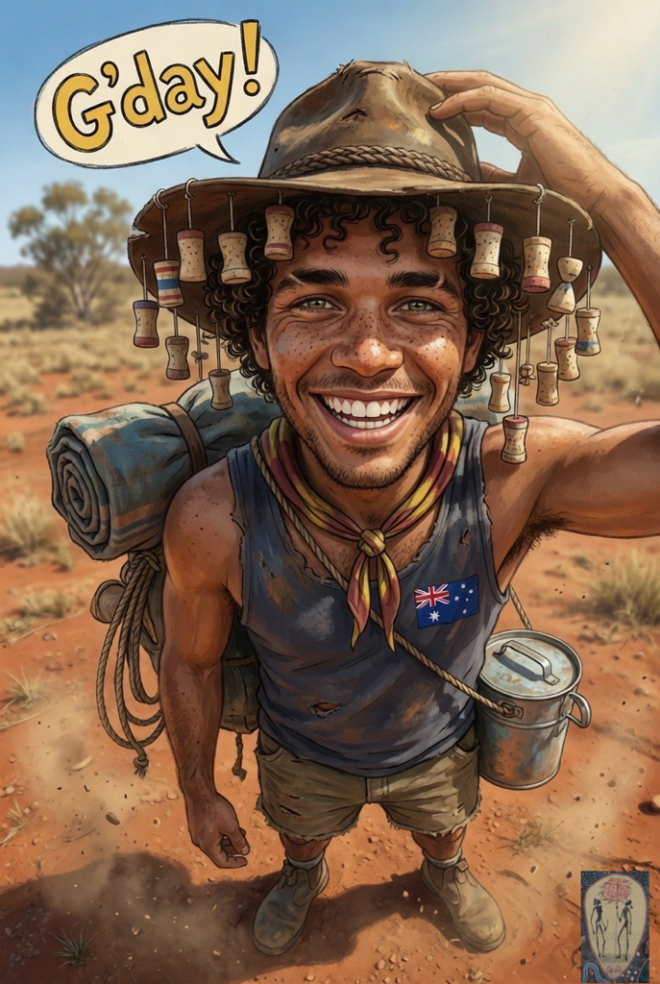
I. G’day
G’day – two syllables, a whole philosophy,
a small word worn smooth by a continent’s hands,
dropped from a thousand throats at the gate,
at the counter, the schoolyard, the red desert sands.
It carries no rank, bows to no one,
equal to beggar and judge and the rain –
the oldest democracy the tongue has invented,
a handshake dissolved into sound, made plain.
II. Ngurambang – Country (Wiradjuri)
Yindyamarra winhanga-nha –
respect the world you are walking through.
Ngurang – home – was here before the word,
before the ship, before the morning dew
had a name in English. Yama – good, yes, good –
the elders said it standing on red clay,
and now the grandson of Erambie mission
hears it inside every bright G’day.
III. Boker Tov – בֹּקֶר טוֹב (Hebrew)
Boker tov – good morning from a people
who carried language across seven seas,
who found in this southernmost country of strangers
a sky that looked like Torah, if you please –
vast, unrolled, demanding to be read.
Shalom means peace and wholeness, hello, goodbye –
we brought it here and set it in the sunlight,
and someone said G’day, and so did I.
IV. Sabah Al-Khayr – صَبَاحُ الخَيْر (Arabic)
Sabah al-khayr – morning of goodness –
spoken in Cairo, in Beirut, in Tyre,
carried across the Indian Ocean in a suitcase
packed with za’atar and a grandmother’s desire
to begin again. Marhaba – welcome –
the syllables open like a door wide.
Now Lakemba rings with both Arabic and cockatoo,
and G’day rides the morning side by side.
V. Buongiorno (Italian)
Buongiorno – buon giorno – beautiful day –
the Italians knew beauty was the right word for dawn,
that morning deserved an adjective, a gift,
not merely the fact of the darkness gone.
They came to Fremantle, to Innisfail and Griffith,
planted vines where the mulga once stood.
Buongiorno became G’day over espresso –
same warmth, different syllables, both good.
VI. Ohayō Gozaimasu – おはようございます (Japanese)
Ohayō gozaimasu – the most formal of mornings,
bowed from the waist, precise as a pine,
a greeting that honours the one who receives it,
that says: your being here is a sign.
From Brisbane to Darwin the Japanese diaspora
folded origami into the flat red earth,
and the schoolchildren learned to say ohayō
and Australians learned what courtesy is worth.
VII. Zǎo Shàng Hǎo – 早上好 (Mandarin)
Zǎo shàng hǎo – the morning is good –
three tones rising like smoke from a kitchen fire,
spoken on the goldfields first, then the restaurants,
then the universities, then the empire
of ordinary life – the school run, the corner shop,
the WeChat message to family overseas.
Two hundred years of Chinese Australia,
and G’day has learned to bow to all of these.
VIII. Namaste / Subah Bakhair – नमस्ते / صبح بخیر (Hindi / Urdu)
Namaste – I bow to the light in you –
palms pressed together, the self made small.
Subah bakhair from Karachi to Parramatta,
good morning called across the suburban sprawl.
Punjab and Gujarat, Mumbai and Lahore
packed their greetings like spice in a jar –
and now the morning smells of chai and eucalyptus,
and G’day carries namaste near and far.
IX. Nyakua / Mālō e Lelei / Ẹ káàárọ̀ (Dinka / Tongan / Yoruba)
Nyakua – greetings in Dinka – came with the lost boys
who were never truly lost, only displaced,
who found in Melbourne and in Adelaide’s suburbs
a morning they had almost ceased to taste.
Mālō e lelei – Tonga’s warm acclamation –
fills Māngere and fills Nuku’alofa alike.
Ẹ káàárọ̀ – good morning in Yoruba –
Nigeria’s gift to every sunrise we might strike.
X. The Chorus – Tharri Ngurambang / G’Day Australia
And so the morning opens like a corroboree –
every tongue a firestick, every voice a flame:
Yindyamarra. Boker tov. Sabah al-khayr.
Buongiorno. Ohayō. Namaste. Subah bakhair.
Zǎo shàng hǎo. Nyakua. Mālō e lelei.
Ẹ káàárọ̀ – and then, beneath them all,
the oldest and the newest word together:
G’day, Australia. Answer when they call.
We are not one voice flattened to a drone,
not one colour bleached beneath the sun –
we are the country that the world has given birth to,
many languages arriving, becoming one.
One nation? Yes – but wide as all its peoples,
deep as the Dreaming, old as the first rain.
G’day, they say. G’day. Good day. Good morning.
The country hears itself and speaks again.
Notes on Language
Yindyamarra winhanga-nha (Wiradjuri): “Respect the world you are walking through.” A foundational Wiradjuri ethical principle, often associated with Elder Uncle Bill Gammage’s teachings.
Ngurang (Wiradjuri): Home, country, place of belonging.
Boker tov (Hebrew: בֹּקֶר טוֹב): Good morning. Shalom (שָׁלוֹם): peace, wholeness, hello, farewell.
Sabah al-khayr (Arabic: صَبَاحُ الخَيْر): Good morning – literally, “a morning of goodness.” Marhaba (مَرْحَبَا): welcome.
Buongiorno (Italian): Good day / good morning.
Ohayō gozaimasu (Japanese: おはようございます): Formal good morning.
Zǎo shàng hǎo (Mandarin: 早上好): Good morning.
Namaste (Hindi: नमस्ते): A greeting of respect – “I bow to the divine in you.”
Subah bakhair (Urdu: صبح بخیر): Good morning.
Nyakua (Dinka): A greeting of welcome and acknowledgement.
Mālō e lelei (Tongan): The standard warm greeting – “It is good (that you are here).”
Ẹ káàárọ̀ (Yoruba): Good morning.
– – –
Bakchos is the founder of Blak and Black, an Australian media and advocacy platform established in 2010. Bakchos writes from the intersecting perspectives of Wiradjuri heritage, Jewish identity, and humanism.
© Bakchos, June 2026



This is more than a feel-good multicultural poem. By placing Wiradjuri language and ethics first, and by writing from the author’s intersecting identities, Bakchos offers a model of Australianness that is both deeply Indigenous and expansively global. It refuses the false choice between cultural maintenance and national cohesion. “G’day” becomes a pragmatic, humble vehicle for Yindyamarra — respect — extended across time, migration, and difference.
I’m an immigrant to Australia. In a nation still navigating reconciliation, immigration, and identity, the poem is quietly radical in its confidence that unity can be wide and deep simultaneously: “One nation? Yes — but wide as all its peoples, / deep as the Dreaming, old as the first rain.”
.
The final line — “The country hears itself and speaks again” — is both invitation and assertion. When we answer the chorus with our own “G’day,” we participate in an ongoing, living act of national self-recognition. Beautifully crafted, generous in spirit, and philosophically coherent, this is a significant addition to contemporary Australian poetry.
“G’DAY: A Chorus of Many Voices” is a rich, polyphonic celebration of Australian identity as a living chorus rather than a single note.
The poem honours the specific contributions and sensory worlds of migrant communities: Jewish “Boker tov” under a sky “like Torah,” Arabic “Sabah al-khayr” alongside cockatoos in Lakemba, Italian “Buongiorno” over espresso in vine country, Japanese formality folded like origami into red earth, Chinese tones in goldfields and corner shops, South Asian “Namaste” and “Subah bakhair” mingling with chai and eucalyptus, and African/Pacific voices (Dinka, Tongan, Yoruba) that brought survival and warmth to new mornings in Melbourne and Adelaide. The closing stanzas explicitly reject flattening: “We are not one voice flattened to a drone, / not one colour bleached beneath the sun.” Instead, Australia is “the country that the world has given birth to, / many languages arriving, becoming one.”
Beautiful.
.
The poem uses the humble, egalitarian Australian greeting “G’day” as both anchor and bridge, weaving Indigenous precedence with the voices of migrant communities into a unified yet pluralistic national soundscape.
Thanks Mirko. I keep plugging away supporting Australia’s multicultural reality.
G’day Bakchos, a bloody good poem mate.
It really is a bloody good poem, Jen
Jen this is indeed a good poem.