
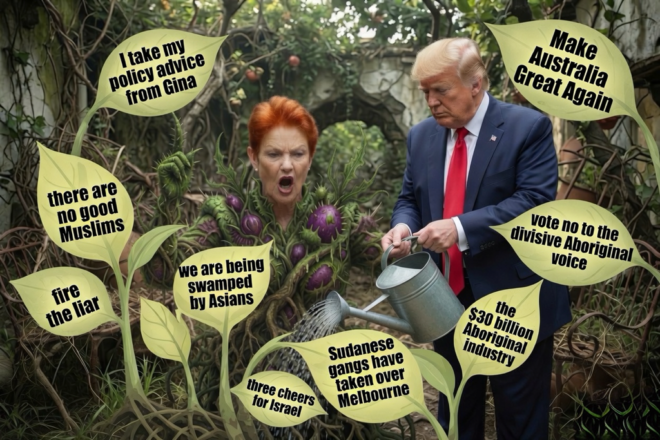
Introduction: A Symptom, Not an Aberration
Pauline Hanson does not disappear. That is perhaps the most important political fact about her. Defeated, imprisoned, ridiculed, and written off across three decades, she has returned each time with her base undimmed and her core themes – immigration, cultural identity, the limits of diversity – no less potent for the ridicule. In 2022 she received nearly six per cent of the national Senate primary vote. In Queensland, that figure approached thirteen per cent. A 2025 Resolve Strategic poll found that one in four Australians believed immigration was too high and Australian culture was under threat. The Scanlon Foundation’s Mapping Social Cohesion surveys – the most rigorous longitudinal measure of Australian attitudes toward diversity – have recorded a steady softening of enthusiasm for multiculturalism since 2019, including among younger Australians.
These are not fringe numbers, and they are not adequately explained by dismissing those who hold such views as simply racist, uneducated, or left behind. They describe something real and widespread in Australian political life, and any serious analysis of Hanson that does not account for them is not analysis – it is reassurance.
This essay attempts a genuinely even-handed account. It takes seriously both the harms Hanson’s rhetoric has demonstrably caused and the legitimate concerns her career has, often crudely, articulated. It presents the evidence on immigration, integration, and social cohesion as contested empirical territory – because that is what it is – rather than as settled science awaiting communication to the unconvinced. It treats multiculturalism as a policy choice with real benefits and real costs, not as a moral achievement whose critics can only be explained by defect of character. And it attempts, throughout, to apply the same standards of evidence and generalisation to all sides of the argument – including to the progressive political culture that has shaped official Australian responses to Hanson for thirty years.
The conclusion reached here is still critical of Hanson’s specific rhetoric, her overbroad generalisations, and the Federal Court’s documented finding of racial discrimination. But that criticism is worth making only if it is earned through honest engagement with the full picture. A critique that explains why Hanson offends without explaining why she persuades has told only half the story. This essay attempts the other half as well.
I. 1996: The Vacuum and the Voice That Filled It
When Pauline Hanson addressed the House of Representatives on 10 September 1996, she was an independent candidate who had defeated a sitting Labor member without party endorsement. The speech that followed would define her career and fracture Australian political debate in ways that have not fully healed in the thirty years since.
Her most famous passage warned that Australia was ‘in danger of being swamped by Asians’ – a word chosen with precision, evoking flood and loss of control – and described Asian migrants as forming ghettos and refusing to assimilate. On Aboriginal Australians, she objected to race-based programs and benefits on the grounds that skin colour should not determine entitlement. Both positions sparked immediate and widespread condemnation.
The condemnation was often justified. The specific claim that Asian migrants formed ghettos and resisted assimilation was not well supported by the evidence available at the time. ABS data showed that Asian-born migrants of the 1984-1995 cohort had higher rates of tertiary education and comparable or higher household incomes than the Australian-born population. Rates of residential concentration were not significantly different from those of earlier European migrant communities – Italian, Greek, and Lebanese Australians – who are now regarded as unambiguously integrated. The empirical foundation of Hanson’s central claim was weak.
But the political conditions that gave it traction were not. The Keating government’s 1992–1996 period had combined accelerated immigration intake with a deep recession that fell hardest on manufacturing workers in regional Queensland and Western Sydney. The bipartisan political consensus on immigration and multiculturalism – rarely contested, rarely examined in public – had produced a policy framework that was better at celebrating diversity in official discourse than at managing its distributional consequences in practice. When anxieties about rapid demographic change were raised in communities far from the major cities, the political class responded less with engagement than with the accusation of racism. That dynamic did not dissolve the anxieties. It drove them underground, where they accumulated until someone was willing to give them a name.
It is also worth noting that the dismissive characterisation of Hanson voters as ‘rednecks,’ ‘uneducated,’ or motivated primarily by racial animus – common in media coverage then and since – applied to them exactly the logic of collective generalisation for which Hanson herself was being criticised. Survey research consistently showed, and continues to show, that most Hanson voters hold restrictionist rather than eliminationist views on immigration. They want less and slower change, more assimilation pressure, and more weight given to the interests of existing residents. These are policy positions. They are not, in themselves, evidence of racism. Treating them as such has been one of the most consistent failures of the political culture that opposes her.
The harm caused by Hanson’s 1996 speech was real. Research by Kevin Dunn and colleagues at the University of Western Sydney documented a measurable increase in racially motivated harassment against Asian Australians in its aftermath. Words from public platforms have public effects, and that effect should be taken seriously. It should also be noted that the stigmatisation of an entire constituency as racist – which was the dominant liberal response – is itself a generalisation that caused its own kind of political harm, by making the underlying concerns unspeakable in mainstream politics while doing nothing to address them.
II. Indigenous Policy: Equality, History and Contested Evidence
Hanson’s positions on Indigenous Australians invoke a principle – equality before the law, regardless of race – that commands wide assent across the political spectrum. The question is whether that principle, applied without reference to the history that made Indigenous-specific policy necessary, is equality in any meaningful sense or its photographic negative.
Her claim that she is as Indigenous as any Aboriginal Australian born on the same date collapses a distinction that matters enormously in law, in anthropology, and in the understanding of the communities themselves. Indigeneity is not reducible to birthplace. It encompasses continuous cultural relationship with country, recognised kinship structures, and the legal standing that flows from prior occupancy across tens of thousands of years. To treat birthplace as the equivalent of that relationship is not the application of a universalist principle. It is the erasure of a specific history by a general one.
At the same time, honest engagement with the evidence on Indigenous policy outcomes requires acknowledging something that progressive political culture has been slow to confront directly. Forty years of land rights, native title, and targeted government expenditure have not closed the gap between Indigenous and non-Indigenous Australians on life expectancy, educational attainment, incarceration rates, or child welfare indicators. On most measures, the gap has narrowed only modestly. This is not a comfortable fact for those who have designed and defended those policies, and it is one that Hanson has exploited, often without analytical rigour. But the exploitation of an inconvenient fact does not make the fact untrue.
There is a serious and ongoing debate among policy researchers, Indigenous community leaders, and welfare economists about why outcomes have been so resistant to change – a debate that includes genuine critique of the structure of remote service delivery, the accountability of some community-controlled organisations, and the degree to which certain program designs have created dependency rather than capacity. That debate does not support Hanson’s conclusion that race-based policy is inherently wrong. It does support the conclusion that the design of specific policies matters enormously, and that insulating those designs from criticism on the grounds that criticism is racist has been, at times, intellectually dishonest.
Her description of the Voice to Parliament as ‘apartheid’ was not a serious contribution to that debate. Apartheid was a system of total racial subjugation backed by state coercion. Applying that term to an advisory body is the kind of historical carelessness that undermines rather than advances political argument. The standard of analytical precision that Hanson’s critics rightly demand of her should also be demanded of the rhetorical moves made in her characterisations of Indigenous policy – including her own.
III. Islam, Security and the Evidence On Integration
Hanson’s turn to Islam as her primary target after 2016 raises a question that the progressive consensus has sometimes preferred to avoid: are there features of some Islamic political traditions that are in genuine tension with liberal democratic norms? This is not a question invented by the far right. It is debated vigorously within European liberal philosophy, within feminist theory, and – crucially – within Muslim communities themselves. Muslim reformers, secularists, and dissidents from Iran to Indonesia to Western Sydney have been making versions of this argument for decades. Their existence does not vindicate Hanson’s version of the argument, but it does establish that the question is legitimate.
Hanson’s 2016 Senate speech engaged with this territory, and engaged with it poorly. Her call to stop Muslim immigration treated approximately 800,000 Australian citizens as a monolith sharing a single set of threatening values. It did not distinguish between political Islam as an ideological movement and the faith as lived by the vast majority of Muslim Australians. It did not engage with the integration evidence.
That evidence is worth examining honestly, because it does not tell a simple story in either direction. ABS data show that Australian Muslims have lower labour force participation than the broader population – a gap that narrows significantly in the second generation. Rates of civic participation, including voting and volunteering, are comparable to other communities of similar socioeconomic background. Crime statistics, when controlled for disadvantage, do not show Muslim Australians as a disproportionately high-risk community. The Scanlon Foundation surveys show that Muslim Australians consistently report high levels of identification with Australia as home. These findings complicate both Hanson’s narrative of inherent incompatibility and the counter-narrative that dismisses any integration concerns as bigotry.
They also sit alongside findings that deserve equal weight. The same Scanlon data show that non-Muslim Australians express higher rates of discomfort with Muslim neighbours than with any other religious or ethnic group. A 2023 Lowy Institute poll found that thirty-two per cent of Australians believed Muslim immigration had been bad for the country – a figure that, whatever its causes, represents a substantial minority view that cannot be attributed entirely to Hanson’s influence. European integration research – from France, Germany, Sweden, and the Netherlands – documents genuine second-generation integration challenges, particularly in communities characterised by high unemployment, poor housing, and concentrated disadvantage, that have produced both cultural friction and, in a small number of cases, radicalisation. These findings do not confirm Hanson’s claims about Australian Muslims. They do establish that integration is a real policy challenge, not a phantom conjured by xenophobia, and that the speed and conditions of settlement matter in ways that official multiculturalism has not always acknowledged.
The February 2026 Sky News comment – ‘How can you tell me there are good Muslims?’ – was not a contribution to that policy debate. It was a claim about the inherent character of a category of people defined by religious identity. That is the architecture of bigotry, and it applies symmetrically: it is no more defensible when applied to Muslims than when applied to Jews, Catholics, or any other religious community. The Federal Court’s 2024 finding in Faruqi v Hanson applied the same analysis to the racial dimension of her 2022 tweet, and the finding was correct. That Hanson sometimes makes a more careful version of an argument does not redeem the versions in which she does not.
IV. The Federal Court Ruling: Where Speech Becomes Discrimination
In September 2022, following the death of Queen Elizabeth II, Senator Mehreen Faruqi published a tweet expressing ambivalence about the monarchy and solidarity with colonised peoples. Hanson’s response was explicit and personal:
‘Your attitude appals and disgusts me. When you immigrated to Australia you took every advantage of this country. You took citizenship, bought multiple homes, and a job in a parliament. It’s clear you’re not happy, so pack your bags and piss off back to Pakistan.’
In 2024, the Federal Court found this constituted unlawful racial discrimination under the Racial Discrimination Act. The judge found that an ordinary reasonable reader would understand the tweet to convey that Faruqi’s belonging in Australia was conditional on her origin – that citizenship, elected office, and decades of Australian life had not made her Australian in any final sense, because her Pakistani origin remained the ground on which her presence could be revoked.
There is a case to be made, and it should be stated fairly, for robust political speech about public figures who use public platforms. A senator who publishes political views invites political response, including vigorous and even contemptuous response. The value of broad political speech protections is not trivial, and the Racial Discrimination Act’s provisions on vilification have been genuinely contested by people who are not apologists for racism but are concerned about where the boundary between protected political speech and prohibited harm should fall.
The court, in this instance, found that the boundary had been crossed, and the finding is persuasive. The critical point is that the tweet did not respond to Faruqi’s argument about the monarchy. It responded to her origin. The directive to return to Pakistan was not a rebuttal of republican politics; it was a statement that a citizen’s belonging was revocable on the basis of where she came from. That is not robust political criticism. It is the logic of conditional citizenship – the idea that some Australians are always on probation, their right to belong dependent on a gratitude that can be revoked at any moment by those who consider themselves the original owners of the national identity.
This logic runs through Hanson’s entire career. It is not incidental to her politics. It is structural.
V. Monoculturalism: A Serious Argument, Taken Seriously
At the National Press Club in June 2026, Hanson offered what may be the most developed articulation of her political philosophy: ‘We are a multiracial society, but we must be monocultural. Australians must live under the one cultural umbrella.’
This argument deserves serious engagement, not because it is beyond criticism, but because it has respectable intellectual antecedents that are being invoked, however imperfectly, and because the empirical questions it raises are genuinely open.
The civic nationalist case for shared values – that liberal welfare states require a sufficient degree of cultural solidarity to sustain the willingness to support redistributive institutions – has been made by political theorists across the ideological spectrum, from John Stuart Mill’s arguments about nationality and government to David Miller’s contemporary liberal nationalism to the French republican tradition of laicite. The core claim is that diversity and solidarity exist in tension, and that beyond a certain threshold, diversity without shared civic values erodes the social trust on which welfare states depend. This is not an argument invented by the far right. It is an argument that serious scholars take seriously.
The empirical support for this position is contested but not negligible. Robert Putnam’s 2007 study of American communities – E Pluribus Unum – found that higher ethnic diversity was associated with lower social trust, not only across groups but within them. Putnam himself was uncomfortable with the findings and delayed publication; he remains committed to multiculturalism as a long-term aspiration while acknowledging the short-term costs his data revealed. A 2019 meta-analysis by Dinesen, Schaeffer, and Sønderskov found that the relationship between diversity and trust was real but context-dependent, moderated significantly by residential integration, institutional quality, and economic inequality. The Australian Scanlon Foundation data show that social cohesion, as measured by trust and belonging, has declined modestly but measurably since 2019, even as Australians remain broadly positive about immigration in principle.
These findings do not confirm Hanson’s policy prescriptions. They do establish that social cohesion is a real variable affected by the pace and conditions of demographic change, and that the relationship between diversity and solidarity is more complex than the standard multicultural narrative has acknowledged. Official multiculturalism in Australia has produced substantial documented benefits: economic dynamism, cultural richness, and a record of intergroup relations that compares favourably with most comparable nations. It has also produced measurable frictions: housing pressure concentrated in high-immigration cities, wage effects in sectors where labour supply is most elastic, and – in some communities and some generations – integration gaps that community celebration has not always been sufficient to close. Reasonable people, engaging honestly with the evidence, can and do disagree about whether the balance has been optimal, and about what policy adjustments might improve it.
Hanson’s version of this argument fails not because the underlying concern is without foundation, but because her prescription – a monoculturalism whose implicit benchmark is Anglo-Celtic norms – does not follow from the evidence, and because her record of application is selective in ways that reveal its limits. She applies the unity principle against Indigenous cultural difference, against Muslim religious practice, and against Asian community cohesion, but not against the structural advantages that flow automatically to English-speaking migrants over non-English-speaking ones. A genuine commitment to civic equality would require examining those asymmetries as well.
VI. Why She Wins: Political Sociology, Not Pathology
The most important question this essay can ask is not whether Hanson is right, but why she keeps winning. The answer tells us more about Australia than about her.
Survey research is clear that most Hanson voters are not primarily motivated by racial animus. The 2024 ANU Electoral Survey found that One Nation voters ranked protecting Australian jobs and wages and maintaining Australian culture ahead of reducing immigration as an end in itself. They are, predominantly, people who feel economically insecure, culturally voiceless, and politically ignored by the major parties. These are the same conditions that have produced analogous political movements across the democratic world – Brexit, Trump, the Rassemblement National, the Sweden Democrats – in the same period. The parallel is not coincidental. It reflects structural economic changes that have produced genuine losers in developed economies, losers who have found that mainstream parties offer them technocratic management rather than political representation.
The economic dimension is more serious than public debate has generally acknowledged. Australia’s immigration intake over the past two decades has been among the highest in the developed world on a per-capita basis. The aggregate economic benefits are real and well-documented: productivity growth, fiscal contribution, entrepreneurship, and innovation, particularly in the knowledge economy. The distributional consequences are less discussed. Research by economists including Bob Gregory has found that large immigration intakes suppress wage growth at the unskilled and semi-skilled end of the labour market – precisely the sectors from which Hanson draws disproportionate support – while concentrating the gains in capital and high-skilled labour. A policy that is beneficial in aggregate can still produce genuine losers, and those losers are entitled to political representation without being told their concerns are inadmissible.
The cultural dimension is equally real. The Scanlon Foundation data show consistent and growing concern – not only among Hanson voters but across demographics – about the pace of cultural change, about housing affordability in high-immigration cities, and about specific cultural practices perceived as incompatible with Australian norms. These concerns are not evenly distributed. They are stronger in communities that have experienced rapid change without the economic insulation that makes such change easier to absorb. Dismissing them as racial anxiety misidentifies their character and forecloses the policy conversations that might address them.
What Hanson does is give these concerns a name, a target, and a simple narrative of cause and effect. The name is Australian identity under threat. The target has changed – Asians in 1996, Muslims in 2016, immigrants broadly in 2026 – but the narrative structure is consistent. There is something worth preserving, it is being lost, and the people responsible can be identified. This narrative is frequently inaccurate in its specifics and harmful in its applications. It is also politically powerful precisely because it speaks to real experiences of dislocation that the political mainstream has been unwilling to name.
VII. The Symmetry Standard: Applied Without Exception
This essay has attempted throughout to apply a consistent standard of evidence and generalisation across all sides of the argument. It is worth stating that standard explicitly, because it is the one that political discourse about Hanson most consistently fails.
On generalisation: collective attributions of negative characteristics to groups are epistemically and morally problematic when applied to Asian Australians, Muslim Australians, and Indigenous Australians. They are equally problematic when applied to the working-class communities from which Hanson draws her support. The characterisation of Hanson voters as racists, rednecks, or deplorables is not wit or precision. It is the same logic applied to a different target, and it has the same distorting effects on political analysis and the same corrosive effects on public discourse.
On evidence: the data on immigration and social cohesion do not tell a simple story. The economic benefits of immigration are real; so are the distributional costs. The integration record of Australia’s multicultural communities is, by international standards, genuinely strong; so are the integration gaps that persist in specific communities and generations. The social trust literature is genuinely contested; the Putnam findings cannot be dismissed as artefacts of American conditions when European data shows comparable patterns. Official multiculturalism has produced both documented benefits and documented frictions. Both deserve acknowledgement, without the qualification of one set of findings being presented in qualified form while the other is presented as settled.
On harm: Hanson’s rhetoric has caused documented harm to Asian and Muslim Australians, evidenced in community surveys, hate crime data, and the Federal Court’s own findings. The dismissal of working-class anxieties as mere racism – a dismissal that has characterised much of the mainstream response to Hanson across thirty years – has also caused harm: political harm, in the form of disenfranchisement; policy harm, in the form of unaddressed distributional consequences of immigration; and democratic harm, in the form of a political culture that treats an entire constituency’s concerns as outside the bounds of legitimate debate.
The symmetry standard does not require false equivalence. Hanson’s specific factual claims have frequently been wrong, and that matters. Her generalisations about Muslim Australians have been overbroad in ways that a Federal Court found legally actionable, and that matters too. The point is not that both sides are equally right or equally wrong. The point is that the standard of rigour, care, and honest engagement with evidence should not vary depending on which side of the argument is being examined. When it does vary – and in Australian political culture’s handling of Hanson, it has varied systematically – it produces not analysis but advocacy.
Conclusion: The Conversation Still Owed
Pauline Hanson’s career is two things simultaneously, and it is dishonest to treat them as separable. It is a record of overbroad generalisations, documented racial discrimination, and rhetoric that has contributed to real harm suffered by real Australians. The Federal Court ruling in Faruqi v Hanson is not a technicality. It is a finding about what her politics cost, in human terms, to the people it targets.
It is also a thirty-year record of giving voice – crudely, frequently inaccurately, but persistently – to concerns about demographic change, economic displacement, and cultural continuity that mainstream political parties chose to manage rather than address. The evidence that those concerns had some foundation in real experience is substantial. The evidence that official multiculturalism, as implemented, produced only benefits and no costs is not. The failure of the political mainstream to make that acknowledgement honestly has been a significant contributor to the political environment in which Hanson not only survives but grows.
The conversation that Australia owes itself – and has largely deferred – is about trade-offs. How much immigration, at what pace, from what backgrounds, with what settlement infrastructure, produces the best outcomes for newcomers and existing residents alike? What does successful integration require from governments, from host communities, and from migrants themselves? What policy mechanisms best address the distributional consequences of rapid demographic change? How should a liberal democracy respond when the civic values of some communities diverge from foundational liberal norms – and how should it police the difference between genuine value conflict and racial prejudice dressed as cultural concern?
These are not Hanson’s questions. She asks cruder versions of them, and answers them with generalisations that do not withstand scrutiny. But they are real questions, with real stakes, and the evidence bearing on them is contested in ways that honest political discourse must acknowledge. They will not be resolved by holding Hanson in contempt – a response that has been tried for thirty years and has produced Hanson at thirteen per cent in Queensland. They will not be resolved by following her into the territory of collective attribution and selective generalisation.
They might begin to be resolved by a political culture willing to hold itself to the same standard of evidence and honesty it demands of its opponents – and by the recognition that the people on both sides of this argument are, in the main, trying to describe something real about the country they live in and are trying, imperfectly, to protect.
That recognition is not a concession to Hanson. It is the precondition for beating her.
– – –
Bakchos is the founder of Blak and Black, an Australian media and advocacy platform established in 2010. Bakchos writes from the intersecting perspectives of Wiradjuri heritage, Jewish identity, and humanism.
© Bakchos, June 2026



Australia is too far down the multicultural path to become monoculture.
It’s time Pauline Hanson is held to the same standards as she demands of her opponents.