
I. Two Arguments That Must Not Be Confused
The case against monoculturalism in Australia rests on two distinct foundations that are often conflated, and the conflation weakens both. The first is a descriptive argument: Australia has never, at any point in its history, been a culturally homogeneous society. This is a statement of fact, as close to incontestable as historical claims come. The second is a prescriptive argument: that multicultural policy – the suite of legislative, institutional, and cultural choices made since 1973 to actively celebrate and sustain ethnic and cultural diversity – is the right framework for governing that diversity. This is a contested policy position, and it should be defended as one.
Separating these arguments matters for intellectual honesty and for persuasive effectiveness. Critics of multiculturalism sometimes make the mistake of treating diversity as a policy choice that can simply be reversed – as though a different government could restore a cultural homogeneity that once existed. That mistake deserves correction: the diversity is structural, historical, and irreversible. But defenders of multiculturalism make a corresponding error when they treat the historical fact of diversity as sufficient justification for any particular policy response to it. How a society manages diversity is a genuine political question on which reasonable people disagree, and Australia’s current answers are not the only defensible ones.
This essay makes both arguments, but keeps them distinct. Australia cannot be a monoculture because it never was one – not in the 65,000 years of First Nations civilisation before European contact, not on the First Fleet that founded the colony, and not in the generations of migration that followed. That is the descriptive case. The prescriptive case – that the multicultural policy framework adopted in 1973 and developed across successive governments of both parties represents a sound and humane response to that diversity – rests on different and additional grounds, and it is strong enough to stand on its own.
II. The Foundation: Sixty-Five Thousand Years Of Plurality
Australia’s cultural diversity predates European contact by a span of time that genuinely strains comprehension. Archaeological evidence, including findings at Madjedbebe in the Northern Territory, places human presence on this continent at a minimum of 65,000 years. Over that extraordinary duration, the First Nations peoples of Australia developed what may be the most complex mosaic of distinct cultures, languages, and legal systems anywhere on earth. Estimates of the number of language groups present at the time of European contact range from 250 to 500 – each representing not merely a different vocabulary, but a different epistemology, a different relationship to country, a different body of law, ceremony, and cosmological understanding.
The Wiradjuri people of central New South Wales did not share a language with the Yolngu of Arnhem Land. The Noongar of the southwest were not culturally interchangeable with the Anangu custodians of the Central Desert. These were distinct nations – sovereign, territorial, and possessed of complex internal governance. The continental monoculture that nationalist mythology sometimes projects backwards onto pre-colonial Australia did not exist. It was, in truth, one of the most culturally diverse places on earth.
This matters for the present argument in a specific way: the cultural plurality of First Nations Australia is not merely a historical curiosity. It is the foundational layer of Australian identity – the layer that makes any claim to a unified national culture built on a single ethnic or linguistic tradition not merely politically contestable but geographically false. The land itself was shaped by and carries the meaning of cultures that predate the oldest known civilisations anywhere else on earth. Any serious account of what Australia is must begin here.
It should also be noted, with equal seriousness, that this foundational plurality survived invasion, dispossession, the Stolen Generations, and sustained institutional attempts at assimilation and destruction. The Wiradjuri still speak Wiradjuri. The songlines still cross the continent. First Nations law and custodianship endure. This survival is not incidental – it is a fact of Australian political life that no policy framework for managing diversity can honestly ignore.
III. The First Fleet’s Inconvenient Manifest
The second refutation of foundational homogeneity comes from a source the monoculture thesis should be most comfortable with: the very moment of European settlement. The First Fleet that entered Port Jackson on 26 January 1788 carried approximately 1,420 people – convicts, marines, naval officers, free settlers, and their families. The dominant character of the company was British, and that matters: the British institutional inheritance would prove decisive in shaping what Australia became. But the fleet was not exclusively British, and the distinction is significant.
Among its passengers were at least twelve people of African, American, or West Indian heritage – including Black Loyalists transported after the American Revolution. There were at least fourteen North Americans. Fifteen individuals came from a range of other nations: Madagascar, Holland, France, Germany, Norway, Portugal, Jamaica, Sweden, and Bengal. Two Channel Islanders served as able seamen. Thirty-three Scots embarked, most as marines and crew. Nine Welsh passengers made the voyage. Among the convicts were Jewish men and women of predominantly Sephardic heritage, whose ancestors had been expelled from Spain during the Inquisition. Joseph Levy, aboard the Scarborough, became the first Jew buried in Australia in April 1788, months after the fleet’s arrival.
The Irish presence deserves particular emphasis. The Irish convicts – and they would come in greater numbers with the Second and Third Fleets – brought with them a Gaelic linguistic tradition, a Catholic faith, and a history of resistance to English colonialism that would leave a permanent mark on the Australian national character. The tension between English Protestant authority and Irish Catholic community shaped Australian politics, culture, and social organisation well into the twentieth century. It was never one culture. Even among the British, it was several.
The lesson of the First Fleet manifest is not that the founders consciously designed a multicultural society. They did not. The lesson is that diversity was structural from the founding moment – a function of the transportation system, the labour needs of the Royal Navy, and the social composition of eighteenth-century Britain – and that the society which grew from that founding was always going to have to manage plurality, because plurality was baked into its origins.
IV. The British Inheritance: An Asset, Not a Contradiction
A rigorous defence of pluralism cannot ignore the British institutional foundation on which Australian society was built, and it should not try to. The common law, the Westminster parliamentary system, independent courts, the English language as a medium of civic and commercial life, a tradition of press freedom and public argument – these are genuine inheritances of the British colonial project, and they have proven to be assets of extraordinary value. They are, in no small part, what made it possible for a diverse and growing population to function as a coherent and increasingly democratic polity.
The point is worth pressing, because it cuts against a certain strain of multicultural advocacy that treats the British inheritance as merely one cultural tradition among equals, to be relativised rather than honoured. That position is both historically inaccurate and politically unpersuasive. The English language is not simply one option among several in Australia; it is the shared medium without which the pluralism of multicultural society cannot function. The rule of law is not a culturally specific preference; it is the institutional infrastructure that protects minority communities from the tyranny of majorities. The Westminster tradition of responsible government is not a British imposition to be overcome; it is the framework within which every subsequent expansion of Australian rights and recognition has been achieved.
Acknowledging this does not concede the monoculture argument. Quite the reverse. It demonstrates that Australia’s successful management of diversity has always depended on a shared institutional scaffold – shared not in ethnic origin, but in civic commitment. The genius of the Australian settlement, at its best, is precisely this combination: a common institutional framework capacious enough to accommodate an extraordinary range of cultural expressions within it. Ethnicity is not the scaffold. Civic institutions are. And those institutions, British in origin but no longer British in ownership, belong now to everyone who holds Australian citizenship regardless of where they or their ancestors were born.
V. 1973 and the Policy of Pluralism
Against this historical and institutional backdrop, the multicultural policy turn of 1973 can be understood not as a radical departure but as a belated reckoning with facts that had always been true. In August of that year, Al Grassby, Minister for Immigration in the Whitlam Labor government, delivered his paper A Multi-Cultural Society for the Future – the first time an Australian government had formally endorsed the maintenance and development of ethnic diversity as a policy goal, rather than merely tolerating it on the way to assimilation.
Grassby’s framing was principled. He identified that nearly a million migrants had declined citizenship, in significant part because of discrimination they had encountered. His response was not to demand conformity but to affirm that the social and cultural rights of migrant Australians were as compelling as those of any other citizen. His governing idea – unity in diversity – expressed a commitment to equity and reciprocity that has remained the intellectual core of Australian multiculturalism since.
What is sometimes underappreciated is how quickly this became a bipartisan position. Malcolm Fraser, who defeated Whitlam in 1975, proved a committed supporter of multicultural policy, appointing the Galbally Committee in 1977 and acting on its recommendations for migrant services and settlement support. By the late 1970s, both major parties had accepted that Australia’s diversity was not a transitional condition to be managed away, but a permanent feature of national life to be actively supported. The Racial Discrimination Act 1975, the Australian Citizenship Act 1973, the establishment of the Special Broadcasting Service – these were not transient policy experiments. They became structural features of Australian civic life that have outlasted every subsequent government.
This bipartisan durability does not, by itself, prove the policy is correct. Popular and enduring policies can be wrong. But it does suggest that the multicultural framework addressed a real and persistent need – and that successive governments, of quite different political temperaments, found that abandoning it caused more problems than sustaining it.
VI. The Empirical Record: Strengths, Strains and What the Data Actually Show
The prescriptive case for multiculturalism cannot rest on history and institutional design alone. It must engage the empirical evidence on social outcomes – and that evidence, honestly assessed, contains both genuine cause for confidence and genuine cause for concern. A serious argument for pluralism must confront both.
Begin with the theoretical challenge. The political scientist Robert Putnam’s research on social capital in the United States found that ethnic diversity, at least in the short to medium term, can reduce levels of social trust – not merely between groups, but within them. In diverse communities, Putnam found, people tended to ‘hunker down,’ reducing trust and civic participation across the board. Putnam himself stressed that these were transitional effects that successful integration policies could address, and he pointed to cases – including historical examples from within the United States – where diversity had eventually produced stronger, more resilient communities. But the findings cannot be wished away. Diversity produces social complexity, and social complexity requires active management. The question is not whether integration presents challenges; it is whether those challenges are addressable within the existing framework.
The longitudinal Australian data provides the most directly relevant evidence, and the picture it presents is substantially positive – but no longer uniformly so. The Scanlon Foundation’s Mapping Social Cohesion surveys, conducted annually since 2007, remain the most comprehensive tracking instrument available. The 2024 report found that more than 85 per cent of Australians believe multiculturalism has been good for Australia. That is a substantial and durable majority, and it has held across nearly two decades of surveys covering periods of economic stress, geopolitical tension, and contentious immigration debates. But the 2024 figure represented a decline from 89 per cent in 2023, and overall social cohesion, while stable year-on-year, sat below its long-term average. Trust in government continued to fall. The proportion of Australians saying the number of immigrants is too high rose significantly compared to both 2023 and 2019.
The Scanlon researchers are careful – and correct – to note that concern about immigration numbers does not straightforwardly translate into anti-migrant sentiment. Their data show that Australians continue to strongly support non-discriminatory migration policy, including for people arriving from conflict zones. The anxiety appears to be tracking real economic pressures – housing affordability, cost of living, wage stagnation – rather than representing a principled turn against cultural pluralism. When people are struggling to pay rent, they reach for concrete explanations, and elevated migration rates provide a visible and politically available one. This is a policy management problem, not a failure of multiculturalism as a social value.
The employment data presents a more structurally troubling picture. The Australian Bureau of Statistics’s migrant settlement outcome data consistently reveals a sharp gradient between visa streams. Skilled migrants have employment rates approaching 81 per cent and strong income trajectories. Humanitarian migrants – refugees – face a categorically different experience. At arrival, they are approximately 88 percentage points less likely to be employed than non-humanitarian migrants, and even five years after resettlement the gap remains above 50 percentage points. A 2025 UNSW study published in the British Journal of Industrial Relations found that this persistent gap is not fully explained by differences in education, English proficiency, age, or gender. Instead, the evidence points to employer discrimination as a primary driver: refugees receive a lower return on equivalent qualifications than other migrants, steering many into precarious, lower-paid roles that fail to utilise their actual capacities and slow their long-term economic and social integration.
CEDA research has identified a related problem across the skilled migration stream: nearly a quarter of permanent skilled migrants work in jobs beneath their skill level. Recent female migrants face a measurable wage shortfall compared with Australian-born workers in equivalent roles. English proficiency programs, while valuable, are poorly targeted – currently focused on family and humanitarian arrivals and those with very low English, while the language gaps that affect employment outcomes for educated migrants in high-skill roles go largely unaddressed.
What the evidence establishes, taken together, is a system with strong foundational values and broad community endorsement that is nonetheless producing unequal outcomes across cohorts – and generating public anxiety in conditions of economic pressure that, if not addressed, can erode the consensus that sustains the framework. None of this constitutes an argument for abandoning multicultural policy. It constitutes an argument for investing more seriously in the policies that make multiculturalism function: targeted English programs, rigorous anti-discrimination enforcement, credential recognition reform, settlement services adequately funded for humanitarian arrivals, and housing and infrastructure investment that keeps pace with population growth. The failure lies not in the framework but in the resourcing and seriousness with which it has been implemented. A complacent multiculturalism that celebrates diversity in principle while underfunding the mechanisms of genuine integration is both intellectually dishonest and politically vulnerable – and the data shows it is increasingly being tested.
VII. Nations Choose Their Balance – And So Did We
It is worth acknowledging directly what the monoculture argument often assumes but rarely states: that nations have genuine choices about how to manage cultural diversity, and that those choices have real consequences. Japan has maintained a highly restrictive immigration policy and a relatively homogeneous cultural character. Singapore has built a multi-ethnic society on a framework of enforced civic unity and strict limits on political expression of ethnic difference. Various European nations have experimented with different balances between cultural openness and demands for assimilation. These are not all equivalent choices, and they are not all equally defensible – but they are genuine choices, not historical accidents, and their consequences can be studied and compared.
Australia in 1973 made a choice. It chose, through its elected government and with subsequent bipartisan endorsement, to move from a policy of assimilation to a policy of pluralism – to shift from demanding that migrants conform to an Anglo-Celtic norm to affirming that cultural difference was a legitimate and valued feature of national life. That choice was not inevitable. It was made by specific people at a specific moment, for specific reasons – among them the practical failure of assimilation policy to integrate the large postwar migrant population, the emergence of human rights as a framework for thinking about citizenship, and the recognition that the White Australia Policy had been both morally wrong and economically damaging.
Understanding 1973 as a choice rather than an inevitability is, paradoxically, a stronger basis for defending it. The historical fact that Australia has always been diverse does not, by itself, determine what policies should govern that diversity. What determines the policy argument is the evidence of outcomes: that the multicultural framework, for all its imperfections and ongoing challenges, has produced a more cohesive, more productive, more humane, and more internationally credible Australia than the assimilationist alternative delivered. That is a comparative judgment, not a metaphysical one, and it is more persuasive for being so.
VIII. The Strength in Diversity – Properly Understood
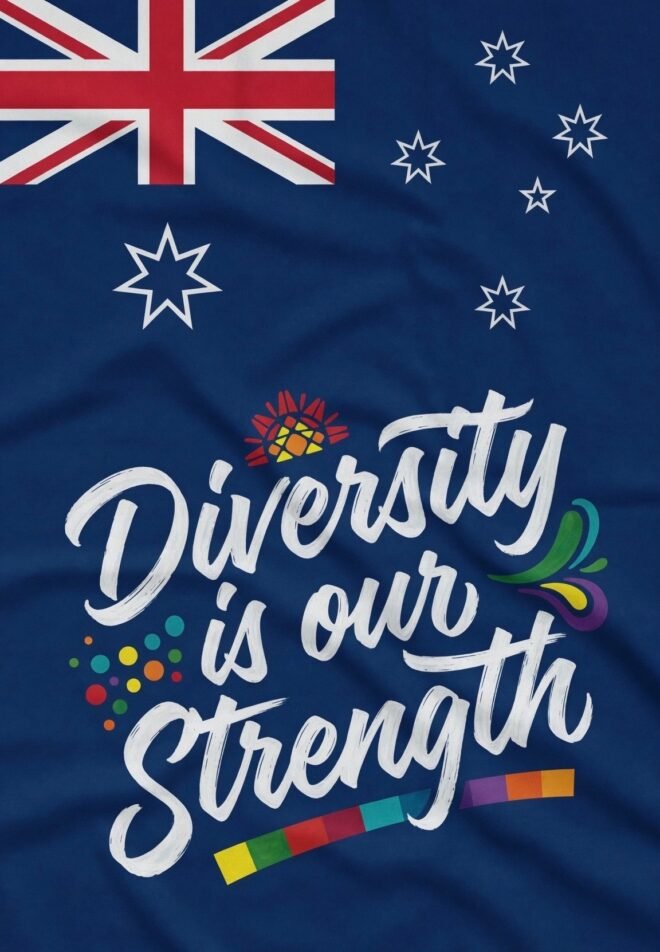
The phrase strength in diversity is often treated as a slogan, and sometimes it functions as one – a way of asserting the value of pluralism without engaging any of its complications. Used that way, it is not persuasive to anyone not already convinced. But properly understood, it describes something empirically real and institutionally significant.
Australia’s capacity to conduct business in Mandarin, Arabic, Hindi, Vietnamese, and Greek; the cultural knowledge that enables Australian institutions to navigate relationships in Asia, the Middle East, and across the Pacific; the demographic vigour that has sustained population growth and economic dynamism across the postwar decades; the intellectual diversity that generates innovation in science, medicine, engineering, and the arts – these are measurable and documented advantages that flow directly from immigration and from the multicultural policy environment that made integration viable. The Snowy Mountains Scheme, that foundational project of postwar nation-building, was accomplished not by a homogeneous Anglo workforce but by workers from more than thirty countries. That is not a rhetorical flourish. It is a historical fact about how Australia built itself.
There is also a form of strength that is harder to quantify but no less real: the ecological and philosophical knowledge embedded in First Nations custodianship of this continent. The land management practices developed across 65,000 years; the legal and relational frameworks that understand country as obligation rather than property; the artistic and ceremonial traditions that give the continent its deepest meaning – none of this can be replicated by any immigrant culture, however vigorous. It is the inheritance of continuous presence across deep time, and its value to Australia – environmental, cultural, and diplomatic – is only beginning to be recognised in policy and practice. A monoculture built on the erasure of this inheritance would be weaker, not stronger, for the erasure.
Strength in diversity, then, is not a slogan about harmony and good feelings. It is a claim about productive capacity, institutional resilience, and national depth. It can be tested against evidence. And when tested honestly – accounting for integration challenges, social capital pressures, and the genuine work required to make pluralism function – it holds up.
IX. Conclusion: The Country We Actually Are
The case against monoculturalism in Australia operates at two levels, and they should be kept distinct even as they reinforce each other. At the descriptive level, the case is overwhelming and effectively unanswerable: this continent has never, at any point in its history, been culturally homogeneous. Not in the 65,000 years of First Nations plurality before European contact. Not on 26 January 1788, when the First Fleet’s manifest included Africans, Americans, Bengalis, Scandinavians, Sephardic Jews, and Gaelic-speaking Irish alongside the English majority. Not in the postwar decades of Southern and Eastern European migration. The monoculture was always a myth – a selective and partial reading of a complex reality that suited particular political purposes at particular moments.
At the prescriptive level, the case is strong but requires more work. Australia’s multicultural policy framework, established in 1973 and consolidated across successive governments of both major parties, represents a defensible and evidence-supported response to a diversity that was always structural. It was built on British institutional foundations – common law, parliamentary democracy, the English language – that gave a diverse population the shared civic scaffold it needed to function as a coherent polity. It has produced integration outcomes that compare favourably with comparable nations. It has generated real economic, cultural, and strategic dividends. And while it faces genuine challenges – in social cohesion research, in the integration of isolated communities, in the persistence of discrimination – those challenges are arguments for better policy, not for abandonment of the framework.
Other nations have made different choices and reached different settlements. That is true. The relevant question is not whether Australia’s multicultural framework is the only conceivable approach to managing diversity, but whether it is the right approach for this country, at this point in its history, given its specific origins, its institutional inheritance, and the evidence of what has and has not worked. The answer, honestly considered, is yes – not because diversity is automatically a strength, but because this country, with this history, has made diversity work in ways that a retreat to assimilationist fantasy could only damage.
The clock cannot be turned back to a monoculture that never existed. More importantly, it should not be. The Australia that actually exists – built on 65,000 years of First Nations cultural plurality, on the improbable diversity of the founding fleet, on the labour and aspiration of successive waves of migration, and on the civic institutions that have held it together through all of that complexity – is a richer, more capable, and more interesting country than the monoculture fantasy ever was. That is not a slogan. It is a judgment the evidence supports.
– – –
Bakchos is the founder of Blak and Black, an Australian media and advocacy platform established in 2010. Bakchos writes from the intersecting perspectives of Wiradjuri heritage, Jewish identity, and humanism.
© Bakchos, June 2026



Australia has never been a monoculture even first Nations. Australia wasn’t a monoculture. We had multiple different groups of people many speaking their own languages with their own laws in their own country with the coming of the first fleet that just added another layer to this complex mosaic of people. In 1973 Australia made the decision to be a multicultural country. That’s 53 years ago it’s not possible to turn the clock back, nor is it desirable to turn the clock back.
Australia’s cultural diversity predates European contact by a span of time that genuinely strains comprehension. Archaeological evidence, including findings at Madjedbebe in the Northern Territory, places human presence on this continent at a minimum of 65,000 years. Over that extraordinary duration, the First Nations peoples of Australia developed what may be the most complex mosaic of distinct cultures, languages, and legal systems anywhere on earth.
Australia cannot be a monoculture because it never was one. Not in the 65,000 years of First Nations cultural plurality that preceded European contact. Not on 26 January 1788, when the First Fleet’s manifest included Africans, Bengalis, Sephardic Jews, and Gaelic-speaking Irish alongside its English majority. And not after 1973, when Australia made a deliberate bipartisan choice to embrace pluralism as policy rather than merely tolerate it as fact.
I’m a migrant. I’ve built a life here. I’ve built a professional practice here. I’ve married here and I have children here. I will almost certainly spend the rest of my working life here and again almost certainly I’ll die and be buried here. I’m an Australian. I’m also a multicultural Australian. I do not see the benefit in monoculture. I see strength in diversity but firmly believe that even in our multicultural society, we have to accept that Australia comes first.
I live in a multicultural part of Australia. I enjoy the vibrancy of the community I live in. I couldn’t think of anything worse than having a mono culture. I agree that certain things have to be standardised across all communities including law language and certain customs without the standardisation the community can’t function as a community but beyond that groups should be able to maintain as much of their culture as is compatible with the above standardisation.