
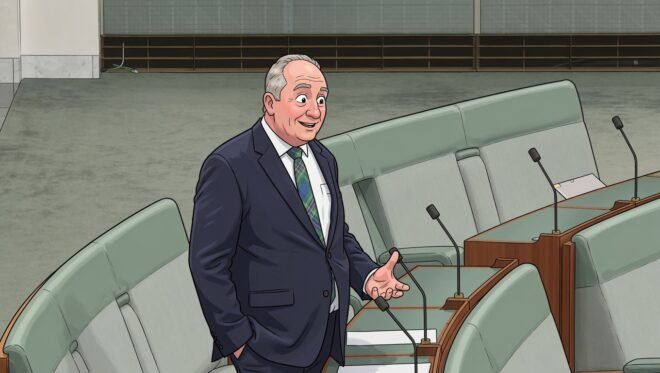
In December 2025, Barnaby Joyce – twice Deputy Prime Minister of Australia, thirty-year veteran of the National Party, member for New England since 2013 – announced what he called “the most considered and serious decision” of his political life: he was leaving the party that had carried him to the second-highest office in the land, to join Pauline Hanson’s One Nation. He would sit out the remainder of his term as an independent, he explained, before contesting the New South Wales Senate seat on One Nation’s ticket at the next election. The announcement was staged, fittingly, on talkback radio in Tamworth, with Hanson at his side and the cattle sales as backdrop – a piece of theatre calibrated for the electorate he was simultaneously abandoning and courting.
The commentary that followed treated the defection largely as a curiosity of personal ambition – the latest instalment in a career defined by reinvention, from Senate defector to National Party leader to backbench irritant to, now, standard-bearer for the party he once warned would send the country “down the toilet.” That framing is not wrong, but it is incomplete. This essay sets out to do four things: trace the actual distance between Joyce’s stated position in 2017 and his stated position in 2025; weigh, as fairly as the public record allows, whether his break with the Nationals reflects genuine policy conviction or status grievance dressed as principle; place One Nation’s current financial architecture against the donor ecosystems that fund its major-party and independent rivals, to test what is actually distinctive about it; and set the strongest available versions of conservative Indigenous and immigration policy against Hanson’s own public rhetoric, because this publication’s standard is to test arguments against their best form, not their worst.
From “Down The Toilet” To “Considered And Serious”
It is worth sitting with the distance Joyce has travelled. In 2017, as a senior minister, he warned voters that Australia would “go down the toilet” under One Nation government. In his November 2025 resignation statement he instead spoke of thirty years with the party ending “with a heavy heart,” and framed the choice not as ideological migration but as escape from what he called the “ejection chair of the backbench.” By the formal December defection statement, the register had shifted again, toward the language of national salvage: Australia, he argued, had “handed away rights we should have kept and taken up obligations we should have left, at a price we cannot pay.”
The rhetorical work being done here deserves scrutiny on its own terms, independent of whether one thinks Joyce sincere. A politician does not simply change his mind about a party; he must construct a narrative in which the change is principled rather than opportunistic, and the shifting register across three separate statements – grievance, then heartbreak, then salvage – suggests a man trying out different justifications rather than working from a single settled one. Nationals leader David Littleproud made the same point with less charity, describing the move as Joyce turning his back on his electorate to pursue leadership of a different outfit rather than accept a diminished role in his own, and dismissing One Nation as “a party of protest, not a party of government.” Littleproud’s characterisation is the more interesting claim, because it is precisely the distinction the sections below want to test.
Weighing The Case For Genuine Misalignment
Fairness requires taking seriously the possibility that Joyce’s break was substantive rather than purely personal, so it is worth reconstructing the actual sequence rather than relying on the defection statement alone. After the May 2025 federal election, Joyce was not appointed to a shadow cabinet position – a real and material demotion for a former deputy prime minister and twice party leader, regardless of the reasons behind it. In August 2025, still a Coalition backbencher, he introduced a private member’s bill to repeal Australia’s net zero emissions framework in its entirety, unwinding five pieces of legislation and amending three more. The government allowed the bill to be debated specifically to expose Coalition division, and Climate Change Minister Chris Bowen accused Joyce of pre-empting the party’s own parallel policy reviews then underway. On its face, this looks like exactly the kind of substantive, documented policy break that would justify a principled departure: Joyce pushing further and faster than his own party on an issue of genuine ideological weight.
The complication is timing. Within weeks of Joyce’s bill, the Queensland Liberal National Party voted at its own conference to abandon the party’s commitment to net zero by 2050 – and Littleproud, the leader Joyce would later describe as impossible to work with, supported that resolution and committed to carry it to the next election. The two moves were not identical in scope or speed: Joyce’s bill sought the wholesale, immediate repeal of the entire legislative framework, while the Queensland resolution was a conference-level commitment to abandon a target, still short of Joyce’s more sweeping legislative ambition and without his timeline. But the directional convergence is the point that matters here – on the specific policy question Joyce chose as his signature break, the party he was leaving was moving toward his position, not away from it, in the same period he was resigning, even if it had not yet matched his pace. That sequence weakens the claim that irreconcilable policy substance forced his hand; it strengthens the alternative reading that his own account gives more directly – that the fracture was relational and status-based, a matter of who would lead and who would be led, rather than a clean ideological rupture that could not be resolved within the party.
Joyce’s own stated reasons for resigning, given on 27 November 2025, were the cost-of-living crisis, regional communities and hospitals, and what he called an increasingly “provocative” Chinese government – a list of concerns unremarkable for a National Party backbencher and not obviously requiring defection to a different party to pursue. He had already announced on 18 October that he would not recontest New England, stating that his relationship with Nationals leadership had “irreparably broken down” – language of relationship, not of policy. The courtship with Hanson visible in the same period, including a widely reported meal in her parliamentary office cooked on a sandwich press, points the same direction: this was, on the available record, substantially a falling-out over standing and treatment within his own party, dressed afterward in the vocabulary of national conviction. None of this means Joyce is insincere in the positions he now holds, on net zero, immigration, or China policy. It means the public record does not support the idea that those positions were the proximate cause of the break, since on the clearest of them his old party was converging with him even as he walked out the door. The honest verdict is a mixed one: the demotion and the sense of exclusion were real, and readers sympathetic to Joyce are entitled to weigh that; but the defection statement’s claim to have been driven by considered principle asks the record to bear more than it currently supports.
It is also worth situating this pattern against the longer arc of Joyce’s career, since the current defection is not his first significant break with his own leadership. He lost the National Party leadership itself in a 2022 spill after his deputy at the time – Littleproud – and a backbencher challenged him directly; he later sent a text describing his own prime minister as a “hypocrite and a liar”, and offered his resignation over the leak before it was rejected. He has, across a long career, shown a recurring pattern of public friction with whoever leads the Coalition above him, regardless of which individual holds that role or what specific policy differences separate them. That pattern does not by itself disprove sincerity in this instance, but it is a relevant prior when assessing how much weight to place on his own account of a break driven by conviction rather than by an established pattern of difficulty accepting subordinate status within his own party’s hierarchy. A reader trying to hold both the sympathetic and sceptical readings in mind should weigh this history alongside the specific 2025 sequence, rather than treating the current defection as an isolated data point.
The Cruise Ship and the Ledger
Whatever the balance of conviction and grievance in Joyce’s own motives, the party he has joined needs to be assessed on its own material terms. Reporting by Guardian Australia in 2026 disclosed that Hanson and Joyce billed taxpayers more than $3,000 to attend fundraising and donor events aboard The World, the luxury cruise ship on which mining billionaire Gina Rinehart owns a private apartment. The two MPs attended private events on the vessel in Brisbane on 17 December 2025 and in Sydney five days later, claiming flights and, in Hanson’s case, a taxpayer-funded chauffeured car, to do so. At the Brisbane event, Rinehart auctioned a dinner with Donald Trump and branded handbags to raise $300,000 for One Nation. Under the parliamentary expenses rules, taxpayer-funded travel may only be claimed where the dominant purpose is parliamentary business – fundraising and donor solicitation are explicitly excluded. Joyce confirmed to the Guardian that he had attended the fundraising events; his office justified the expenditure as being for “party political duties.”
Rinehart’s involvement extends well beyond hosting. She has reportedly provided the party with a Cirrus G7 aircraft and $2 million to assist its electoral campaigning, and in June 2026 One Nation ran a fundraiser styled “Fire the Liar”, raising $4 million. A party that Joyce, in his own defection statement, described as attractive precisely because it was not captured by “sectional interests” is currently being underwritten by one of the most concentrated sectional interests in the country, and its two most senior parliamentary figures have been billing that same activity, at least in part, to the public purse.
Comparative Donor Ecosystems: Is One Nation Actually Different?
It would be unfair to treat One Nation’s funding arrangements as uniquely compromised without setting them against how the rest of the Australian political system is financed, because the honest answer is that all of it runs on concentrated private wealth to a degree most voters underestimate. Analysis of the AEC’s 2024–25 disclosure data – covering the year of the last federal election – found that fossil fuel companies alone donated close to $4 million across Labor, the Liberals and the Nationals, with Adani/Bravus Mining, Hancock Prospecting and INPEX together contributing over $1.5 million to both major-party blocs. The Coalition’s combined federal, state and territory divisions spent $214 million in that year and received $221 million in declared receipts; the same disclosures record delivery platform DoorDash giving $785,000 to the Liberal Party in the four months before the election, against $3,000 to Labor, in the same period the company was fighting Labor’s gig-economy reforms. On the other side of politics, Labor’s declared receipts for the cycle included $3.3 million from the Mining and Energy Union and multi-million-dollar sums routed through party investment vehicles, while Guardian Australia’s analysis put roughly $36.7 million of Labor’s $162 million in declared receipts as coming from sources not identified in the annual returns at all – a transparency gap, not a Labor-specific vice, since equivalent opacity affects Coalition filings too.
The clearest outlier in scale, rather than structure, is Clive Palmer: his company Mineralogy poured $52.9 million into the Trumpet of Patriots vehicle in the same disclosure year, dwarfing every other single-donor contribution in the country, and the party still failed to win a lower house seat – a useful caution against assuming that concentrated money buys results automatically. The Climate 200 model, which funds the so-called teal independents, is structurally distinct again: it describes itself as a crowdfunding vehicle, raised its early war-chest from thousands of small and mid-sized individual donors alongside a smaller number of large ones, and its convenor has publicly stated that funded candidates receive no strings attached and no ongoing control from the fund. Whether that claim survives close scrutiny is a fair question for another essay, but the disclosed donor base is at least structurally broader than a single family fortune.
Set against this landscape, what is genuinely distinctive about One Nation’s current financing is not that it takes money from wealthy interests – every serious party in the country does that, including the ones campaigning against it – but the degree of concentration in a single source, and the blurring of that source’s commercial, political and personal register. Rinehart is not one donor among many for One Nation the way fossil fuel money is one stream among many for Labor and the Coalition, or the way thousands of small donors sit alongside a handful of large ones in the Climate 200 model. She is reported to have supplied the party’s aircraft, a substantial direct cash injection, and the venue and social access – her own cruise-ship apartment – through which its most senior MPs solicit further donations at taxpayer expense. That is closer to the Palmer pattern of single-patron capture than to the diversified, if still opaque, donor bases of the major parties, and it is the more precise version of the criticism Joyce’s defection invites: not that he has joined a party funded by rich people, since he came from one of those too, but that he has joined the one most structurally dependent on a single household’s continued goodwill.
It is also worth noting how the disclosure regime itself shapes what the public can and cannot see, since the comparison above is only as good as the data underlying it. Australia’s donation disclosure threshold was lowered to $5,000 under 2025 electoral reforms, with real-time reporting requirements intended to close the gap that had previously allowed donors to split large sums across a party’s national and state branches to stay under the old, considerably higher threshold. Critics of that same reform – including several crossbench independents – have argued that the accompanying donation caps entrench precisely the major parties whose funding this essay has just surveyed, by capping the kind of grassroots small-dollar fundraising the teal model depends on more heavily than it caps the concentrated wealth that funds One Nation or Trumpet of Patriots. Whatever view one takes of that argument, it is a reminder that the comparative picture assembled here is drawn from a disclosure system that is itself imperfect and contested, structured by the same parties whose funding it purports to make transparent – a point of genuine institutional weakness that deserves acknowledgment rather than a false confidence in the completeness of the ledger.
What One Nation Has Meant, And Means, For First Nations Australians
It would be a lapse in this publication’s own editorial standards to discuss a senior political figure joining One Nation without naming what the party has stood for on the questions closest to Blak and Black’s founding purpose. One Nation’s origins were substantially built on opposition to affirmative action for Aboriginal communities, and its founding decade included the publication, under Hanson’s name, of claims that Aboriginal women had eaten their own babies and that tribes had cannibalised their members – claims her own party director at the time defended as necessary to correct public “misconceptions” that were said to bear on the legitimacy of Indigenous welfare funding. Hanson has since said she was unaware much of the material published under her name was not her own writing, but she never sought to disown the political argument the book was mobilised to make, and the party’s platform through successive iterations has retained a consistent scepticism toward measures directed at Indigenous disadvantage, land rights, and self-determination.
This history matters for how we should read Joyce’s move, because the standard defence of such defections – that a politician is simply chasing votes, or reacting to intra-party marginalisation, and that the ideological content of the destination party is incidental – does not survive contact with the specifics. Joyce is not joining an obscure regional bloc; he is joining a party with a documented history of using fabricated claims about Aboriginal people to argue against funding directed at closing measurable gaps in health, incarceration, and life expectancy – the same gaps this publication has spent a decade and a half documenting through the Robodebt, RCIADIC, and custody-death case studies that form the spine of our institutional accountability work. Institutional affiliation carries meaning independent of individual intent, whatever the balance of conviction and grievance behind Joyce’s own decision. Joining a movement lends it your legitimacy whether or not you share its worst instincts, and a party that has never formally repudiated its founding claims about Aboriginal Australians does not become a neutral vehicle for regional grievance simply because a respected former minister has joined it.
Steelmanning The Conservative Case On Indigenous Policy
Having named what One Nation specifically represents, this publication’s own standard requires testing that critique against the strongest, not the weakest, version of conservative scepticism toward Indigenous policy mechanisms – because collapsing every conservative position into Hanson’s is neither accurate nor useful. The most serious conservative-compatible proposal for constitutional recognition came not from One Nation, but from Noel Pearson and Damien Freeman’s “radical centrist” model, which explicitly preserved parliamentary sovereignty – Parliament would have a duty to consult an Indigenous body, but no duty to follow its advice – precisely in order to answer the conservative objection that any advisory mechanism risked constitutional overreach. That proposal treated Indigenous Australians as, in its own framing, participants in the ordinary democratic process rather than as litigants against it, and it drew serious engagement from figures across the political spectrum before the eventual referendum debate hardened into its familiar binary.
The “practical reconciliation” critique voiced most prominently by Indigenous conservative figures such as Jacinta Price and Warren Mundine deserves the same treatment. Their argument is not that Indigenous disadvantage is illegitimate or unworthy of government attention – a claim that would collapse into the One Nation position – but that a national advisory body is the wrong instrument for it: that governments retain full discretion to ignore its advice regardless of the body’s existence, that Indigenous Australians already have formal representation through their local members and senators, and that measurable outcomes in family violence, housing, health and education require targeted service delivery and funding rather than a new layer of national representation. This is a position that can be argued in good faith and that counts prominent Indigenous voices among its authors – a materially different proposition from a platform built on denying the historical basis for the disadvantage in the first place. The honest distinction this publication wants to draw is exactly here: practical reconciliation disputes the mechanism while accepting the problem; One Nation’s founding rhetoric denied the problem was real, or was Australia’s to fix, in the first place. Conflating the two does a disservice to both the argument and to the readers trying to tell them apart.
It is fair to add that the practical reconciliation position has its own internal tensions worth naming, in the same spirit of symmetrical scrutiny this publication applies to arguments it is more sympathetic to. The claim that existing local representation is sufficient sits uneasily with the historical record this publication has spent fifteen years documenting – a record in which local members and senators demonstrably failed to prevent outcomes like the Robodebt scheme’s disproportionate impact on Indigenous communities, or the custody deaths this publication has covered in detail, suggesting that ordinary electorate representation has not, in practice, been sufficient to protect Indigenous interests even when it existed in principle. And the claim that a national advisory body would necessarily crowd out targeted service delivery, rather than inform and improve it, is an empirical prediction rather than a settled fact, and the two are not obviously in tension in the way the argument sometimes implies. None of this defeats the practical reconciliation case outright, but it means the steelman, honestly assembled, still has to answer these objections rather than being treated as self-evidently correct because it is more moderate in tone than One Nation’s founding claims.
Steelmanning the Conservative Case on Immigration
The same discipline applies to immigration and social cohesion, an area where the gap between Hanson’s rhetoric and the mainstream conservative position is, on the current record, unusually wide and worth stating precisely. In the aftermath of the December 2025 Bondi Beach attack, the Coalition’s own immigration spokesperson, Tasmanian senator Jonno Duniam, set out an “Australian Values Migration Plan” built around tighter visa vetting and stricter enforcement of existing values statements – but insisted explicitly, in terms that directly reject Hanson’s framing, that the Coalition does not seek “a homogeneous society” and regards migration as having enriched regional and urban Australia alike. Even government ministers not otherwise aligned with Coalition immigration politics flagged post-Bondi reviews of visa vetting aimed specifically at identifying applicants with documented histories of antisemitic or racist advocacy – a position with cross-partisan support that has nothing to do with ethnic or religious quotas and everything to do with individual conduct.
The strongest version of this argument, made at length elsewhere in this publication’s own pages, holds that genuine integration is harder and more demanding than the “hollow multiculturalism” of cultural festivals and translated forms – that a serious settlement policy requires sustained investment in language acquisition, civics education and employment pathways, and honest, individualised vetting for records of political violence or theocratic advocacy, applied without regard to ethnicity or religion. That case can be made, and has been made in these pages, without recourse to the claim that Australia must be “mono-cultural” – the specific formulation Hanson used at the National Press Club on 17 June 2026, arguing that a multiracial society could not also be a multicultural one. Duniam’s own language is a deliberate rejection of exactly that formulation. The distinction is not cosmetic: one position asks migrants to meet demanding, individually assessed standards of civic participation while preserving a plural cultural settlement; the other asks that cultural plurality itself be abandoned. Readers evaluating Joyce’s migration into this space should understand that he has not simply joined “the party that wants tougher immigration policy” – several parties want that, in varying and defensible forms – but the specific party whose leader has staked out the more extreme of the two positions, the one the Coalition’s own frontbench has taken care to publicly disavow.
Even the vetting argument, in its strongest form, carries a genuine practical difficulty that its proponents have not fully resolved: assessing an individual applicant’s record of political violence or theocratic advocacy at visa-processing scale requires exactly the kind of granular, resource-intensive casework that Australia’s immigration system has historically struggled to fund, and the alternative – proxy indicators like country of origin, religious affiliation, or online activity – risks collapsing back into precisely the ethnic and religious profiling the argument explicitly disavows. Experts examining the post-Bondi vetting proposals raised exactly this concern, noting that social-media-based screening for extremist sympathies is difficult to apply consistently and carries real risk of political bias in what counts as objectionable content. A charitable reading of the values-based vetting position has to hold both things together: it is a coherent argument in principle, and it remains substantially unresolved in the specifics of how it would actually be implemented without either becoming toothless or sliding into the profiling it claims to reject.
The Alliance In Context
The timing of Joyce’s public appearances alongside Hanson is not incidental. He addressed the anti-immigration “Put Australia First” rally in Sydney on 21 December 2025, a week after the Bondi Beach attack, at the same moment One Nation’s polling began its sharpest rise – a DemosAU poll in January 2026 had the party at 23 per cent of the primary vote, level with the Coalition and closing on Labor. Joyce’s defection sits inside that surge, not apart from it. This is the pattern worth naming plainly, with the steelmanned distinctions above intact: a political migration presented in the language of principle, occurring at a moment of material advantage, into a party riding a security-driven backlash it has proven adept at converting into electoral capital, financed substantially by a single mining fortune, and whose founding rhetoric on Aboriginal Australia remains formally unrepudiated – while the mainstream conservative positions on both Indigenous policy and immigration, properly stated, are neither identical to Hanson’s nor deserving of being tarred with her specific formulations.
The Arithmetic of a Minor Party’s Ascent
It is worth setting Joyce’s move against the numbers, because the party he has joined is no longer the fringe curiosity of the late 1990s. One Nation now holds a House of Representatives seat via David Farley, elected at the 2026 Farrer by-election, alongside Joyce sitting as an independent pending his Senate run, and Senate representation across New South Wales, Western Australia, and South Australia following recent gains. Lee Hanson, expected to succeed her mother as party president, already sits in a taxpayer-funded senior adviser role to NSW senator Sean Bell while campaigning to build the party’s presence in Tasmania. This is the shape of a party building durable institutional infrastructure – family succession, multi-state organisation, a lower-house foothold, and now a former deputy prime minister queued for the Senate – rather than a protest vote that dissipates between election cycles.
The scale of that infrastructure is precisely what makes the funding questions raised above consequential rather than incidental. A party contesting the balance of power in the Senate, with a plausible claim on government-forming leverage after the next election, financed substantially by a single mining fortune and staffed at senior levels by figures drawing public salaries while building the party’s electoral base, is not a marginal phenomenon that can be safely ignored on the assumption it will fade. Joyce’s defection should be read as a wager that this infrastructure will hold and grow – a wager, on current polling, that looks considerably less reckless than it would have a decade ago.
A Note on Consistency
It would be intellectually lazy – and would fail the evidentiary symmetry this publication has committed to – to let Joyce’s move pass without also acknowledging the strongest version of the argument his defenders make in good faith: that a thirty-year National Party veteran genuinely may have concluded, after real professional demotion and what he describes as an irreparable breakdown with his leadership, that his values are better served outside a party he no longer recognises. That argument deserves to be stated rather than dismissed, and the sections above have tried to weigh it honestly rather than assume bad faith. What the record does not support is the specific claim, made in his own defection statement, that the move was compelled by irreconcilable policy conviction – since on the clearest policy marker he set for himself, net zero, his old party was moving toward him, not away, in the very weeks he was leaving.
What the wider record does establish, with rather less room for competing interpretation, is this: the party Joyce has joined is currently financed to an unusual degree of concentration by a single mining fortune, in a manner qualitatively different from the diversified – if still often opaque – donor bases of every other serious party in the country; its two most senior figures have billed the public for attendance at that fortune’s private fundraising events; its electoral fortunes have been built substantially on the politics of post-atrocity anxiety; its leader has staked out a position on cultural pluralism more extreme than her own would-be Coalition rivals are willing to publicly hold; and its founding decade included claims about Aboriginal Australians that no successor leadership has formally repudiated. None of this forecloses the possibility that mainstream conservative positions on Indigenous policy and immigration, properly and charitably stated, have real substance and deserve serious engagement rather than dismissal – this publication has tried to give them that here. But a former deputy prime minister has now lent his name, his seniority, and his rural authority not to that steelmanned conservatism but to the specific institution built on its more extreme edge, dressed in the language of considered principle. Australians are entitled to hold all of these things in mind at once.
It is worth being explicit, in closing, about where description ends and judgment begins in the argument above. The funding concentration, the expense claims, the polling timeline and Hanson’s own June 2026 formulation are matters of record. The characterisation of One Nation as sitting on the “more extreme edge” of conservative politics, rather than as one reasonable variant among several, is this publication’s interpretive judgment, reached openly and on the evidence set out above – not a neutral finding beyond dispute. A reader who weighs Hanson’s monoculturalism, the party’s unrepudiated founding claims, and its donor concentration more lightly than this essay does could reasonably locate One Nation closer to the Coalition’s own hardening position than the argument here allows, and would not be arguing in bad faith to do so. This publication’s own editorial standard asks that such judgments survive scrutiny from people who would draw the line differently, and that standard is better served by naming the judgment as a judgment than by presenting it as the only conclusion the facts could support.
– – –
Bakchos is the founder of Blak and Black, an Australian media and advocacy platform established in 2010. Bakchos writes from the intersecting perspectives of Wiradjuri heritage, Jewish identity, and humanism.
© Bakchos, June 2026




When Barnaby Joyce left the Nationals for One Nation, he called it his most considered decision in politics. This post goes past the press conference and looks at what actually changed — his own party’s leadership, not necessarily his own policy convictions — and at the mining fortune now bankrolling the party he’s joined. It also gives conservative arguments on Indigenous policy and immigration a fair hearing, rather than dismissing them outright.
Kelly it’s reasonable to be cynical about Joyce’s decision to leave the Nationals and join One Nation. I share your cynicism.
Joyce smells money, it’s as simple as that.
This post raises legitimate questions: Political funding transparency, the use of parliamentary resources for donor events, and whether affiliation lends legitimacy are fair and important topics regardless of party. The essay correctly notes that One Nation circa 2026 is no longer a pure 1990s protest vehicle—it holds seats (e.g., via David Farley in Farrer), has multi-state organisation, family succession elements, and has polled strongly (DemosAU January 2026 showing ~23% primary, tied with the Coalition). demosau.com
Barnaby Joyce is nothing more than another Gina marionette.
The key distinction drawn — concentration in a single household (Rinehart supplying aircraft, cash, and venue) versus diversified (if still imperfect) funding elsewhere — is precise and defensible. The post doesn’t implies One Nation is uniquely “bad” for taking rich people’s money; it argues it is structurally more dependent on one source.