
Introduction
Every few months, someone reaches for Slobodan Milosevic to make a point about Israel. Usually the comparison is put crudely – Hamas as the Kosovo Liberation Army, October 7 as an internal uprising, the whole apparatus of 1999 waiting to be reassembled over Gaza – and it is not hard to dismantle that version, because Hamas is not the KLA and October 7 was not a secessionist revolt. But the crude version is not the analogy anyone serious is actually making. The analogy that matters, and the one worth answering honestly, is state-to-state: two governments – Belgrade then, Jerusalem now – accused by international bodies of grave violations against a civilian population under their power, one subjected to sanctions, bombardment, and a dedicated tribunal, the other shielded at the Security Council, resupplied throughout, and never coerced. That comparison does not depend on treating Hamas as anyone’s moral equivalent. It depends only on comparing how the international system has treated two states accused of comparable categories of harm, and asking why the coercive machinery moved so differently. This essay tries to answer that question honestly, without either flattening the two wars into the same event or using their real differences to dissolve the pattern in how power, not law, has determined who gets isolated and who gets protected.
A note on timing: the active war in Gaza paused under a ceasefire that took effect on 10 October 2025, brokered as part of a twenty-point plan. Fighting has not fully stopped – violations have been reported on both sides, and by August 2026 well over a thousand Palestinians had been killed in Gaza since the ceasefire began – but the character of the conflict has shifted from open war to a fragile, contested truce with disarmament, Israeli withdrawal, and reconstruction all substantially stalled. An essay written as though the war were still at full intensity would misdescribe where things now stand, so what follows treats the active-war period and the ceasefire period as distinct phases of the same unresolved conflict.
The Yugoslav Precedent: Isolation, Bombardment and The Hague
The wars that accompanied Yugoslavia’s dissolution – Croatia from 1991 to 1995, Bosnia from 1992 to 1995, and Kosovo in 1998 and 1999 – produced some of the best-documented atrocities of the post-Cold War era. Serb forces, acting with material and political support from Belgrade, carried out campaigns of ethnic cleansing across multiple theatres: the expulsion of non-Serb populations from towns and regions, the systematic killing of civilians, and, at Srebrenica in July 1995, a massacre later ruled genocide by both the ICTY and the International Court of Justice. This is not a contested characterisation in international law; it is a settled one, established through years of forensic exhumation, survivor testimony, and documentary evidence presented to multiple tribunals.
The international response escalated in step with the atrocities, though rarely fast enough to prevent them. In 1992 the UN Security Council imposed comprehensive sanctions on the Federal Republic of Yugoslavia, including an oil embargo – a measure aimed squarely at the state apparatus prosecuting the war. A parallel arms embargo applied nominally to all parties in Bosnia, but in practice disadvantaged the Bosniak government, which had far less pre-existing access to weapons than the Serb forces it faced, a fact that remains one of the more uncomfortable footnotes of the West’s engagement. UN peacekeepers were deployed under a mandate that proved catastrophically inadequate, most infamously at Srebrenica, where a lightly armed Dutch battalion was unable to prevent the massacre it was meant to deter. It took the shock of Srebrenica to produce a harder response: NATO airstrikes against Bosnian Serb positions in the second half of 1995 helped bring the parties to the negotiating table at Dayton.
Kosovo followed a different and more radical trajectory. In 1999, after a year of violence and failed diplomacy, NATO conducted a seventy-eight-day bombing campaign against Serbia itself – an act of war against a sovereign state, undertaken without UN Security Council authorisation, because Russia and China would have vetoed any resolution permitting it. NATO governments framed the campaign as a humanitarian intervention to halt the mass expulsion of Kosovo Albanians – Human Rights Watch put the number driven from their homes during the 1999 campaign at roughly 863,000. The campaign was not bloodless for the population it claimed to protect: the same organisation estimated roughly five hundred civilian deaths resulted directly from the NATO bombing.
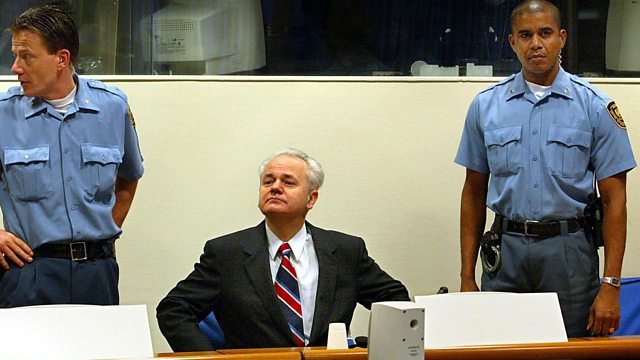
The legal reckoning was equally unusual, and also less complete than its reputation suggests. The UN Security Council created the International Criminal Tribunal for the former Yugoslavia in 1993, purpose-built for the conflict, and in May 1999 – while NATO’s bombs were still falling and while Milosevic remained the head of state of a country at war with the alliance prosecuting him – the tribunal indicted him. It was the first time a sitting head of state had been indicted by an international court. By the time the charges were finalised they ran to sixty-six counts spanning Kosovo, Croatia, and Bosnia: genocide, crimes against humanity, and war crimes, including the deportation of the roughly 863,000 Kosovo Albanians already noted above. Milosevic was ousted in a popular uprising in October 2000, transferred to The Hague the following year, and died in his cell in March 2006 before any verdict was reached.
But the tribunal that indicted Milosevic also, in the same period, examined and closed the file on NATO. After complaints from Yugoslav lawyers, Russian parliamentarians, and human rights groups covering the full range of allegations raised against the bombing campaign – deliberate targeting of civilians, the choice of unlawful military targets, the bombing of Serbian state television that killed sixteen civilians, the use of cluster munitions – ICTY Chief Prosecutor Carla Del Ponte’s office conducted an extensive internal review and announced in June 2000 that there was no basis to open an investigation into any of those allegations or into other incidents connected to the campaign, finding no deliberate targeting of civilians or of unlawful military targets and no evidence of the crime base needed for genocide or crimes-against-humanity charges, which had been the loudest complaint from Belgrade and Moscow but far from the only one reviewed. NATO welcomed the decision as vindication; critics, including Amnesty International, had already argued in a contemporaneous report that NATO’s targeting choices did not always meet its legal obligations. Whatever the merits of that specific legal call, the episode is itself instructive: the same institutional machinery capable of indicting a sitting head of state for war crimes reviewed serious allegations against the alliance that created and sustained it, and declined to proceed on any of them. Even the tribunal held up as the model of even-handed international justice drew a line around the conduct of the powerful actor in its own theatre of operations.
It is worth separating that finding from a second and distinct lesson the ICTY’s history teaches, because the two are often collapsed into one point when they support different arguments. Milosevic’s actual transfer to The Hague depended on a specific and narrow sequence of political conditions that had nothing to do with the tribunal’s own authority. The indictment sitting on paper in May 1999 did nothing to move him; what moved him was his defeat in Serbia’s own domestic uprising in October 2000, more than a year later. Even then, transfer required a successor government in Belgrade willing to hand him over – a government that had its own strong incentive to cooperate, since EU accession talks and the lifting of sanctions were explicitly conditioned on cooperation with the tribunal. Take away the electoral defeat, the cooperative successor government, or the EU membership carrot dangled in front of it, and Milosevic very plausibly dies as a sitting head of state who was never tried, indictment or no indictment. None of those three conditions exists, or shows any sign of emerging, in the Israeli case: there is no domestic political defeat of the current government in prospect on this issue, no successor government waiting to hand over indicted officials, and no external incentive on the scale of EU accession that Israel’s government has reason to trade for compliance with the ICC. The lesson is not that the ICC is a structurally weaker court than the ICTY was – legally, the two operate on different bases, as the following section discusses – but that even the ICTY’s celebrated success required a political alignment that was largely a matter of luck and defeat rather than of law, and that alignment is simply absent here.
Gaza After October 7: A Record Of Diplomatic Friction Without Coercion
The current phase of the Israeli-Palestinian conflict began with the Hamas-led attack of 7 October 2023, in which approximately 1,200 people in Israel were killed, the overwhelming majority of them civilians, and more than 250 people were taken hostage. Hamas is designated a terrorist organisation by the United States, the European Union, and a number of other governments; it governs Gaza while operating militarily from within its dense civilian population, using tunnel networks and, according to extensive reporting and Israeli military claims, positioning fighters and infrastructure in and around hospitals, schools, and residential buildings.
Israel’s military campaign that followed, waged at full intensity until the October 2025 ceasefire, produced very high Palestinian casualties. By August 2026, Gaza’s health ministry – which operates under Hamas authority but whose broad casualty figures have been treated as a reasonably reliable baseline by the UN and independent researchers, even as its precise breakdown by combatant status is disputed – had recorded more than 73,000 confirmed deaths since October 2023, including tens of thousands of children, alongside satellite assessments finding the large majority of structures in Gaza damaged or destroyed. Israel maintains that its targeting was directed at Hamas’s military capacity and that the civilian toll is substantially attributable to Hamas’s practice of embedding among the population it governs. Independent analyses of the resulting civilian-to-combatant casualty ratio diverge widely, and the question remains genuinely contested rather than settled.
It matters here to separate two legal problems that are often run together under the single heading of “the war in Gaza,” because they raise different questions and rest on different evidence. The first is the conduct of urban combat operations themselves: whether specific strikes on specific targets met the requirements of distinction and proportionality under the law of armed conflict, a question inseparable from the reality that Hamas fights from within a densely populated civilian area. The second is the siege: the restriction of food, fuel, medicine, and humanitarian access into Gaza, and whether that restriction amounted to starvation used as a method of warfare. These are not the same allegation. The ICC’s November 2024 arrest warrants against Prime Minister Benjamin Netanyahu and then-Defence Minister Yoav Gallant were built substantially around the second question – starvation as a method of warfare, alongside murder, persecution, and directing attacks against civilians – rather than around a claim that any individual strike was itself unlawful. Conflating the two blurs a case about the legality of a blockade with a much harder, strike-by-strike proportionality analysis that depends on operational detail rarely available to outside observers in real time.
The diplomatic and legal response to both sets of allegations was extensive in volume but limited in coercive force. The UN Security Council passed only a handful of resolutions on the war, with the United States vetoing or otherwise blocking several ceasefire-related drafts before eventually backing the negotiated truce. The General Assembly passed multiple non-binding resolutions critical of Israel’s conduct, continuing what has for decades been a disproportionately high level of General Assembly attention to Israel relative to other, often deadlier, conflicts. The International Court of Justice, hearing South Africa’s genocide case, issued provisional measures in January 2024 ordering Israel to take steps to prevent genocidal acts and permit humanitarian access – an interim order on a lower evidentiary threshold than a final judgment, not a finding of genocide. Written pleadings are scheduled to continue into 2029, and no merits judgment has been issued. Separately, and predating the war by more than a year in its legal groundwork, the ICJ issued a non-binding advisory opinion in July 2024 finding that Israel’s decades-long occupation of the Palestinian territories, including Gaza and the West Bank, is unlawful and must end as rapidly as possible – a ruling about the underlying occupation rather than about the conduct of the war itself, but one that forms part of the same body of international judicial findings against the Israeli state during this period.
What has not happened is, in a sense, the more revealing part of the record. There has been no military intervention against Israel of any kind. There has been no Yugoslavia-style comprehensive sanctions regime – no Security Council oil embargo, no coordinated international isolation of the state apparatus. The United States continued to provide military and diplomatic support throughout the war, at times attaching conditions or expressing public frustration, and it was Washington that ultimately brokered the ceasefire – a reminder that the same patron relationship that shielded Israel from coercive multilateral action was also the vehicle through which the war was eventually paused. What has been intense is public and civil-society pressure: mass protest movements across Western capitals, sustained campus activism, the Boycott, Divestment and Sanctions campaign, and a scattering of arms-export restrictions among European governments – measures that register political discomfort without approaching the coercive weight of a Security Council sanctions regime.
Five Structural Asymmetries
The disparity between these two records is real, but several structural facts help explain it without requiring a claim that international law was applied consistently in either case – and without requiring the strawman version of the Milosevic analogy that the introduction set aside.
The first asymmetry has to be built correctly, because it is the one most often argued badly on both sides. The honest comparison is not Milosevic-to-Hamas; it is Serbia-the-state to Israel-the-state, both accused of grave violations against a civilian population under their effective control. On that comparison, context matters that a Hamas-as-Milosevic framing conveniently skips: Gaza has been under an Israeli and Egyptian land, sea, and air blockade since 2007, following Hamas’s takeover of the territory, and in July 2024 the International Court of Justice found – in a non-binding but authoritative advisory opinion – that Israel’s occupation of the Palestinian territories generally is unlawful and must end. Those findings are part of the legal and political backdrop against which October 7 occurred, and any honest accounting of “who started what” has to include them rather than treating the war as beginning on a blank slate. None of that, however, erases what October 7 itself was: a cross-border attack that killed roughly 1,200 people, most of them civilians, and took more than 250 hostages, carried out by a group that governs Gaza and rejects Israel’s existence outright. Occupation and blockade help explain the conditions Hamas emerged from and operated within; they do not convert a mass-casualty attack on civilians into a legitimate act of resistance, any more than decades of grievance converted the Srebrenica massacre into anything other than what the tribunals found it to be. The two facts sit together, uncomfortably, without cancelling each other out: Israel entered this war carrying an adverse international-law finding about its underlying control of Palestinian territory, and the war itself began with an atrocity against Israeli civilians that Israel did not provoke on the day it happened, whatever the deeper history around it. Milosevic’s forces, by contrast, were not responding to an attack of that kind; they were the ones expelling and killing to consolidate ethnic control over contested territory. That remains a real difference in the two states’ postures at the point coercive action was considered, even once the occupation and blockade are placed on the scale.
The second asymmetry is alliance structure and relative power. In 1999, NATO could bomb Serbia with very limited risk of triggering a wider war between great powers; Yugoslavia had no patron capable of matching NATO’s capability or willing to risk direct confrontation to protect it. Israel occupies the opposite position: it is a close U.S. ally with an advanced conventional military and an undeclared nuclear deterrent, embedded in a decades-old bilateral relationship built on sustained military financing, intelligence cooperation, and a domestic U.S. political consensus that treats support for Israel’s security as a bipartisan baseline. There is no bloc today willing to underwrite coercive action against Israel the way NATO underwrote action against Belgrade – and, as the ICTY’s own decision not to investigate NATO shows, even the most powerful actor’s conduct within a successful war-crimes tribunal’s jurisdiction can end up outside the tribunal’s practical reach. The pattern repeats itself: powerful actors get investigated less thoroughly than weak ones, whether the tribunal in question is prosecuting Belgrade in 2000 or being asked to reach Jerusalem and Washington today.
The third is the legal architecture available in each case. The ICTY was a bespoke instrument, created by the Security Council specifically to address the Yugoslav wars, with jurisdiction that was never seriously contested by the government it ultimately prosecuted once Milosevic was out of power. The International Criminal Court, by contrast, is a treaty body whose jurisdiction over Israeli nationals is genuinely disputed as a matter of international law, given that Israel is not a party to the Rome Statute; the Court’s jurisdictional theory rests on Palestine’s accession to the Statute, a basis the United States and Israel reject as illegitimate. The asymmetry in enforceability between a Security Council-created tribunal and a contested treaty court is a structural feature of international law, not a special exemption invented for Israel – but it does mean the two proceedings are not comparable in their coercive weight, whatever the strength of the underlying allegations.
The fourth is the tactical terrain of urban combat itself. Gaza is among the most densely populated urban combat environments in modern warfare, and Hamas’s documented practice of operating from within civilian infrastructure raises genuinely distinct legal questions of distinction and proportionality – questions the Yugoslav tribunals rarely had to confront in the same form, since Serb forces were generally not fighting an adversary embedded within the attacking force’s own civilian population in the way Hamas is embedded within Gaza’s. This is not a claim that urban density excuses any particular strike; it is a claim that strike-by-strike proportionality analysis in Gaza depends on operational facts – who was in a building, what military use it had, what alternatives existed – that are far harder to establish from outside than the largely undisputed facts of 1990s ethnic-cleansing campaigns.
The fifth, and analytically separate, is the siege and access question. Restricting the flow of food, fuel, and medicine into a besieged territory is a distinct legal category from the conduct of strikes, governed by different rules – the law on starvation as a method of warfare and on humanitarian access, rather than the law of targeting. This is the category the ICC warrants centred on, and it is also the category where the post-ceasefire record has continued to generate friction between two irreconcilable accounts. Gaza’s Government Media Office has reported that only a fraction of the humanitarian trucks specified under the ceasefire agreement have actually entered the territory, with crossings periodically closed and restrictions on specific food categories persisting well after the guns fell silent; the UN’s own crossing-point tallies have likewise run well below Israeli figures for months at a stretch. COGAT, the Israeli military body that controls the crossings, reports a very different picture over the same period – tens of thousands of trucks and hundreds of thousands of tons of food and supplies delivered, several hundred trucks entering daily, and food prices in Gaza falling sharply since the ceasefire began – while disputing that the UN’s own delivery statistics capture the bulk of what it says has crossed. Neither side’s figures have been independently verified at the scale claimed, and, exactly as with the combatant-casualty question raised earlier, this essay is not in a position to adjudicate between them. What can be said is that the siege question has continued to be litigated in the court of documented, if contested, fact well into the ceasefire period, in a way the targeting question – largely frozen in the historical record of 2023–2025 – has not.
The Double Standard, Examined From Both Directions
None of this dissolves the double-standard argument; it only clarifies what the argument can and cannot support, and the strongest single piece of evidence for it may be the ICTY’s own history rather than anything unique to the Israeli case. A tribunal created by the Security Council specifically to prosecute the perpetrators of the Yugoslav wars reviewed credible allegations against the very alliance that had created the political conditions for its work, and declined to open an investigation – a decision NATO’s own leadership welcomed as vindication of a campaign it insisted had been conducted lawfully throughout. Whether or not that legal conclusion was correct on its own terms, the sequence illustrates something the Gaza comparison only extends: even functioning, well-resourced, broadly respected international tribunals have historically drawn their coercive force against weak or isolated states, and have handled allegations against powerful ones – NATO in 2000, Israel and the United States today – with considerably more caution, deference, or practical unenforceability. Israel’s position is not a novel exception to how international law works; it is closer to the rule, made visible because the case is unusually high-profile.
Critics of Israel’s treatment are correct, then, on a specific and defensible point: Western governments were willing to deploy military force and construct a dedicated international tribunal against a weaker, non-aligned state, while extending sustained diplomatic and material protection to a close strategic ally facing serious allegations of its own, and while quietly declining to pursue serious allegations against the alliance doing the prosecuting. The UN system’s decades-long pattern of disproportionate General Assembly attention to Israel cuts the other way, but the Security Council’s use of the veto to shield Israel from binding action is itself a form of double standard that predates October 2023 and continued through the war.
But critics of the Milosevic comparison, properly stated, also have a defensible point. Even accounting for occupation and blockade, Hamas is not the recognised Bosnian government NATO ultimately backed, and October 7 was a cross-border massacre of civilians by a group that also governs a civilian population and rejects the state it attacked – a legally distinct starting posture from an internal ethnic-cleansing campaign by a state government, whatever one concludes about the proportionality of what followed. And the world of 1999 was considerably more unipolar and Western-led than the multipolar landscape of the 2020s, in which a Global South-majority General Assembly, a more assertive Russia and China, and a less automatically deferential Western public opinion all pull against the kind of unchallenged Western consensus that made the NATO-ICTY combination possible in the Balkans.
There is also a third front in the double-standard argument that gets less attention than either of the first two: the selectivity of moral urgency itself. This is not a claim that international legal mechanisms have ignored Sudan or Syria – the ICC issued an arrest warrant for Omar al-Bashir over Darfur as early as 2009, and Syrian perpetrators have faced both the residual mechanisms built to preserve evidence of atrocities and a growing number of national prosecutions in European courts under universal jurisdiction. The selectivity is narrower and more specific than “no accountability”: it is a gap in protest intensity, General Assembly ritual, and Western street politics. Many of the same governments and activist movements that treat Gaza as a uniquely urgent moral emergency have shown markedly less sustained public mobilisation over comparably or more deadly conflicts in Sudan, Syria, and Yemen – wars that have produced casualty figures rivalling or exceeding Gaza’s, with far fewer mass protests in Western capitals, far less General Assembly floor time, and none of the sustained campus and civil-society campaigning that has attached to Gaza specifically. The same asymmetries that protect Israel from Security Council action also, in a different register, help explain why conflicts involving no Western-aligned party at all struggle to hold the same volume of Western public attention, whatever their formal legal treatment.
Conclusion: Not the Same War, Not the Same Enforcement
Two things can both be true, and the honest version of this comparison depends on holding them together rather than collapsing one into the other. The first is that these are not the same war. Milosevic’s forces launched and sustained campaigns of ethnic cleansing to consolidate territorial control; Israel’s campaign followed a cross-border massacre and hostage-taking by a non-state actor governing the territory it struck from, even as Israel entered that war under an adverse international-law finding about the underlying occupation, and even as the siege and targeting questions raised by its conduct since remain separately and seriously contested, at the ICJ, at the ICC, and in the documented record of the ceasefire that followed. Equating the two wars requires either ignoring how the current war began or ignoring the decades of occupation and blockade that preceded it, and a comparison that only manages one of those omissions is not more honest for having picked the more convenient one.
The second truth is that these have not been the same enforcement. Milosevic faced comprehensive sanctions, NATO bombardment, and a purpose-built tribunal because he led a militarily weak, diplomatically isolated state with no great-power patron willing to shield it – and even that tribunal, when the question turned to NATO’s own conduct, declined to press the case. Israel has faced ICJ proceedings, ICC arrest warrants, and diplomatic isolation across large parts of the UN system, but it has retained the sustained military and political backing of the United States throughout, has faced no coercive multilateral force of any kind, and reached its current ceasefire through American mediation rather than international pressure. That difference in enforcement is not primarily a difference in the underlying facts of civilian harm – Gaza’s death toll and destruction are not in serious dispute, whatever the argument over method and cause – it is a difference in what the international system has been willing, or able, to compel. Holding both truths at once means resisting two opposite temptations: treating the enforcement gap as proof that Israel’s conduct must therefore be broadly comparable to Milosevic’s, and treating the real differences between the two wars as proof that the enforcement gap does not matter. Neither equation survives contact with the actual record. What the record shows, instead, is a single consistent finding across both cases: international law’s coercive machinery moves against the isolated and the weak far more readily than it moves against the protected and the strong, regardless of how the underlying war began.
– – –
Bakchos is the founder of Blak and Black, an Australian media and advocacy platform established in 2010. Bakchos writes from the intersecting perspectives of Wiradjuri heritage, Jewish identity, and humanism.
© Bakchos, August 2026