
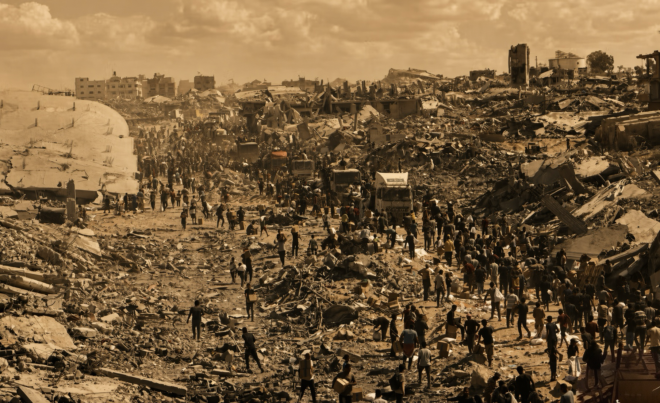
An Essay on Disappearance, and the Politics That Could Reverse It
After a poem written a year ago, itself built on the frame of Pete Seeger’s “Where Have All the Flowers Gone”
A poem asks a question it does not expect to have answered. That is its power and its limit. An essay owes the reader more: it must try to answer, or at least show its working. This essay follows the turns of the poem it grew from – villages, children, mothers, voices, hearts, justice, conscience – and asks, in each, not only where the Palestinians have gone, but how a people can go missing in plain sight, tracked by satellites, itemised in UN reports, and still be spoken of in the passive voice, as if disappearance were weather rather than policy. It then adds an eighth turn the poem, written before any of this had a shape, could not have made: not only what has been lost, but what would have to happen to answer it.
It is worth stating the counter-case at the outset, because an argument that will not face its strongest objection is not an argument, only a mood. Israel’s actions since October 2023 did not begin in a vacuum: Hamas’s attack that month killed around 1,200 Israelis and took hostages, and no state is expected to absorb that without response. Security concerns in a region with a genuine history of attacks on Israeli civilians are real, not manufactured. The question this essay asks is not whether Israel had cause to act, but whether what has followed – measured now in the ceasefire’s own violations, not just the war that preceded it – can still be described as security, or whether it has become something else.
I write this as the child of a Holocaust survivor, and I hold, without qualification, that Israel has the right to exist within secure, internationally recognised borders, safe from the annihilationist threats that have shadowed Jewish existence within living memory. I hold, with equal and unreserved conviction, that the Palestinian people have the right to life and to self-determination. These are not two competing claims to be traded off against one another. They are the same claim, made twice, in two languages, and a politics that answers one by denying the other has already failed both.
I. The Villages
The poem’s first disappearance is of place: people torn from where they lived. This is not a metaphor drawn from 1948, however much it echoes it. Throughout 2025 – before any new legal mechanism existed to formalise it – the Israeli human rights organisation B’Tselem documented at least twenty-one Palestinian communities forcibly uprooted, fully or partially, by state-backed settler violence. Then, beginning in December 2025 and culminating on 8 February 2026 in a security cabinet decision formalised the following week by government resolution, Israeli authorities added a bureaucratic mechanism to that violence: the registration of West Bank land as Israeli state property wherever Palestinian ownership cannot be formally proven. Israel’s own finance minister has described this as a fundamental change to the legal reality on the ground; his defence minister has called it, without euphemism, a strengthening of Israel’s hold on the territory. The International Court of Justice found in July 2024 that the occupation itself is unlawful under international law and called for its end. The villages are not disappearing by accident, and they were not waiting for a new law to begin disappearing.
II. The Children
More than a million people were displaced during the two years of war in Gaza before the October 2025 ceasefire, and the ceasefire has not returned them home so much as relocated the danger. Satellite assessments published by the UN in August 2026 recorded that the destruction of buildings in Gaza has continued to rise – by nearly ten per cent – since the guns were supposed to have gone quiet. Aid agencies now describe Gaza as divided by a so-called “yellow line,” with well over half the territory under continuing Israeli military control and the population compressed into the smaller, already devastated remainder. Children are not abstractions in these figures; UN humanitarian reporting through 2026 continues to record them among the dead in strikes on tents and shelters designated as safe. A ceasefire that still produces child casualties is not, functionally, a ceasefire for the people it is supposed to protect.
III. The Mothers
Grief that cannot be witnessed does not stop being grief; it simply loses its audience. In a report published in February 2026, Amnesty International quoted a mother of three from Ras Ein al-Ouja, near Jericho, who said the fear of attacks had forced her family to put their children to bed with their shoes on, in case they had to flee without warning. She and her family were among more than six hundred people displaced from that single community after being driven out into the winter cold in January 2026. This is not rhetorical mothering, offered up for sympathy; it is a description of a specific, adapted survival behaviour, the kind that only exists because return is not assumed. Where the poem hears silence, the record shows something more precise: testimony that exists, is collected, is published – and is not acted upon. The silence is not the mothers’ absence of voice. It is the world’s absence of response.
IV. The Voices
Here the poem’s target is closest to home, and hardest to write about honestly, because it implicates the writing itself. Palestinian dead are frequently reported through passive constructions – people “were killed,” buildings “were destroyed” – that let the sentence forget its subject. Casualty figures accumulate in the tens of thousands, reported by Gaza’s Ministry of Health and increasingly corroborated rather than dismissed by UN agencies, yet public attention cycles past them in days. This is not a claim that journalism has been dishonest; it is a claim, harder to rebut, that scale and repetition dull attention in a way that individual atrocity does not, and that headline culture is not built to sustain seven hundred consecutive days of the same emergency. A voice buried in headlines has not been silenced by censorship. It has been silenced by habituation.
V. The Hearts
Turning away is a policy choice dressed as fatigue. Nearly twenty governments have formally condemned Israel’s West Bank land measures as de facto annexation; a wave of states – including Australia, the United Kingdom, France, and Canada – moved in 2025 to recognise Palestinian statehood, bringing recognition into the majority of UN member states. And yet recognition has not yet translated into consequence: the annexation measures it condemns have continued, indeed accelerated, in the months since. There is a difference between a heart that has not noticed and a heart that has noticed, spoken, and then declined to act. The latter is colder, not warmer, for having spoken first.
That turning away acquired an unambiguous vocabulary in August 2026. Itamar Ben-Gvir, Israel’s National Security Minister and a sitting member of the security cabinet, said in a podcast interview that surfaced that month that Israeli forces should carry out nightly killings of “30 to 40” people in Gaza, extending beyond anyone posing an immediate threat, because, in his words, the people in question are “not even people” and “not worthy of life.” The remark was reported consistently across outlets from Al Jazeera to ABC News and CBS News, and drew condemnation even from some of Israel’s own supporters. Whether the nightly toll he named has ever been enacted as policy is beside the point the remark actually proves: a minister who controls the country’s police and prisons judged it safe, standing where he stands, to say that a whole people are not people. Dehumanising language of this kind is not a rhetorical excess that merely accompanies violence. It is the permission structure that precedes it and outlives it.
VI. Justice
The poem’s sixth stanza asks where justice has wandered to; the honest answer is that its address is known, but no one has gone to collect it. The ICJ’s 2024 advisory opinion was unambiguous: the occupation is unlawful and must end. Advisory opinions, by design, carry no enforcement mechanism, and that design choice is itself a form of politics – international law that pronounces judgment but withholds the means of compliance is not absent justice so much as justice deliberately declawed. Impunity here is not the state of nature. It is a maintained condition, upheld by the states with the power to withdraw it and the will not to.
VII. What Answering Both Would Require
A dual-rights claim that stops at diagnosis has not yet earned its conclusion. If Israeli security and Palestinian self-determination are, as this essay has argued, the same claim made twice, then something more than moral witness is owed: an account of what actually answering both would look like, in the specific terms of borders, force, reconstruction, governance, settlers, and Hamas. To leave that unwritten is to have diagnosed a crime more carefully than one has imagined a settlement – and a settlement, unlike a diagnosis, has to survive contact with the people who would have to live inside it.
Some of this is no longer only hypothetical, though it remains contested by the parties who would have to carry it out. The UN Security Council endorsed the Trump administration’s twenty-point framework and the creation of a Board of Peace in Resolution 2803, adopted in November 2025. Building on that framework, Hamas and the other Gaza factions agreed in late July and early August 2026 to a fifteen-point roadmap under which they would surrender heavy weapons and tunnel networks in verified phases to a technocratic Palestinian body, the National Committee for the Administration of Gaza, while a multinational International Stabilization Force assumed security functions and Israeli forces withdrew from the Strip on a phased timetable. Israeli Prime Minister Benjamin Netanyahu rejected that roadmap days later, telling his Cabinet in early August that Israel would not withdraw from its current positions until Hamas was, in his own words, completely disarmed, and that the version of the agreement made public did not reflect Israel’s position. So the agreement that exists is a document Hamas has accepted and Israel has not: a genuine advance on having no document at all, but not yet the mechanism its drafters describe it as.
Reconstruction under the roadmap is meant to run through the National Committee, financed chiefly by Gulf states including Saudi Arabia and the UAE, rather than around Gazan institutions – a design choice that matters, because reconstruction imposed over the heads of the people it rebuilds for reproduces the dispossession this essay has already traced, only in concrete rather than in columns of the displaced. What the roadmap does not specify, and what this essay holds it should, is an end date for technocratic rule: a committee with no elected mandate cannot govern indefinitely without becoming its own kind of occupation, however better-intentioned. That is this essay’s own position, not a term of the agreement – the case for it is that Palestinian self-determination, the right this essay has argued for throughout, means eventual Palestinian government by election, in Gaza and the West Bank together, not permanent administration by committee.
Borders and settlers are the harder sentence, and the essay will not soften it, nor pretend anyone has agreed to it. The ICJ’s 2024 opinion is not ambiguous: the settlements are unlawful, they should be evacuated, and Israel owes reparations for their construction. No party at the Gaza negotiating table has put settler evacuation, land swaps, or financed relocation on the table for the West Bank; this is the essay’s own prescription, following directly from the ICJ’s finding, not a report on anything agreed. More than seven hundred thousand settlers now live across the West Bank and East Jerusalem, woven into services, roads, and law in ways that make evacuation politically ferocious to propose and harder still to execute – but difficulty is not a counter-argument to a legal finding, only a description of the cost of ignoring one. A negotiated route exists in outline: phased Israeli withdrawal from settlements outside the main blocs, agreed one-for-one land swaps to resolve the blocs that remain, and international financing for settler relocation, on the same model the Gaza roadmap uses for disarmament and reconstruction – costed, verified, and sequenced, rather than indefinitely deferred. Whether that route is politically survivable for any Israeli government is a genuine, open question. That it is legally and morally the correct one is not.
None of this forecloses disagreement about sequencing, guarantors, or the durability of any given ceasefire, and a reader who thinks the Board of Peace roadmap will collapse under Israel’s rejection of it – or that Hamas’s factional rivals would simply inherit any weapons it did surrender – is arguing from evidence, not from bad faith. What can fairly be said is narrower than a prediction and harder to dismiss than a wish: for Gaza, a mechanism specifying force, governance, and reconstruction together now exists in text, accepted by one party and rejected by the other, which is further than the war ever got on its own. For the West Bank, no comparable text exists at all; the essay’s own claim there is normative, not diplomatic. What both halves share is that the absence of a finished settlement is not evidence that none is possible. It is evidence of what has not yet been demanded.
VIII. Conscience
There is scripture, too, that will not let this rest as merely a matter of politics. The opening chapter of Genesis records that humanity was made “in the image of God” – not this or that nation before another, but the whole of it, each person carrying the same likeness. The rabbis of the Mishnah drew the ethical conclusion from that verse centuries before international law existed to draw it in secular terms: humanity descends from a single ancestor precisely so that no one could ever say to another, my lineage is greater than yours, and so that whoever destroys a single life is accounted as though he had destroyed an entire world. A tradition that grounds human worth in the image of God carries no exception clause for Gaza or the West Bank. If the doctrine holds anywhere, it holds there, and a minister who calls a people “not even people” has not merely made a political error. Measured against that inheritance, it is a theological one – and the inheritance does not stop at rhetoric. A conscience that will not look steadily at Ras Ein al-Ouja is the same conscience that will not pay for settler relocation, or insist that Hamas’s weapons actually leave Gaza rather than change hands. The theology and the roadmap are the same test, asked twice.
The poem’s final turn addresses the reader, and so must the essay. Conscience is not a spectator’s emotion, felt and then filed away; it is only conscience if it changes what a person or a state is willing to do next. The evidence assembled here – from UN human rights bodies, from Amnesty International, from the International Court of Justice, from Israel’s own ministers describing their own policy in their own words – does not require faith to accept, only attention. The people, the villages, the children, the mothers, and the voices this essay traces have not vanished. They have been made difficult to keep looking at. That is a different thing, and it is reversible in a way that disappearance is not. Where conscience goes, if nothing changes, is exactly where the poem feared: gone with Palestine, every one. The question the poem could only ask, this essay has tried to answer: a contested mechanism for Gaza, a normative prescription for the West Bank, and elections as the measure of whether either people is actually being allowed to govern itself. The reader’s task now is not to invent a plan of their own. It is to decide whether this one – or any plan that actually answers both claims – is worth demanding.
– – –
Bakchos is the founder of Blak and Black, an Australian media and advocacy platform established in 2010. Bakchos writes from the intersecting perspectives of Wiradjuri heritage, Jewish identity, and humanism.
© Bakchos, August 2026

The fact that the member of Parliament, a government minister, a member of the security council, and the person in charge of the police and prisons finds it acceptable to say that a whole people are not people, and the majority of the country seems to agree with him, is disturbing extreme.
And Ben Gvir Itamar’s intention to hold public executions is a very grim spectacle reminiscent of burning witches. Another Dark Age.
Ben Gvir Itamar’s whole being is an affront to the Jewish faith. I quote a lengthy passage from my essay:
“There is scripture, too, that will not let this rest as merely a matter of politics. The opening chapter of Genesis records that humanity was made “in the image of God” – not this or that nation before another, but the whole of it, each person carrying the same likeness. The rabbis of the Mishnah drew the ethical conclusion from that verse centuries before international law existed to draw it in secular terms: humanity descends from a single ancestor precisely so that no one could ever say to another, my lineage is greater than yours, and so that whoever destroys a single life is accounted as though he had destroyed an entire world.”
Zionism is making the Palestinian villages disappear, nothing else but Zionist aggression.
I don’t care what anyone else says what Israel is doing in Gaza is genocide and that’s the harsh reality.
Gaza is a genocide against the Palestinian people by Zionism.
Ask Bibi Netanyahu where all the Palestinians have gone, no doubt he knows.
Hi Mirko, Netanyahu is a war criminal, and a genocidal bastard.
Here have all the Palestinians gone? Buried under the rubble of Netanyahu’s Vernichtungskrieg.
The missing Palestinians have been victims of a genocidal maniac by the name of Bibi Netanyahu.