
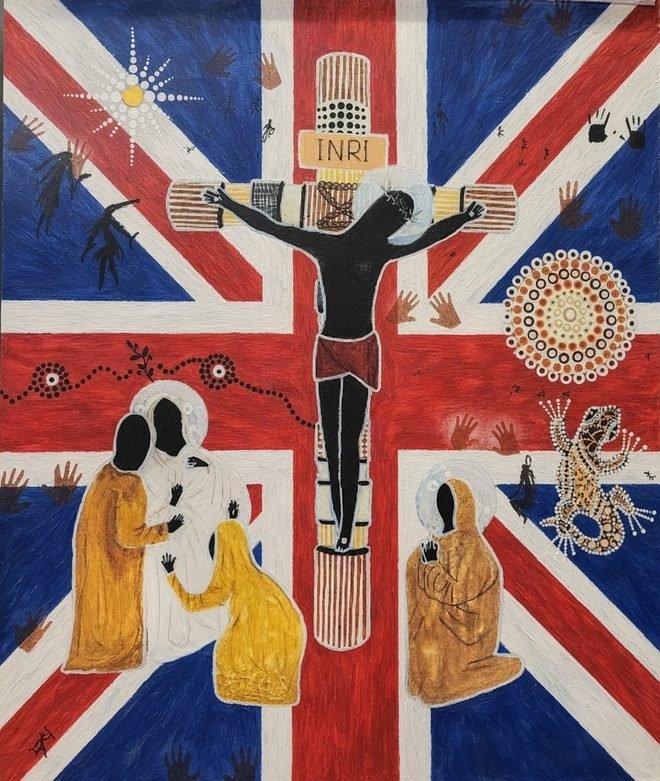
How a continent’s first peoples were killed, confined and counted out, and why the arithmetic still matters
For at least sixty-five thousand years, and quite possibly far longer, Aboriginal and Torres Strait Islander peoples have inhabited the Australian continent, and for the most part they lived as hunters and gatherers. It is among the longest continuous human occupations of any landscape on earth, and it was sustained not by accident but by deep knowledge: of seasons and waters, of plants and animals, of the manner in which country could be tended so that it would in turn provide. Then, in 1788, strangers arrived at Sydney Cove. Within a few short years the descendants of those first peoples had been turned, by an inversion as brutal as it is linguistically neat, from hunter-gatherers into the hunted and gathered.
The phrase is a rhetorical device, but it is also a fair summary of a historical sequence. Indigenous Australians were hunted, in the sense that they were killed by introduced disease, by the guns of settlers, stockmen and Native Police, and by the slower violence of starvation once their country was fenced, cleared and stocked with sheep and cattle. They were gathered, in the sense that those who survived were rounded up and confined by statute on missions, reserves and government stations, where their movements, wages, marriages and children were controlled by officials. And the logic of gathering did not end with the protection boards. It persists, in altered form, in the figures that describe who fills Australia’s prisons today. This essay traces that arc. It begins with the scale of the demographic catastrophe, considers its principal causes, examines the legal architecture of confinement, and concludes with the contemporary evidence of over-representation in custody, arguing that this history is not a closed chapter but a continuing condition.
A Continent Peopled, a People Uncounted
Any account of the destruction must begin with the difficulty of measuring it. Estimates of the Indigenous population of Australia before 1788 vary enormously. Historians have traditionally proposed figures of between three hundred thousand and one million people, while some recent modelling suggests a median figure closer to 2.2 million. The uncertainty is not merely academic. It determines how steep the subsequent decline is judged to have been, and it reminds us that the people who watched the First Fleet anchor were not a scattering of nomads but a large and diverse population, holding country under complex systems of law.
What is not in doubt is the condition in which the new Commonwealth found the survivors. At federation in 1901 the Indigenous population was estimated at only 93,333 people. The breakdown by state and territory, itself an exercise in informed guesswork, ran as follows: some 7,434 in New South Wales, 652 in Victoria, 26,670 in Queensland, 5,185 in South Australia, 157 in Tasmania and 23,235 in the Northern Territory, together with a figure of 30,000 for Western Australia that was frankly estimated, because no full enumeration of Aboriginal people there had been attempted. These were not census counts. Practices varied from colony to colony, and many people, especially those living traditionally or in remote regions, were never enumerated at all. Where Aboriginal people were actually counted, the raw figures were lower still, often cited at around forty to fifty thousand, depending on how officials distinguished “full-blood” from mixed ancestry and the “civilised” from the “nomadic”. The Tasmanian figure in particular reflects those narrow colonial definitions rather than the survival of a community whose descendants live and flourish today.
The Constitution itself institutionalised the neglect. Section 127 directed that, in reckoning the numbers of the people of the Commonwealth or of a State, “aboriginal natives shall not be counted”. The provision bore on matters such as parliamentary representation and funding, and in practice people of mixed descent were generally included in the main population figures while those regarded as full-blood were excluded or estimated separately. The non-Indigenous population counted in 1901 was about 3.77 million, so that Indigenous people made up, on the best estimates, perhaps two to two and a half per cent of the whole. A people who had been the sole inhabitants of the continent for sixty-five millennia had become, in the arithmetic of the new nation, a rounding error, and the founding document wrote that erasure into law until section 127 was repealed in 1967. Measured against any pre-contact estimate, the reduction in numbers was somewhere between eighty and ninety-five per cent, and possibly more depending on the starting figure, with the steepest losses in the densely settled south-east and in Tasmania, and slower or later impacts in remote regions.
The Dominant Killer: Disease
The largest single cause of this collapse was not the musket but the microbe. Aboriginal people had no prior exposure, and therefore no acquired immunity, to the great Old World pathogens carried by the ships of the colonisers. Epidemiologists describe such populations as “virgin soil”, and the consequences of an epidemic in virgin soil are catastrophic: mortality of fifty to eighty per cent or higher in affected communities, and a social disruption so profound that survivors were often unable to rear the next generation in sufficient numbers to permit recovery.
Smallpox is the best known of these visitations. A major epidemic struck in 1789, around Sydney, and spread widely through the south-east; a second wave followed between 1829 and 1831. Contemporary accounts and modern modelling point to extraordinarily high death rates, and recent work has estimated tens to hundreds of thousands of deaths from the 1789 outbreak alone in the south-eastern regions. Smallpox was far from the only killer. Influenza, measles, tuberculosis, whooping cough, scarlet fever and dysentery all took their toll, and sexually transmitted infections, above all syphilis and gonorrhoea, reduced fertility and drove up infant mortality, so that populations bled by one epidemic could not replenish themselves before the next arrived.
Disease did not wait for settlers. It moved along trade routes, river systems and pathways of travel, frequently running far ahead of direct European settlement, so that communities could be devastated before they had ever laid eyes on a colonist. Later, when survivors were concentrated on missions and reserves, crowding, poor sanitation and inadequate food and medical care ensured high ongoing mortality from respiratory and infectious disease. Historians and demographers, among them Noel Butlin and Richard Broome, together with medical historians, consistently identify disease as the largest single cause of excess deaths.
It would nonetheless be a mistake to treat disease as a purely natural calamity that stands apart from the colonial project. A people already dispossessed, malnourished and in flight from violence is far more vulnerable to infection than one secure in its own country, and every other process described in this essay magnified the impact of the pathogens. Disease provided the opening; colonisation ensured that the wound would not heal.
The Hunted: Frontier Violence
If disease was the largest cause of death, violence was the most deliberate. As the pastoral frontier expanded across the continent, violent encounters between settlers, stockmen, police and Indigenous groups were widespread. They took the form of retaliatory killings, of massacres, and of organised campaigns launched after stock theft, after resistance to occupation, or simply in competition for water and resources. Among the instruments of this violence were the Native Police forces, armed detachments commanded by European officers and deployed against Aboriginal communities, most notoriously on the Queensland frontier. Contemporary accounts record parties of mounted men riding out to “disperse” Aboriginal camps, a euphemism that concealed precisely what dispersal meant.
The documented massacres and killings number in the thousands of incidents, and estimates of the overall death toll from direct violence typically range from tens of thousands, with some scholars arguing for higher figures. Such numbers are necessarily uncertain, since many killings were never recorded and others were deliberately concealed, but the pattern is beyond serious dispute. Violence also did more than kill directly. It fragmented communities, displaced survivors from their country, and thereby facilitated both the further spread of disease and the loss of land.
Indigenous resistance was significant and prolonged in many regions, and it is important to say so, because the popular image of a passive people who simply faded away before the advance of civilisation is false. Aboriginal people fought for their country, in some places for decades. But they were ultimately overwhelmed by superior numbers, by firearms, and by the organisation of a settler state that could draw upon police, courts and military force, and that only rarely treated the killing of Aboriginal people as a crime to be prosecuted. In the most literal sense of the word, Aboriginal people were hunted.
Dispossession and the Destruction of Country
Beneath the visible violence lay a slower and more comprehensive assault: the destruction of the economic and ecological foundations of Aboriginal life. The doctrine of terra nullius, which treated the continent as belonging to no one and so denied the existence of Aboriginal law and ownership, supplied the legal fiction under which the land could be taken. The pastoral industry supplied the means. Occupation by sheep and cattle, the erection of fences and the clearing of vegetation destroyed or degraded the systems by which Aboriginal people had hunted, gathered and managed country for millennia. Waterholes were fouled, food plants were grazed out and game retreated, and people who were shut out from their own resources were left to choose between starvation and theft, and then punished for the latter.
The results were malnutrition, starvation and a heightened vulnerability to the very diseases already described. Forced removals to missions, reserves and government settlements compounded the harm by disrupting social structures, the transmission of knowledge between generations, and fertility itself. Alcohol, social breakdown, high rates of infertility caused by disease, and elevated infant and child mortality reinforced these losses. In Tasmania the combination of disease, violence and removal nearly extinguished local populations, and a colonial myth of extinction long outlived the facts.
The exact proportional contributions of these causes remain debated because the records are incomplete. Yet the multi-causal pattern, with disease first and foremost, reinforced by the processes of colonisation, is well established in historical and demographic scholarship. That consensus dispels two opposite temptations. The first is to blame everything on violence and to disregard the microbe; the second is to treat disease as the whole story and so to absolve colonisation of responsibility. Each cause fed the others. Violence scattered communities and opened them to infection; dispossession weakened bodies and made recovery impossible; and the removal of the survivors from their country broke the chains of knowledge and kinship on which the next generation depended.
The Gathered: Protection, Missions and Reserves
Those who survived the hunt were gathered. The systematic confinement of Aboriginal Australians to missions and reserves began in the mid-to-late nineteenth century, and its first comprehensive colony-wide framework was Victoria’s Aboriginal Protection Act 1869. It is important not to read this system back into the earlier decades. Early missionary efforts, such as the Parramatta Native Institution of 1814, the Lake Macquarie mission of the 1820s and Wellington Valley in 1832, were primarily voluntary or small-scale ventures in conversion, education and what their sponsors called “civilising”. They possessed no broad legal power to compel the wider Indigenous population to live on them. Some early government settlements, such as Wybalenna on Flinders Island in the 1830s, involved relocation after conflict, but they were not part of a systematic policy.
From the 1860s, colonial governments shifted to “protection”, and with it to legal powers to control where Aboriginal people lived, moved and worked. The Victorian Act of 1869 established the Board for the Protection of Aborigines, with authority to prescribe where Aboriginal people must reside, to regulate their employment and marriage, and to control the care and custody of their children. It strengthened earlier arrangements, including a Central Board and reserves from 1860, and enabled compulsion onto missions and government stations; by the late 1860s a significant portion of Victoria’s Aboriginal population already lived on them. Queensland’s Aboriginals Protection and Restriction of the Sale of Opium Act 1897 was more restrictive still. It allowed the Chief Protector to remove people onto, and between, reserves and missions and to control their lives extensively, and it became a model for later laws elsewhere. Other jurisdictions followed in the late nineteenth and early twentieth centuries, among them Western Australia in 1886 and 1905 and New South Wales in 1909, typically empowering protectors or boards to dictate residence on reserves or missions, to restrict movement off them, to control wages and to remove children.
Missions, run by churches, and reserves or stations, run by governments, overlapped in practice, and many people were forced or pressured onto them under the protection laws. Conditions varied, but the system as a whole restricted freedom of movement, cultural practice, family life and employment. The removal of children, remembered in later generations as the Stolen Generations, was the most intimate expression of this power. The segregation and control lasted into the mid-twentieth century before being gradually dismantled under successive policies of assimilation and, later, self-determination.
There is a bitter irony in the vocabulary. “Protection” was the language of confinement, and the people who had once gathered food from their own country were now gathered by the state, to be housed, rationed, supervised and, until 1967, excluded from the count of the nation’s people. Dispossession had taken the land; the protection era sought to govern what remained of the lives lived upon it.
Gathered Again: Incarceration in the Present
The story does not end with the dismantling of the protection boards. Aboriginal and Torres Strait Islander people remain heavily over-represented in Australian prisons. The latest figures from the Australian Bureau of Statistics, in its Prisoners in Australia release for 30 June 2025, record 17,432 Aboriginal and Torres Strait Islander prisoners, who made up 37 per cent of the total adult prison population of 46,998. The age-standardised imprisonment rate for Indigenous adults was 2,500 per 100,000, against a national rate for the whole adult population of 216 per 100,000. Indigenous Australians make up only about three to 3.8 per cent of the total population, yet they account for more than a third of those in prison.
Depending on whether crude or age-standardised rates are used, this represents an imprisonment rate roughly ten to fifteen times higher than that of non-Indigenous Australians. Age-standardised rates are preferred because the Indigenous population is younger on average, and on that basis the overall ratio is commonly cited in the range of twelve to seventeen times. The disparity is starker still when broken down by sex. Around 2024, Indigenous men were imprisoned at roughly twelve to thirteen times the rate of non-Indigenous men, and Indigenous women at more than sixteen times the rate of non-Indigenous women.
The disparity is long-standing and, on some measures, has widened in recent years. Reducing it is one of the national Closing the Gap targets, which commits governments to cutting the Indigenous adult incarceration rate by at least fifteen per cent by 2031. Yet the rate has been increasing rather than falling.
To say that the modern prison is the descendant of the reserve is not to claim that the two institutions are identical, nor that the circumstances of every prisoner can be read off a colonial statute. Criminal justice is shaped by many hands: by policing practices, by bail and sentencing laws, by access to legal representation, and by the intergenerational legacies of poverty, trauma and dislocation. The Royal Commission into Aboriginal Deaths in Custody, reporting in 1991, found that the high number of Aboriginal deaths in custody was a product of the extraordinary rate at which Aboriginal people were being taken into custody in the first place, and it traced that over-representation to the enduring legacy of dispossession, removal and disadvantage. More than three decades later the central finding has lost none of its force. The question the figures raise cannot be avoided: when one people is hunted from its land, gathered onto reserves and then, generations later, gathered into cells at ten or more times the rate of its neighbours, it is hard to believe that the earlier history has no bearing on the later outcome.
Conclusion
The sentence with which this essay began compresses a long and terrible history into a single inversion. For sixty-five thousand years or more, Aboriginal peoples hunted and gathered on a continent they knew intimately. In little more than a century they were reduced by perhaps eighty to ninety-five per cent, by disease above all, but by violence, dispossession and the systematic breakdown of their societies as well. The survivors were then gathered, by law, onto missions and reserves, counted by no one and controlled in almost every detail of their lives. The apparatus of protection has gone, but its shadow remains in the statistics of the courts and the prisons.
None of this is an argument for despair, and still less for the fiction that Indigenous Australians are merely the objects of history. They resisted the frontier, they endured the reserves, and they continue to assert their law, language and kinship against every attempt to extinguish them. The task for the wider society is a more modest one, and in its way more difficult: to count accurately, to remember honestly, and to recognise that the institutions which govern Indigenous lives today have a genealogy. A nation that wrote the erasure of a people into its Constitution cannot expect to repair the consequences by good intentions alone. If the movement from hunter-gatherers to hunted and gathered is to be reversed, it will require not only the closing of statistical gaps but the return of what the whole sequence took away: security in country, authority over the decisions that shape community life, and the plain recognition that the people who lived here first are still here.
A Note on the Figures
The 1901 state and territory numbers are colonial estimates, not census counts, and the Western Australian figure was estimated in the absence of any full enumeration. Pre-1788 population estimates range from several hundred thousand to more than two million, so the proportion of decline is stated as a range. The disease and frontier-violence death estimates are scholarly estimates and remain contested. The incarceration figures are those of the Australian Bureau of Statistics, Prisoners in Australia, 30 June 2025.
– – –
Bakchos is the founder of Blak and Black, an Australian media and advocacy platform established in 2010. Bakchos writes from the intersecting perspectives of Wiradjuri heritage, Jewish identity, and humanism.
© Bakchos, November 2026