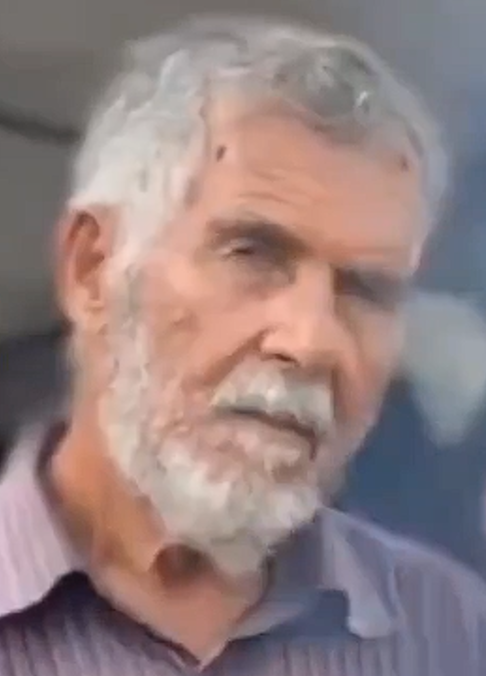
He sees you watching him, an empty pot in his hands as he waits for someone to ladle gruel. His son is gone. His son-in-law is gone. His daughter, his daughter-in-law, his wife and his grandchildren all wait for him to return with their meagre ration.
A short video of Abdullah Mohammed Saber Ayoub has laid poverty bare in my mind for a week: a poverty born not of a lack of means, but of man’s avarice. I see a man grieving for his family, for the way he is made reliant on others, for the loss of everything he once had. A larder stocked full. A garden. Books and drawings to stimulate his mind. Sons to help him in his age. A home filled with the laughter and love of family and friends, free to share a repast harvested from fields that were once fertile and abundant, and are now obliterated and littered with the debris of war. Fields now graves.
I see something more. Anger. Resentment. He resents that you see him, forced to ask for something that three years ago he would have been able to provide for himself and his family. He resents that you see him bounded in a ghetto by a disaster he could not foresee or escape.
The shame in that frame is not his. A man who fed his household for a lifetime does not hold out an empty pot through any failing of his own. The dishonour belongs to those who have made a ladle of gruel the measure of his family’s survival, and to those of us who have watched it happen from a safe distance.
At one point I think he may dissolve into tears, but he lifts his chin and looks at me, and it is then that I see the most deeply seated of his emotions, the one that matters most. Defiance. He will not give me, give you, give the camera his tears. Defiance is the proud, smouldering coal that burns more deeply than anger in Gaza’s furnace.
Consider glass. Sand and ash are melded together and moved as they are shaped by hands they must obey. The glassmaker returns the piece again and again to the glory hole, the furnace where it is reheated so that it stays workable, and each return changes it a little. But once those hands stop, once the glory hole closes for the last time and the glass is left to anneal, cooling slowly until it settles, the maker must face what he has shaped. Glass, however transparent, leaves no place to hide a maker’s imperfection. In Gaza, those of us who watched are among the makers, and what has been shaped will be there to look back at us.
The war in Gaza is a furnace that melts and reforms souls. In its crucible Abdullah has lived for seventy-seven years. He was able to study and learn, to raise a family and to find the quiet joys of an ordinary day. It is possible that he has been displaced more than once. Born on contested land at the close of the Nakba, he has likely known marginalisation and uncertainty his whole life. Every new conflict, every attack, reheats his soul and shapes it a little more.
I doubt that Abdullah’s defiance will shift. Could I lift him and his family out of the wasteland and carry them to new shores, warm kitchens and abundant produce, that defiance would still define his remaining days. It stands at the glory hole and weathers each blast of heat, grudgingly accepting that it will be hot and that it will be shaped, but always waiting for the moment when it can show you what is at its heart.
History rarely recalls the names of those who stood in defiance of an overwhelming foe and lost. The most famous must be Leonidas and the 300 Spartans who fought the Persians at Thermopylae. Grossly outnumbered, with death all but assured, they stood their ground so that their comrades could escape and the Greek city-states could live to fight on. Abdullah may not be a Spartan, but he stands as proudly against a foe he knows he will never overcome. That he must cede to the deprivations of occupation and military control does not mean he accepts the terms.
There is a difference, and it deepens the comparison rather than weakening it. The Spartans chose their pass and knew the hour at which they would hold it. Abdullah chose nothing. His stand was handed to him with the siege, the hunger and the queue for gruel, and he holds it without a shield, without comrades beside him, and without any assurance that history will remember him. What he has left to defend is the one thing that cannot be rationed: his refusal to be diminished.
Abdullah is unlikely to take up arms at his age, or to attack anyone, but his quiet defiance, as children caper in front of him, is as dangerous as any slingshot. He will remember you, me, all of us: how we watched and did nothing. We will not see him cry and we will not see him grovel. He knows that we owe him, and should he get the chance, he will demand payment in full, recompense for the dishonour, and what he is owed he will share among his family. He is one among many, shaped in the same furnace, and he despairs that it will fire up again and claim more of his world. We owe him a debt larger than any one person can repay. Is it any wonder he looks at us with such defiance?
– – –
© Watershedd, October 2026