Eleven years after Paris, the 1.5 degree line is gone. What is left to defend, and who is already paying.
When delegates in Paris adopted their agreement in December 2015, the room erupted in applause. Almost every government on earth had put its name to a single shared ambition: to hold the rise in global temperature well below two degrees celsius above preindustrial levels, and to pursue efforts to hold it to one and a half. The second number was a late and somewhat improbable addition, pushed forward by small island states and vulnerable nations who understood that two degrees would be a death sentence for their homes. For eleven years it became the moral centre of the climate movement. It was printed on banners, chanted at rallies and repeated by diplomats until it became a kind of liturgy: keep 1.5 alive.
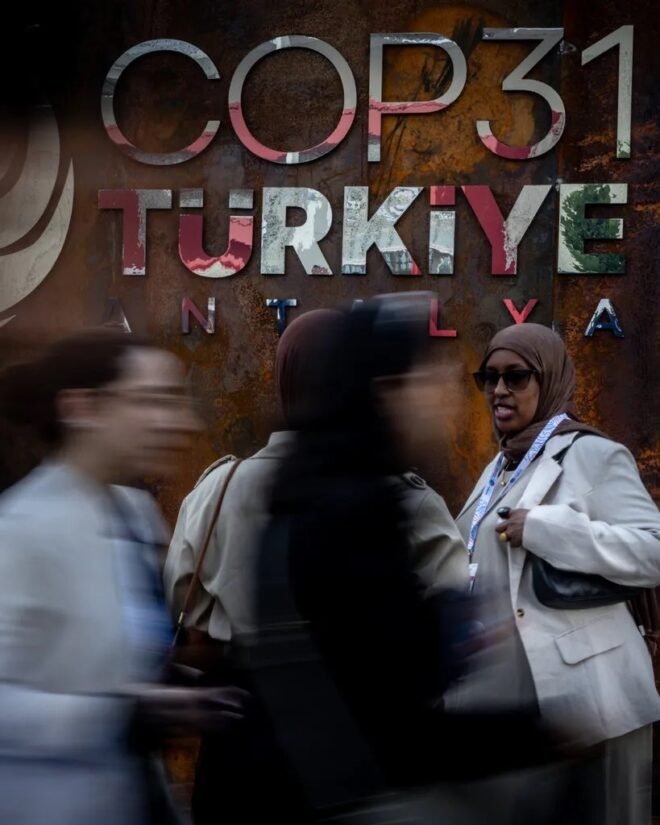
This week, at the thirty-first conference of the parties in Antalya, the phrase is being spoken in the past tense. The United Nations Environment Programme has concluded that the world has no realistic path to meeting the 1.5 degree target, and that every remaining pathway involves overshooting it. Australia’s climate minister, Chris Bowen, who is leading the negotiations, has said bluntly that the world has no chance of holding to the line. The question is no longer whether the threshold will be crossed but how high temperatures will climb beyond it, how long they will stay there, and what is lost in the meantime. To understand where we are, it is worth looking honestly at the decade since Paris, which was neither the failure its harshest critics describe nor the success its architects hoped for.
What Paris changed, and what it did not
The Paris Agreement was built on an unusual theory of diplomacy. Earlier attempts, most notably the Kyoto Protocol, had tried to impose binding emissions targets from the top down, and they collapsed on the refusal of the largest emitters to accept them. Paris inverted the structure. Each country would decide its own contribution, publish it, and return every five years with something more ambitious, while a regime of transparency and peer pressure did the work that enforcement could not. It was a bet that shame, markets and technology would eventually pull governments further than treaty law could push them.
In one respect the bet has paid off. The projections of where the world was heading have moved dramatically. In 2015, the pledges then on the table pointed to something like three to three and a half degrees of warming by 2100, and many analyses of the policies actually in place suggested the world was drifting toward four. The United Nations now says that even if current pledges are fully implemented, the world is on course for about 2.6 degrees. That is a full degree and more below the worst trajectories of a decade ago, and it is not nothing. A degree of avoided warming is the difference between a planet that is very hard to live on in places and one that is catastrophic almost everywhere. Much of that improvement came from forces that Paris helped to catalyse but did not fully control, above all the collapse in the cost of solar power, wind power and batteries. Solar, which was a boutique technology in 2015, is now the cheapest source of new electricity across much of the world, and electric vehicles have moved from curiosity to mass market in China and Europe. Coal’s long expansion has stalled in several of the largest economies, and clean energy investment now comfortably exceeds spending on fossil fuels.
But the improvement has been, in the grimmest sense, too gradual and too uneven. Another recent assessment notes that the projected warming of 2.6 degrees is the same outlook as in 2024 and 2025, which is to say that the progress has stopped. The easy gains, the ones that came from retiring the dirtiest power plants and from falling technology costs, have been banked. What remains requires the transformation of steel, cement, shipping, aviation, agriculture and the way cities are built, and that work is slower, more expensive and more politically contested. Global emissions have kept rising for most of the period since Paris, interrupted only by the pandemic. They have flattened in some years and in some places, but flattening is not falling, and the atmosphere responds to the accumulated total rather than to the annual rate.
The deeper problem was always the gap between what the agreement said and what the pledges delivered. The countries that signed Paris promised to keep warming well below two degrees, yet their own national plans, even when added together and even when fulfilled in full, never came close to that promise. The five-year ratchet was meant to close the gap by encouraging each round of plans to be bolder than the last. In practice the rounds have been incremental, delayed and in some cases quietly diluted. The summit in Glasgow in 2021 produced the first explicit reference to phasing down coal. Dubai in 2023 produced a commitment, after bruising negotiation, to transition away from fossil fuels in energy systems, which sounds obvious but had been resisted for nearly thirty years. Yet the follow-through has been feeble, and the most recent summit in Belém in 2025 was widely judged to have let fossil fuels off lightly once more. As one climate advocate put it at this year’s opening, the world is breaching 1.5 because it avoided for so long the fundamental question of what caused the problem, which is fossil fuels.
The politics of retreat
Any honest account of the past eleven years has to reckon with the way the political ground has shifted beneath the agreement. Paris was concluded at a moment of unusual optimism about international cooperation, with the United States and China, the two largest emitters, having just reached a bilateral understanding that made a global deal possible. That alignment has dissolved. The United States has twice announced its withdrawal from the agreement, and under the current administration it has not merely stepped back but actively promoted fossil fuel production and dismantled domestic climate regulation. Its absence from the Antalya talks is conspicuous, and it removes both the largest historical emitter and a major source of finance and technology from the table. China, meanwhile, has become the dominant manufacturer of clean technology and appears to be nearing a peak in its own emissions, but it remains the world’s largest emitter and still builds coal capacity at a scale that unsettles every projection.
Beyond the great powers, a wave of geopolitical conflict, energy-security anxiety and economic nationalism has pushed climate down the list of governmental priorities. Wars have redrawn energy markets and revived arguments for domestic oil and gas. Inflation and the cost of living have made voters in many democracies impatient with policies that raise prices in the short term, and a vocal movement of political opponents has learned to frame climate action as an elite project imposed on ordinary people. The United Nations Secretary-General, António Guterres, has acknowledged what he calls a leadership gap, though he insists that overshooting 1.5 degrees is not surrender.
It is worth dwelling on that distinction, because it will shape the politics of the coming decade. There is a danger that “the target is dead” becomes an excuse rather than a diagnosis. The physics of climate change contains no cliff edge at 1.5 degrees; the harms grow continuously with every increment of warming. A world that reaches 1.7 degrees is considerably better off than one that reaches 2.2, and that world in turn is far better off than one that reaches 3. The temptation, once a symbolic line has been crossed, is to conclude that nothing matters any more. The science says precisely the opposite: everything still matters, and arguably matters more, because the remaining decisions determine how deep the damage goes.
Where we are now
The planet today has already warmed by about 1.4 degrees by the standard multi-year measure, and individual years have already exceeded 1.5. The year 2024 was the first calendar year in the instrumental record to average above that figure, and the last three years have been the hottest ever measured. Scientists have been debating whether warming has accelerated beyond what the models projected, owing to a combination of falling pollution from shipping and industry that had been masking some heating, changes in cloud cover, and the weakening of natural carbon sinks. The central estimate is that the long-term average will cross 1.5 degrees within the next few years.
The arithmetic of what remains is unforgiving. To have any chance of staying under 1.5 degrees, total emissions from 2026 onward cannot exceed roughly 130 billion tonnes of carbon dioxide, which at current rates is a little over three years of global emissions. That budget is effectively spent. What the most optimistic scenarios now offer is a temporary overshoot followed by a return. The UN’s most hopeful pathway requires global emissions to fall 18 percent by 2030, 45 percent by 2035 and 69 percent by 2040 relative to 2025 levels, which would peak warming at around 1.7 to 1.8 degrees and then bring it back toward 1.5 by the end of the century, relying on large-scale removal of carbon dioxide from the atmosphere. The pace of cuts implied is of the order of six percent a year, a rate the world has only achieved during the worst economic shocks, and the removal technologies it depends on barely exist at scale. Even the most optimistic scenario, in which every national plan and net-zero pledge is fully honoured, leaves peak warming at about 1.8 degrees, and the UN’s own report describes a return below 1.5 as deeply uncertain.
The risks that now confront us
The first and most obvious risk is the intensification of extreme weather, which is no longer a projection but a lived experience. Heat waves that would once have been rare events now recur, and the combination of high temperature and humidity is beginning to approach the limits of human tolerance in parts of South Asia, the Gulf and West Africa. Wildfire seasons have lengthened across the Mediterranean, western North America, Australia and the Amazon, where fires are burning again this year. A warmer atmosphere holds more moisture and releases it violently, so that floods have become deadlier on every continent, while droughts in other regions deplete rivers, reservoirs and aquifers.
The second risk is that of irreversible loss. A basic feature of the overshoot scenario is that some damage cannot be undone by simply cooling the planet again later. Losses incurred above 1.5 degrees, such as the destruction of warm-water coral reefs and the submergence of low-lying islands, cannot be reversed even if temperatures eventually fall. Coral reefs, which shelter a quarter of marine life and feed hundreds of millions of people, have been suffering repeated mass bleaching events, and many scientists now regard the loss of most warm-water reefs as close to certain. The great ice sheets of Greenland and West Antarctica, and the mountain glaciers on which billions depend for water, respond slowly but are already shedding mass at a pace that commits the world to metres of sea-level rise over coming centuries. A recent United Nations assessment on the cryosphere warns of exactly this: that a prolonged overshoot may lock in melting that no later cooling will reverse.
This leads to the third and most unsettling risk, the possibility of crossing tipping points in the climate system. Scientists have identified a number of components of the Earth system that could shift abruptly and self-reinforcingly once pushed past a threshold: the dieback of parts of the Amazon rainforest into savannah, the collapse of the great Atlantic circulation that carries heat northward, the thawing of permafrost with its vast stores of carbon and methane, and the destabilisation of the ice sheets. The uncertainties are large, and no one can say precisely where the thresholds lie. But research over the past several years has tended to move estimates of those thresholds downward rather than upward, and some of them may lie within the range of warming that we are now likely to reach. The danger of overshoot is not only that we exceed a number, but that in doing so we spend time in a zone where the probability of triggering cascading, irreversible change rises steadily.
The fourth risk is the human and economic one, and it is distributed with brutal inequality. Those who have contributed least to the problem are suffering most. Low-income countries and small island states face the heaviest losses relative to the size of their economies, and they have the least capacity to adapt. Here the gap between promise and delivery is stark. Wealthy countries pledged at successive summits to increase finance for adaptation and for loss and damage, yet the latest United Nations assessment of adaptation reveals a widening financing gap, with efforts to prepare for impacts not keeping pace with escalating risks. Agriculture, which depends on stable seasons, is being stressed in regions already prone to hunger, and the combination of failed harvests, water scarcity, displacement and conflict creates the conditions for instability that will not respect borders. Insurers are already withdrawing from the most exposed regions, and the cost of capital is rising for countries most at risk, which makes the transition to clean energy more expensive precisely where it is most needed.
The fifth risk is political and psychological: that the declaration of failure itself becomes corrosive. Climate campaigners have long feared a swing from denial to despair, in which the public concludes that the problem is too large to solve and withdraws from the effort. Declaring the target dead, however accurate scientifically, hands that narrative to those who prefer inaction. The countervailing task for leaders is to explain that the goal has shifted from preventing a threshold to limiting the scale of harm, and that this remains a worthy and urgent aim. Every tenth of a degree avoided spares millions of people from flooding, from lethal heat, from hunger.
Frontline voices: the Pacific and First Nations Australia
If the statistics of overshoot feel abstract, they stop being abstract the moment one asks who is already paying. The 1.5 degree line was never a diplomatic abstraction for the peoples of the Pacific. It was their line, drawn by their negotiators and defended through years of being the smallest voices in the loudest rooms. The slogan the movement adopted, 1.5 to stay alive, began as a plain statement of a survival condition from nations whose highest ground is sometimes a few metres above the sea. Pacific leaders had already declared, years before the present summit, that climate change was the single greatest threat to the livelihoods, security and wellbeing of the region, and they have spent the decade since proving that they meant it, not merely by lobbying for cuts that larger states would not make, but by reshaping the legal and moral terms of the debate.
For an atoll nation, the idea of a temporary overshoot is close to meaningless. Sea-level rise lags behind temperature and then outlasts it, so that a world which peaks at 1.8 degrees and later cools will still carry the seas it has already committed itself to. Long before the land is submerged it becomes uninhabitable: freshwater lenses turn saline, gardens fail, storm surges breach the places where the dead are buried, and the reefs that once broke the waves are bleached into rubble. What is at stake is also not only a place but a way of being in the world. In Fiji the word vanua holds together land, people, ancestors and obligation in a single idea, and the loss of a vanua is not the loss of real estate but the severing of a whole structure of belonging. This is why Pacific governments have insisted on the language of dignity and not merely adaptation, and why they have pursued remarkable legal innovations. They have declared that their maritime boundaries will stand regardless of what the sea does to their coastlines, and that statehood does not evaporate with the shoreline. Tuvalu has agreed a treaty with Australia, the Falepili Union, which provides a pathway for Tuvaluans to live in Australia while recognising the continuing sovereignty of their nation. It is a pioneering arrangement. It is also a reminder of what the world’s failure to cut emissions looks like in practice: the negotiation of the terms on which a people may leave.
The Pacific has also taken the argument to the courts. Driven in large part by the persistence of Vanuatu, and by a campaign that began among Pacific law students, the International Court of Justice was asked what obligations states owe to protect the climate system, and its advisory opinion in 2025 affirmed in substance that those obligations are real, that they are legal and not merely political, and that a failure to meet them can carry responsibility, including the duty to make reparation. An advisory opinion does not command anyone, yet it changes the ground on which every future negotiation and every future case will stand, and it came about because some of the smallest countries on earth decided that the law was a lever they could pull.
Australia cannot comfortably regard these as other people’s stories, because the same dynamics are unfolding within its own borders, to its own First Nations peoples. The Torres Strait Islanders, who live on low-lying islands between Cape York and Papua New Guinea, are Australians whose homelands are already being washed by king tides and eroded by the sea. In 2022 the United Nations Human Rights Committee found, in a case brought by Islanders from Masig, Boigu, Poruma and Warraber, that Australia had violated their rights to enjoy their culture and to be free from arbitrary interference with their homes and family life by failing to protect them adequately from the effects of climate change. It was a landmark finding, and the response of successive governments has been slow and incomplete. A subsequent case in the Federal Court, brought by Islander leaders including Pabai Pabai, ended in 2025 without a finding that the Commonwealth owed them a legal duty of care, although the court did acknowledge how deeply their connection to Country is bound up with the survival of their islands. Whatever becomes of further litigation, the lesson for the rest of the country is plain: for First Nations peoples, climate change is not only an environmental and economic threat but a threat to continuity, to ceremony, to the places where law is held and the stories that attach to them.
On the mainland, the pattern is the same, and it is intensified by the long legacy of dispossession and underinvestment. Remote Aboriginal communities often live in overcrowded and poorly built housing, with unreliable power and little capacity to keep homes cool in an extreme heat that is becoming more frequent and more prolonged across the north and the centre. When the Fitzroy River in the Kimberley broke its banks in 2023 and flooded communities for weeks, the disaster exposed how thin the margins of safety are for people who live far from services, and how easily climate shocks turn into prolonged social and cultural dislocation. Fire, flood, cyclone and drought now strike places that carry sacred sites, burial grounds and living knowledge, and for the people responsible for those places the damage is a breach of duty as much as a loss of property.
And yet the story is not only one of vulnerability, because First Nations peoples are also holders of the knowledge that a warming country most needs. For tens of thousands of years, Aboriginal and Torres Strait Islander peoples managed the Australian landscape through fire, water, seasonal calendars and reciprocal obligations to Country, practices that sustained rich ecosystems on one of the driest inhabited continents. Today the revival of cultural burning is helping to reduce the fuel loads that feed catastrophic bushfires, and in northern Australia fire management led by Aboriginal rangers, which shifts burning to the early dry season and so prevents hotter late-season blazes, has become one of the country’s most successful programs for cutting emissions. The same pattern appears globally. Indigenous peoples steward roughly a quarter of the world’s land surface, and the territories they manage, from the Amazon to the boreal north, are repeatedly shown to lose forest more slowly than neighbouring lands. Their rights are not a sentimental addendum to climate policy but one of its most effective instruments.
This is why the next phase of the energy transition poses a test of justice as much as of engineering. The rush to build wind and solar farms, transmission lines and critical-minerals mines will fall heavily on land that is subject to native title or otherwise held by First Nations communities, and there is a real danger that a green economy will repeat the old pattern of taking first and consulting afterwards. The principle of free, prior and informed consent, which Australia endorsed when it supported the United Nations Declaration on the Rights of Indigenous Peoples, is not a procedural courtesy; it is the difference between a transition that shares power and benefit and one that merely relocates the burden. A climate settlement that cuts carbon but reproduces dispossession would be a hollow victory. The peoples of the Pacific and of First Nations Australia have asked for something both simpler and harder: that the world treat the places they come from as irreplaceable, and treat them, in the negotiating rooms and in the law, as people with a voice rather than as the cost of doing business.
What can still be done
None of this means that the situation is hopeless, and it would be a mistake to let the language of death obscure real grounds for determination. The most important fact about the past decade is that the technologies of decarbonisation have become economically viable in a way few anticipated in 2015. The question is increasingly not whether clean energy can be made cheap enough, but whether political systems will clear the obstacles to deploying it quickly: grid connections, permitting delays, finance for developing countries, and the entrenched interests of the fossil fuel industry. The cheapest tonne of carbon to cut is one that never needs to be removed from the atmosphere, so rapid reductions in the next decade matter more than any later technological rescue.
Methane is one concrete lever. It is a short-lived but potent greenhouse gas, and cutting emissions from oil and gas operations, landfills and agriculture can slow near-term warming faster than almost any other measure. Protecting forests, which store enormous quantities of carbon and regulate regional climates, is another, and it is one in which Indigenous land rights and climate outcomes point in the same direction. Adaptation, long treated as the poor relation of mitigation, now has to be treated as a core part of any serious strategy, which means money for early warning systems, resilient infrastructure, drought-tolerant crops and, where necessary, the managed relocation of communities on terms they themselves determine. And there is a pressing need to confront the question of removal and overshoot management honestly: how much carbon dioxide can realistically be drawn down, at what cost, and under what governance, since a plan that assumes the technology will arrive in time is a plan to postpone the work.
What is most needed, though, is not another technology or another target but a restoration of seriousness. The Paris architecture assumed continued goodwill and a shared sense of crisis, and both are in shorter supply. The conference in Antalya will not by itself reverse that, but it can still do the unglamorous work of setting out credible pathways for the coming decade, strengthening the next round of national plans due in 2030, closing the adaptation finance gap, and rebuilding trust between the countries that caused the problem and the countries that bear its costs.
Conclusion
Eleven years after Paris, the world is both better and worse off than the diplomats of 2015 might have predicted. Better, because the catastrophic trajectories of that era have been bent downward by cheaper clean technology and by policy that, however inadequate, did shift investment and expectation. Worse, because the one and a half degree line, which seemed difficult but conceivable, has slipped beyond reach, and because the political consensus that made Paris possible has frayed at precisely the moment when it is most required.
The slogan that defined a decade has failed, but the commitment behind it need not. To say that 1.5 degrees is dead is to describe a physical reality; it is not to say that we are free to stop. The difference between peaking at 1.8 degrees and drifting toward three is the difference between a damaged but recognisable world and one in which the conditions that have supported human civilisation are placed in serious doubt. The next decade, more than any before it, will decide which of those futures we inherit, and the generation now confronting that choice will judge us by what we did once we knew the line had been crossed. Those who have lived longest on the front line, in the islands of the Pacific and on Country across this continent, have never needed the number to tell them what was at stake.
– – –
Bakchos is the founder of Blak and Black, an Australian media and advocacy platform established in 2010. Bakchos writes from the intersecting perspectives of Wiradjuri heritage, Jewish identity, and humanism.
© Bakchos, November 2026