
No Words
The horse fell off the poem – now it lies
In colours bleeding under broken skies.
No speech, just eyes: her silence bursts in red,
Her grief a cage where unsaid words are said.
A girl unfolds her fingers, clay and smoke,
A blue-wrapped bird that flutters, choked – awoke.
Walls crumble in her stare; no comfort grows
Where anguished souls in painted shadow pose.
Paint peels, yet hope clings stubborn to the frame;
The absent tongue is fire without a name.
No words for how the bullet shapes the night –
Just hands, just eyes, a silent, watching light.
The poem falls – yet memory remains:
Her silent soul endures war’s voiceless pains.
by Bakchos
Introduction
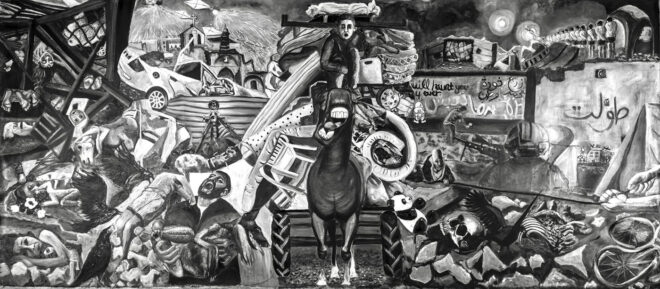
Malak Mattar’s No Words (2024), an oil on panel measuring 5 x 2.3 meters, stands as a harrowing and monumental work of art that documents the ongoing genocide in Gaza. Born in Gaza in 1999, Mattar has emerged as one of the most compelling voices in contemporary Palestinian art, using her canvas to bear witness to the unimaginable atrocities faced by her people. This larger-than-life monochromatic painting, exhibited in venues such as the Ferruzzi Gallery in Venice and the Toronto Palestine Film Festival, captures the visceral horror of a “livestreamed genocide” through fragmented scenes of death, destruction and displacement. At its core, No Words is not merely an artwork but a historical document, a cry of resistance and a deeply personal reflection of Mattar’s trauma and survivor’s guilt. This post explores the thematic, stylistic and cultural significance of No Words, situating it within Mattar’s oeuvre, the broader context of Palestinian art and the global discourse on art as a form of resistance during times of genocide.
Contextual Background: Malak Mattar and the Gaza Experience
Malak Mattar’s artistic journey is inseparable from her lived experience in Gaza, a region that has endured decades of occupation, blockade and repeated military assaults. Born and raised in Gaza City, Mattar grew up under the shadow of the Israeli occupation, witnessing four wars by the age of 24, including the devastating 51-day assault in 2014 that marked the beginning of her artistic practice. She began painting at 13, using art as a coping mechanism for the trauma of war and the constant fear of death. Her early works, characterised by vibrant colours and expressive depictions of Palestinian women, celebrated resilience and hope, often incorporating symbols like doves, oranges and pomegranates to evoke Palestinian identity and steadfastness.
However, the events following October 7, 2023, profoundly altered Mattar’s artistic trajectory. Having left Gaza on October 5, 2023, to pursue a Master’s degree in Fine Art at Central Saint Martins in London, Mattar narrowly escaped the escalating violence that engulfed her homeland. The subsequent genocide, which has claimed over 100,000 Palestinian lives and displaced countless others, left Mattar grappling with survivor’s guilt and the agony of being separated from her family, who endured communication blackouts and forced displacement. This period of intense personal and collective trauma is reflected in No Words, a work that marks a dramatic shift from her earlier colourful palette to a stark monochromatic scheme, mirroring the grim reality of Gaza’s destruction.
Artistic Analysis of No Words
Composition and Scale
No Words is a monumental work, its 5 x 2.3-meter dimensions commanding attention and immersing viewers in its overwhelming narrative. The sheer scale of the painting mirrors the magnitude of the genocide, forcing audiences to confront the enormity of the suffering it depicts. The canvas is densely packed with fragmented scenes, creating a “painful puzzle” that resists easy comprehension, much like the chaotic and unrelenting stream of images from Gaza’s destruction saturating global media. This fragmentation is deliberate, reflecting the shattered lives and landscapes of Gaza, as well as the psychological fragmentation experienced by those witnessing the genocide from afar.
At the centre of the composition, a horse cries out in anguish, driven by a frightened young boy whose cart carries a pile of belongings, including a shrouded corpse. This central image anchors the painting, symbolising the forced displacement that Mattar describes as the most significant aspect of the genocide, surpassing even the Nakba of 1948 in its brutality. The horse, a recurring motif in Mattar’s work symbolising both freedom and suffering, here embodies the collective horror of Gaza’s people and animals, caught in a cycle of violence and loss. Surrounding this focal point are vignettes of devastation: bodies crushed under rubble, a man carrying a wounded dog, children’s corpses, abandoned toys and the haunting image of birds feeding on human remains. These scenes are not arranged in a linear narrative but are layered chaotically, evoking the relentless barrage of atrocities reported from Gaza.
Monochromatic Palette
The decision to render No Words in shades of black, white and grey is a striking departure from Mattar’s earlier vibrant works, which were filled with reds, yellows and greens symbolising hope and resilience. Mattar has explained that the genocide drained the colour from her palette, as the vivid hues she once used no longer felt relevant in the face of such apocalyptic horror. The monochromatic scheme aligns with the stark, documentary-like quality of the painting, reminiscent of black-and-white photographs from colonial-era Palestine or war-time journalism. This choice not only reflects the desolation of Gaza but also serves as a visual metaphor for Mattar’s personal grief and the collective mourning of her people.
The grayscale palette also enhances the painting’s emotional impact, making its imagery more immediate and raw. As Mattar has stated, “If it’s uncomfortable to look at, that’s good. Don’t get comfortable. This is reality, there’s a genocide going on.” The absence of colour strips away any aesthetic distraction, forcing viewers to confront the unfiltered horror of the scenes depicted. This aligns with Mattar’s intention for the painting to be “completely horrific” to accurately reflect the genocide’s brutality.
Symbolism and Imagery
No Words is rich with symbolic imagery that draws on both personal and collective Palestinian experiences. The shrouded corpse on the cart evokes the countless lives lost, while the children’s toys scattered amidst the ruins symbolise the destruction of innocence and the loss of a generation. The image of stripped-down Palestinian men references the humiliating treatment of prisoners, a recurring theme in reports from Gaza, while the rain of white phosphorus bombs alludes to the use of illegal weaponry. The abandoned press vest and camera are poignant reminders of the targeting of journalists, with over 100 media workers killed in Gaza since October 2023.
Cultural landmarks also feature prominently, underscoring the erasure of Gaza’s heritage. Mattar includes depictions of the Rashad Shawa Cultural Centre, the Great Omari Mosque, Al-Shifa Hospital and the Church of Saint Porphyrius, all of which have been damaged or destroyed. These elements highlight the genocide’s assault on Palestinian culture, which Mattar describes as “at the heart of the damage.” Personal motifs, such as the white garden chair, connect the painting to Mattar’s own memories of family gatherings, grounding the collective tragedy in her intimate experience.
The graffiti in the painting – “will haunt you forever” in English and “Gaza wants to live” and “plant a revolution, sow a nation” in Arabic – serves as both a lament and a call to action. These phrases encapsulate the painting’s dual role as a memorial and a form of resistance, urging viewers to bear witness and to support Palestinian liberation. Mattar’s inclusion of her own hands pulling a woman from the rubble is a powerful act of agency, symbolising her desire to counteract her sense of helplessness through her art.
Stylistic Influences and Comparisons
Mattar’s style in No Words has been compared to Pablo Picasso’s Guernica (1937), another monumental work that documents the horrors of war. Like Guernica, No Words uses a monochromatic palette and fragmented composition to convey the chaos and suffering of conflict, with both works centring on anguished animals (Picasso’s horse and bull, Mattar’s horse) as symbols of collective pain. However, Mattar resists comparisons to Western artists, emphasising that her work emerges from a uniquely Palestinian context and does not require validation through Western lenses. She draws inspiration from Palestinian cultural heritage, including the poetry of Mahmoud Darwish, whose work inspired the title of her Venice exhibition, The Horse Fell off the Poem.
Mattar’s expressionist roots are evident in the emotive, gestural quality of her brushwork, which conveys raw anguish and urgency. Her preparatory sketches, created in charcoal and pencil during her residency at An Effort in London, informed the final composition, lending it a documentary immediacy derived from real-time images and testimonies from Gaza. This process underscores Mattar’s role as both artist and archivist, documenting a genocide as it unfolds.
Thematic Exploration
Art as Documentation and Resistance
No Words is, at its core, a documentary work that seeks to preserve the memory of Gaza’s genocide for future generations. Mattar has described her art as a form of historical documentation, a means of resisting the systematic dehumanisation of Palestinians. In Gaza, where cultural institutions and archives are systematically targeted, art becomes a vital tool for preserving collective memory. By compiling images from family, friends, media and social media, Mattar creates a visual archive of atrocities that counters attempts to erase or distort Palestinian narratives.
The painting also serves as a form of resistance, aligning with the Palestinian tradition of using art to assert identity and agency in the face of occupation. Mattar views her role as an artist as a “national duty,” a responsibility to bridge the gap between Gaza and the world. Her father’s encouragement to “tell our story” during phone calls amidst explosions underscores the expectation that Palestinian artists serve as voices for their people. The graffiti in No Words – “plant a revolution, sow a nation” – explicitly frames art as a revolutionary act, sowing the seeds for liberation and justice.
Trauma and Survivor’s Guilt
Mattar’s personal trauma permeates No Words, making it a deeply autobiographical work. Having escaped Gaza just one day before the genocide intensified, Mattar was consumed by survivor’s guilt, a feeling she initially dismissed as a “fancy English term” but came to understand profoundly. The painting reflects her struggle to process the destruction of her homeland from afar, compounded by the anxiety of losing contact with her family during communication blackouts. The studio, once a place of therapy and catharsis, became a site of confrontation with pain, as Mattar immersed herself in images of death and destruction.
Mattar’s guilt is expressed by the woman she is trying to pull from the rubble, representative of her desire to act and save her people regardless of distance. She has described the genocide as having “aged me decades,” a sentiment reflected in the painting’s somber tone and relentless imagery. No Words thus serves as both a personal catharsis and a collective lament, channeling Mattar’s rage, love and hope into a work that demands to be felt.
The Erasure of Culture and Memory
A central theme of No Words is the deliberate targeting of Palestinian culture and memory, which Mattar identifies as a core component of the genocide. The destruction of cultural landmarks like the Rashad Shawa Cultural Centre and the Great Omari Mosque is not merely collateral damage but a calculated effort to erase Gaza’s identity and history. By depicting these sites, Mattar asserts their significance and resists their obliteration, preserving them in the collective consciousness through her art.
The painting also addresses the broader erasure of Palestinian humanity, as seen in the dehumanising imagery of stripped prisoners and the targeting of journalists. The abandoned press vest and camera symbolise the silencing of truth, while the birds feeding on human remains evoke the ultimate desecration of life and dignity. Through these images, Mattar challenges the global indifference that allows such atrocities to continue, urging viewers to confront the reality behind the headlines.
Cultural and Global Significance
Palestinian Art in the Global Context
No Words situates Mattar within a rich tradition of Palestinian art that has long served as a medium for resistance and storytelling. Artists like Ismail Shammout, Sliman Mansour and Taysir Batniji have used their work to document the Nakba, occupation and ongoing struggles, creating a visual language of Palestinian identity. Mattar’s contribution lies in her ability to capture the immediacy of a genocide unfolding in real time, using the global reach of social media and international exhibitions to amplify her message.
Her exhibitions, from Venice to Toronto to New Delhi, have garnered significant attention, particularly in a cultural landscape where Palestinian voices are often censored or marginalised. The controversy surrounding the 60th Venice Biennale, where Israel’s participation sparked protests from the Art Not Genocide Alliance (of which Mattar was a signatory), underscores the political stakes of her work. By exhibiting No Words outside the Biennale’s “business as usual,” Mattar asserts the urgency of her message, aligning with curator Adriano Pedrosa’s theme of “Foreigners Everywhere” to centre the voices of the displaced and marginalised.
Art in the Time of Genocide
Mattar’s work raises critical questions about the role of art during genocide. As she has stated, “In the time of genocide, art is a powerful way of resisting the systematic dehumanisation of our people.” No Words challenges the notion of art as a passive or decorative medium, instead positioning it as an active intervention in the struggle for justice. By making viewers uncomfortable, Mattar disrupts complacency, insisting that the genocide in Gaza is not a distant tragedy but a global moral crisis.
The painting also engages with the ethics of representation, navigating the tension between aestheticising suffering and bearing witness to it. Mattar’s documentary approach, grounded in real images and testimonies, avoids sensationalism, instead presenting a raw and unflinching portrayal of reality. This aligns with the broader role of art in human rights advocacy, where works like No Words serve as evidence, memorial and catalyst for action.
Reception and Impact
No Words has been widely praised for its emotional and political impact, with critics comparing it to canonical works like Guernica while recognising its unique contribution to contemporary art. Its exhibitions at the Ferruzzi Gallery, the Toronto Palestine Film Festival and The People’s Forum in New York have drawn large audiences, testifying to Mattar’s growing international influence. The painting’s ability to resonate across cultures stems from its universal themes of loss, resilience and resistance, even as it remains deeply rooted in the Palestinian experience.
Mattar’s work has also sparked conversations about the responsibilities of artists in times of crisis. Her refusal to offer hope or beauty in No Words – a departure from her earlier optimistic works – challenges audiences to confront the genocide without the comfort of redemptive narratives. This raw honesty has earned her comparisons to artists like Goya and Käthe Kollwitz, whose works similarly grappled with the horrors of war and oppression.
Conclusion
Malak Mattar’s No Words is a towering achievement in contemporary art, a work that transcends its medium to become a testament, a protest and a memorial. Through its monumental scale, monochromatic palette and fragmented composition, the painting captures the apocalyptic horror of Gaza’s genocide, documenting atrocities that threaten to be forgotten or dismissed. Mattar’s personal trauma and survivor’s guilt infuse the work with raw emotional power, while its cultural and political resonance situates it within a long tradition of Palestinian resistance.
As a documentary work, No Words preserves the memory of Gaza’s suffering, resisting the erasure of its people and culture. As a form of resistance, it demands accountability and action, urging viewers to bear witness and to plant the seeds of revolution. In a world saturated with images of violence, Mattar’s painting cuts through the noise, offering a vision that is both unbearable and unforgettable. “Gaza wants to live,” the graffiti declares and through No Words, Malak Mattar ensures that its voice will haunt us forever.

Quand les mots manquent, la peinture prend le relais. « No Words » de Malak Mattar dit tout ce que nous n’arrivons pas à exprimer sur Gaza. Une œuvre monumentale. Un témoignage inoubliable. ?
Art has long been a mirror to the soul’s darkest recesses, capturing the ineffable horrors of war in ways that surpass mere verbal description. Building on the previous exploration of Malak Mattar’s “No Words” and Pablo Picasso’s “Guernica”, this discussion expands to include Francisco Goya’s seminal series “The Disasters of War”, a collection of 82 etchings created between 1810 and 1820. These works, spanning over two centuries, emerge from distinct conflicts—Goya’s from the Peninsular War (1808–1814) during Napoleon’s invasion of Spain, Picasso’s from the Spanish Civil War’s bombing of Guernica, and Mattar’s from the 2023–ongoing Israeli assault on Gaza. Yet, they converge as unflinching anti-war testimonies, employing stark visuals, symbolic depth, and a rejection of heroic narratives to expose the barbarity inflicted on civilians. Critics often link them through a lineage of influence: Goya’s raw depictions of brutality paved the way for Picasso’s abstracted chaos in *Guernica*, which in turn echoes in Mattar’s contemporary monochrome apocalypse, dubbed “Gaza’s Guernica.” This extended analysis delves into the artists’ backgrounds, the works’ descriptions and creations, stylistic and thematic parallels, key differences, and their cultural legacies, underscoring how these pieces embody art’s profound ability to humanize suffering and critique violence.
Artists’ Backgrounds: Forged in the Fires of Conflict and Exile
Understanding these artworks requires contextualizing the personal and historical traumas that shaped their creators. Francisco Goya, born in 1746 in Aragon, Spain, rose from humble origins to become the court painter to King Charles IV, mastering portraiture and tapestry designs. By the early 1800s, however, Goya’s life was marred by illness—a mysterious affliction in 1793 left him deaf, deepening his cynicism and introspection. The Peninsular War, sparked by Napoleon’s 1808 invasion and the subsequent Spanish uprising, transformed Goya from a royal favorite into a witness of atrocity. Though he briefly served under the French-backed King Joseph Bonaparte, Goya’s sympathies lay with the Spanish resistance. “The Disasters of War” was born from this turmoil, etched in private as a personal reckoning rather than a commission, unpublished until 1863 due to its incendiary content. Goya’s exile to Bordeaux in 1824, fleeing Ferdinand VII’s repressive regime, mirrored his growing disillusionment with humanity’s capacity for cruelty.
Pablo Picasso, as previously noted, was born in 1881 and revolutionized modern art through Cubism. Exiled in Paris during the Spanish Civil War, he responded to the April 1937 bombing of Guernica—a civilian massacre orchestrated by fascist forces—with a commissioned mural that channeled his outrage against totalitarianism. Picasso’s distance from the frontlines contrasted with Goya’s proximity, yet both drew from eyewitness accounts and photographs to fuel their visions.
Malak Mattar, the youngest at birth in 1999 in Gaza, embodies a generation defined by perpetual siege. Self-taught amid Israeli blockades and bombardments, her early works celebrated Palestinian resilience in vivid colors. The October 2023 escalation, however, thrust her into exile in London, where survivor’s guilt and family losses stripped her palette bare, birthing *No Words* as a direct confrontation with what she terms “genocide.” Mattar’s immediacy—painting amid real-time horrors—echoes Goya’s eyewitness urgency, while her global advocacy aligns with Picasso’s anti-fascist stance.
Descriptions of the Works: From Etched Nightmares to Monochrome Mayhem
Each work’s form amplifies its message of desolation. Goya’s “The Disasters of War” comprises 82 aquatint etchings, modest in size (averaging 6 x 9 inches) but immense in impact. Divided into three parts—war’s brutalities, famine’s toll, and post-war repression—the series features harrowing scenes: mutilated bodies strung from trees (“Great Deeds Against the Dead”), starving civilians (“Thanks to the Potato”), and executions (“And There Is No Remedy”). Goya’s captions, like “I saw it” or “One can’t look,” add sardonic bite, blending realism with grotesque exaggeration. His technique—etching’s deep blacks and stark contrasts—creates a documentary feel, as if snapshots from hell.
Picasso’s “Guernica”, at 3.49 x 7.77 meters, overwhelms with its Cubist fragmentation: a dying horse, a bull symbolising brutality, screaming women, a dead child, and mechanised horrors like a glaring light bulb. Monochrome grays evoke newsreels, distorting forms to convey disorientation.
Mattar’s “No Words” (2.2 x 5 meters) mirrors this scale in oil on linen, portraying Gaza’s ruins: skull piles, drone-shadowed skies, a horse-drawn cart of refugees, rubble, and spectral tanks. Its black-and-white starkness signifies emotional void, with haunting details like abandoned toys and decomposing remains underscoring civilian devastation.
Stylistic and Thematic Comparisons: A Lineage of Horror and Humanism
These works form a chain of artistic inheritance, united by their rejection of war’s glorification in favor of gruesome truth-telling. Stylistically, all employ limited palettes for emphasis: Goya’s etchings use black ink’s intensity, Picasso’s grays mimic wartime photography, and Mattar’s monochrome signals mourning—a deliberate evolution from her colorful past. Scale and composition draw viewers in: Goya’s intimate prints demand close scrutiny, while Picasso and Mattar’s murals immerse, forcing confrontation with chaos. Symbolism abounds—Goya’s dangling corpses parallel Picasso’s fragmented bodies and Mattar’s skulls, critiquing dehumanization.
Thematically, they decry civilian atrocities as war’s core evil. Goya’s series exposes the Peninsular War’s indiscriminate violence, influencing Picasso’s portrayal of Guernica’s aerial terror—a first in modern warfare—and Mattar’s documentation of Gaza’s bombardment and displacement. All evoke empathy through victims’ plight: Goya’s starving figures, Picasso’s wailing mother, Mattar’s exiled cart-puller. They critique power—Goya lambasts French invaders and Spanish collaborators, Picasso fascism, Mattar occupation—transforming personal trauma into universal anti-war pleas. As one analysis notes, Goya’s “unflinching vision” anticipates Picasso’s, with both evoking “empathy for victims” through dramatic representation.
Key Differences: Eras, Mediums, and Perspectives
Despite shared outrage, differences reflect their contexts and approaches. Temporally, Goya documents early modern warfare’s ground-level savagery, Picasso aerial bombing’s mechanization, and Mattar 21st-century drone surveillance and siege tactics. Mediums vary: Goya’s etchings allow mass reproduction and captions for irony, Picasso’s oil mural emphasizes abstraction, Mattar’s linen painting blends realism with expressionism.
Stylistically, Goya’s romantic realism grounds horror in recognizable humanity, contrasting Picasso’s Cubist distortion for timeless allegory and Mattar’s figurative brutality tied to specific Palestinian motifs. Perspectives differ: Goya, an insider witness, balances critique; Picasso, an exile, universalizes; Mattar, a survivor in diaspora, infuses urgency with personal loss. Goya’s series critiques all sides, while Picasso and Mattar target specific aggressors.
Reception and Cultural Impact: Echoes Across Generations
These works have profoundly shaped anti-war discourse. Goya’s “Disasters”, published posthumously, influenced 19th-century realists and 20th-century artists like Otto Dix, directly inspiring Picasso’s “Guernica” and even his “Massacre in Korea” (1951). It toured protests and resides in collections worldwide, symbolizing resistance to tyranny.
“Guernica” became an anti-fascist icon, touring post-1937 and inspiring Vietnam-era activism, now at Madrid’s Reina Sofía.
Mattar’s “No Words”, debuting in 2024 amid global outcry, faces censorship but galvanizes solidarity through exhibitions in Venice, London, and New York, raising funds for Palestine. Its “Guernica” label amplifies ceasefire calls, extending Goya and Picasso’s legacy into digital-age advocacy.
Conclusion: Art’s Silent Screams Against Oblivion
Juxtaposing Goya’s “The Disasters of War”, Picasso’s “Guernica”, and Mattar’s “No Words” reveals a continuum of artistic resistance, where war’s soul-crushing horrors are laid bare to foster empathy and demand accountability. Goya revolutionized war art by shifting from glory to gruesomeness, influencing Picasso’s modernist outcry and Mattar’s contemporary lament. In a world where conflicts persist—from Napoleon’s invasions to Gaza’s siege—these works remind us that art outlasts bombs, preserving the human cost and urging us not to avert our gaze. As Goya’s captions implore and Mattar’s title asserts, when words fail, art’s reflections endure.