
The poor man’s plea dissolves, unheard, ignored,
While gilded tongues twist truths to suit their side.
Behind closed doors, corruption is adorned,
And justice, blind, becomes a ploy to hide.
What worth are laws if gold decides the turn?
What hope remains when courts betray their creed?
For justice, pure, must never bow or earn
The favour of the powerful and their greed.
Bakchos
Introduction
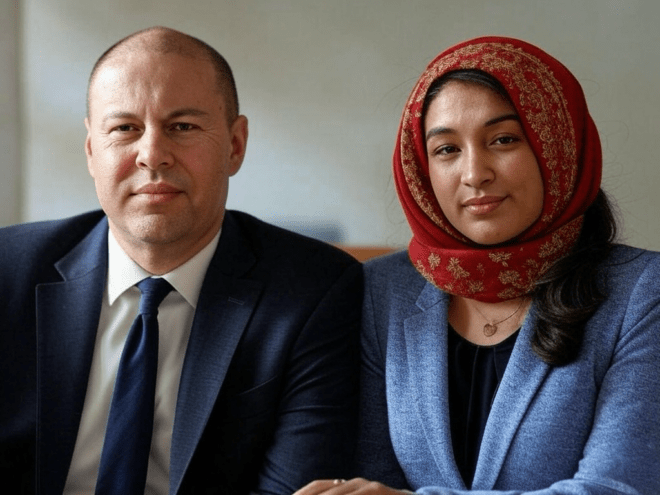
Australia’s legal and political frameworks, shaped by the historical context of the 1901 Constitution, often manifest as arenas where power dynamics, privilege, and accountability intersect. Critics assert that the Australian legal system is crafted to entrench power and privilege, frequently at the expense of transparency and accountability. This critique is vividly illustrated through two significant cases: Staindl v Frydenberg [2020] FCAFC 41, a legal challenge concerning then-Federal Treasurer Josh Frydenberg, and the ongoing narrative surrounding Senator Fatima Payman. The former case revolved around allegations regarding Frydenberg’s potential dual citizenship under Section 44(i) of the Constitution, while the latter encapsulates Payman’s political expulsion from the Labor Party, scrutiny over her citizenship status, and her bold decision to confront the Taliban in Afghanistan. As of April 3, 2025, these cases reveal a legal and political landscape that seems to protect the powerful while imposing significant burdens on those who dare to challenge the status quo. This analysis delves into their legal frameworks, political contexts, social repercussions, and broader implications, questioning whether Australia’s democracy prioritizes entrenched elites over equitable transparency.
Legal Frameworks
The case of Staindl v Frydenberg scrutinized Section 44(i) of the Constitution, a provision designed to prevent dual citizens from holding parliamentary office. This clause is steeped in historical fears of foreign influence dating back to the federation era. Michael Staindl, a climate activist from Frydenberg’s Kooyong electorate, challenged Frydenberg’s eligibility based on allegations of his potential Hungarian citizenship, a claim rooted in Frydenberg’s maternal lineage. The Full Court of the Federal Court unanimously dismissed Staindl’s claim on March 17, 2020, citing historical evidence that Frydenberg’s mother, Erica Strausz, a Holocaust survivor, was rendered stateless upon fleeing Hungary in 1949. The court’s decision relied on expert testimony regarding Hungarian law and the naturalisation process in Australia, which does not require renunciation of prior citizenship. The ruling underscored the high evidentiary burden placed on Staindl, a private citizen, against Frydenberg’s well-resourced legal team, further illustrating the critique that the legal system entrenches privilege by imposing significant barriers to accountability and transparency.
In contrast, Fatima Payman’s legal situation, also linked to Section 44(i), unfolds within a political rather than judicial framework, exposing similar systemic flaws. Payman, who fled Afghanistan as a refugee and became a citizen in 2005, was elected as a Labor senator in 2022. Her citizenship came under scrutiny following accusations from One Nation leader Pauline Hanson in November 2024, suggesting Payman retained Afghan citizenship. This claim was complicated by the Taliban’s takeover in 2021, which disrupted formal renunciation processes. Payman contended that she had taken all reasonable steps to renounce her citizenship, yet the Senate’s overwhelming rejection of an investigation into her status – despite Labor’s legal advice supporting her position – reflects a political environment that favours protectionism over transparent resolution. Unlike the judicial clarity achieved in Frydenberg’s case, Payman’s situation remains mired in ambiguity, suggesting a system that privileges the status quo and leaves dissenters vulnerable to political attacks, further undermining accountability.
Political Dynamics
The political contexts surrounding these cases reveal contrasting mechanisms for preserving power. In Staindl v Frydenberg, the challenge emerged externally, fuelled by Staindl’s frustration with Frydenberg’s climate policies. Frydenberg, a prominent figure in the Liberal Party since 2018, enjoyed steadfast party support during the citizenship crisis that affected multiple parliamentarians in 2017–2018. The Liberal Party framed Staindl’s legal action as unfounded, even suggesting anti-Semitic undertones due to Frydenberg’s Jewish heritage – a narrative that galvanised support for Frydenberg. With elite legal backing, Frydenberg retained his seat until 2022, when he was ultimately ousted by teal independent Monique Ryan in a climate-focused electoral upset. This cohesion within the Liberal Party exemplifies how political privilege can leverage resources to deflect challenges, aligning with the critique that the system is designed to shield the powerful.
In stark contrast, Payman’s journey unfolded within the Labor Party, revealing its internal rigidity. As a young Muslim woman from a refugee background, Payman was emblematic of Labor’s push for diversity. However, her decision to vote with the Greens in June 2024 to recognise Palestinian statehood – a significant breach of Labor’s long-standing caucus solidarity – triggered swift repercussions. Initially suspended for one sitting week, her indefinite exclusion followed after she asserted her commitment to conscience over party lines. Prime Minister Anthony Albanese defended the party’s actions as necessary for unity, but critics labeled it an effort to silence a progressive voice on a contentious issue. Following her expulsion, Payman shifted to the crossbench, exposing Labor’s intolerance for dissenting perspectives. Where Frydenberg was insulated by party support, Payman faced punitive measures, underscoring a system that prioritises party control over individual accountability, particularly for marginalised members.
Social and Personal Consequences
The social and personal repercussions of these cases starkly illustrate the critique of entrenched privilege. Staindl endured devastating financial consequences as a result of his legal challenge. Initially ordered to pay Frydenberg’s legal costs amounting to $855,000 – later reduced to $410,000 – Staindl ultimately settled for $350,000 through crowdfunding, narrowly avoiding bankruptcy and the loss of his home. This financial burden levied against a citizen daring to challenge a well-resourced politician reveals a profound lack of transparency in cost allocation and accountability for those in power, who faced no personal risk. Staindl characterised his experience as political retribution for his activism, while Frydenberg labeled it justice for what he deemed a “disgraceful” claim. Public sentiment was divided; some viewed Staindl as a victim of an unequal system, while others saw him as a reckless litigant deserving of punishment. This disparity underscores a legal framework that favours privilege over equitable recourse.
Conversely, Payman’s consequences were more political and emotional in nature, reflecting a different kind of systemic inequity. Her stance on Palestine, deeply intertwined with her Afghan-Muslim identity, led to social ostracism from her Labor colleagues, who turned against her following her vote. While she maintained her Senate seat until 2028 and garnered support from Muslim and progressive communities, the emotional toll of her ostracism was significant. Unlike Staindl’s financial ruin, Payman’s cost was her party affiliation, yet her resilience and public backing provided a buffer. Her treatment ignited discussions about Labor’s inclusivity, contrasting sharply with Frydenberg’s experience of vindication within a supportive party structure. Both cases exemplify a system that disciplines those who challenge it – financially or politically – while simultaneously protecting the privileged.
Payman’s Recent Decision to Return to Afghanistan
On April 1, 2025, Fatima Payman announced her intention to travel to Afghanistan to seek confirmation from the Taliban regarding her citizenship status, a dramatic move tied to her ongoing citizenship controversy. Facing persistent claims from Pauline Hanson, Payman asserted, “The Taliban don’t have official citizenship renunciation processes… but that’s not going to stop me.” Having previously contacted the Afghan Embassy in 2021 – only to be informed that renunciation was impossible post-Taliban – Payman now seeks a direct resolution just 33 days before a federal election. This decision, made against Australia’s “Do Not Travel” advisory and without diplomatic support due to severed ties with the Taliban, places her safety at risk in pursuit of clarity. The Taliban’s response, if forthcoming, remains uncertain, as does the High Court’s potential stance should her eligibility come under formal challenge.
Payman’s bold move directly confronts the opacity of the existing system. By seeking clarity outside a legal framework that offers no clear path for resolution, she compels transparency, albeit at great personal risk. While critics may label her decision as reckless – given Labor’s prior legal endorsement of her citizenship status – supporters view it as an act of defiance against a system that privileges ambiguity to undermine her position. This action starkly contrasts with Frydenberg’s reliance on established judicial processes, highlighting the disparity in how the powerful navigate the system compared to those on the margins, who must often push its boundaries at considerable personal cost.
Comparative Analysis
- Eligibility and Identity: Frydenberg’s Jewish-Hungarian heritage was legally validated, thus protecting his privilege. In contrast, Payman’s Afghan-Muslim background remains a political liability, reflecting systemic biases against non-Western identities.
- Source of Challenge: Staindl’s external legal challenge faltered against Frydenberg’s considerable resources, while Payman’s internal dissent faced fierce resistance, demonstrating varied mechanisms for preserving power.
- Party Support: Frydenberg’s Liberal backing insulated him from challenges, while Payman’s expulsion from Labor punished her, underscoring how political parties entrench privilege over accountability.
- Outcomes: Staindl’s financial ruin contrasts with Payman’s political survival (at least temporarily), illustrating the steep costs associated with challenging the status quo, tailored to their respective positions.
- Societal Impact: Frydenberg’s case reinforced legal barriers to accountability, while Payman’s saga raises critical questions about inclusivity and transparency, potentially influencing voter dynamics.
Broader Implications
These cases substantiate the argument that Australia’s legal system is designed to entrench power and privilege at the expense of transparency and accountability. Staindl v Frydenberg highlights how financial penalties deter citizen challenges, revealing how elite support can obstruct access to justice. Section 44(i), a remnant of colonial fears about foreign loyalty, remains ill-suited to a contemporary Australia shaped by post-war migration. The citizenship crisis of 2017–2018 illuminated the absurdities inherent in this provision, yet meaningful reform remains elusive, preserving a system that favors incumbents while punishing those who seek clarity.
The treatment of Payman – coupled with her audacious decision to confront the Taliban – reveals a political landscape that prioritises party control over individual accountability, with her citizenship ambiguity weaponised rather than resolved. Her proactive approach may force necessary reforms or further entrench existing power structures if it fails. Both cases fuel ongoing calls to abolish Section 44(i), address disparities in legal costs, and foster greater political openness, prompting critical reflection on whether Australia’s democracy truly serves the interests of the public or merely those of the privileged elite.
Historically, Section 44(i) reflects a federation-era paranoia regarding foreign allegiance, an attitude that feels increasingly antiquated in a nation built on the foundation of post-war migration. The previous citizenship crisis showcased its absurdities, yet reform efforts remain stagnant, preserving a system that punishes rather than clarifies. The human costs endured by Staindl and Payman highlight the urgent need for a reckoning with systemic inequities that continue to shape the Australian political and legal landscape.
Conclusion
The narratives of Staindl v Frydenberg and Fatima Payman’s journey reveal a legal and political system that critics argue is structured to entrench power and privilege at the expense of transparency and accountability. Frydenberg’s victory resulted in Staindl’s financial devastation, reinforcing elite dominance, while Payman’s expulsion and her courageous decision to confront the Taliban challenge a system that punishes dissent and obscures truth. As Australia navigates its increasingly multicultural future, these cases underscore the necessity for reform – legal clarity regarding Section 44(i), equitable access to justice, and political tolerance for diverse voices. Without significant changes, the system risks perpetuating privilege over the needs of the populace, as vividly illustrated by the experiences of Staindl and Payman.