
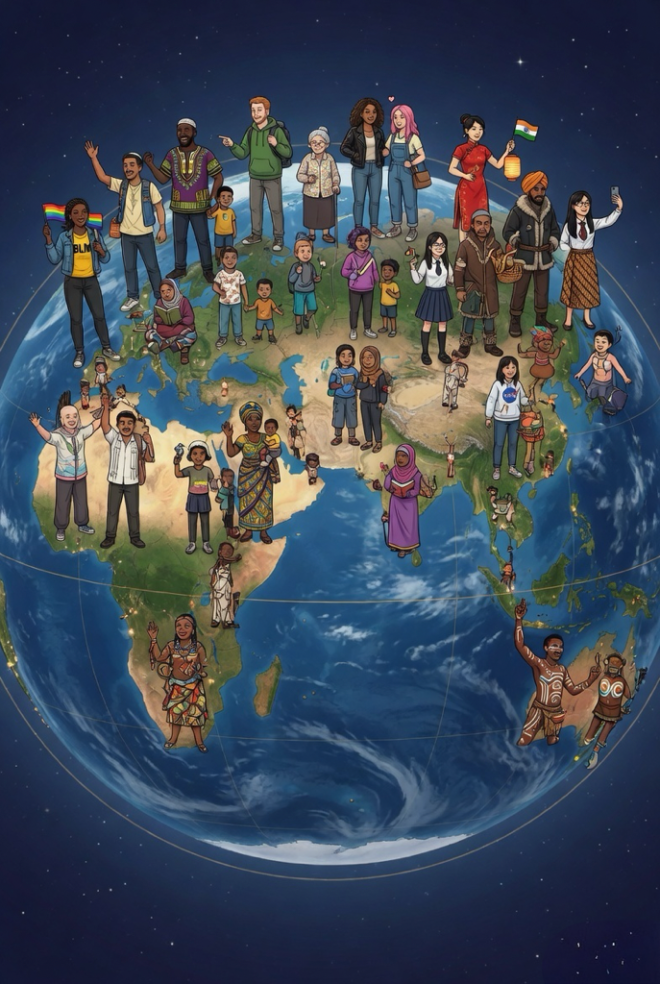
Introduction: The Living Dream
There are stories so ancient, so deeply embedded in the human psyche, that they seem to predate language itself. The Australian Aboriginal Dreamtime is one such story – or rather, it is the story behind all stories, a cosmological framework so vast and so intricate that Western concepts of mythology fail to contain it adequately. The poem “The Dreamtime” offers a lyrical window into this extraordinary worldview, conjuring ancestral heroes who rise from primordial darkness, split apart the unknown night, carve rivers and springs from sleeping earth, birth all living things, decree the laws by which humanity must live, and ultimately weave an unbreakable cycle of spirit and matter that endures to the present day. Figures such as the rain-man Pakadringa, the Thunder-giants, the Dawn-folk, and the magnificent Rainbow-Serpent act not as distant deities but as intimate creators whose every footstep, every decision, and every flaw is encoded permanently into the landscape itself. Spirits reincarnate through maternal wombs, guarded by animal totems that stretch from Dreamtime’s earliest dawn to the living present. The bullroarer drones the eternal Word. The past is not past. The ancestors are not dead.
What makes this framework remarkable beyond its extraordinary internal richness is the degree to which it resonates with indigenous creation narratives from virtually every corner of the inhabited world. Despite Australia’s profound geographic isolation – a continent separated from the rest of humanity for somewhere between 50,000 and 65,000 years – the core motifs of the Dreamtime find clear, undeniable echoes in the mythologies of Native American peoples, Polynesian navigators, African hunter-gatherers and village societies, and countless other traditions that developed in complete independence from one another. These parallels are not coincidental borrowings, nor are they the product of ancient contact. They are something far more significant. They are evidence of what might best be described as the oneness of humanity: a shared psychological, spiritual, and imaginative architecture that transcends continents, oceans, and millennia of geographic separation, testifying to the universal human need to explain existence, honour ancestry, live ethically with the natural world, and affirm that all people – however different their languages, their customs, and their landscapes – are threads in a single, eternal web.
This essay explores those resonances in depth, examining how the Dreamtime’s foundational motifs – ancestral creator beings shaping a formless world, the establishment of moral law through flawed exemplars, totemism as a living bond between humanity and nature, and cyclical rebirth as the organizing principle of existence – mirror corresponding structures in indigenous traditions from across the globe. In doing so, it argues that the Dreamtime is not merely an Australian inheritance but a testament to a universal human imagination, and that recognizing these shared roots offers both intellectual illumination and a profound, healing truth for a fractured modern world.
The Creator Who Shapes the World: Ancestral Beings Across Cultures
The most immediately striking parallel between the Dreamtime and other indigenous traditions lies in the figure of the ancestral creator who transforms primordial chaos into ordered, inhabited landscape. In the poem, Dreamtime heroes and the Rainbow-Serpent emerge from nothingness – “save the shade” – to carve the physical world into being. The Rainbow-Serpent in particular, a motif shared across many distinct Aboriginal language groups and nations, travels beneath a flat and sleeping earth, pushing up ridges and gorges, cutting waterways, and breathing life into animal tribes. This serpent is not merely a symbolic figure; it is a geological and biological reality encoded in the land, present in every river bend and rocky escarpment, alive in the patterns of seasonal rainfall and flood.
This figure of the world-shaping ancestral being appears with remarkable consistency in traditions developed in complete isolation from Aboriginal Australia. Among the Northwest Coast peoples of North America – the Haida, the Tlingit, the Tsimshian – the trickster-transformer Raven is the agent of creation, stealing light from the darkness and scattering it across the sky, reshaping coastlines, rivers, and mountains through a combination of cunning, appetite, and inadvertent generosity. Raven does not create from divine omnipotence but through action, movement, and consequence, just as Dreamtime ancestors create not by decree but by travelling, by doing, by leaving traces. Among Plains peoples, Coyote performs a similar function – a morally ambiguous being whose creative and destructive impulses together produce a world rich with both beauty and danger. What is essential in all these figures is that creation is not an event completed in the distant past but an ongoing process embedded in the geography itself, accessible through ceremony, story, and right relationship with the land.
Polynesian cosmology offers perhaps the most structurally elegant parallel to the Dreamtime’s creative figures. The Māori tradition of Aotearoa New Zealand describes Māui as a demigod of almost reckless creative energy, who fishes the North Island of New Zealand up from the ocean floor, who lassoes the sun to slow its passage across the sky so that his people have enough daylight to complete their work, and who ultimately attempts – and fails – to win immortality for humanity by entering the body of the goddess of death. Like Dreamtime ancestors, Māui is simultaneously creator, culture-hero, and moral exemplar whose limitations are as instructive as his achievements. The separation of Ranginui the sky father from Papatūānuku the earth mother by their son Tāne similarly echoes the Dreamtime’s emergence from undifferentiated darkness, as the primal unity of the cosmos gives way to the structured, differentiated world that living beings can inhabit. In both traditions, the act of creation is an act of separation, of distinction, of giving form to what was formless.
African indigenous traditions complete this global portrait. The Dogon people of Mali describe Nommo, primordial amphibious beings who descend from the sky to organize a chaotic world, create human beings, and establish the social and agricultural laws by which communities must live. The San, or Bushmen, of southern Africa – themselves possessors of one of the oldest continuous cultural traditions on earth, rivalling even the Aboriginal Australians in antiquity – tell of creator-trickster figures who impart survival knowledge, establish moral boundaries, and embed power into the landscape through their movements and deeds. The parallels to the Dreamtime are structural rather than superficial: in each case, creation is intimate, relational, and geographical, not abstract or theological. The world is not made from nothing by an omnipotent god operating at a cosmic remove; it is shaped by beings who walk, who err, who leave their mark in specific places that their descendants can visit, touch, and revere.
Moral Law Through Flawed Exemplars: The Ethics of Imperfect Ancestors
A second profound convergence between the Dreamtime and global indigenous traditions lies in the moral function of ancestral beings who are explicitly, instructively imperfect. The poem’s Dreamtime heroes “fixed for mortal man his lawful wife” and “planned for different tribes their different ways,” establishing social and ethical order not through flawless divine command but through the record of their own deeds – including their failures, their transgressions, and their conflicts. This is a radically different model of moral instruction from that offered by many Western religious traditions, in which divine law descends from an omniscient and morally perfect source. In the Dreamtime, law emerges from narrative, from the accumulated consequences of ancestral action, and it is binding precisely because it is written into the landscape that Aboriginal people inhabit and move through every day.
This model of moral instruction through flawed ancestral exemplars is widespread in indigenous traditions globally. In Native American mythology, the trickster figures who create the world are also the figures who violate its rules most flagrantly, and their violations are precisely what make those rules meaningful. Coyote steals fire, sleeps with those he should not, breaks taboos, and suffers consequences – consequences that illuminate the logic of the taboos themselves. The Cherokee Uktena, a monstrous serpent whose dazzling crest is simultaneously deadly and desirable, warns against the human tendency to covet power that exceeds one’s proper place in the order of things. The Iroquois tradition of Sky Woman, who falls from the Sky World through a hole created by the uprooting of the sacred tree, encodes in its very structure the warning against transgression: something was disturbed that should not have been disturbed, and from that disturbance, the entire world as we know it – beautiful, mortal, and full of difficulty – comes into being.
The Māori tradition is particularly rich in this regard. The hero Māui’s death comes not from external misfortune but from overreach – from his attempt to enter the body of Hine-nui-te-pō, the goddess of death, in order to steal immortality for humanity. His failure is not presented as tragedy but as instruction: there are boundaries that cannot be crossed, and the attempt to cross them has consequences for all. The same logic governs the Dreamtime. Ancestral beings who violate law – who take what is not theirs, who cross boundaries of kinship or territory, who fail in their obligations to the community – leave traces of that violation in the landscape, and those traces serve as permanent, geographical moral lessons. Law is not merely told; it is embedded in place, visible to those who know how to read it.
Totemism and the Kinship of All Living Things
Perhaps the most philosophically rich parallel between the Dreamtime and other indigenous traditions lies in the practice and worldview of totemism – the understanding that human beings are related to, responsible for, and spiritually connected to specific animals, plants, or natural phenomena in ways that are both intimate and obligatory. In the poem, totems serve as guardians that protect reincarnating spirits from death to birth, ensuring continuity across the boundary between mortality and the ancestral realm. Every person belongs to a totemic lineage that reaches back to Dreamtime’s dawn and forward into generations not yet born. The totem is not merely a symbol; it is a living relative, a spiritual partner, a mark of identity and responsibility that connects the individual to the entire fabric of the natural world.
This understanding of totemic kinship pervades indigenous traditions globally, though its specific expressions vary enormously. Among the Native peoples of the Pacific Northwest, clan totems – the eagle, the bear, the killer whale, the wolf – are not merely heraldic symbols but genealogical realities, tracing lineage back to ancestral beings who were simultaneously human and animal. The great carved totem poles that punctuate the landscapes of these nations are not decorative objects but cosmological texts, recording the relationships between human clans, animal relatives, and ancestral spirits in the same way that Aboriginal songlines record the movements of Dreamtime creators across the Australian landscape. In both traditions, the human community is understood as a subset of a much larger community that includes non-human persons, and the health of the human community depends on maintaining right relationship with those non-human relatives.
African traditions offer similarly profound expressions of totemic kinship. Among many Bantu-speaking peoples of sub-Saharan Africa, clan totems carry obligations of protection and restraint: members of a leopard clan may not harm leopards, must speak of them with respect, and understand themselves as related to them in a way that is more than metaphorical. This is structurally identical to the Aboriginal understanding of totemic obligation, in which the person responsible for a particular species must perform the ceremonies that ensure that species’ abundance, and must observe the dietary and behavioural restrictions that mark their special relationship to that being. In both cases, totemism is not a primitive confusion of the human and the animal; it is a sophisticated ecological ethics, an understanding that human survival and flourishing are inseparable from the health of the broader living community.
Cyclical Time and the Eternal Return of the Ancestors
The concept most distinctive to the Dreamtime – and yet most surprisingly resonant with traditions around the world – is its radically non-linear understanding of time. The Dreamtime is not merely a creation period in the distant past; it is an “everywhen,” a living reality in which past, present, and future coexist, interpenetrate, and mutually sustain one another. The ancestors did not create the world and then depart; they are present in the land, in the ceremonies, in the bodies of those who carry their totemic spirits forward through successive incarnations. “They live today who lived in Dreamtime’s dawn.” This is not metaphor. It is ontology – a description of the actual structure of reality as Aboriginal peoples understand and experience it.
This cyclical, ancestrally saturated understanding of time finds echoes in Māori whakapapa, in which genealogy is not merely a record of biological descent but a cosmological map that connects the living to the gods and to the original creative acts that brought the world into being. To know one’s whakapapa is to know one’s place in a living continuum that stretches from the separation of earth and sky to the present moment, and the ancestors who populate that genealogy are not historical figures but living presences whose spiritual power remains active and available to their descendants. This understanding of ancestral time is structurally identical to the Dreamtime’s “everywhen,” and it generates the same kind of intimate, obligatory relationship between the living and the land that characterizes Aboriginal culture.
The Hopi of the American Southwest describe time through the concept of pacha – a cyclical flow of worlds, each destroyed and recreated, with the survivors of each destruction carrying forward the knowledge and responsibility of all previous cycles. The present world is not the first world but the fourth, and the obligation of those who inhabit it is to remember the lessons of previous destructions and live accordingly. This cyclical cosmology resonates deeply with the Dreamtime’s insistence that creation is ongoing, that the world must be continuously renewed through ceremony and right relationship, and that failure to honour the ancestral order has consequences not merely for individuals but for the entire fabric of existence.
The Oneness of Humanity: Convergence as Evidence
What are we to make of these extraordinary convergences between traditions separated by tens of thousands of years and thousands of kilometres of ocean? Two explanations present themselves, and both are likely partially true. The first is psychological: all human beings, regardless of their culture or their history, confront the same fundamental existential questions. Where did we come from? How should we live? What endures after death? Are we alone in a hostile universe, or do we belong to a larger community of being? The fact that isolated traditions converge on similar answers – ancestral creators, totemic kinship, cyclical time, moral law embedded in landscape – suggests that these answers resonate with something deep in the structure of human consciousness itself, something that Carl Jung might have called the collective unconscious and that evolutionary psychologists might describe as the product of a shared cognitive architecture shaped by millions of years of common evolutionary history.
The second explanation is simply that the human situation, wherever it is lived, presents certain recurring features that demand recurring responses. All human communities live in landscapes that predate them and will outlast them. All must negotiate the tension between individual desire and communal obligation. All must find ways to transmit knowledge, values, and identity across generations. All must confront mortality and find a way to make sense of it. The Dreamtime, in its extraordinary richness and sophistication, offers one set of responses to these universal challenges – and the fact that those responses are mirrored, in broad structural outline, by traditions from every inhabited continent suggests not that all cultures are the same, but that all cultures are human, shaped by the same needs, the same hopes, and the same fundamental experience of being alive in a world we did not make and cannot fully understand.
Conclusion: One Human Family, Dreaming Together
In an age defined by division – by nationalism, by religious conflict, by the hardening of identity into opposition – the Dreamtime and its global kin offer a radical and healing truth. Humanity is not fragmented by distance or difference. We are unified by the stories we tell to make sense of existence: stories of ancestors who shaped the world from chaos, who gave us law at the cost of their own flawlessness, who bound us to the living community of non-human persons, and who left their spirits in the land so that we might never feel entirely alone. From the red earth of the Australian outback to the cedar forests of the Pacific Northwest, from the volcanic islands of Polynesia to the vast savannas of sub-Saharan Africa, human beings have dreamed the same dream in a thousand different languages, and that dream is the story of our belonging – to the earth, to each other, and to all who came before us.
To honour the Dreamtime is not merely to honour Aboriginal Australians, though that honour is long overdue and urgently necessary. It is to honour the entire human inheritance of sacred story, to recognize that every creation myth, every ancestral narrative, every ceremony performed in darkness to renew the world is a variation on the same fundamental act of imagination and devotion. The poem’s closing call to “ever sing these songs about the past” and recognize that “simple things great shadows cast” is an invitation extended not only to Aboriginal Australians but to all of humanity. In singing the songs of the past – all the songs, from all the traditions, in all the languages – we affirm the oneness that has always bound us: one human family, born from the same ancestral darkness, dreaming the world into being, together, across all the distances that have never truly separated us at all.
—
Bakchos is the founder of Blak and Black, an Australian media and advocacy platform established in 2010. Bakchos writes from the intersecting perspectives of Wiradjuri heritage, Jewish identity, and humanism.
© Bakchos, June 2026



Agree Bakchos, we all all one species, human.
G’day Bill, that’s the whole point of this post: we are family … the whole of humanity is one family!
Yes Bakchos we are all family.
This is so true Bakchos:
“To honour the Dreamtime is not merely to honour Aboriginal Australians, though that honour is long overdue and urgently necessary. It is to honour the entire human inheritance of sacred story, to recognize that every creation myth, every ancestral narrative, every ceremony performed in darkness to renew the world is a variation on the same fundamental act of imagination and devotion.”
Faceless we are all one, despite what people like Pauline Hanson try and make us believe.
Mark your conclusion lands with genuine power. By framing recognition of these shared roots as “healing” for a fractured world, the essay avoids both cultural relativism (“all stories are equally true”) and reductive universalism (“therefore all cultures are the same”). It honors specificity while affirming commonality — a difficult balance that many writers fail to strike.
Thank you for your comments Margaret, The post presents as a form of advocacy writing—poetic, persuasive, and rooted in cultural insight. I’m far from happy with the finished work, it needs redoing. Its weaknesses are largely those of ambition: it reaches for a sweeping humanistic vision and occasionally sacrifices precision for resonance, that’s poor scholarship.
Mark it’s a good post, with a solid argument. You’re selling yourself short. Maybe write a follow up when you have time.
Bakchos your prose is vivid and rhythmic—“the bullroarer drones the eternal Word,” “they live today who lived in Dreamtime’s dawn”—without descending into purple excess. It treats sacred material with reverence yet avoids sentimentality. The repeated emphasis on creation as geographical, relational, and ongoing rather than abstract or once-and-for-all is particularly insightful and accurate to both Aboriginal ontology and the comparative examples.