
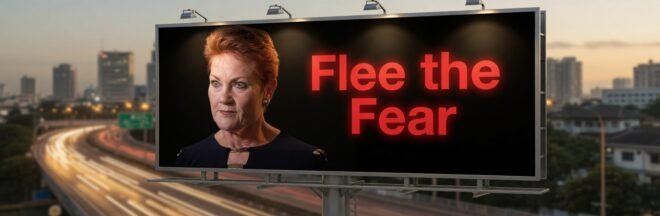
There is a slogan that has begun to circulate in Australia’s political vernacular, modest in its syllables but precise in its intent: Flee The Fear. It is, on one reading, a counsel of personal courage – an invitation to refuse the paralysis that demagogues bank on. On another reading, it is a direct indictment of a particular political project, one that has endured in Australian public life with disturbing persistence. That project belongs to Pauline Hanson.
To understand why Flee The Fear is not merely a campaign line but a genuine political philosophy in miniature, one must first understand what Pauline Hanson has actually done to Australian political culture over three decades. She has not, contrary to her self-presentation, spoken uncomfortable truths. She has manufactured uncomfortable feelings – feelings of threat, displacement, contamination, and loss – and attached them to the bodies of people who were already marginalised: First Nations Australians, Asian migrants, Muslims, refugees, and now, with the predictable recidivism of the fearmonger, almost any group that can be credibly positioned as Other. Fear is her instrument, her currency, and her product. And Flee The Fear is, in its deepest sense, a refusal to purchase it.
The Architecture of Fear
Hanson’s political career is a study in what the philosopher Martha Nussbaum has called the politics of disgust and fear – an approach that bypasses rational deliberation and appeals instead to the limbic instincts of threat-response. When Hanson rose to prominence in the mid-1990s, she did so not by presenting policy alternatives but by presenting a catalogue of dangers. Australia, she warned, was being swamped by Asians. The speech was infamous, legally contested, and politically galvanising. It was also, in its structure, a perfect specimen of the fearmonger’s art: identify a group, exaggerate their presence and influence, attach them to a diffuse sense of national decline, and position yourself as the plain-spoken prophet no one else dares to be.
This structure has never substantially changed, even as the target populations have rotated. By the 2000s it was Muslims who threatened the Australian way of life. By the 2010s it was African gangs destabilising Melbourne’s streets – a claim repeated so insistently that it became a kind of folk truth regardless of the statistical record. In the 2020s, the fear machine has been retooled for new anxieties: identity politics, the so-called woke agenda, Indigenous land rights recast as a threat to property and sovereignty, and the perennial bogeyman of immigration overwhelming essential services. The names of the feared change; the grammar of the fear does not.
Fear is Hanson’s instrument, her currency, and her product. Flee The Fear is a refusal to purchase it.
What makes this architecture so durable is that it does not require evidence to function. It requires only anxiety – and anxiety, in a society navigating genuine economic precarity, rapid demographic change, and institutional distrust, is never in short supply. Hanson’s genius, if one must call it that, has been to harvest pre-existing unease and redirect it toward politically convenient targets rather than structural causes. When wages stagnate, the fearmonger does not point to capital or policy failure; she points to the migrant. When services deteriorate, she does not interrogate the decades of privatisation and underfunding that produced the crisis; she gestures toward the refugee who is consuming what is rightfully yours. This is the classic displacement mechanism of authoritarian populism, and it has a long and ugly genealogy.
What the Fear Does To Us
The political philosophy behind Flee The Fear begins with a clear-eyed account of what sustained fear-politics actually costs a society. The costs are not merely abstract or ideological. They are measurable, human, and frequently lethal.
Consider First Nations Australians. Hanson’s party, One Nation, has consistently opposed every significant structural reform aimed at addressing Indigenous disadvantage – from the Apology To The Stolen Generations, which she characterised as an exercise in collective guilt rather than historical reckoning, to the Voice to Parliament referendum, which she campaigned against with particular venom, framing constitutional recognition as a threat to the unity and equality of all Australians. This framing is itself a fear-delivery mechanism: it positions Indigenous rights not as the repair of a historical injury but as a zero-sum seizure of something that belongs to non-Indigenous Australians. It asks non-Indigenous people to be afraid of justice, and a sufficient number of them have been.
The consequences of this fear are not hypothetical. Indigenous Australians continue to die in custody at rates that should constitute a national emergency. The gap in life expectancy, health outcomes, educational attainment, and incarceration between First Nations people and the broader population remains a reproach to every government that has promised to close it. One Nation’s sustained opposition to structural reform has not caused these outcomes alone, but it has contributed to the political climate in which such reform becomes electorally dangerous to pursue. Fear politics does not merely win elections; it shapes the ceiling of what is politically possible.
The same analysis applies to the treatment of refugees and asylum seekers. Australia’s offshore detention regime – among the harshest in the democratic world – was built, brick by brick, on the architecture of fear that politicians like Hanson helped normalise. The language of invasion, of queue-jumping, of security threats hidden among the desperate, created the conditions in which indefinite detention of children could be presented not as a human rights violation but as a regrettable necessity. When fear is your framework, cruelty becomes pragmatism.
The Slogan as Counter-Philosophy
Flee The Fear, then, is not a slogan of avoidance. It is a slogan of refusal. It does not ask Australians to flee from their genuine concerns about housing affordability, wage stagnation, or the quality of public services. It asks them to flee from the manufactured fear that prevents those concerns from being addressed honestly – the fear that redirects legitimate grievance toward the most vulnerable rather than toward the powerful.
There is a profound political intelligence in the double meaning the phrase carries. On one level, it is addressed to the targets of Hanson’s fear campaigns: the migrants, the Muslims, the First Nations people told that their rights are a threat, the refugees condemned by a country that has signed the international instruments guaranteeing their protection. To them, Flee The Fear says: your fear is rational, it responds to real danger, and the answer is solidarity, legal protection, and political organisation. On another level, the phrase is addressed to those who have been enrolled as Hanson’s audience: the voters told that their country is being taken from them, that their culture is under siege, that strangers are to be distrusted. To them, Flee The Fear says: you have been sold anxiety as a substitute for policy, and the politician selling it profits from your paralysis. Flee it. Choose otherwise.
Flee The Fear is not a counsel of timidity. It is a summons to moral courage – the hardest kind, because it asks us to resist what we are being told to feel.
In the prophetic tradition that has always informed the political vision of Blak and Black, the challenge to fear is inseparable from the challenge to idolatry. The Hebrew prophets were not gentle with those who manufactured social anxiety for political advantage. Isaiah’s indictment of those who devour the poor, who turn aside the needy from justice, who make widows their prey and rob the fatherless – this is not merely a religious text. It is a political analysis. The powerful have always found it useful to make the powerless afraid of each other, because fear directed horizontally does not travel vertically to where accountability belongs.
Hanson in 2026: The Fear Persists
It would be convenient to treat Hanson as a historical relic, a figure whose moment has passed. The 2026 political landscape makes that complacency impossible. One Nation’s ongoing presence in the Senate, the party’s courtship of disaffected voters from across the political spectrum, and the defection to its ranks of figures like Barnaby Joyce – a development that would have seemed satirical a decade ago – confirm that the fear machine remains operational and is acquiring new drivers.
The issues have updated their packaging. Where once it was Asian immigration, now it is the intersecting anxieties of cost-of-living pressure, cultural change, and a diffuse sense that the institutions meant to represent ordinary Australians have been captured by elites with alien values. Hanson has proved adept at positioning herself as the authentic voice of those left behind by a political establishment she characterises as contemptuous of real Australians. This is, again, a fear-delivery mechanism: it constructs an in-group (real Australians, battlers, people who speak plain truth) and an out-group (elites, academics, advocates, the ABC), and it presents Hanson as the only bridge between authentic Australia and an increasingly hostile political class.
What this narrative carefully omits is that One Nation’s actual policy platform – such as it is – would do almost nothing to address the structural causes of the anxieties it exploits. Housing is unaffordable not because of immigration alone but because of decades of policy that has treated residential property as an investment asset rather than a social good. Wages are stagnant not because of multiculturalism but because of the systematic weakening of collective bargaining power. Public services are overstretched not because refugees are consuming them but because successive governments have prioritised tax cuts over public investment. Flee The Fear points toward this analysis. Hanson’s politics points away from it.
Why the Slogan is Right
The appropriateness of Flee The Fear as an anchor for political opposition to Hanson rests on several grounds that deserve explicit articulation.
First, it correctly diagnoses the mechanism. Hanson’s politics is not, at its root, a politics of ideas or even of interests. It is a politics of emotion, specifically the emotion of fear. Any counter-politics must therefore engage at the emotional level as well as the intellectual one. Flee The Fear does this. It names the emotion, refuses to pretend it is not there, and offers an alternative emotional register – courage, solidarity, the refusal to be manipulated – rather than simply a counter-argument.
Second, it is inclusive in its address. The slogan does not belong to any single community. It speaks to First Nations Australians who have been told for decades that their rights are a threat. It speaks to migrants who have been told their presence is a problem. It speaks to Australians of all backgrounds who are tired of being asked to be afraid of their neighbours as a substitute for receiving good governance. This breadth of address is politically important: fear-politics typically fragments progressive coalitions by setting potential allies against each other, and a slogan that speaks to the shared experience of being targeted or manipulated by that politics can help reconstitute those coalitions.
Third, and perhaps most importantly, Flee The Fear implicitly asserts a vision of the kind of country Australia might be. Behind every fear campaign is a frozen vision of national identity – a moment that must be preserved against contamination and change. Flee The Fear refuses that frozen vision. It suggests that a country confident in itself, grounded in its history without being imprisoned by it, committed to the equal dignity of all its people, does not need to be afraid of its own diversity. It suggests that the Australia worth living in is one that has the courage to be honest about its past, generous about its present, and ambitious about its future. That is not a timid vision. It is, in fact, the most demanding one.
Pauline Hanson has spent thirty years telling Australians what to be afraid of. She has been, in that project, industrious, resourceful, and – to a troubling degree – successful. The political culture she has helped shape is one in which fear has become a first resort rather than a last one, in which the instinct to blame the vulnerable has been normalised, and in which the genuine structural challenges facing the country are perpetually deferred in favour of another round of culture war.
Flee The Fear names this project and rejects it. It does not offer the false comfort of easy answers or the cheap satisfaction of a scapegoat. It offers something harder and more durable: the invitation to build a politics grounded in courage, solidarity, and the conviction that Australia’s diversity is a strength to be honoured rather than a threat to be managed.
Flee the fear. Not because fear is always irrational – sometimes it is the most rational response in the world. But because the fear Pauline Hanson is selling is not yours. It was manufactured for you, at a cost to others you will never fully see. The first act of political freedom is to recognise the manufacture. The second is to refuse the product.
Bakchos is the founder of Blak and Black, an Australian media and advocacy platform established in 2010. Bakchos writes from the intersecting perspectives of Wiradjuri heritage, Jewish identity, and humanism.
– – –
Bakchos is the founder of Blak and Black, an Australian media and advocacy platform established in 2010. Bakchos writes from the intersecting perspectives of Wiradjuri heritage, Jewish identity, and humanism.
© Bakchos, June 2026



Love the slogan. I hope people understand that the fear to flee, is the manufactured fear hat Pauline Hanson is peddling.
Pauline Hanson is an ugly person, selling an ugly product, to uninformed buyers.
Pauline Hanson has built a successful political career on hate, that should be a concern to everyone.
Fear is easy to sell, hope on the other hand…
We all should fear the fear that Pauline Hanson is creating for her own profit.
Pauline Hanson has not spoken uncomfortable truths, she has manufactured uncomfortable feelings.
That’s the harsh truth Mirko, Pauline Hanson manufactures the fears, then tries to capitalise on those manufactured fears.