

I joined the Australian Labor Party at sixteen, at the Granville branch. I carried a Builders Labourers’ Federation ticket and a BWIU ticket before I carried much of anything else. I did not arrive at Labor through sentiment or family habit; I arrived through the conviction, common enough among working people of my background, that the party of the union movement was the party that would stand between ordinary Australians – and especially Indigenous Australians – and the institutions that had spent two centuries treating us as a problem to be managed rather than a people to be reckoned with. I do not write this essay lightly, and I do not write it out of the reflexive contrarianism that passes for political commentary in this country. I write it because I spent years inside the party’s rooms and branches, believing in the thing it said it was, before I watched it decide, repeatedly and at every level of government, that Indigenous Australians were expendable when expendability was convenient.
This is the story of why that belief broke, told through one case I know in exhaustive and painful detail, set against a pattern I have watched repeat itself for two decades, and set finally against an uncomfortable comparison: that Pauline Hanson’s One Nation, a party I have never voted for and do not intend to vote for, has never once pretended to be something other than what it is. That, I have come to think, is not a small distinction. It may be the only distinction that matters when you are the person on the receiving end of a political culture’s private contempt.
The Case of Mr Marina
In May 2002, an ACT public servant named Angel Marina wrote to the Chief Executive of ACT Treasury. The subject of his letter was a colleague – his line manager – an Indigenous man related by family to Isabell Coe of the Aboriginal Tent Embassy. I will not soften what Marina wrote, because softening it would be its own kind of dishonesty, and because the ACT Labor Government of the day did not think it needed softening either; it simply declined to act on it. Marina told the Chief Executive that “friends within the Australian Federal Police” had informed him that his manager’s relative had “a criminal record as do other members of his family,” and that this “confirms my experience that Aborigines are compulsive liars and criminals and unsuitable to hold management positions.” He repeated the formulation twice more in the same letter, once to dismiss his manager’s qualifications and once again to demand his dismissal, citing “the general disposition of Aborigines to lie.”
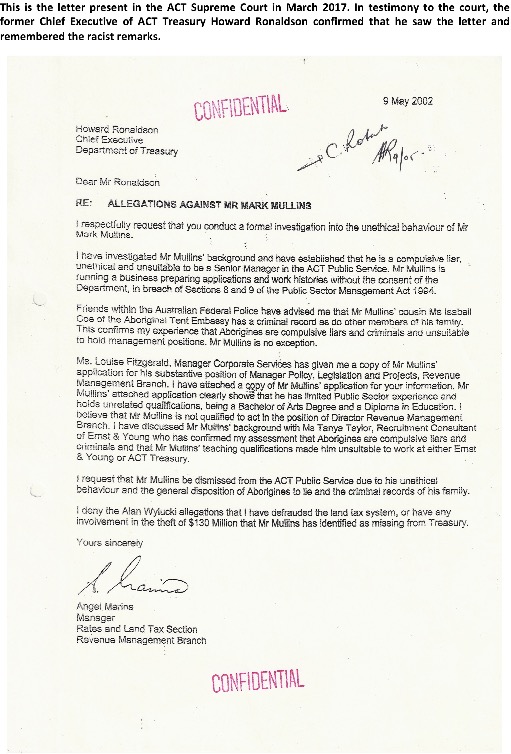
This was not a slip of the tongue in a meeting, deniable afterwards as heat-of-the-moment. It was a written submission to a senior public official, deliberate and repeated, built from a stated racial theory about an entire people, attached to a demand that a named Indigenous public servant lose his job. Under any competent human resources framework, let alone any government serious about its obligations under anti-discrimination law, that letter should have ended Marina’s career, not his manager’s.
It did not. The minister responsible for ACT Treasury at the time, Ted Quinlan – who also held the police portfolio – was given a copy of it. He did nothing with it in 2003, and when the matter began moving toward the Human Rights Commission, he did something worse than nothing: by the account given to me directly by Meredith Whitten, who worked for the ACT government at the time, Quinlan sided with Marina, a man she said he knew personally through his own connections to ACT sport. Marina, for what it is worth, had cultivated a minor public profile as a sporting identity in Canberra – the kind of local visibility that opens doors to ministers who might otherwise have no reason to take a public servant’s side over a Human Rights Commission complaint. I make no claim to know what passed between Quinlan and Marina beyond what I was told and what the documentary record shows. I do know what the outcome was: a white public servant who had put racist material about an entire people in writing, and used it to try to end an Indigenous colleague’s career, faced no consequence. The minister who could have acted, didn’t. The party that has spent a generation telling Indigenous Australians it is our natural political home decided, when it mattered, that the easier path was silence.
I want to be careful here, in the way I try to be careful in everything Blak and Black publishes. I am not a court, and this essay is not a verdict. I am telling you what I witnessed, what I was told by someone who was there, and what a letter that exists says in its own words. If anyone named in this account believes I have misstated a fact, I will correct it – that is the standard I hold myself to, and it is the standard I think journalism and political memory owe to everybody, including people I am angry at. But the core of it is not in dispute: the letter exists, its language is what it is, and the ACT Labor government’s response to it was to do nothing.
A Pattern, Not an Incident
If this were an isolated failure – one minister, one bad year, one uncharacteristic lapse in an otherwise vigilant administration – I would not have built twenty years of political estrangement on top of it. It was not isolated. The ACT has been governed by Labor, in coalition or in majority, continuously since well before that letter was written, and it has stayed in office through every election since. In that time, the Canberra Times and independent outlets like RiotACT/Region have carried a steady stream of reporting on the mistreatment of Indigenous people by ACT government agencies – in policing, in child protection, in the courts, in the public service itself. None of it has dislodged the party from office, and none of it, in my observation, has produced the kind of institutional reckoning that the party’s own rhetoric about reconciliation and Indigenous rights would seem to demand.
That rhetoric is the part I find hardest to forgive, because it is not merely absent – it is loudly, repeatedly, publicly asserted. Labor governments, federal and territory alike, hold Welcome to Country ceremonies, fly the flags, quote the Uluru Statement from the Heart when it is politically costless to do so, and describe themselves, without apparent irony, as the party of reconciliation. I have sat through enough of those ceremonies to know how hollow they can feel when the institution performing them has, within living memory, declined to discipline a man who wrote that Aboriginal people are “compulsive liars and criminals.” Words are supposed to cost something. For the ALP, in my experience, they have cost nothing at all. That gap – between the public liturgy of reconciliation and the private calculus of who gets protected when a complaint lands on a minister’s desk – is not a pub test the party can pass, and I do not think it deserves to.
The Custody Ledger
If Marina’s letter were the only data point I had, a critic could fairly call it a single bad decision by a single minister, unrepresentative of the party as a whole. It is not the only data point. Nationally, more than 630 Aboriginal and Torres Strait Islander people have died in custody since the 1991 Royal Commission handed down its 339 recommendations – a Royal Commission established, let it be remembered, precisely because successive governments had failed to treat Indigenous deaths in custody as a matter requiring urgent structural reform. That figure has not levelled off with time; 2024–25 was the worst year on record, with 33 Indigenous deaths in custody, and the Indigenous share of the national prison population has climbed from roughly 14 per cent at the time of the Royal Commission to around 35 per cent today. Recommendations as basic as removing hanging points from cells – made in 1991, restated in review after review – still have not been fully implemented in facilities where Indigenous people continue to die by hanging.
I make this point carefully, because deaths in custody are not a Labor failure alone; governments of every political colour, state and federal, have had the numbers in front of them and have not treated implementation as urgent. But Labor has held government nationally, and in the ACT continuously, for long stretches of exactly the period in which this ledger has grown, and it is Labor that has built its national brand most heavily around reconciliation and First Nations partnership. A party is entitled to be judged by the gap between the ledger it inherits and the ledger it leaves behind. On deaths in custody, that gap has not closed under Labor governments any more than it closed under their opponents – which is precisely my point. The rhetoric of reconciliation has not translated into the one outcome that would prove it was more than rhetoric: fewer Indigenous people dying in the state’s care.
When the State Became the Complainant
The clearest illustration I can offer of how far this institutional reflex can run is not Marina’s case. It is my own.
In 2015 I was charged by the Australian Federal Police with sixteen counts arising from an affidavit the prosecution said I had forged in order to improperly influence a public official in the course of their duties. The matter was prosecuted by the ACT Director of Public Prosecutions – an office that sits within, and answers to, the same ACT Labor government whose treasurer had declined, over a decade earlier, to act on Marina’s letter. My trial took place in 2017. The case against me turned out to rest on a document that my defence demonstrated, to the jury’s satisfaction, had itself been forged somewhere within the ranks of the ACT government – the very body that was the complainant in the matter. The jury accepted that defence. I was acquitted on all sixteen counts.
I set this out not to claim a special grievance but because it is the same institutional posture I have described throughout this essay, seen from the other side of the table. In 2003, the ACT Labor Government’s apparatus declined to hold one of its own accountable for a written act of racism against an Indigenous public servant. By 2015, the apparatus of that same government had produced, at the centre of a sixteen-count criminal prosecution against an Indigenous critic of that government, a document a jury accepted was not genuine. I am not asking any reader to take my word for the outcome; it is a matter of public record that I was acquitted on every count. My New York-based human rights attorney is currently finalising a submission to the United Nations Human Rights Committee concerning this matter. I will report the outcome of that process in these pages when there is an outcome to report, and not before.
Gaza and the Doubling Down
More recently, under the prime ministership of Anthony Albanese, I have watched the federal party apply the same logic on a different stage. The Commonwealth Government’s approach to the suffering of Palestinians in Gaza has, in my assessment, been shaped far more by domestic political risk-management than by any consistent human rights principle. I do not say this as someone indifferent to antisemitism, or to the trauma Australian Jews carry, including from recent events here at home. I am, as it happens, both Jewish and Indigenous, and I do not experience those identities as being in tension with each other or with a clear-eyed view of this conflict. I do not dispute that Jewish Australians have faced real and rising discrimination, including after the Bondi attack, nor do I dispute that a Royal Commission examining antisemitism is a legitimate and defensible response to that.
What I dispute is not the intention behind that inquiry but the asymmetry built into how complaints of discrimination tend to be handled once they reach an institution’s own doorstep. A complaint of antisemitism, in my observation, is generally treated as substantially self-evidencing: the complainant’s account is the starting point rather than one input among several, corroboration functions as confirmation rather than as a precondition for being believed, and the burden sits with the institution to explain why an account should not be accepted at face value. A complaint of institutional racism made by an Indigenous person is, far more often, treated as a claim requiring proof before it is treated as true: documentary corroboration is demanded up front, the complainant’s motive is scrutinised as closely as the substance of what they allege, and the matter is routinely referred back through the very agency or department it concerns, rather than to an external body with power to compel evidence. Nothing in any statute mandates this difference. It lives entirely in institutional practice – in which complaints are fast-tracked to a Royal Commission, and which are filed, unactioned, in a minister’s in-tray, as Marina’s letter was in 2003. A party that wants credit for holding a single, consistent human rights standard has to apply that standard to its complaint-handling processes, not only to its press releases.
This is, I think, the same institutional habit at two different scales. In 2003 it was a minister deciding a racist letter was not worth acting on. In the 2020s it is a government deciding that a consistent human rights standard is not worth the domestic political cost of applying it evenly. The instinct is the same: manage the politics, defer the principle, and trust that the rhetoric of care will paper over the absence of it.
Steelmanning the Defence
It would be dishonest of me – and it is not the standard I hold this publication to – if I did not put the other side of this as fairly as I can. A defender of the ALP would say, reasonably, that political parties are large, factional coalitions, not monolithic actors, and that the sins of one minister in one territory branch twenty years ago cannot fairly indict the party as a national institution today. They would point to genuine achievements: the Rudd government’s apology to the Stolen Generations, various Labor governments’ expansion of native title processes, the current federal government’s higher representation of Indigenous voices in its own ranks. They would say that One Nation’s transparency about its views is not a virtue but simply a lack of any electoral incentive to disguise them, given the party has never needed the kind of broad-church coalition-building that forces larger parties to hold divergent factions together. And they would say, fairly, that comparing a party’s institutional failure to protect one man in 2003 with its considered current foreign policy position is stretching a single case further than it can bear.
These are not trivial arguments and I do not dismiss them. The apology mattered. Native title reform, however incomplete, was real. I do not think every ALP minister or member shares Quinlan’s judgment, and I have known individual Labor people, including in the ACT, who fought hard and honestly for Indigenous constituents. My argument is not that every person who has ever worn a Labor ticket is complicit in what happened to Mr Mullins. My argument is that the institution, at the point where its stated values collided with the political cost of enforcing them, chose the cost every time I have watched it closely enough to see the choice being made. One apology, however sincere, does not offset a governing culture that will not discipline a man for writing what Marina wrote, and will not apply the same evidentiary rigour to Indigenous complaints that it extends to complaints made by others. A single act of institutional courage does not purchase two decades of institutional cowardice.
The Uncomfortable Comparison
This brings me to the comparison I know some readers will find provocative, and which I make with full awareness of what One Nation is and has been. I have never voted for One Nation. I am not going to start. Pauline Hanson’s positions on Indigenous rights, on immigration, on multiculturalism and on domestic violence are, in my view, frequently wrong, sometimes dangerously so, and I have written at length elsewhere in this publication about the harm those positions have done and continue to do.
But there is one thing I will say for her, and for her party, that I cannot say for Labor: she has never lied to me about what she believes. Hanson’s views on Indigenous Australians are on the front page, in her own words, in Parliament, on record, unambiguous and unapologetic. Whatever else that is, it is honest in the narrow but important sense that it allows every voter, and every Indigenous Australian, to know exactly what they are dealing with and to make an informed decision about whether to support it. I can fight an open position. I know where the line is drawn and I can organise against it in daylight.
What I have found far harder to fight is a party that holds, in practice, many of the same instincts – a willingness to protect the comfortable over the vulnerable when a complaint becomes inconvenient, a preparedness to let racism go unaddressed when the man who wrote it has the right friends – while wrapping that practice in the language of reconciliation, human rights, and Voice, Treaty, Truth. The gap between what Labor says about itself and what it has, in cases I know intimately, actually done is not a minor rhetorical inconsistency. It is the mechanism by which the party gets to hold Indigenous votes and Indigenous goodwill decade after decade while declining to spend any real political capital protecting Indigenous people when it costs something to do so. Hanson never asks for that goodwill. Labor asks for it constantly, and in my experience, has not consistently earned it.
There is a passage in the prophetic tradition I return to often in my own thinking, in which the prophets reserve their sharpest condemnation not for the openly wicked but for those who observe the forms of righteousness while hollowing out its substance – who “draw near with their mouth and honour with their lips” while their hearts are elsewhere. It is not the open enemy who does the most lasting damage to the practice of justice; it is the institution that claims justice as its brand while administering something else entirely. Marcus Aurelius, in a very different register, wrote that a man’s worth is measured by what he is occupied with when nobody is watching. Ted Quinlan’s decision in 2003 was made almost entirely out of public view, in an internal correspondence between a minister and a Chief Executive. That is precisely the kind of decision – small, unwitnessed, low-cost to make either way – that tells you what an institution actually values, as distinct from what it says at press conferences.
What Honesty Is Worth, and What It Isn’t
I want to be precise about what I am, and am not, conceding to One Nation in the comparison I have just drawn, because I think a reader could take it further than I intend and I would rather correct that here than leave it to be misread. Hanson’s positions on Indigenous Australians are not merely positions I happen to disagree with. On my reading of the evidence, several of them are factually wrong, and if enacted would cause real harm to people I write for and about in this publication. Transparency about a wrong position does not make the position less wrong. A party that tells you plainly that it intends to do you harm has not thereby earned moral credit for the harm; it has only removed your ability to say you were not warned.
What transparency does purchase – and this is the only thing I am crediting it with – is your capacity to resist. An open position can be debated in Parliament, tested at an election, organised against by community groups, and defeated in daylight, through ordinary democratic contest. A concealed institutional instinct – one that operates through ministers who quietly decline to act, through complaint-handling processes that shift their evidentiary standard depending on who is complaining, through the selective application of scrutiny – cannot be fought in the same way, because it is never put up for a vote. You cannot campaign against a reflex that never announces itself. You can only document it, case by case, year by year, as I have tried to do here, and hope the documentation becomes a form of accountability the institution has otherwise managed to avoid.
So when I say Hanson has never lied to me, I am making a narrow, procedural claim, not a moral one. I am saying the mechanism of harm differs, not that the harm itself is smaller. I do not want any reader to leave this essay thinking I have gone soft on One Nation’s substance in the course of making a point about Labor’s hypocrisy. Both things are true at once: One Nation’s positions are ones I will keep opposing in these pages, and the ALP’s practised art of concealing similar instincts behind the language of reconciliation is, in the specific and narrow sense of what can be resisted and by whom, harder to fight. A wrong you can see clearly is not a wrong you should tolerate. It is, at most, a wrong you are better equipped to resist.
Conclusion
I did not leave the Labor Party because I stopped believing in the things it claims to stand for. I left because I watched, at close range and over many years, the distance between what the party says and what it does when nobody outside the room is looking. Mr Marina’s letter is not, to me, an aberration from 2003 that has since been corrected; it is the first entry in a ledger that runs through a national deaths-in-custody toll no government has treated with the urgency its own rhetoric demands, through a sixteen-count prosecution in which the state I am describing turned out, on the evidence a jury accepted, to be the author of the very document used against me, and into the federal government’s current handling of Gaza and its uneven application of scrutiny between Jewish and Indigenous complaints of discrimination. I do not offer this as a comfortable conclusion, and I recognise it will be read by some as unfair to individual Labor people who have acted honourably. To them, my answer is the same one I would want applied to my own writing: judge the institution by its pattern, not only by its best exceptions.
I will not vote for One Nation. Its positions on the matters closest to my life and my family’s history are ones I intend to keep opposing in these pages for as long as I am able to write. But I will say this much for Pauline Hanson, and I say it as someone who has spent a career inside the institutions that are supposed to protect people like me: she has never once made me guess what she thinks of Indigenous Australians, and she has never dressed up a decision to protect a comfortable ally in the language of human rights. The Australian Labor Party has done both, more than once, in cases I know personally and in policy I have watched unfold nationally. A party that hides its contempt behind a flag it did not earn the right to fly is, in the end, harder to forgive than one that never claimed the flag at all. That is why I would never vote for Labor again, and why I intend to keep saying so.
– – –
Bakchos is the founder of Blak and Black, an Australian media and advocacy platform established in 2010. Bakchos writes from the intersecting perspectives of Wiradjuri heritage, Jewish identity, and humanism.
© Bakchos, July 2026


Pauline Hanson might be honest about who she is, but who she is isn’t something to be proud of.
It is not, Kelly. The post examines character more than voting options. In a strange way, Hanson’s transparency about her values (if not her finances) contrasts with Albanese’s active hypocrisy that has become so very plain since becoming PM. He leads a party in which a critical opinion is viciousy opposed by by rusted-ons who refuse to see fault in the party or it’s leaders. The reality is people are a party and its leaders can be wanting a much as anyone else. The ALP believes in power, not people and Indigenous issues are a politically correct checkbox to tick, but rarely action.
Kelly, Pauline Hanson is a nasty person, what she’s saying about domestic violence is simply unconscionable.
Pauline Hanson is an inherently dishonest person.
Bakchos as we’ve discussed recently, Meredith Whitten is as guilty as Angel Marina, for what happened, possibly more so, as she was more senior, and undoubtedly more intelligent.
Hi Marc, I’m well aware that Angel Marina is lying, but his name is on every questionable document, and he stated under oath that he did it all by himself, therefore he has to wear the blame in the UN for everything his racism has caused.
What the ALP did to you cuz is disgraceful. Fuck the cunts!
After what Ted Quinlan and Peter Garrisson did to you, I’ll never vote Labor either, and I’ll be doing everything in my power to convince as many people as I can not to vote Labor either.
With respect. Being of Pacific Heritage on my mother’s side and Australian on my father’s side I have had the experience of dealings with the very wealthy and very poor, but am of the opinion that in Australia still the attitude of many is the indigenous peoples and others are ” liars” and “criminals” truly a shame but a fact in my experience and opinion.