
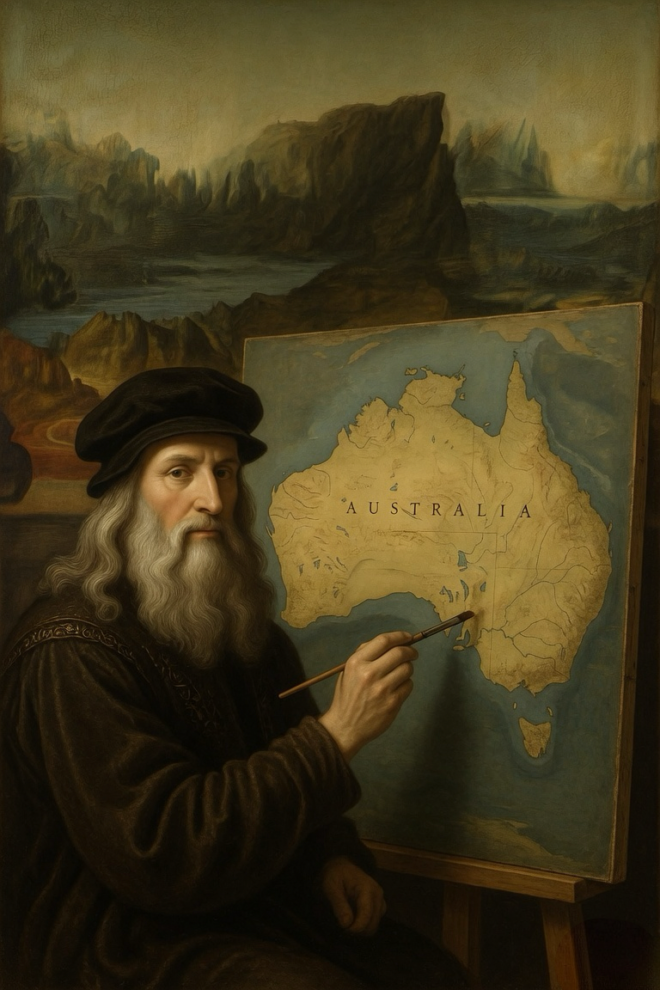
Somewhere in the thicket of my teenage years, while I was labouring over Italian verb conjugations and falling in love with a language that seemed to sing even when it was merely conjugating the passato prossimo, I came across a line attributed to Leonardo da Vinci. I cannot point you to the source now – forty years is a long time, and memory is a poor archivist – but the line has never left me. Leonardo, so the story goes, never considered the Mona Lisa finished. He kept her with him for years, retouching the corners of her mouth, adjusting the sfumato at the edge of her jaw, because he believed a work of art is never truly finished. It is only ever abandoned, or interrupted, or carried as far as a single life will allow.
I have never been able to verify the attribution, and in the spirit of the evidentiary rigour I try to bring to everything else I write, I want to be honest about that uncertainty rather than dress it up as fact. But whether or not Leonardo actually said it, the idea is true independently of him, and I have tested it against my own small practice. I write poetry, occasionally, unevenly, the way a man tends a garden he loves but does not always have time for. And what I have noticed, across years of returning to the same poems, is that they do not sit still. I revise a line here, cut a stanza there, replace an image that once felt exact but now feels borrowed. After enough revisions, the poem in front of me barely resembles the poem I first put down on the page. It is not that the earlier version was wrong. It is that the poem was never a fixed object to begin with. It was a living relationship between an idea and its expression, and living relationships change.
I have come to think that a nation is very much the same kind of thing.
A Nation As An Unfinished Canvas
We know how Australia began – or rather, we know the several, overlapping, sometimes contradictory ways it began, because a nation does not have a single origin point any more than a poem has a single line that explains it. There is the deep continuity of the oldest continuous cultures on Earth, tens of thousands of years of law, ceremony, and custodianship of country that predates every other thread in this story by an almost unimaginable margin. There is the violent rupture of invasion and colonisation, the frontier and its massacres, the missions, the stolen generations, the long refusal of the state to reckon honestly with what was done in its name. And there is the newer, still-thickening weave of migration – indentured labour, postwar arrivals, refugees from a dozen different catastrophes, and the ordinary, undramatic movement of people who simply came looking for a life and stayed to build one.
None of these threads is the whole picture, and none of them can be honestly erased to make the others look cleaner. That is the first discipline this way of seeing the country demands: respect for the actual history, not a curated one. Da Vinci did not paint over the underdrawing when he changed his mind about the Mona Lisa’s smile – the underdrawing is still there, beneath the surface, visible to anyone with the instruments to look for it. Australia’s underdrawing is still there too. You can see it in the topsoil disturbed by frontier violence, in the language reclaimed after generations of suppression, in the shape of a city grid laid over songlines it never consulted. Pretending otherwise – painting a prettier picture over the top and calling it the whole work – is not reverence for the art. It is vandalism of it.
But acknowledging the past is not enough. The harder discipline is staying with the work as it is being made, rather than freezing it at any single moment – including this one.
The Medium Is The Message: Multiculturalism As Pigment
If Australia is a work of art still in progress, then multiculturalism is not a decoration applied to the canvas after the fact. It is the pigment itself – the actual material the country is being painted with, layer upon layer, colour bleeding into colour in ways no single brushstroke controls. I will not claim this combination is without precedent anywhere in human history; that is a bigger claim than I can responsibly stand behind, and the essay does not need it. What I will say plainly is that it is unusual: few states have tried to run a deliberate, large-scale, globally sourced settlement project on the same ground as an unresolved and unreconciled colonial dispossession, with both processes still visibly unfinished at the same time. That combination is not a curiosity. It is a demand. It means the country cannot treat multiculturalism as a separate, self-contained achievement to be celebrated on its own terms, quarantined from the older and harder question of what is owed to the people whose country this was before any settlement, multicultural or otherwise, began. The unusualness of the combination is precisely what obliges the honesty – not a hedge to be managed, but the whole reason the discipline matters.
None of this is abstract. Walk it down from the level of metaphor to the level of a Tuesday afternoon and you find the actual friction the painting is made of. You find outer-suburban and regional communities absorbing new arrivals faster than housing, schools, and health services have been funded to cope with, and resenting – not without cause – being told by inner-city commentators that their unease is simply prejudice. You find enclaves where a language other than English is the daily currency of the street, the shop, and the mosque or temple, and a real, unresolved argument about whether that is cultural richness, a failure of integration, or simply what settlement always looks like in its first generation before it thins out in the second and third. You find group-based multicultural policy – funding, representation, and recognition organised around ethnic or religious blocs – sitting in genuine tension with a liberal commitment to the individual as the basic unit of citizenship, a tension no amount of goodwill dissolves, because it is a real disagreement about what fairness requires. You find, too, that “multicultural Australia” is not one experience but many, and unevenly rewarded ones: skilled migrants from some countries move into the professions within a decade, while refugees from others remain locked out of recognised qualifications and decent housing for a generation, and the gap between those cohorts is not an accident of culture but frequently an outcome of policy choices that could have been made differently. A metropolitan Australian celebrating the diversity of a Saturday market and a regional Australian watching a meatworks town change composition within a single decade are not describing different countries, but they are living different drafts of the same one, and the essay is worth less if it pretends those drafts read the same.
A poem that erases its own drafts – that pretends the clumsy first attempt never happened – ends up thinner for it, because the labour of arrival is part of what gives the final version its weight. A nation that erases its history, whether the deep history of its First Peoples or the more recent history of who has been welcomed and who excluded, and on what terms, thins out in exactly the same way.
Embracing The Experiment Without Romanticising It
“Embracing the experiment” is easy to sentimentalise into something toothless – a multicultural-festival version of nationhood, all lion dances and paella pans, with none of the harder work underneath. That is not what I mean. To embrace the experiment properly is to accept that it is genuinely experimental – that it can fail, that it has failed in particular places and particular moments, and that failure is not proof the whole project should be abandoned any more than a bad line is proof a poem should be torn up. It means holding fierce loyalty to the project of a plural Australia alongside equally fierce honesty about where it is falling short: where institutions built to protect the vulnerable instead protect themselves, where the rhetoric of a “fair go” coexists with outcomes that are anything but fair for First Nations people, for refugees, for anyone the state has decided to treat as a problem to be managed rather than a people to be reckoned with.
The Stoics, whom I return to often in my own thinking, had a useful distinction here: the difference between what is within our control and what is not. We do not control how Australia began. We do not control the frontier violence, the massacres, the stolen children, the decades of White Australia policy that this nation’s multicultural present had to be built against and in spite of. That is the underdrawing, fixed now, unchangeable. What remains within our control – what is, in fact, entirely within our control, in the way a poet’s next revision is entirely within the poet’s control – is what we do with the canvas from this point forward. Whether we keep working honestly with the material we have been given, or whether we reach for the false comfort of pretending the canvas is blanker than it is, or pretending it is finished when it manifestly is not.
A Fair Hearing For The Sceptic
Working honestly with the canvas, though, means more than resolve. It means testing the premise against its strongest opponents rather than only its weakest ones. The serious sceptic of multiculturalism as public policy does not, in the best version of the case, argue from bigotry. The argument, at its most defensible, runs something like this: shared institutions, a shared language, and a reasonably thick common culture are not incidental to social trust and functioning democracy – they are load-bearing. Diversity, on this view, is not a cost-free good to be maximised without limit; past a certain pace and scale, it can strain the very civic solidarity that makes redistribution, mutual obligation, and collective action possible in the first place, because people are demonstrably less willing to fund and support institutions they perceive as serving people unlike themselves. On this account, a state that pursues rapid, large-scale, group-conscious multiculturalism without equal seriousness about integration, a common civic language, and a shared story is not being generous. It is gambling with the social trust that everything else – including the protections vulnerable minorities eventually rely on – is built upon.
This argument deserves to be met rather than waved away, and the honest answer to it is a qualification, not a denial. The evidence on declining social trust in more diverse societies is real but contested, sensitive to how trust is measured, and it tends to understate how much of the strain attributed to diversity is in fact attributable to inequality, segregation, and institutional neglect running alongside it. But the sceptic is not wrong that solidarity has to be built and is not simply generated as a byproduct of good intentions. Where I part company with the sceptic is not on the diagnosis but on the remedy. The answer to the strain is not to arrest the painting mid-stroke and declare that this is as far as the composition should go. It is to do the harder, less glamorous work the sceptic is right to insist on: a genuinely shared civic language and set of institutions that people from every background are inducted into and expected to hold in common, alongside – not instead of – the recognition of difference. A country that does the recognition without the induction gets fragmentation. A country that does the induction without the recognition gets assimilation dressed up as unity, which First Nations Australians in particular have every reason to distrust, having lived through exactly that policy under a crueller name. The honest position holds both demands at once, and refuses the sceptic’s implicit suggestion that they are mutually exclusive.
Respecting The Country For What It Is, Not What Some Would Prefer It To Be
There is a particular kind of dishonesty that afflicts public conversation about national identity, and it comes from two opposite directions that end up in the same place. One direction insists on a nostalgic Australia that never quite existed – a homogeneous, uncomplicated past before “all this multiculturalism,” conveniently forgetting that the country was multicultural, multilingual, and dazzlingly diverse for tens of thousands of years before a single European ship arrived, and forgetting too the messy, often reluctant, always contested process by which the postwar multicultural settlement was actually built. The other direction insists on an equally flattened story in the other direction – a country reduced entirely to its worst chapters, as though the drovers and the shearers and the Snowy Mountains Scheme workers and the Vietnamese boat people and the Sudanese resettlement communities and the Wiradjuri elders holding ceremony on their own country today were not all, in their own ways, still painting on the same canvas.
Both of these are failures of the same kind: a refusal to look at the actual painting in front of us and see it as it is, layered, contradictory, unfinished, alive. Marcus Aurelius wrote to himself, in the private notebook that became the Meditations, that the art of living is more like wrestling than dancing – you have to be ready to stand firm against whatever comes, without knowing the shape of it in advance. I think that is closer to the truth of what Australia is being asked to do than any of the more comfortable metaphors on offer. This is not a finished ballroom dance with a known ending. It is a live wrestling match with our own history, our own contradictions, our own capacity for both cruelty and generosity, and the outcome is not decided.
Building The Masterpiece We Have Not Yet Seen
I do not know how this painting ends, and I do not think anyone alive today will see it end – it is not the kind of work that finishes in a single generation’s lifetime. That, too, is part of what makes the Da Vinci image so apt, whether or not he actually said the words attributed to him. He worked on the Mona Lisa for the better part of two decades and reportedly died with her still unfinished. Whoever comes after him – whoever hangs the painting, whoever conserves it, whoever restores the varnish that yellows with time – inherits an obligation to the work that Leonardo himself never got to complete. That is not tragedy. That is simply what a great, living work of art asks of everyone who comes into contact with it: continued attention, continued care, continued willingness to keep working rather than to declare the thing done and walk away.
We owe our country that same discipline. Not blind loyalty, which is a kind of laziness dressed up as patriotism. Not cynicism, which is a kind of laziness dressed up as sophistication. But the harder, more sustained work of staying with the piece – revising where revision is honestly called for, defending what has been rightly built, refusing both the nostalgic lie and the nihilistic one, and trusting that the trajectory we are on, however imperfect, however unfinished, however contested at every turn, is worth the continued labour of getting it right.
I think of my own poems, sitting in their folders, revised a dozen times over, never quite finished, never quite abandoned either. I think of a Wiradjuri elder’s voice carrying across a fire on a Friday night with people of a dozen faiths gathered to listen. I think of Odysseus, twenty years from home, still not finished with his own story, still finding out what kind of man the journey had made him. And I think of a continent that held its own unbroken art for sixty thousand years before anyone thought to ask whether a “multicultural experiment” was possible here at all – as if the deepest and longest-running experiment in continuous culture on Earth had not already been under way, quietly, magnificently, the whole time.
The masterpiece is not behind us. It is not even fully in front of us. It is happening now, in the brushstroke we are laying down today, in the argument we are having, in the wrong we are trying to right, in the elder’s story we are trying to honour, in the newest arrival’s first nervous sentence of English at a citizenship ceremony. Leonardo never finished the Mona Lisa. We will never finish this. That is not our failure. That is the whole point.
– – –
Bakchos is the founder of Blak and Black, an Australian media and advocacy platform established in 2010. Bakchos writes from the intersecting perspectives of Wiradjuri heritage, Jewish identity, and humanism.
© Bakchos, July 2026

Hey there Bakchos this post is certainly food for thought.
This is an interesting essay, Bakchos. I’ve never before considered Australia to be a work of art in progress, but I can see the logic of your position.
Bakchos you’re clearly comfortable writing about poetry and philosophy, not to mention art. A strange essay, that strangely makes sense.