
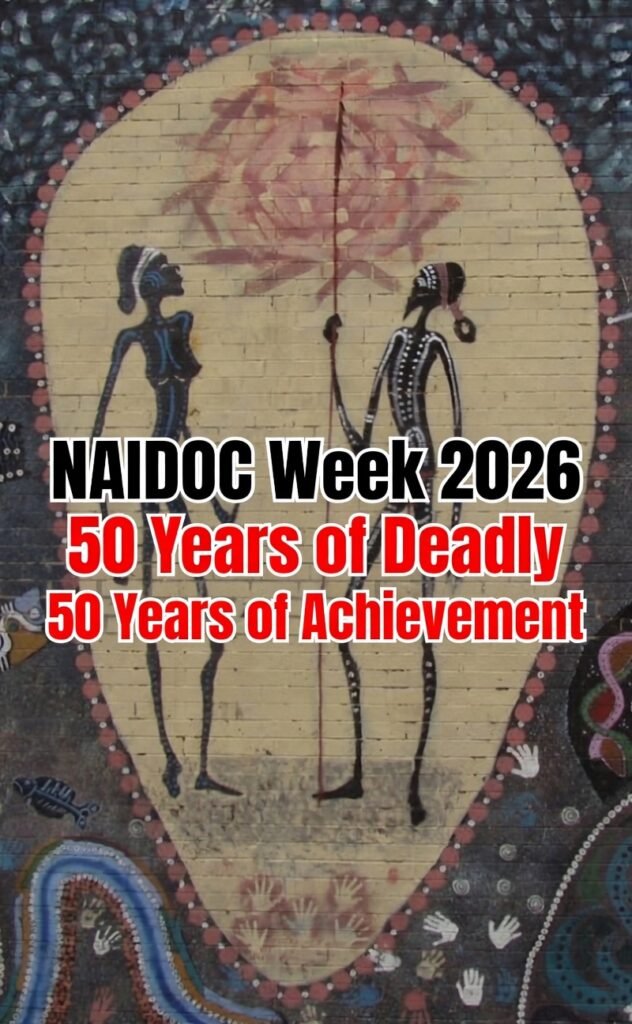
This year’s NAIDOC theme, Fifty Years of Deadly, marks two things at once, and both deserve to be said plainly before anything else is added to them. In 1974, for the first time, the national committee coordinating what was then a single day of observance was composed entirely of Aboriginal people. The year after, that observance became a week. Those two facts, unglamorous as bureaucratic milestones tend to sound, mark the moment First Nations people took direct control of how their own recognition would be organised, timed, and told. Everything this essay describes flows from that act of taking hold of the microphone rather than waiting to be handed it.
There will be another piece from this desk during NAIDOC Week that deals with the ledger’s other column: the incarceration rates, the Closing the Gap targets still off track, the deaths in custody that keep recurring, the states that have walked back from treaty processes they once committed to. That column is real and this publication has never looked away from it. But a fair accounting requires both columns, and the achievement column over fifty years is long, specific, and too often summarised into a single feel-good sentence at a citizenship ceremony. It deserves better than that. What follows is an attempt to give it the specificity it has earned.
“Fifty Years of Deadly is a marker, not just of time passed, but of the momentum still building.”
The Long Road to the Room
The 1974 all-Aboriginal committee and the 1975 week did not appear from nowhere. They were the institutional endpoint of decades of organised political action that Australians are still, in 2026, not taught with enough seriousness in most classrooms. William Cooper and the Australian Aborigines League staged the Day of Mourning in Sydney in 1938, timed deliberately against the 150th anniversary of the First Fleet’s landing, to insist that the nation’s foundation story include the dispossession it depended on. That protest tradition ran through the 1965 Freedom Ride, through Charles Perkins’s insistence on being heard rather than managed, and through the Wave Hill walk-off of 1966, when Vincent Lingiari led Gurindji stockmen and their families off Wave Hill station in a strike that began as a demand for equal wages and became, over eight years, a demand for land itself.
The 1967 referendum is the moment most Australians can name, and it deserves its place: over ninety per cent of voters agreed to remove the constitutional provisions excluding Aboriginal people from the census and from Commonwealth law-making. What is less often said is that this result was the product of a decade of methodical campaigning by Aboriginal organisers, most prominently through the Federal Council for the Advancement of Aborigines and Torres Strait Islanders, who understood that public sentiment does not move on its own. It is organised. Fifty years of NAIDOC sits downstream of that organising tradition, and it has never stopped drawing on it.
Land Returned, Title Recognised
Vincent Lingiari’s strike ended in 1975 when Gough Whitlam poured soil into his hand, but the more consequential outcome was the legislation it set in motion. The Aboriginal Land Rights (Northern Territory) Act 1976 became the first Commonwealth statute to recognise Aboriginal systems of land ownership, converting former reserves into inalienable freehold and establishing a statutory claims process for the first time.
The turning point came in 1992 with Mabo. Eddie Koiki Mabo, a Meriam man from the Torres Strait, spent a decade persuading the High Court to reject the fiction of terra nullius and recognise that his people’s land rights had survived colonisation. He died five months before the judgment. The Native Title Act 1993 followed, and determinations have since been made over more than 55 per cent of the Australian continent, including major settlements such as the Noongar agreement in Western Australia.
That headline figure requires immediate qualification. Once non-exclusive rights and co-existing pastoral leases are taken into account, legal experts and the Productivity Commission assess genuine Indigenous ownership or control at closer to 30 per cent, concentrated almost entirely in remote and very remote areas. Recognition on paper is not the same as control on the ground and conflating the two serves no one. What can be said plainly is that the direction over fifty years has been toward greater recognition, not less. A March 2025 High Court decision in a case brought by the estate of Yolngu leader Galarrwuy Yunupingu opened the possibility of Commonwealth compensation for historical extinguishment of native title in the Northern Territory — a development whose full implications are still working through the courts.
A Movement That Builds Its Own Institutions
What distinguishes the last two decades from earlier ones is not just recognition won from courts and parliaments but institutions built and staffed by First Nations people themselves. NITV has operated as a dedicated national broadcaster since 2007, producing news, current affairs, and drama entirely through Indigenous editorial control. AIATSIS maintains AustLang, an authoritative public database now covering more than 1,200 Aboriginal and Torres Strait Islander languages and language varieties, alongside its Dictionaries Program, which since 2018 has supported the publication of twenty-two community dictionaries and printed more than 20,000 copies for use in schools and homes. The National Indigenous Languages Survey, now in its fourth iteration, is co-designed with the communities it studies rather than conducted on them and will be the first to specifically capture Aboriginal and Torres Strait Islander sign languages.
Language revival is, on the numbers, one of the harder stories to tell with unqualified optimism; Australia’s rate of language loss remains among the highest in the world, and just over a dozen languages are still learned as a first language by children. But the direction of travel matters. The 2017 NSW Aboriginal Languages Act was the first state legislation of its kind, establishing a trust to fund community-led revitalisation, and similar programs have since spread. Programs like Paper and Talk are reconnecting communities with recordings and documents held in archives, in some cases returning a language to active use after a period in which no living speaker remained. That is not a small thing. It is communities doing, with method and patience, the specific technical work of bringing a language back from the archive to the tongue.
Culture, Told on Its Own Terms
The NAIDOC poster competition, running since 1967 and now exhibited in institutions including the National Museum of Australia, has given generations of First Nations artists a national platform without requiring them to pass through a non-Indigenous curatorial gatekeeper first. This year’s winning artist, Zaachariaha Fielding, a Yankunytjatjara musician and visual artist from the APY Lands who represented Australia at Eurovision in 2024 as one half of Electric Fields, described the theme as a reminder to keep learning his own history and culture, with, in his words, plenty more still to do. That combination of pride and unfinished business is the emotional register this whole movement tends to strike, and it is a healthier one than either triumphalism or despair.
The National NAIDOC Committee’s decision to award this year’s Lifetime Achievement honour posthumously to Rhoda Roberts AO, the Widjabul Wieybal woman who became SBS’s inaugural Elder in Residence and spent decades building First Nations media and storytelling infrastructure in this country, is itself a marker of how much institutional ground has been covered. There is now enough of a body of Indigenous-led cultural institution-building in Australia that a lifetime of it can be honoured on its own terms, inside a framework First Nations people themselves designed and run.
Music carried that same claim to self-representation into the mainstream charts, which is a harder room to break into than a gallery or a museum because the audience does not come looking for instruction. Yothu Yindi took the Warumpi Band’s earlier fusion of language, rock, and land rights politics onto national radio with Treaty in 1991, still one of the few songs in the world’s charts sung partly in an Indigenous language demanding a specific political settlement rather than gesturing at grievance in general terms. Archie Roach’s Took the Children Away, released the following year, did more to make the Stolen Generations legible to a mainstream Australian audience than a decade of policy reports had managed, because it asked to be understood as a son’s testimony before it asked to be understood as history. Neither man waited for permission to make work that was simultaneously art and evidence.
Words on the Page
What music did in three minutes, literature has done at greater length and, arguably, with even less compromise, because a novel cannot be edited down to a chorus. Kim Scott, a Noongar writer, has shown what that looks like twice over: Benang, awarded the Miles Franklin in 2000, and That Deadman Dance, which won it again in 2011, both treat the coloniser’s own documentary record, the letters, the surveys, the mission files, as material to be turned over and interrogated rather than simply narrated from within. Alexis Wright, a Waanyi writer, took the same prize for Carpentaria in 2007 and returned to claim it a second time in 2024 for Praiseworthy, a novel large enough in ambition that the judges reached for comparisons usually reserved for the form’s biggest swings. Both writers arrived at the country’s most prestigious literary honour by the same route: not as an Indigenous category within Australian letters, but as its most formally daring practitioners, full stop.
That confidence had to be built, and it was built earlier than most readers realise. Oodgeroo Noonuccal’s We Are Going, published in 1964, was the first book of poetry by an Aboriginal Australian to reach print, three years before the referendum that is usually treated as the era’s opening act; it is now a foundational text taught, unevenly but increasingly, in Australian schools. Bruce Pascoe’s Dark Emu picked up that same insistence on evidence decades later, reopening a public argument about pre-colonial Aboriginal agriculture and land management that professional historians and archaeologists are still working through, contest and all. What connects Noonuccal, Scott, Wright, and Pascoe across sixty years is not a shared style but a shared refusal: none of them waited for a non-Indigenous authority to certify that the interior life of their communities was complex enough to deserve serious literature. They simply wrote it, and the prizes followed.
Health and the Professions
If literature and land rights are where this movement’s confidence shows most clearly, health is where its patience is tested hardest, and honesty requires saying so plainly rather than folding it into a footnote. On the latest national figures, Aboriginal and Torres Strait Islander life expectancy at birth sits 8.8 years below the non-Indigenous rate for men and 8.1 years below it for women, a gap the 2031 Closing the Gap target is not currently on track to meet. No amount of institution-building elsewhere in this essay changes that number, and this publication has no interest in pretending otherwise.
What the past fifty years have built is not yet a closed gap, but it is a workforce and an infrastructure that did not exist before, and that distinction matters because infrastructure is what eventually moves numbers. The Aboriginal Community Controlled Health Organisation sector, coordinated nationally through the National Aboriginal Community Controlled Health Organisation, now numbers well over a hundred services delivering primary care designed and run by the communities they serve on the well-evidenced premise that culturally safe, community-controlled care produces better clinical outcomes than services designed elsewhere and delivered in. Alongside it, the Aboriginal and Torres Strait Islander Health Practitioner workforce, a registered health profession in its own right since 2012, has grown into a specific, recognised clinical pathway that did not exist in any formalised form a generation ago.
The same is true across law and public administration. The number of Aboriginal and Torres Strait Islander lawyers, judges, and senior public servants remains far below population parity, and this publication has documented, from direct institutional experience, how far short of genuine equity the public service still falls. But the trajectory bears stating: the first Aboriginal judge appointed to an Australian court, Bob Bellear, sat on the NSW District Court from 1996; there are now Aboriginal and Torres Strait Islander judicial officers across state, territory, and federal jurisdictions, Aboriginal-led legal services operating in every state, and a growing cohort of Indigenous senior executives inside the same bureaucracies this publication has spent fifteen years holding to account. Institutional change of that kind is slow and it is incomplete, but it did not happen by accident, and it did not happen without a great many First Nations people choosing to work inside institutions that had rarely made room for them before.
Higher education tells a similar story of scale, even where the destination is still a long way off. Aboriginal and Torres Strait Islander university enrolments have grown roughly fivefold since the early 1990s, and dedicated Indigenous higher education units, most of them staffed and directed by First Nations academics, now operate at every major Australian university, a structural change from a period when a First Nations student on campus was rare enough to be remarked upon. Indigenous-led research centres such as the Jumbunna Institute at UTS and the National Centre for Indigenous Studies at ANU have shifted a portion of the research agenda itself, deciding what gets studied and how, rather than remaining objects of study conducted by others.
On the Field, in the Parliament, in the Boardroom
If the professions show institutional patience, sport shows the same movement operating in full public view, where an achievement cannot be quietly deferred or reviewed into abeyance; it either happens in front of the whole country or it doesn’t happen at all. That publicness is precisely why the record runs back further, and matters more, than the handful of names usually reached for. Lionel Rose, a Gunditjmara man, became the first Aboriginal Australian to win a world boxing title in 1968 and was named Australian of the Year the same year, at a time when Aboriginal people still could not vote in every state; a generation later, Evonne Goolagong Cawley, a Wiradjuri woman, won seven Grand Slam singles titles through the 1970s, and Ash Barty has spoken openly about growing up on that same example before becoming, in 2021, the first Aboriginal woman to win Wimbledon in over four decades. The line between those three is not incidental. Each closed a gap the one before her had opened.
Cathy Freeman‘s 400 metres gold at the Sydney Olympics in 2000, run in a suit combining the Australian and Aboriginal flags, sits at the centre of that lineage precisely because it fused the individual and the political without either one needing a press release to explain it; the statement was the run itself. Adam Goodes then spent two Brownlow Medals’ worth of goodwill on something harder than winning: naming racism publicly when he encountered it, at real professional and personal cost, and forcing a reckoning the AFL had spent years deferring. Patty Mills, the first Indigenous Australian to win an NBA championship, in 2014, has since used that platform the way Goodes used his, treating visibility as a resource to be spent on community programs rather than hoarded as personal brand. And Torres Strait Islander athletes carry a parallel record of their own, through rugby league and beyond, growing within NAIDOC’s programming as a recognised tradition in its own right rather than a footnote to Aboriginal achievement.
The same shift from individual breakthrough to structural presence shows up in Parliament, though it took longer to arrive there than it did on the sporting field. Neville Bonner became the first Aboriginal member of the federal Parliament in 1971, entirely alone in the role for the whole of his tenure; the Parliament elected in 2022, by contrast, seated eleven First Nations members across both chambers, the highest number in the nation’s history, spanning every major party and the crossbench, with Linda Burney becoming the first Aboriginal woman to hold the federal Indigenous Australians portfolio. That is the difference between a single seat held by exception and a critical mass that no longer depends on any one member’s survival in the role. Whatever view one takes of the 2023 referendum result on the Voice, the process that produced the Uluru Statement from the Heart belongs in the same column: hundreds of First Nations delegates, drawn from every region of the country, reached a consensus document through structured dialogue that most multilateral bodies would envy the discipline of. That the country did not yet vote to enact its central proposal does not erase the fact that it was built, and built well, entirely by First Nations people setting their own terms of engagement with the state.
Economic structures have moved in the same direction, from individual exception toward a self-sustaining sector. Supply Nation’s directory now connects more than six thousand verified Aboriginal and Torres Strait Islander businesses with corporate and government buyers on commercial terms, up from a few hundred when the organisation was founded in 2009, though it is worth being precise about what that scale still represents: Indigenous Australians make up roughly three per cent of the population but own a small fraction of one per cent of the nation’s registered businesses, so growth from a low base is not the same as parity, and nobody serious claims otherwise. Indigenous Community-Controlled Organisations now deliver health, legal, and family services across the country on the evidence, increasingly accepted even by government’s own review bodies, that community control produces better outcomes than services designed and delivered from outside. The establishment of the National Commission for Aboriginal and Torres Strait Islander Children and Young People, operational since January 2025, is a recent and direct product of that argument being won.
Fifty More
None of this argues that the work is finished, and Blak and Black’s forthcoming NAIDOC Week piece will say plainly where it is not. But an achievement does not need to be total to be real. Vincent Lingiari did not live to see the full extent of land rights law; Eddie Mabo did not live to see his own judgment delivered; Rhoda Roberts did not live to collect her own award in person. The pattern across fifty years of this movement is people building something whose full value would only be realised by those who came after them and doing it anyway. That is, in the end, what the word carries when Aboriginal English uses deadly to mean excellent: not perfection, but a standard met with everything you had, in circumstances that did not make it easy.
The NAIDOC theme looks forward as much as back: language returning, young people growing up proud, the fight continuing with new tools and the same fire under new voices. Fifty years ago, an all-Aboriginal committee took charge of a single day of observance. What they, and everyone who has carried that work since, built from it is worth naming in full before the argument moves, as it must, to what remains undone.
Blak and Black will publish a companion essay during NAIDOC Week examining the areas where structural change has stalled, including incarceration, child protection, and the current state of Closing the Gap targets.
– – –
Bakchos is the founder of Blak and Black, an Australian media and advocacy platform established in 2010. Bakchos writes from the intersecting perspectives of Wiradjuri heritage, Jewish identity, and humanism.
© Bakchos, July 2026



Vincent Lingiari did not live to see the full extent of land rights law; Eddie Mabo did not live to see his own judgment delivered; Rhoda Roberts did not live to collect her own award in person.
Agreed, they did not, Buck. The shorter lifespans of Indigenous people robs them of such achievements. But they’ve left brilliant legacies.
Bakchos your analysis is Deadly! Well done!
NAIDOC’s “Fifty Years of Deadly” theme marks a specific institutional milestone: 1974, the first all-Aboriginal national committee took control of what had been a single day of observance. Fifty years on, the record of what’s followed — in law, language, literature, health workforce development, and political representation — is substantial enough to warrant more than a ceremonial mention.
50 years of achievements against the odds. Well done Indigenous Australians.
Let’s not forget Charles Perkins, the first Indigenous man to graduate from university. He was awarded a Bachelor of Arts by the University of Sydney in 1966. In 1965 he helped lead the Freedom Ride into regional NSW drawing attention to the blatant discrimination faced in rural towns. He managed the Foundation for Aboriginal Affairs that promulgated the Yes vote for the 1967 referendum to remove discriminatory sections in the constitution and was the first Indigenous person to be appointed to head an Australian Government department in the Hawke years. A lifelong activist and advocate. There’s many more we have missed, but I once sat beside him on a plane and have never forgotten the pride and dignity of the towering form in the window seat.
50 years of growing in strength. Where there’s a will to succeed, success will come. 50 years strong.
Charles Perkins Was an incredible man and an incredible inspiration.