
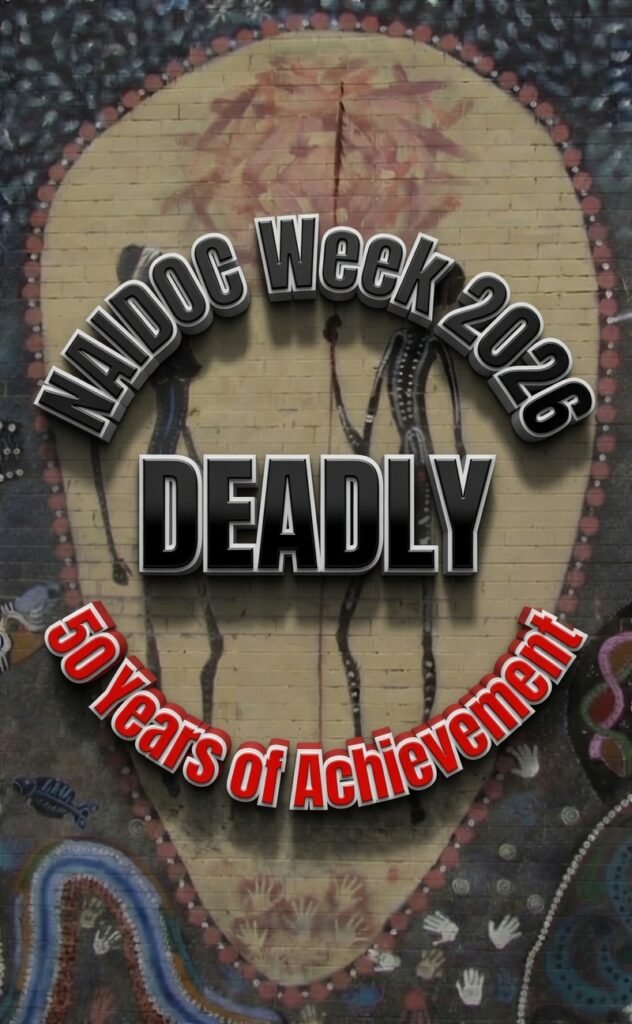
Yesterday belonged to celebration, and rightly so. Fifty years of NAIDOC is fifty years of a people who, for long stretches of this country’s policy history, were the deliberate target of an official assimilation program – a documented policy, not a contested inference, confirmed in the Commonwealth’s own records and in the Bringing Them Home findings – and who not only survived it but built institutions, produced scholars and Elders and artists, and forced a reluctant nation to say their names in its official calendar. That achievement is real. It does not need my qualification and it will not get one here.
But an honest ledger has two columns, and Blak and Black has never been in the business of keeping one without the other. The same fifty years that produced NAIDOC’s institutional permanence has also produced a body of unfinished business so large that it now has its own bureaucracy: a Productivity Commission, an Annual Data Compilation Report, a Closing the Gap dashboard updated on a schedule, as though the gap itself were a matter of routine administration rather than an ongoing emergency. This essay is about that second column. It is written with the same respect for evidence I would apply to any institution I hold to account – including, and especially, the institutions that claim to be closing the gap.
The Count We Still Keep
In April 1991 the Royal Commission into Aboriginal Deaths in Custody handed down 339 recommendations, built on its investigation of 99 deaths. The number of Aboriginal and Torres Strait Islander people who have died in custody since that report was tabled has now passed 600. In the twelve months to June 2025 alone, the Australian Institute of Criminology recorded 33 Aboriginal and Torres Strait Islander deaths in custody – close to a third of all custodial deaths nationally, from a population that is under four per cent of the country, the highest proportion since records began. More than a third of those deaths involved people who had not been convicted of anything; they died on remand, in a system where refusal of bail has become the default rather than the exception. Fifty years of survival, and we are still building a Royal Commission’s worth of names every generation.
The Children We Still Take
Fifty years after the movement that would become NAIDOC began pressing the case that the Stolen Generations were a crime, not a policy, Aboriginal and Torres Strait Islander children are entering out-of-home care at a rate of 50.3 per thousand – higher than it was at the 2019 baseline, not lower. This is one of only four Closing the Gap targets nationally assessed as actively worsening. The removal is now administered by child protection departments rather than missions, and the paperwork is better, but the outcome for a child taken from country and kin looks, from where the child is standing, uncomfortably familiar.
The Ledger, Honestly Read
Of the nineteen national Closing the Gap targets, only four are currently on track to be met. Ten are improving but not fast enough to reach their targets on the timeline the nation set for itself. Four – adult incarceration, children in out-of-home care, suicide, and early childhood development – are getting worse, not better, under a National Agreement that governments signed with First Nations organisations in good faith. The Productivity Commissioner overseeing this data is himself a Gungarri man, and his verdict is not mine to soften: outcomes cannot be reduced to a number, but the numbers we do have describe a system still failing the people it claims to serve, state by state, target by target.
None of this is happening because Aboriginal and Torres Strait Islander people have failed to do their part. Every jurisdiction’s own data shows improvement is achievable when governments actually resource community-controlled organisations to lead. Where that partnership is real, the numbers move. Where it is performed rather than practised, they do not.
Where The Ledger Moves The Right Way
It would be its own kind of dishonesty to read only the four worsening targets and ignore the rest of the dashboard. Preschool enrolment is on track to be met. Employment is on track. The area of Australia’s land and sea country under Aboriginal and Torres Strait Islander legal rights or interests keeps growing and remains on track – the one target, tellingly, where the mechanism is land return rather than service delivery. Healthy birthweight has improved for a second consecutive year, now at 89.2 per cent of babies, even though it remains short of the target itself. Six further targets are improving without yet being on track, which is a meaningfully different finding from failing.
The Productivity Commissioner’s own reading of this mixed picture is worth taking as seriously as his warnings: outcomes move where governments actually share decision-making and resourcing with the Aboriginal Community Controlled sector, and stall or reverse where that sharing is promised but not delivered. This is not a rhetorical concession offered to balance the ledger. It is the single most consistent finding across five years of this reporting, repeated by a Gungarri Commissioner who has no institutional incentive to flatter the sector he is auditing. Community-controlled family violence and legal services, in the jurisdictions that fund them properly, produce measurably different outcomes than the mainstream services layered over the top of communities that had no say in designing them. The evidence for self-determination, in other words, is not only moral. It is the best-supported empirical finding in the entire Closing the Gap data set.
Risk Factors, Read Honestly
Intellectual honesty about this ledger requires engaging with the indicators that are harder to sit with, rather than skating past them to avoid an uncomfortable inference. Family violence is one. Based on the 2018–19 baseline survey, 8.4 per cent of Aboriginal and Torres Strait Islander women reported experiencing physical or threatened violence from a family member in the preceding year, and hospitalisation rates for family violence injury rose through the following decade before easing slightly in the most recent data. Youth disengagement from education and employment (Target 7) is one of the targets the 2025 report records as worsening. These figures are real, and a publication that claims evidentiary symmetry does not get to look away from them because they are politically uncomfortable for the case it is otherwise making.
What intellectual honesty does not require is treating these figures as a verdict on culture or character, because the research base does not support that inference. The Australian Institute of Health and Welfare’s own analysis links elevated family violence rates specifically to colonisation, the dispossession of land, the imposed disruption of traditional gender roles and authority structures, and the intergenerational trauma of forced removals – compounded by poverty, overcrowded housing, and inadequate service response, each of which independently predicts family violence in any population, Indigenous or not. Removing a child, over-policing a community, or under-funding a legal service does not reduce family violence; the data shows it correlates with more of it, not less, because it deepens precisely the poverty, housing stress and severed authority structures identified as drivers. A causal story that runs from colonisation and structural disadvantage to elevated risk, and then to entrenchment through under-resourced and culturally unsafe responses, is not an excuse. It is the specific, falsifiable claim the evidence actually supports, and it is a different claim from either ‘this is simply what happens in this culture’ or ‘this has nothing to do with individual conduct.’ Both of those simpler stories are easier to argue and neither survives contact with the data.
The Counterargument, Engaged
The most common objection to an essay like this one is not empirical, it is moral: that structural explanations let people off the hook, and that at some point a community has to take responsibility for what happens inside it rather than pointing at governments. That argument deserves a direct answer rather than a dismissal, because it is not made only in bad faith and it is not obviously wrong on its face.
The direct answer is that the premise and the structural account are not actually in competition. Individual responsibility and structural constraint operate at different levels of explanation, and holding one does not require abandoning the other, any more than acknowledging that poverty predicts crime absolves any individual offender of a specific act. The empirical problem with the ‘responsibility’ framing as usually deployed is narrower and more falsifiable than its critics allow: it typically proposes that removing external supports and increasing punitive pressure will improve outcomes by forcing greater self-reliance. The twenty years since the Northern Territory Emergency Response gave that specific policy theory a large-scale test, and the Closing the Gap data above is close to a direct answer to it – incarceration, out-of-home care and family violence indicators have not improved under two decades of increasingly punitive intervention; on several measures they have worsened. Community-controlled organisations, by contrast, are not asking to be exempted from responsibility for family violence, youth offending or school attendance in their own communities; SNAICC and equivalent bodies have spent a decade publishing their own strategies for exactly those problems. What they are asking is to lead the response rather than have it imposed, because the data says that is the version of ‘taking responsibility’ that actually moves the numbers. The disagreement, read carefully, is less about whether responsibility matters and more about who is best placed to exercise it.
The Voice That Was Silenced, And The Treaty That Still Waits
In October 2023, the country was asked a simple constitutional question – whether Aboriginal and Torres Strait Islander people should have a say in the laws made about them – and it said no. I will not pretend that result was anything other than what it plainly was: a nation choosing, at a referendum, not to extend a formal hearing to peoples with whom it has never concluded a treaty – unlike Canada, New Zealand or the United States, each of which negotiated treaties, however imperfectly honoured, with the Indigenous nations inside their borders. Makarrata – truth-telling and agreement-making, the second and third steps of the Uluru Statement’s sequence – remains stalled in most jurisdictions, and the handful of state-based treaty processes that survive do so at the pleasure of governments that can and do walk away from them, as Queensland demonstrated when it dismantled its own truth-telling inquiry after an election.
What This Is Not
This is not despair, and it is not a case against the last fifty years. It is a refusal to let the anniversary do the work that only structural reform can do. NAIDOC’s endurance proves something the data above cannot: that Aboriginal and Torres Strait Islander law, kinship, and epistemology have outlasted every institution built to contain them, and will outlast this one too. Wiradjuri law does not measure a people’s worth by a Productivity Commission dashboard, and it never has. But the dashboard exists, the deaths are real, the children removed are real, and a movement capable of building fifty years of institutional permanence is more than capable of naming its unfinished business without flinching.
The prophetic tradition I was raised alongside has a word for this kind of ledger-keeping: it does not call it pessimism, it calls it fidelity – the refusal to let comfort substitute for justice, or anniversary for accountability. The old people did not survive what they survived so that their descendants would settle for being counted kindly in a report. They survived so we would keep counting, out loud, until the count changed. Fifty years down. The next fifty start now.

– – –
Bakchos is the founder of Blak and Black, an Australian media and advocacy platform established in 2010. Bakchos writes from the intersecting perspectives of Wiradjuri heritage, Jewish identity, and humanism.
© Bakchos, July 2026



Wiradjuri law does not measure a people’s worth by a Productivity Commission dashboard, and it never has.
The evidence for self-determination, in other words, is not only moral. It is the best-supported empirical finding in the entire Closing the Gap data set.
Australia always has been, and remains, a racist country.
Hold on everyone, the next 50 years will be something to behold.