
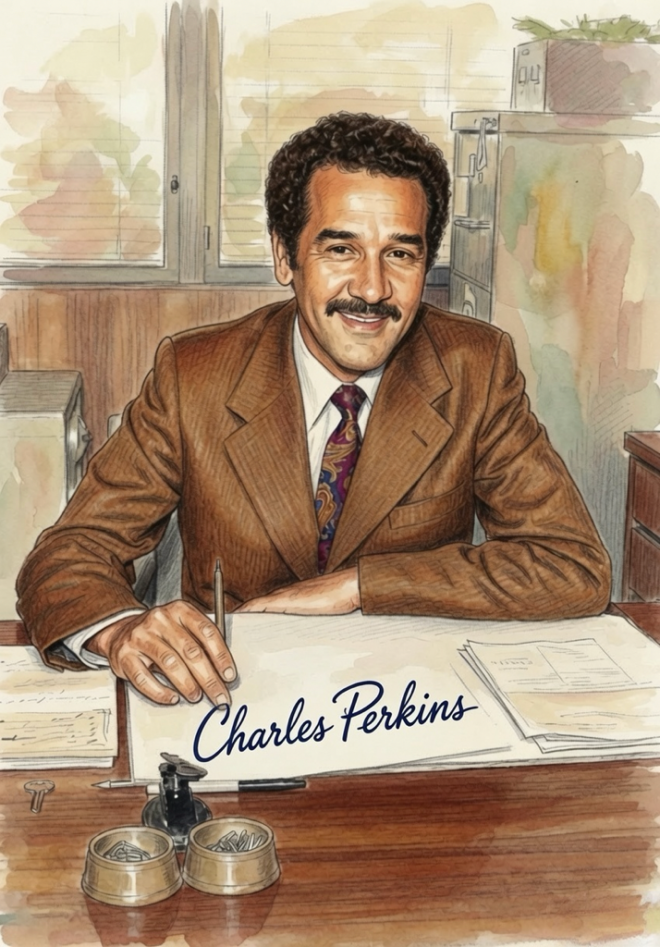
There is a particular kind of Australian courage that does not announce itself with speeches so much as with buses. In February 1965, a battered coach pulled out of Sydney carrying thirty-odd university students north and west into the towns of the Central West and the Northern Rivers – Wellington, Walgett, Gulargambone, Kempsey, Bowraville, Moree, Lismore – and at the front of it, the eldest of the group at twenty-nine, was an Arrernte and Kalkadoon man named Charles Nelson Perkins. He was not the youngest idealist on that bus. He was, by the time it left the Wayside Chapel, already a man who had trained as a fitter and turner, trialled and trained with Everton in England, and clawed his way into a university lecture theatre most of his countrymen assumed was not built for someone like him. He knew exactly what he was doing, and he knew exactly what it would cost.
NAIDOC Week asks us, each year, to hold two things at once: celebration of what has been achieved, and honesty about what remains undone. Few lives in this country’s modern history sit more precisely at that intersection than Perkins’s. To tell his story only as triumph – first Aboriginal university graduate, department secretary, Officer of the Order of Australia – is to smooth over a man who spent his whole life refusing to be sanded down. To tell it only as grievance is to miss the fact that he built things, institutions, careers, and possibilities that did not exist before him. The truth, as it usually is with the men and women who actually move history rather than merely narrate it, sits uncomfortably in the middle.
A Childhood Built On Removal
Perkins was born in 1936 at the Alice Springs Telegraph Station Aboriginal Reserve, to Hetti, an Arrernte woman, and Martin Connelly, a Kalkadoon man of Irish descent whom Charles would not meet until he was thirty-three. His mother had already lost two daughters to the practice of forcibly removing Aboriginal children from their families – taken to Adelaide and never seen again. At ten, Charles himself was removed from Alice Springs and sent to St Francis House, a home for Aboriginal boys established by Father Percy Smith in Adelaide. This is not incidental biographical colour. It is the foundation stone. Perkins did not arrive at his activism as an abstraction picked up in a university tutorial; he arrived at it through the direct, bodily experience of the policies he would spend his adult life dismantling. Whatever framework of governance history remembers him as helping construct, it was built on the wreckage of a family the same governance had already broken.
He trained as a fitter and turner, and it was football – first with Adelaide club Port Thistle, then a stint in England training and trialling with Everton (with interest also shown by Liverpool and Manchester United) and playing for the leading amateur side Bishop Auckland, then with Adelaide Croatia and Sydney Pan-Hellenic on his return – that gave him both an income and an escape route into a wider world. It is worth pausing on this: before Perkins was ever a household name in Aboriginal affairs, he was already accustomed to being one of very few Indigenous faces in rooms – dressing rooms, boardrooms, lecture halls – built by and for other people entirely. That particular loneliness, repeated often enough, tends to produce either accommodation or resolve. In Perkins it produced resolve.
The Bus That Would Not Stop For A Fence
By 1963 he had enrolled at the University of Sydney, one of only two Aboriginal students on campus, the other being Gary Williams. It was there, through the Student Action for Aborigines group he came to lead, that the Freedom Ride was conceived – explicitly modelled on the American civil rights buses that had rolled through the Deep South a few years earlier, but aimed squarely at an Australian complacency that preferred to believe segregation was somebody else’s national sin.
What the Freedom Ride found on the ground was not subtle. In Walgett, Aboriginal ex-servicemen – men who had fought and, in some cases, died for Australia in two world wars – were barred from the Returned Services League club on every day but Anzac Day. In Moree, the council had excluded Aboriginal children from the town pool for forty years, permitting them access only under supervision for school swimming lessons. When Perkins and the students picketed the pool, they were followed out of town by a convoy of cars, one of which forced their bus off the road in the dark. They returned to Moree anyway. They forced the council to reverse the ban a second time when it discovered the first reversal had been quietly reneged on.
This was not theatre for its own sake. It was documentation – surveys of housing, health and education conditions gathered town by town – married to confrontation, timed deliberately for the cameras that were, for the first time, capable of carrying rural Australia’s ordinary cruelties into loungerooms in Sydney and Melbourne that had never had to look at them directly. Perkins understood something that a great deal of Australian public life still has not fully absorbed: that discrimination survives longest in the dark, and that visibility, however uncomfortable, is itself a form of accountability. The Freedom Ride did not invent Australian racism. It simply made it impossible, for a fortnight at least, to pretend not to have seen it.
Graduation as a Political Act
In May 1966, Perkins graduated from the University of Sydney with a Bachelor of Arts – the first Aboriginal man to graduate from an Australian university. It is easy, sixty years on, to let that fact flatten into a plaque or a scholarship name. It should not. Consider what the achievement actually required: a man forcibly separated from his mother and country as a child, educated in an institution built to produce tradesmen and labourers rather than graduates, working part-time cleaning toilets at the City of South Sydney to help fund his study, doing all of this while simultaneously organising one of the most consequential civil rights actions in the nation’s history. The degree was not the reward at the end of the struggle. It was fought for on exactly the same terrain as the struggle itself.
In the years immediately after the Freedom Ride, he threw the same energy behind the campaign for the 1967 referendum, helping build the public case for counting Aboriginal people in the census and empowering the Commonwealth to legislate for them – a campaign that would return the highest “Yes” vote in Australian referendum history. His kidneys began failing not long after, and in 1972 he received a transplant that would give him almost three decades of life he might not otherwise have had – by his own account, at the time of his death Australia’s longest-surviving transplant recipient, and a gift that sharpened rather than softened his sense of obligation to use the time. He became manager of the Foundation for Aboriginal Affairs, moved to Canberra in 1969 to work in the newly formed Office of Aboriginal Affairs under Harold Holt’s government, joined the Aboriginal Tent Embassy’s push for land rights and human rights recognition in 1972, and in 1973 took up a senior executive role in the Department of Aboriginal Affairs – a role in which he was formally reprimanded more than once for the offence of continuing to speak publicly and lead demonstrations while employed as a public servant. That tension – between the bureaucrat obliged to work within government and the activist obliged to hold government to account – never resolved in Perkins. He simply refused to let either half of himself win outright, and Australia was the better for his refusal to resolve it neatly.
Inside The Machine, Still Shouting
In 1984 he became the first Aboriginal person to serve as Secretary of the Department of Aboriginal Affairs – the most senior public service position an Aboriginal person had yet held in the Commonwealth bureaucracy. He went on to chair the Aboriginal Development Commission and Aboriginal Hostels Ltd, and later, in 1993, joined the Aboriginal and Torres Strait Islander Commission, becoming its deputy chair the following year. He was awarded the Order of Australia in 1987. Wherever he lived – Adelaide, Sydney, Canberra, Alice Springs – he found or built an organisation through which Aboriginal people could exercise power rather than simply request it.
What deserves particular honesty here, in the spirit that this masthead tries to hold itself to, is that Perkins was not a comfortable figure inside the institutions he helped build and lead. He remained, until his death in 2000, capable of saying things that embarrassed the government that employed him – criticising the Australian Football League and Rugby League as institutionally racist, warning bluntly about civic unrest ahead of the Sydney Olympics, remaining critical of the Federal Council for Aboriginal Advancement even after the success of the 1967 referendum campaign he had helped drive, on the grounds that it had not gone far enough in transferring real power to Aboriginal people themselves. This is the least comfortable but most instructive part of his legacy for anyone thinking about First Nations advocacy today: Perkins never treated a seat at the table as a substitute for the argument that needed to be had at it. Institutional office, for him, was a lever, not a destination.
Kumantjayi
Perkins died in Sydney on 19 October 2000, of renal failure. Arrernte custom dictated that his given name not be spoken for a period after his death; he was known instead as Kumantjayi Perkins, a mark of the same cultural law and respect he had spent his public life defending the right of his people to practise. He was given a state funeral, and his body was returned to Alice Springs, to the country of his mother’s people, a week later. He is survived, in every sense that matters for this reflection, by his daughters Hetti and Rachel Perkins – the latter a filmmaker who has done as much as anyone to keep his memory, and his method, alive on screen – and by his son Adam.
In the years since, his name has been attached to a memorial oration and prize at the University of Sydney, to a trust funding Indigenous postgraduate scholarships at Oxford, and to the Charles Perkins Centre, whose own account of its namesake closes on a line worth sitting with: that the institution shares his philosophy of collaboration, inclusivity, and the continuing refusal to accept the status quo as fixed. It is a generous description, and an accurate one, but it is worth noticing what work that word “continuing” is doing. Perkins did not treat the status quo as something you challenge once, win against, and retire from. He treated it as something that regenerates unless it is challenged again, and again, by each generation in turn.
What The Bus Was Actually For
Sixty-one years after the Freedom Ride left Sydney, the specific indignities it exposed – the barred pool, the segregated cinema, the RSL door closed to Aboriginal diggers – have mostly gone, at least in their most naked form. What has not gone is the underlying pattern Perkins spent his life diagnosing: that Aboriginal disadvantage in health, housing, education and justice persists not because the problem is obscure but because the political will to fix it is intermittent, and that intermittency is itself a policy choice dressed up as circumstance. Closing the Gap targets are missed with a regularity that would be a scandal in any other portfolio of Commonwealth spending. Aboriginal deaths in custody continue at a rate that thirty-four years of royal commission recommendations have not meaningfully altered. Self-determination remains, in practice, something granted in instalments rather than restored as a right.
This is not a reason to diminish what Perkins achieved. It is, if anything, the argument for why his life is worth returning to during NAIDOC Week rather than simply commemorating. The Freedom Ride worked because it refused patience as a virtue when patience was being demanded only of the people already suffering. It worked because a man who could have settled for the considerable personal achievement of being the first – first graduate, first department secretary, first in a hundred rooms – decided that being first was only useful insofar as it made him harder to ignore on behalf of everyone still waiting behind him.
The bus Perkins organised in 1965 was never really about a swimming pool in Moree, any more than the man himself was ever really about his own advancement. It was about the proposition, stated plainly and defended at some personal risk, that Aboriginal Australians were entitled to walk through the front door of their own country. That proposition is not yet fully honoured. Perkins would, one suspects, have found that unsurprising, and would have already been organising the next bus.
Blak and Black acknowledges Charles Nelson Perkins AO, and the countless Aboriginal and Torres Strait Islander leaders whose courage made the ground this masthead stands on. This NAIDOC Week, as every week, the work continues.
– – –
Bakchos is the founder of Blak and Black, an Australian media and advocacy platform established in 2010. Bakchos writes from the intersecting perspectives of Wiradjuri heritage, Jewish identity, and humanism.
© Bakchos, July 2026

Before he was the first Aboriginal department secretary, Charles Perkins was a 29-year-old student who organised a bus tour through regional NSW to confront segregation the country preferred not to see.
Charles Perkins was the first Aboriginal man to graduate from an Australian university, the first to head a Commonwealth department, and the organiser of the 1965 Freedom Ride — one of this country’s defining civil rights actions. His life holds achievement and unfinished business together in a way our institutions still haven’t fully reckoned with.
Charles Perkins was a great Australian, a great leader, and a great champion for his people.
Before he was the first Aboriginal department secretary, Charles Perkins was a 29-year-old student who organised a bus tour through regional NSW to confront segregation the country preferred not to see. This NAIDOC Week — the Freedom Ride, and what still isn’t finished