
An Inheritance In Stone
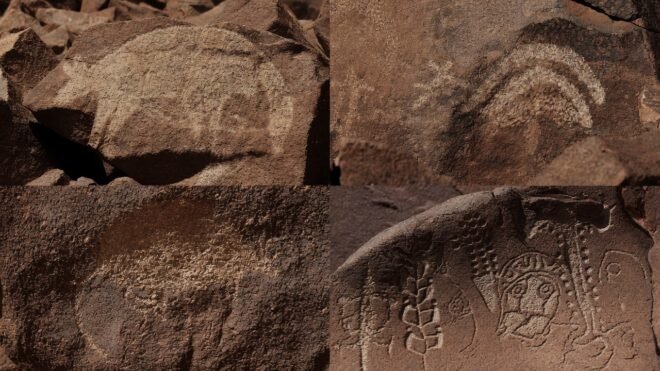
On the Burrup Peninsula, where the Pilbara’s red igneous ranges fall away into the Indian Ocean, the land itself carries a message written in a script older than any alphabet. Across the peninsula and the forty-two islands of the Dampier Archipelago, somewhere between one and two million images have been struck, pecked and abraded into the dark desert varnish of the rock – a body of work so vast that no single lifetime, and perhaps no single discipline, could ever fully account for it. In July 2025, UNESCO inscribed this landscape, known to its custodians as Murujuga, on the World Heritage List, recognising it under three separate criteria as a site of Outstanding Universal Value. For the Mardathoonera (Mardudhunera) people and their neighbouring Ngarda-Ngarli nations, the listing confirmed in international law what had never been in doubt in Lore: that this is one of the great cultural achievements of the human species.
What makes Murujuga extraordinary is not simply its age, though the oldest engravings may stretch back more than fifty thousand years, deep into the Pleistocene and close to the earliest evidence of the human presence on this continent. Nor is it simply its scale, staggering as that is. What sets Murujuga apart is that it has never stopped being made, read and lived. It is simultaneously the oldest and the newest thing on the peninsula – an archive that is still being consulted by the people whose ancestors compiled it. This essay considers why that combination of depth, density and living continuity has earned Murujuga a place among humanity’s most significant cultural landscapes, and why its protection is now one of the more urgent tests of Australia’s willingness to honour what it has just promised the world.
A Country Shaped By Ice And Water
To understand Murujuga is to understand that Aboriginal occupation of this continent is not a matter of some vague antiquity but of a specific, extraordinarily long and well-evidenced duration – at least sixty-five thousand years, according to the archaeological record established at sites such as Madjedbebe in Arnhem Land. Within that immense span, the Ngarda-Ngarli peoples, among them the Mardathoonera, Ngarluma, Yindjibarndi, Yaburara and Wong-Goo-Tt-Oo, have held this particular stretch of coast and sea without interruption. Their relationship to it is governed by Lore – the body of ancestral law, narrative and obligation laid down by the Marrga, the creative beings whose actions during the shaping of the world continue to structure the relationships between people, land, sea, animals and the unseen.
The very name Murujuga, said to evoke the silhouette of a hip bone, describes a landscape that has been anything but static. It takes in the Burrup Peninsula, the scattered islands of the archipelago, the waters between them, and – crucially – country that now lies beneath the sea. During the Last Glacial Maximum, roughly twenty thousand years ago, sea levels were more than a hundred metres lower than today, and the coastline sat far out from its present position. What is now seabed was then open plain, hunted and occupied and, in all likelihood, engraved. The rise of the oceans that followed did not erase this history so much as submerge it, folding drowned country into the same cultural landscape as the exposed peninsula above. Few heritage sites anywhere carry so literal a record of catastrophic environmental change absorbed into unbroken cultural memory.
For the people who hold this Country, the engravings are not treated as remnants of a vanished past to be studied from a respectful distance. They are understood as the handiwork and continuing presence of the Marrga, carriers of knowledge about seasons, resources and obligation, and touchstones for songs and ceremonies – among them those associated with the Seven Sisters, Minyuburru, whose story threads across the wider Pilbara – that are still sung today. Senior Mardathoonera custodians, Raelene Cooper prominent among them, describe the maintenance of these sites as a duty inherited rather than a heritage curated: an ongoing responsibility, not a closed chapter.
The Densest Gallery On Earth
No comparable concentration of rock art exists anywhere else in the world. Spread across close to a hundred thousand hectares, the one to two million petroglyphs of Murujuga are not scattered highlights in an otherwise empty landscape but a continuous cultural fabric, in which boulders, cliff faces and outcrops carry images in deliberate relation to one another and to the surrounding terrain.
The technique itself is a study in patience and material knowledge. The peninsula’s igneous boulders are coated in a thin skin of iron and manganese oxide – the desert varnish that darkens over millennia of exposure. Artists worked through this dark crust, pecking and abrading it away to expose the paler rock beneath, producing an image that reads with striking contrast and that has proven durable enough to survive tens of thousands of years of wind, heat and salt air. Many panels show clear evidence of overworking, where later generations added to, revised or layered new imagery over older motifs – a visible record of the site’s use across an immense stretch of time, rather than a single act of creation.
It is worth pausing on the sheer logistics of a corpus this size. Even a conservative estimate of one million individual engravings, spread across a landscape the size of a small city, implies a depth of sustained cultural investment that has few parallels anywhere on Earth. This was not the work of one community in one era but the accumulated output of countless generations returning to the same Country, adding to a project none of them could have seen completed, in the confidence that it would be carried on by those who came after them. That confidence has, so far, been entirely vindicated.
The rock art does not stand alone. Stone arrangements, shell middens, fish traps and scatters of worked stone tools are woven through the same landscape, together describing a fully inhabited Country rather than an isolated gallery. Archaeologists have identified broad stylistic phases within this record, moving from early, often geometric and starkly graphic imagery toward later phases of greater naturalism and figurative variety. Pinning exact dates to individual motifs remains genuinely difficult – the usual tools of radiocarbon dating do not apply well to engravings on rock, and researchers have instead turned to techniques such as optical exposure dating of the varnish itself to build a chronology. What is not in dispute is that the earliest surviving work likely dates to somewhere between forty and more than fifty thousand years ago, placing Murujuga among the oldest sustained artistic traditions identified anywhere on the planet.
Genius Worked In Rock
It is on the strength of its artistry that Murujuga meets UNESCO’s first criterion, reserved for masterpieces of human creative genius. This is not a courtesy classification. The engravings display a command of technique, composition and symbolic economy that stands comparison with any of the world’s celebrated Palaeolithic traditions.
Among the earliest and most haunting images are the so-called archaic faces – schematic human faces rendered with concentric circles for eyes, produced through a combination of pecked outline and raised, untouched relief. These are among the oldest known depictions of the human face anywhere in the world, and versions of the same motif recur across the arid interior of the continent, suggesting shared symbolic vocabularies and long-distance cultural contact stretching far beyond the Pilbara coast.
Equally striking is what the rock art records about a vanished fauna. Engravings of thylacines and of a now-extinct fat-tailed kangaroo species place extant images of animals that disappeared from the mainland many thousands of years ago directly into the archaeological record, giving palaeontology a visual complement to the fossil evidence. Alongside these are macropods, birds, fish, echidnas and an extensive vocabulary of geometric and abstract forms whose meaning – maps, Dreaming tracks, ceremonial diagrams – remains, appropriately, held closest by those with the cultural authority to interpret them.
The composition of individual panels rewards close attention as much as the individual motifs do. In the accessible galleries of Ngajarli, or Deep Gorge, and in the Gum Tree Valley precinct, human figures, macropods and fish are frequently arranged within the one scene rather than scattered at random, suggesting narrative or ceremonial sequences rather than isolated portraits. Superimposition is common and instructive: later engravers regularly reworked or added to existing panels rather than seeking untouched rock, which points to specific surfaces holding accumulated significance across generations rather than being chosen for convenience alone.
What distinguishes Murujuga from a simple inventory of images is evidence of deliberate placement. Motifs recur at vantage points overlooking water, at prominent hills, and along sightlines to the sea, suggesting an art practice conceived in dialogue with the land rather than laid over it incidentally. Taken together – the technical control of the pecking and abrasion, the stylistic range from severe geometry to fluid naturalism, and the intentional siting within Country – this is a body of work of unmistakable creative ambition, sustained and elaborated over an almost unimaginable length of time.
Not A Relic But A Living Law
UNESCO’s third criterion asks whether a site bears exceptional testimony to a living cultural tradition, and it is here that Murujuga distinguishes itself most sharply from many of the world’s other ancient rock art landscapes. Sites such as Lascaux or Chauvet are, for their present-day custodians, closed chapters – extraordinary, but severed from the belief systems that produced them. Murujuga is not. The engravings remain active within Ngarda-Ngarli spiritual and social life: understood as the imprint of ancestral beings, read as instruction in Lore, and tied to songs and ceremonial obligations that continue to be practised.
This living quality is not an abstraction invoked for the purposes of a heritage nomination – it is visible in the contemporary struggle to protect the site. Raelene Cooper’s advocacy through Save Our Songlines, including legal challenges to industrial approvals on the peninsula and a formal complaint to UNESCO over the adequacy of protections since inscription, is itself an expression of the same obligation the rock art describes: that custodianship of Country is a duty actively discharged, generation after generation, not a status conferred once and then left to look after itself.
It is worth dwelling on how rare this continuity is in the wider sweep of human history. Fifty thousand years takes in the last glacial period, sea-level rise of more than a hundred metres, and every social and technological transformation that has occurred elsewhere on Earth in that time. That a body of cultural knowledge could travel intact through all of it, and remain legible and binding to people alive today, is not merely of academic interest. It is a demonstration – arguably unmatched anywhere else in the world – of what cultural resilience actually looks like when tested against the largest scales of time and environmental upheaval.
A Record Written By Rising Seas
The fifth criterion under which Murujuga was inscribed concerns outstanding traditional human interaction with the environment, particularly under conditions of irreversible change – and few places on Earth offer a clearer case study. The engravings of extinct species function as a visual palaeoenvironmental archive, registering the presence of animals and, by extension, ecological conditions that no longer exist. The deliberate inclusion of submerged Country within the boundaries of the World Heritage listing is itself an acknowledgment that a great deal of this record now lies underwater, and that the cultural landscape cannot be understood by looking only at what remains above the tide.
The stone arrangements and resource sites scattered through the peninsula point toward something more than survival in the face of that change – they suggest active, intentional custodianship: the deliberate management of resources and the careful, repeated placement of art within a landscape being watched and adjusted to as it transformed. In an era in which humanity is once again confronting rising seas and disappearing coastlines, Murujuga is not simply a curiosity from the deep past. It is evidence, tens of thousands of years old, that a society can absorb catastrophic environmental change without losing its coherence, its law, or its art.
What The World Heritage Listing Means
The 2025 inscription of Murujuga did not happen quickly or easily. It followed decades of sustained advocacy by Traditional Owners working through the Murujuga Aboriginal Corporation, pressing a case that combined archaeological evidence, cultural testimony and international diplomacy. Its success made Murujuga one of a small number of Australian properties recognised for Indigenous cultural values in their own right, standing alongside – while remaining quite distinct from – sites such as Kakadu, and setting Murujuga apart specifically for the density, antiquity and living character of its rock art.
The listing situates Murujuga within the company of the world’s most significant rock art landscapes – Lascaux in France, Alta in Norway, the Drakensberg in South Africa – while marking out what is genuinely singular about the Pilbara site: a scale of engraving unmatched anywhere else, a continuity of practice that most of those other sites cannot claim, and a form of heritage that is at once tangible, in the stone itself, and intangible, in the law and knowledge the stone encodes. For researchers, the site remains a live and largely open field, offering material for work on early human migration into and across the continent, the development of graphic and symbolic communication, and the long interaction between people and a rapidly changing coastal environment. For Indigenous Australia more broadly, the listing carries a weight beyond the Pilbara: an international acknowledgment that living culture, not only its physical remains, is a legitimate and necessary object of protection.
The Case For The Gas Industry – And Its Limits
Any honest account of Murujuga has to reckon with the fact that it sits inside one of the most economically significant industrial precincts in Australia, and that the case for that industry is not simply corporate self-interest. The North West Shelf Project has operated on the peninsula since the 1980s and, on Woodside’s own figures, has paid more than $40 billion in royalties and excise, employs close to nine hundred people directly with a further thirteen hundred contractors, and in 2024 alone supplied fourteen per cent of Western Australia’s domestic gas. Government ministers and industry bodies frame this in the language of energy security: gas from the Burrup keeps homes and industry running across the state, and the jobs and royalties involved are not abstractions but livelihoods and public revenue that Western Australia, and the Pilbara in particular, has built decades of planning around. Woodside has also pointed to its funding of the original World Heritage nomination process and its social investment in Karratha as evidence that industry and cultural heritage can, in its account, coexist.
That case deserves to be stated plainly rather than waved away, because the strongest version of the protective argument does not depend on denying it. It depends on a narrower and harder-to-dismiss claim: that the specific emissions produced by processing gas this close to a fifty-thousand-year archive are measurably degrading it, and that the state’s own regulators now largely agree. When the federal government granted approval in September 2025 for the North West Shelf Project’s extension out to 2070, it did not do so without qualification – it attached forty-eight separate conditions, including a requirement that certain emissions be cut by up to sixty per cent by 2030, with further reductions to follow, specifically to address impacts on the Murujuga rock art. A government confident that industry and heritage were simply compatible would not need to mandate emissions cuts of that size as the price of continued operation. The conditions are, in effect, an admission of the harm the industry argument prefers to describe as manageable rather than real.
Nor is the tension resolved simply by imposing conditions and moving on. The Murujuga Rock Art Monitoring Program, established specifically to settle the scientific dispute, has recorded higher-than-expected levels of ammonia and ozone in the local airshed together with significant black carbon deposition, and the twenty-one air quality monitoring stations built across the property since exist precisely because the earlier assumption – that industry could expand indefinitely alongside the art without consequence – did not survive scrutiny. None of this means the Pilbara’s gas economy has no legitimate claim to consideration, or that every job and every dollar of royalty revenue is expendable. It means the argument is not gas versus no gas. It is whether conditions written down on paper in Canberra are actually enforced on the ground in Karratha quickly enough to matter to rock that cannot be restored once its surface is gone.
Protection Promised, Protection Owed
World Heritage status is not, in itself, a shield. Murujuga sits within one of the most heavily industrialised stretches of coastline in Australia, and the same qualities that make its rock art so significant – its exposure, its openness to the air – also make it vulnerable to what surrounds it. In the lead-up to inscription, the International Council on Monuments and Sites, UNESCO’s own advisory body, recommended that Australia secure the total removal of degrading acidic emissions affecting the petroglyphs and halt further industrial development in the vicinity, a recommendation the World Heritage Committee ultimately softened rather than adopted in full. The listing that followed in July 2025 carried an amendment, moved with the support of Kenya and other member states, requiring Australia to keep researching industrial impacts, strengthen the monitoring and regulatory framework, fold any undeveloped strategic land into the protected estate, and ensure decommissioning and rehabilitation plans exist for industrial activity in the area.
Traditional Owners have not confined their response to statements of concern. Raelene Cooper, a former chair of the Murujuga Aboriginal Corporation and founder of the Save Our Songlines campaign, pursued federal court action to compel heritage consideration of the site even before inscription, and has continued to press the case since. In July 2026, lawyers acting for Cooper wrote to UNESCO alleging that the federal Environment Minister was aware of evidence that industrial emissions were causing irreversible harm to the rock art before making representations to the World Heritage Committee in 2025, and that the North West Shelf extension approved weeks after inscription – allowing operations to continue until 2070 – sits in tension with the commitments Australia made to secure the listing. The government’s response has been to point to its support for the Corporation and to the protections the listing itself provides; Cooper’s answer is that a listing without enforcement is a promise, not a protection.
That gap is the crux of the matter: a World Heritage listing obliges a state party to protect what it has nominated, and the test of Australia’s 2025 achievement will not be the plaque but what is, or is not, still standing in fifty years. A World Heritage site belongs, in the language of the Convention itself, to the whole of humanity, and damage to it is loss shared far beyond the Pilbara. If the oldest known depictions of the human face, and a visual record of animals extinct for thousands of years, are allowed to erode under industrial emissions within a decade of international recognition, the loss will not be Australia’s alone to bear – though the responsibility for preventing it plainly is.
There is also a harder question sitting underneath the technical disputes over emissions modelling and heritage assessment: whether a nation can genuinely claim to value a fifty-thousand-year cultural achievement while continuing to licence, and extend to 2070, the industry sitting closest to it. Reconciling those two positions will require more than monitoring stations and management plans, welcome as both are. It will require a willingness to let Traditional Owner authority over Country actually constrain what gets approved next door to it – which is, after all, the entire premise on which the World Heritage listing itself was granted.
Caring For Living Heritage At Scale
There is a second, quieter challenge that receives less attention than the fight over emissions: how a site of this scale and fragility is actually managed day to day, once the international spotlight has been turned on. Murujuga is not a museum with a controlled entrance and climate-controlled galleries. It is close to a hundred thousand hectares of open Country, much of it accessible on foot, sitting immediately beside a working industrial town and now appearing with increasing frequency on the itineraries of visitors drawn by the World Heritage listing itself. Public interest is, in one sense, precisely what advocates for inscription hoped to achieve – greater visibility can generate political will. Yet foot traffic, vehicle access, informal photography and the simple accumulation of well-meaning curiosity all carry the capacity to accelerate wear on surfaces that have survived fifty thousand years of wind, heat and salt air precisely because they were, until recently, rarely disturbed.
Traditional Owners have been managing exactly this tension for far longer than any government conservation authority. Through ranger programs and on-Country protocols developed and run by the Murujuga Aboriginal Corporation, custodians determine where visitors may walk, which panels may be photographed or discussed publicly, and which sites carry restrictions tied to gender, ceremony or specific bodies of Lore that are not for general disclosure. These are not arbitrary rules but living expressions of the same obligations the engravings encode. That system, however, depends on the continuous transmission of highly specific cultural knowledge from senior custodians to younger Ngarda-Ngarli people – knowledge about which motifs belong to which stories, which sites require particular forms of care, and which responsibilities attach to particular families and groups.
This is a harder and more demanding form of heritage management than fencing, signage or monitoring stations. The thing being protected is not only the physical rock but the living authority to interpret it. That authority cannot be fully captured in a static management plan and then left to run itself; it must be actively practised, taught and renewed. Sustaining it will require sustained investment in people – in training, employment and resourcing for Indigenous rangers and cultural advisors – as much as in scientific equipment. There are also practical tensions to navigate: the very tourism that can build broader support for protection may, if poorly managed, erode the very values visitors come to see. Post-listing visitor growth will test whether Australia can develop models of access that are genuinely led by Traditional Owners rather than simply regulated by them. Climate change adds another layer of complexity, with shifting weather patterns potentially affecting both the rock surfaces and the seasonal knowledge systems that guide their care.
In short, caring for Murujuga at scale means recognising that its Outstanding Universal Value lies as much in the continuing practice of custodianship as in the stone itself. Without deliberate, well-resourced support for that living practice, the World Heritage listing risks becoming a prestigious label attached to a site whose deepest values are gradually diminished by neglect of the people who have maintained them for millennia.
Conclusion: A Voice Still Speaking
The rock art of Murujuga matters to the world because it collapses the distance we usually assume exists between the ancient and the living. It is at once among the oldest sustained bodies of human creative work yet identified, and a body of law still spoken to, still consulted, still binding on the people whose ancestors made it. Its UNESCO inscription in 2025 gave international form to a fact that Ngarda-Ngarli custodians, and the Mardathoonera people in particular, have never needed convincing of: that this is a place of Outstanding Universal Value, held in stone, in Lore, and in unbroken practice.
What happens next will test whether that recognition was sincere. Protecting Murujuga is no longer simply a question of conservation science, important though the science is. It requires Australia to hold two complex realities in tension: the legitimate economic contribution of the North West Shelf gas industry – in jobs, royalties and domestic energy supply – and the measurable risk that certain industrial emissions pose to a fifty-thousand-year cultural archive. It also requires grappling with the quieter but equally demanding task of managing living heritage at scale: supporting Traditional Owner-led ranger programs, transmitting cultural knowledge across generations, and developing visitor access that strengthens rather than erodes the site’s values.
These are not competing distractions from the central task. They are the central task. The rock art has already survived the end of the last ice age and the drowning of more than a hundred metres of coastline. It may yet survive the pressures of the twenty-first century – but only if the commitments made at inscription are translated into enforceable protections, adequately resourced Indigenous governance, and a willingness to let Traditional Owner authority over Country genuinely shape decisions about what happens next door to it. The test is not whether Australia can admire Murujuga from a distance. It is whether it can honour the living obligations the rock art continues to describe.
Notes And Sources
Woodside Energy, ‘North West Shelf Project Extension’ and ‘North West Shelf Project’, woodside.com (2025–26): royalties, employment, and 2024 domestic gas supply share.
Australian Energy Producers comment and Commonwealth statements accompanying the North West Shelf Project Extension approval, reported in industry press including Rigzone and World Oil, September 2025.
Murray Watt, Minister for the Environment and Water, conditions of approval for the North West Shelf Project Extension, September 2025, reported by Rigzone and Petroleum Australia.
Murujuga Rock Art Monitoring Program findings and associated reporting on air quality monitoring infrastructure, National Indigenous Times, May–June 2025.
ICOMOS advice to the World Heritage Committee and the Committee’s draft decision on the Murujuga nomination, UNESCO World Heritage Centre documentation, 2025.
World Heritage Committee inscription decision and accompanying amendment on ongoing monitoring, research and decommissioning planning, 47th session, Paris, July 2025; National Indigenous Times.
Correspondence from lawyers acting for Raelene Cooper to UNESCO, reported by SBS NITV, July 2026; Australian Government response via departmental spokesperson.
– – –
Bakchos is the founder of Blak and Black, an Australian media and advocacy platform established in 2010. Bakchos writes from the intersecting perspectives of Wiradjuri heritage, Jewish identity, and humanism.
© Bakchos, July 2026


2 million images. The first drawing of a human face. A treasure for all of humanity. Put at risk by an avaricious gas industry and corrupt politicians..
Australia’s 2025 UNESCO inscription of Murujuga recognised something rare: rock art up to 50,000 years old that remains part of a living legal and ceremonial tradition for the Ngarda-Ngarli peoples. It also created an obligation. Weeks after inscription, the federal government approved the North West Shelf gas project’s extension to 2070 — with 48 conditions attached, including mandated emissions cuts specifically to protect the rock art.
It’s time to put indigenous history and culture before mining company profits especially given that much of the gas that’s produced by Australia gets exported overseas at ridiculously cheap rates. Thanks to John Howard..
I visited the area when I first arrived in Australia. The rock art is amazing and stunningly beautiful.
Our lore, history and spiritual traditions are as valid as anyone else’s.