
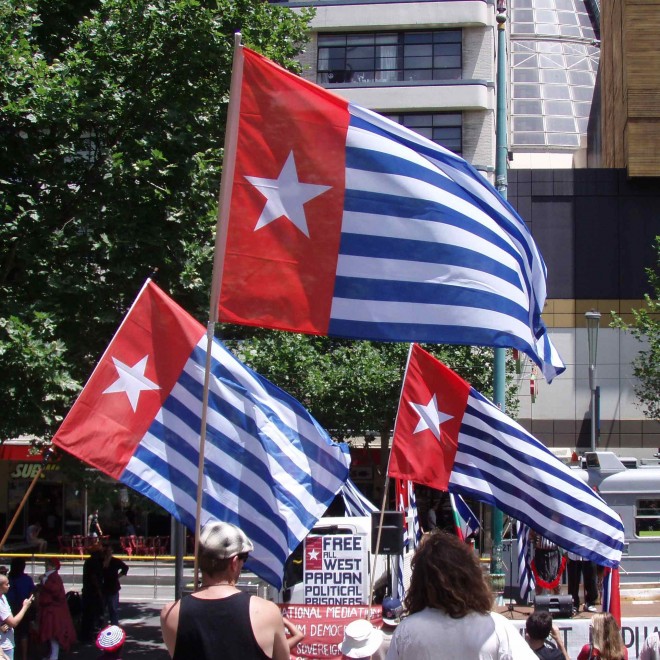
I. Mums And Dads, Not Radicals
When Blak and Black first began publishing back in 2010, one of the very first causes we turned our attention to was West Papua. It has stayed with us ever since, not as a passing item on a list of grievances, but as a thread that runs through everything this platform has tried to be about: the refusal to look away from injustice simply because it is inconvenient, distant, or poorly understood.
Many of the people who have worked alongside Blak and Black over the years I first met not in boardrooms or committee rooms, but on the street – at demonstrations and marches in support of the rights of the West Papuan people. And if there is one thing I want to say plainly, before anything else, it is this: the overwhelming majority of people I have met at Free West Papua marches were not hardened radicals. They were not agitators looking for a fight. They were, in the plainest and most old-fashioned sense of the word, mums and dads. Ordinary people. People who had taken an afternoon out of an ordinary life to stand on a footpath holding a sign, because something in them could not sit comfortably with silence.
This matters, because it goes to the heart of how these movements are so often characterised. Most of the people involved with Blak and Black, likewise, are not radicals by temperament or by design. They are simply people with a conscience. And a conscience is not the exclusive property of any one belief system. You don’t need religious conviction to have one. Among the West Papuan solidarity movement I have stood beside Christians and Muslims, people of no faith at all, and Jewish people such as myself. What unites all of them is not doctrine. It is the capacity to see when something looks wrong, and the willingness to keep asking questions about it rather than look away.
I have met people from Canada, the United States, the Netherlands and elsewhere at these marches – people who travelled, organised, and gave up their weekends for no material benefit to themselves. I have seen many of the same faces at marches in solidarity with the Palestinian people, and I would say much the same thing about them: ordinary people, motivated by conscience rather than ideology.
It is worth being honest, too, that labels like “radical” or “communist” are sometimes reached for as a way of avoiding engagement with the substance of a claim rather than examining it. That is a habit worth naming on all sides of a debate, not only this one – dismissing an opponent’s motives is very often easier than answering their argument. A great many of the younger people who turn up to these marches were born after the Cold War ended, and the vocabulary of that era means little to them. What follows in this essay tries to set that vocabulary aside and look instead at the substance of the historical record, including the parts of it that are genuinely disputed.
II. This Is Our Homeland – And A Contested Legal History
West Papua is the ancestral homeland of the Papuan people – a place where language, culture, kinship systems, and relationship to land have been formed over tens of thousands of years. That much is not seriously disputed by anyone. What is disputed, and disputed in good faith by serious people on more than one side, is the legal and political status that followed the end of Dutch colonial rule.
The bare facts are these. The Netherlands relinquished sovereignty over the rest of the Dutch East Indies to Indonesia in 1949 but retained Netherlands New Guinea, intending to prepare it separately for self-government. Indonesia, under Sukarno, regarded this as an unfinished piece of its own anti-colonial struggle and never accepted the Dutch position. After a period of rising tension and limited armed confrontation, the 1962 New York Agreement, brokered by the United States under UN auspices, provided for Dutch administration to pass to a UN Temporary Executive Authority and then to Indonesia, on condition that Indonesia later hold an “Act of Free Choice” allowing the Papuan population to decide their own political future.
That act took place between July and August 1969. Roughly 1,025 Papuan representatives, selected by the Indonesian military rather than elected by the population at large, voted unanimously for integration with Indonesia. The UN General Assembly, in Resolution 2504, formally “took note” of the outcome – a deliberately weaker form of words than endorsement, and one that stopped short of ruling on whether the process complied with the self-determination standards the UN had itself set out in earlier resolutions. Indonesia and its supporters treat that 1969 vote, and the international acknowledgment that followed, as having settled West Papua’s status as a matter of law: sovereignty transferred through a recognised international agreement, endorsed by the UN, and unchallenged since by any UN member state. Papuan advocates and a number of independent historians regard the same event as a plebiscite in name only, given the small, hand-picked electorate and the documented conditions of military pressure under which it was conducted – hence its common nickname among critics, the “Act of No Choice.”
Both of these positions rest on real facts rather than invention, and an honest essay should say so plainly. What is true is that the international legal status of West Papua as part of Indonesia has stood, formally unchallenged by any state, for over half a century. What is also true is that the process by which that status was achieved remains one of the most heavily criticised decolonisation exercises the UN ever oversaw, and that the organisation’s own choice of language in 1969 reflected discomfort with it even at the time.
III. The Indonesian Perspective
No account of this issue is complete, or fair, without setting out how Indonesia understands its own position – because it is a position held not only by the Indonesian state but by a great many ordinary Indonesians, and by a portion of Papuans themselves.
From Jakarta’s perspective, the retention of Papua was never annexation, but the completion of decolonisation: the Dutch had already ceded the rest of the archipelago, and holding onto the western half of New Guinea looked to Indonesian nationalists like an attempt to preserve a colonial foothold under a different name. Indonesia points to the New York Agreement and the 1969 vote as an internationally sanctioned, UN-supervised process, not a unilateral seizure, and notes that no government in the world today recognises West Papuan independence or disputes Indonesian sovereignty over the territory.
Indonesia’s government also points to real investment since the introduction of the 2001 Special Autonomy Law and its 2021 revision: a formal share of oil and gas royalties directed to the region, a Papuan People’s Council intended to protect customary rights, expanded university enrolment, improvements in maternal and infant health indicators, and large infrastructure projects such as the Trans-Papua Highway. Jakarta cites a 2025 national budget allocation of roughly USD 4 billion across the six Papuan provinces as evidence of ongoing commitment, and points out that many Papuans serve as teachers, civil servants, soldiers, and elected officials within the Indonesian system rather than supporting separatism.
This is a substantive position held in good faith, not a fig leaf, and it deserves to be represented as such rather than dismissed. It is also, on the evidence, an incomplete one. Independent monitors note that the USD 4 billion figure works out to roughly a third of the average per-province transfer received elsewhere in Indonesia, that implementation of the Special Autonomy Law has been criticised by Indonesia’s own academic researchers as inconsistently applied, and that the 2021 revision reduced rather than strengthened some indigenous protections. Development, in other words, is real, but the claim that it has resolved the underlying political grievance is contested by evidence as well as by rhetoric – which is precisely why this remains a live dispute rather than a closed one.
It is also worth being honest that Papuan opinion itself is not monolithic, however much both sides of the international debate sometimes speak as though it were. Reliable, methodologically sound polling is scarce, for the obvious reason that the region’s political sensitivity makes independent survey work difficult to conduct and harder still to verify. What can be said with confidence is that a range of views genuinely exists among Papuans themselves – from committed support for full independence, through a preference for genuinely implemented special autonomy within Indonesia, to straightforward integration and participation in Indonesian civic and political life. Any essay that treats “the Papuan position” as a single, unanimous voice is doing the same thing it accuses others of doing when they flatten a people’s history into a single headline.
IV. Two Tracks, And Violence To Condemn On Both
One of the most important distinctions this essay can draw – and one that is too often collapsed in both directions – is between the political movement for Papuan self-determination and the armed insurgency that operates alongside it. These are not the same thing and treating them as identical does a disservice to the truth and to the people caught between them.
The political track is represented by organisations such as the United Liberation Movement for West Papua (ULMWP), which has pursued its case for over six decades through petitions, engagement with the UN decolonisation committee, and diplomatic outreach to the Netherlands, the United Kingdom, the United States, the Melanesian Spearhead Group and the Pacific Islands Forum. This is the track described in the earlier sections of this essay, and it has no record of directing violence against civilians.
The armed track is the West Papua National Liberation Army (TPNPB), the military wing of the older Free Papua Movement (OPM), which operates as a loosely coordinated set of guerrilla units under commanders who frequently act without central coordination – a decentralised structure that makes it genuinely difficult to hold any single leadership accountable for a given unit’s conduct, and that likely explains why some of the group’s most serious incidents have occurred without evidence of high-level direction or a unified TPNPB policy. That structural reality helps explain how such incidents happen; it does not excuse them. The TPNPB has, on repeated and well-documented occasions, killed civilians. In the 2018 Nduga massacre, TPNPB fighters executed roughly two dozen road-construction workers they accused of being military informants; independent investigations found the victims to have been civilians. In 2022, TPNPB fighters killed a number of traders and motorcycle-taxi drivers in Nduga with no established military affiliation. New Zealand pilot Philip Mehrtens was held hostage for over a year between 2023 and 2024 after his light aircraft was seized in Nduga; a second New Zealand pilot, Glen Malcolm Conning, was shot dead near Mimika in August 2024, in circumstances the TPNPB has disputed. In April 2025, the group claimed responsibility for killing seventeen people it described as illegal miners.
None of this should be minimised, excused, or explained away by reference to the underlying political grievance, however serious that grievance may be. The deliberate killing of unarmed civilians – construction workers, traders, a foreign pilot – is a war crime whoever commits it, and this essay condemns it without qualification and without exception, exactly as it condemns unlawful killing carried out by the state security forces described below.
Because the other side of this record is equally serious and equally well documented. Indonesian security forces have been repeatedly implicated in extrajudicial killings, torture, and the destruction of homes and property during counter-insurgency operations, with cases surging from the low single figures before 2019 to seventeen and eighteen documented extrajudicial killings in 2023 and 2024 respectively, according to the human rights monitoring organisation Human Rights Monitor. Human Rights Watch reported in mid-2025 that military operations in the Central Highlands, including drone strikes and the use of explosive munitions, had killed and injured dozens of civilians and displaced thousands more. Internal displacement linked to the conflict has climbed from roughly 43,000 people in 2018 to more than 105,000 by early 2026, according to the same monitoring group, with entire villages abandoned as security forces destroy houses and livestock in raids intended to cut off TPNPB supply lines. Very few of the personnel implicated in these incidents have faced public prosecution; investigations by Indonesia’s national human rights commission, Komnas HAM, have in multiple cases stalled without published findings.
The honest conclusion is not that one side is blameless. It is that both the TPNPB and elements of the Indonesian security forces have committed acts against civilians that would properly be classed as violations of international humanitarian law, that accountability on both sides has been essentially absent, and that the ordinary people of the highlands – the same kind of mums and dads this essay opened with – are the ones paying the price for that impunity, regardless of which uniform is responsible in any given incident. It is worth stating the mechanism plainly rather than leaving it implied: the absence of credible accountability on either side is not a peripheral failing but a driver of the conflict in its own right. Where neither an insurgent commander nor a security force officer expects to face consequences for killing a civilian, the incentive to exercise restraint weakens on both sides at once, and the cycle of violence documented above is, in significant part, sustained by that shared impunity rather than of either side’s cause.
V. The Human Cost Of Development
Beyond the armed conflict itself, a great deal of the pressure on Papuan communities comes from development projects carried out with limited free, prior, and informed consent – a standard Indonesia has formally endorsed internationally but has been criticised for not applying in practice.
The Merauke Food Estate Project is the most frequently cited example: a large-scale agricultural development, announced to eventually encompass as much as two million hectares (some reporting on the wider National Strategic Project puts the figure as high as three million) for new rice, sugar and bioethanol plantations, involving the clearing of customary forest land that communities depend on for subsistence and cultural continuity. In March 2025, nine UN special rapporteurs wrote jointly to the Indonesian government and a lead project developer warning that more than 50,000 Indigenous people across approximately forty villages would be directly affected, and citing a failure to secure free, prior, and informed consent, large-scale deforestation, and intimidation of community leaders and environmental defenders by military personnel deployed to the project area. Human rights organisations have documented that these projects are frequently enforced through a substantial military presence rather than negotiated consent, even in areas – Merauke among them – where there is no active insurgency to justify a security deployment on the government’s own stated logic. A revived transmigration programme, resettling non-Papuan Indonesians into the region, has compounded concern among Papuan communities about being made a demographic minority in their own homeland, a concern Indonesian officials have publicly rejected as unfounded.
None of this is to say development itself is illegitimate, or that Papua should remain undeveloped as a matter of principle – that would be a strange position for anyone to hold, and Papuan leaders themselves have long called for economic opportunity. The dispute is over consent, distribution of benefit, and the use of military force to enforce projects that indigenous landholders have not meaningfully agreed to.
VI. A Genuine Double Standard, Stated Carefully
There remains a real asymmetry worth naming, even after all of the above nuance is accounted for. When European and other established states speak of investing heavily in their own sovereignty and security, this is treated internationally as an unremarkable exercise of a state’s ordinary prerogatives. When a stateless people without an army or a UN seat raises the same underlying concern – the right to determine and defend their own future – it is far more often filed under “separatism” or “an internal security matter” and treated as inherently more suspect.
This is not a claim that West Papua’s situation is identical to that of any European state, nor an argument that statehood should be granted automatically to any people who wish it – international law and practice quite reasonably impose a higher bar than that, precisely because so many competing claims exist worldwide. It is, more modestly, an observation about how differently the same underlying aspiration – security, self-governance, a voice in one’s own future – is received depending on the relative power of the party expressing it, an asymmetry worth naming honestly without pretending it resolves the harder questions raised above.
VII. History Deserves Its Full Context
One of the most persistent difficulties with how this issue is discussed internationally is that it tends to surface only in the form of a single headline – a violent incident, a security operation, a casualty count – stripped of the six decades of history, and the genuine legal complexity, that produced it. A conflict reported only in its most recent eruption will nearly always look more irrational and less explicable than it actually is.
Whatever position one reaches on the underlying political question, the history deserves to be understood in full: the disputed circumstances of the 1969 Act of Free Choice and the deliberately cautious language the UN itself used in response to it; the decades of peaceful advocacy that followed through the UN, the Melanesian Spearhead Group and the Pacific Islands Forum; the genuine, if incompletely realised, development effort Indonesia has undertaken since 2001; and the ongoing human cost – from both insurgent violence and state security operations – borne by ordinary Papuan families in the decades since. Context does not excuse violence by anyone. It does explain why a dispute widely assumed abroad to be settled remains, for the people living through it, very much unresolved.
VIII. A Pacific Family, Not A Footnote
There is a further dimension to this story worth more attention than it usually receives: West Papua’s place within the broader Melanesian and Pacific family. Geographically, culturally, and historically, West Papua shares deep ties with Vanuatu, the Solomon Islands, Fiji, and Papua New Guinea – shared language groups, kinship networks, and a common experience of colonisation followed by an uneven decolonisation.
This is why Papuan advocates have taken their case to the Melanesian Spearhead Group and the Pacific Islands Forum rather than treating the issue as a matter for Jakarta and Canberra alone. Pacific nations have, at various points, shown real solidarity – raising West Papua at the UN and giving Papuan representatives a platform. That solidarity has also been inconsistent, shaped by trade relationships, aid dependency, and diplomatic caution toward a much larger neighbour. International civil solidarity – the kind expressed on footpaths in Sydney, Melbourne, Auckland, Toronto, and Amsterdam – carries weight precisely because it signals to Pacific governments that their own populations expect more than private sympathy and public silence.
IX. What Progress Would Actually Look Like
It is worth being concrete, because vague sympathy is easy to offer and easy to withdraw, and vague hostility is just as easy. A number of specific, achievable steps recur across serious proposals from Papuan civil society, international NGOs, and even some Indonesian reformers: unrestricted access for independent journalists and human rights monitors, who continue to face severe entry restrictions; genuine, transparent investigation and prosecution of documented abuses on both sides, rather than internal inquiries that stall without public findings; free, prior, and informed consent processes for development and resource projects that are more than a formality; full and verifiable implementation of the Special Autonomy Law’s existing provisions, rather than the selective implementation independent researchers have documented; and a renewed hearing for West Papua’s status at the UN decolonisation forums Papuan advocates have petitioned for six decades, without prejudging what conclusion that hearing should reach.
None of these are radical demands, and none of them require Indonesia to concede the ultimate political question in order to be implemented. They are, in large part, commitments Indonesia has already made on paper. The gap between commitment and implementation – not a settled dispute about sovereignty – is where the most immediate and achievable progress lies.
X. Context Matters. History Matters. Human Dignity Matters
This is the case West Papuan advocates have made, patiently, for over half a century: that any honest discussion of this conflict has to begin with its full history, has to reckon with its human consequences on every side, and has to proceed from the principle that all peoples deserve serious consideration under international law – not a diminished consideration calibrated to their strategic importance or their capacity to make noise. It is equally the case that a fair hearing of that argument requires acknowledging Indonesia’s own legitimate historical narrative, its genuine if imperfect development record, and the plain fact that violence – by insurgents or by the state – deserves condemnation regardless of the cause it claims to serve.
It is worth returning, in closing, to where this essay began: with the mums and dads on the footpath, ordinary people with an ordinary conscience, who show up to marches not because they have been radicalised by ideology but because they have looked at the available facts – imperfect, contested, and incomplete as those facts often are – and found themselves unable to look away. That instinct is not naïve. It is one of the more reliable safeguards a democratic society has against the slow normalisation of an unresolved injustice, provided it is paired with the discipline of getting the facts right rather than merely the feeling right.
West Papua’s advocates have asked, for six decades, to have their history heard in full and their future treated as a live question rather than a closed file. Indonesia, for its part, has a genuine claim to make about legal continuity, international recognition, and real if incomplete investment. Both of those things can be true at once, and untangling them honestly – rather than reaching for the version that is easiest to cheer for – is the only way any of it moves forward. Context matters. History matters. Human dignity matters, on every side of this conflict, and it is owed in full.
– – –
Bakchos is the founder of Blak and Black, an Australian media and advocacy platform established in 2010. Bakchos writes from the intersecting perspectives of Wiradjuri heritage, Jewish identity, and humanism.
© Bakchos, July 2026

West Papua is too often covered in single incidents — a clash, a hostage case, a casualty count — stripped of the 60-year history behind them. This piece tries to do better: it sets out Indonesia’s own decolonisation narrative and development record, distinguishes the peaceful political track (ULMWP) from the armed insurgency (TPNPB), and names documented abuses by both insurgents and state security forces without exception.
What is happening in West Papua is just a colonial resource grab.
The Merauke food estate project, now the subject of UN special rapporteur concern, and asks a harder question: what does an unresolved 1969 “Act of Free Choice” — one the UN itself only ever “took note of,” rather than endorsed — actually mean sixty years on?
West Papua should be allowed its independence from Indonesia.