
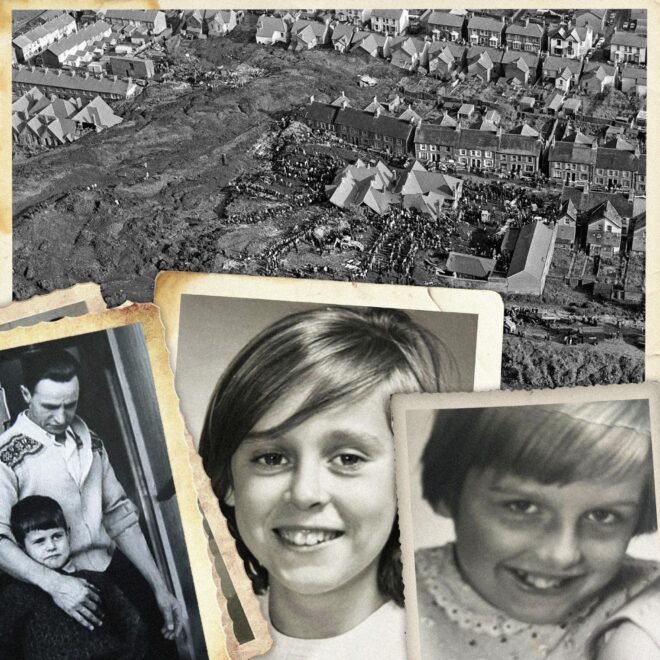
At a quarter past nine on the morning of Friday 21 October 1966, the children of Pantglas Junior School had finished assembly and gone to their classrooms. It was the last day before half-term. Above them, on the flank of the mountain, part of Tip 7 had begun to move.
What followed took minutes. Some 150,000 cubic yards of colliery spoil, saturated by days of rain, liquefied and ran downhill as a black slurry. It crossed a disused canal and a railway embankment, struck a farm cottage and then the school, and went on into a terrace of houses in Moy Road. Survivors described a roar like a low-flying aircraft, followed by a silence so complete that it frightened them more than the noise had.
By evening the village knew it had lost 144 people. One hundred and sixteen were children, most of them between seven and ten, and five were teachers. Nearly half the pupils of the junior school were dead. The first to dig were not officials. They were fathers, mothers, neighbours and miners from the Merthyr Vale colliery, men whose own labour had produced the waste now burying their children. They dug with shovels, buckets and bare hands. A few children were pulled out alive in the first hour or two. After about eleven o’clock there were none. The last child brought out alive was nine-year-old Jeff Edwards, and the recovery of the dead went on for days.
I begin with the morning because what concerns me sixty years on is less the disaster itself than what the institutions responsible did, and did not do, once it had happened.
What the Tribunal found
The Tribunal of Inquiry, chaired by Lord Justice Edmund Davies, sat for 76 days and reported in August 1967. Its conclusions left no room for the comfortable fiction that this had been an act of God. The National Coal Board bore the blame, together with the men who managed its operations in South Wales. The report described the disaster as a “terrifying tale of bungling ineptitude by many men charged with tasks for which they were totally unfitted.” It remains one of the harshest sentences in the history of British official reporting.
The detail was as damning as the phrase. Tip 7 had been sited on a slope above the village that was known locally to be spring-fed. Tipping began there in 1958 and the heap grew for eight years. There had been earlier slips, including one in 1963 at the same tip complex, serious enough to frighten the people who saw it. Local residents and some men who worked on the mountain had said the tips were dangerous. The Board had no coherent policy for tip safety, and its engineers were trained to think about the hazards of underground mining and almost never about the waste that mining left on the surface. No one with the right training and the authority to act was ever asked whether the mountain above a village could kill.
The strongest defence of the Board deserves to be stated, because the Tribunal considered it. In the 1960s the science of spoil-heap stability was undeveloped, and the mechanics by which saturated colliery waste can liquefy and flow were not widely understood in the industry. The Board could say with some justice that it worked with the knowledge of its time. The Tribunal did not accept that this excused the failure, and I think it was right. The question was never whether the Board’s engineers could have predicted the precise mechanism of the slide. It was whether anyone had been charged with asking if tipping on a spring-fed slope above a school was safe, and whether the question was pursued once the 1963 slip and the warnings of local people made it unavoidable. The answer to both was no. A failure of knowledge is different from a failure to look for knowledge, and it was the second that the Tribunal found.
In the days after the disaster the Board’s chairman, Lord Robens, suggested publicly that the slide had been caused by previously unknown springs. The Tribunal found that this was wrong: the springs were known, and their presence should have been evident to the Board. I make no claim about Robens’s state of mind. He may have believed what he said. But that possibility is itself instructive, and I return to it below. He twice offered to resign and was twice refused, and he remained chairman until 1971.
No one was prosecuted. No one, so far as the record shows, was dismissed or disciplined by the Board as a consequence of the Tribunal’s findings. This is the central fact of the aftermath, and for many in the village it has been the hardest to bear. An inquiry can establish with great clarity that a catastrophe was caused by neglect, and the legal system can then decline to attach any consequence to those who neglected. The report gave the families the truth. It did not give them accountability.
The money
Compensation for the bereaved was set at a level that now looks almost indecent: £500 per child lost. The sum did not reflect any serious attempt to value what had been taken. It reflected how the law of the time valued children who had not yet earned.
Then there was the matter of the tips. Aberfan was overlooked by a series of them, and the remaining heaps still stood above the village. They had to be removed, and the cost properly belonged to the Coal Board, which had created them. Instead, pressure was applied for the Aberfan Disaster Fund to pay. The Fund was made up of money given by the public in grief, for the bereaved and the village, and £150,000 was taken from it to relieve a public body of its own liability. The money was not repaid until 1997, and then without interest. In 2007 the Welsh Government made a further payment of £1.5 million, an acknowledgement that the debt was not only financial.
The story of the money is as important as the story of the slide. The slide is a story about negligence. The money is a story about what institutions do once they have been caught, and what they will ask of people who have already given everything.
A public body
There is a particular sharpness to Aberfan that is lost if it is lumped together with other industrial disasters. The coal industry had been nationalised in 1947. The Coal Board was not a private company pursuing a margin. It was a public body, established by statute to serve the public interest and answerable in principle to a minister, and through the minister to Parliament. In the coalfields that had meant something real. Nationalisation had been won after generations of struggle, and it carried a promise that the industry would be run for the people who worked in it and lived alongside it.
It would be a mistake to conclude that public ownership was the problem. In 1913 an explosion at the privately owned Universal Colliery at Senghenydd, a few valleys from Aberfan, killed 439 men and boys, and the penalties that followed were trivial by any measure. Private ownership did not produce accountability then, and the Aberfan Tribunal did not suggest that private owners would have managed the tips better. The question is not whether the owner is a company or the state. It is whether anyone in the structure has a reason to find out what is happening on the mountain and an obligation to answer for it.
Here the critics of nationalisation have a point that should be stated fairly. A private firm that is repeatedly negligent can lose its licence, its insurance, its customers or its capital, and its directors can be sued. A public monopoly has none of these exposures. It cannot go bankrupt, it has no competitor to expose it, and it is largely its own regulator. At Aberfan the body that created the hazard also judged whether the hazard was acceptable. The law governing tips was thin enough that Parliament legislated within three years. The check that public ownership was supposed to supply, democratic accountability, existed on paper and operated hardly at all in practice.
That is why the betrayal was felt so deeply. The community had been told the industry belonged to the nation, and then found that when it failed, nobody had to answer for the nation’s property. No shareholder lost money and no owner was disgraced. The institution did not behave like an owner who had made a terrible mistake. It behaved like a bureaucracy whose first concern was to survive.
Why institutions do not hear
I want to separate what the Tribunal established from what I am inferring. The Tribunal established that the Board had no tip-safety policy, that its engineers were trained for underground hazards, that earlier slips and local warnings were not acted on, and that no one was assigned to ask the relevant question. What follows about why that happened is inference, drawn from how large institutions tend to behave, and I offer it as such.
The first point is that the incentives ran in one direction. A colliery manager was measured on output and cost. Tipping waste near the pit head was cheap and quick, and moving it somewhere safer was slow and expensive. The cost of a hazardous tip would fall on a village at some future date, while the cost of a safe one fell on the manager’s budget at once. When the price of a risk is paid by someone else, later, and the price of avoiding it is paid by you, now, an organisation will drift toward the risk without any individual deciding that it should.
The second is that danger of this kind does not show in the numbers. A tip that has not yet slid looks identical, on every measure a manager reports upward, to one that is perfectly safe. Risk that is low in probability and catastrophic in consequence is the hardest for an institution to price, because for most of its life nothing happens, and each year in which nothing happens seems to confirm that the concern was exaggerated. The 1963 slip should have broken that pattern. That it did not suggests the organisation had no channel through which a near miss became a change in practice.
The third is that information degrades on its way up. Each level has reason to present its own area as under control, and bad news is softened, delayed or reframed before it reaches anyone with authority to act. The people at the top then say, quite sincerely, that they were not told. This is the mechanism I find most plausible behind the Robens statement about unknown springs. I do not need to suppose that he lied. It is enough that the institution beneath him was structured so that the truth was not what reached him.
The fourth is that raising a danger carries a cost for the person who raises it. The local resident who complains is a nuisance. The junior engineer who questions a siting decision is implicitly criticising the people he reports to. Silence is safe for the individual and speaking is risky. Across an organisation of thousands this produces what the Tribunal found: many people who sensed something was wrong, and no one required to say so.
None of this is confined to 1966 or to coal. The Robodebt Royal Commission, which reported in 2023, examined a scheme run by Australian public servants under a government that wanted savings. Concerns raised inside and outside the public service were not acted on, and the people most affected were disbelieved for years. It was not a case of an absent regulator or an unprecedented hazard. It was an institution in which the incentive was to make the problem go away, the warnings came from people who could be ignored, and consequences for those responsible arrived late if at all. Anyone who has worked inside a large public service will recognise the conditions. They are not exotic. They are the ordinary state of a large organisation that has not been made to do otherwise.
The same pattern is familiar to First Nations communities. The Royal Commission into Aboriginal Deaths in Custody reported in 1991 with 339 recommendations, built on evidence that was available and warnings that had been given. Families who had said for years that their relatives were not being kept safe were, in effect, vindicated. Yet deaths in custody have continued, and for many families the experience of having the truth established and then watching little follow is one the survivors of Aberfan would recognise at once. A finding is not an outcome. A report that is accepted and shelved leaves a community where it was before, except that it now holds official confirmation that it was right and was ignored.
That is the lesson of Aberfan for those who run institutions. It is not enough to forbid negligence. An institution has to be built so that bad news travels upward unaltered, so that someone is named as responsible for each foreseeable risk, so that the person who raises a danger is protected and not penalised, and so that failing to act has consequences for those who failed. The Mines and Quarries (Tips) Act 1969 put colliery tips under statutory control for the first time, with requirements for inspection, classification and safe design, and it was a real and necessary reform. But legislation addresses the particular hazard. It does not alter the habit that allowed the hazard to grow, which is the habit of not hearing the people who know.
What remains
The physical danger has not entirely passed. Wales still has thousands of disused coal tips, and a considerable number are classed as higher risk. In February 2020, after Storm Dennis, a large slip occurred at Tylorstown in the Rhondda. No one was killed, but it was a sharp reminder that the legacy of an industry does not disappear when the pits close. The work of inspecting, monitoring and where necessary stabilising or removing these tips now falls on governments, because the industry that created them is gone. That responsibility is part of the unfinished business of Aberfan.
Sixty years on, Aberfan is a living village and not only a memorial. The school site is now a memorial garden, and each year the community marks the moment with silence. Survivors who were children in that classroom or on that street are now in their sixties. Many have spoken of decades of nightmares, of survivor’s guilt, and of the absence of any help. In 1966 there was no language for what these children had witnessed and no services to meet it, and the psychological consequences of the disaster were recognised late, for many too late to matter. The people of Aberfan did not choose to become a symbol. They are a community that lost a generation in a quarter of an hour, and was then asked, over many years, to go on proving that it had been wronged.
Remembering properly
It would be easy to mark an anniversary like this with a brief and solemn ritual, and then return the story to the shelf. The disaster would become something that happened to other people, long ago, because of a mountain and the rain. That is the version institutions would prefer, because it makes the event a tragedy and not a failure of responsibility. It turns a failure of decisions into a failure of nature.
The honest account is harder. The children died because a tip was placed where it should not have been and left there. They died because people were told it was dangerous and did not act, because a public body did not treat the risk to a village as a priority, and because when the inquiry was over no one was made to answer for it. Each of these is a human failing, and each can be repeated.
The children of Aberfan were not statistics. They were half a generation of one village. The least we can do, sixty years on, is to remember what happened, why it was allowed to happen, and that the warnings were there. The most we can do is to ask, whenever a community tells us that something above it is unsafe, whether we are prepared to listen before the mountain moves.
– – –
Bakchos is the founder of Blak and Black, an Australian media and advocacy platform established in 2010. Bakchos writes from the intersecting perspectives of Wiradjuri heritage, Jewish identity, and humanism.
© Bakchos, October 2026



A finding is not an outcome. From Aberfan to deaths in custody, the pattern is familiar: the truth is established, a report is accepted, and little follows.
I don’t know whether public ownership was really the problem at Aberfan, or whether the better question is who in the structure had a reason to find out and an obligation to answer. It looks at how incentives, information that degrades on its way up, and the personal cost of raising a concern combine to produce failures that no individual decides on
That was a totally avoidable tragedy.
The unsettling thing about this whole saga is, the report gave the families the truth. It did not give them accountability.
The Aberfan Disaster is a testament to the attitudes that still permeate many corporations and government. No one likes to see people harmed, especially children, but who is going to wear the blame for the foreseeable, for what the safety concerns the workers were expressing? My pay on the Westgate Bridge highlighted a similar contempt for accountability. Blame the workers or the dead weight who cannot reply.
.
I find it particularly astounding that the funds donated by Britons to the families of Aberfan were plundered to cover costs of preventing a subsequent horror. I did not know that pay of the story. And they wonder why unions arose.