
A Comment Worth Answering
Every so often a comment arrives on Blak and Black that deserves more than the delete button. This one appeared beneath a piece on Pauline Hanson, and it opened with a challenge. Hanson’s statements, its author wrote, cannot be “debunked”; he had yet to see a successful debunking of anything said about the disastrous consequences of mass immigration to white countries. He left enough identifying detail to be traced, though I have no intention of using it. What interested me was what followed the challenge.
He went on to supply his own account of those consequences. Australia, he said, is a white country, founded and settled by Europeans of British descent. Under the White Australia policy it was a beautiful place of striking homogeneity, held together by “a common blood/culture” and a shared history, beliefs and values. Today, in his telling, it is a “confused and congested multicultural pigsty,” its newer citizens “feral and filthy.”
I want to take that claim at its word. I will come to the assertions about crime and fraud later. But the heart of the comment is a claim about inheritance. The author presents himself as the custodian of a civilisation: British, European, built by his people for his people. I would like to ask what that civilisation actually is, and what it asks of those who claim it. I first studied the classics at the University of Sydney, and I have never really stopped, and my answer is that his claim fails on its own terms. It fails at the very first step, with a battle fought two and a half thousand years ago on a plain beside the Aegean.
What Mill Actually Said
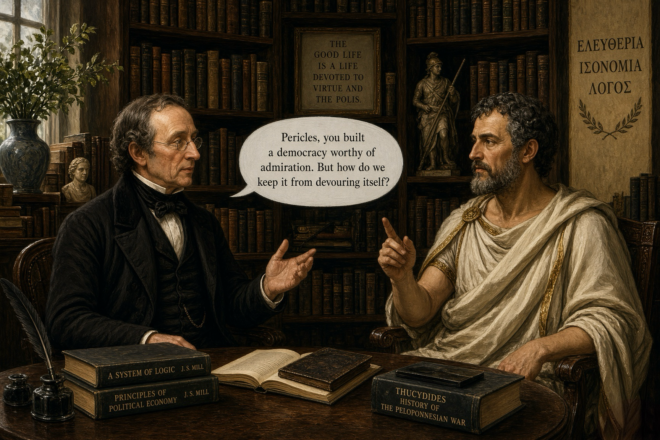
In 1846 John Stuart Mill reviewed the first volumes of George Grote’s History of Greece, and in the course of that review he wrote a sentence that has been quoted ever since: that the battle of Marathon, even as an event in English history, is more important than the battle of Hastings. He added a sharper line for good measure. Had the issue of that day been different, he said, the Britons and the Saxons might still have been wandering in the woods.
The claim sounds outlandish, and it was meant to startle. It also chimed with the settled assumption of Mill’s readers, the products of the Victorian public schools and ancient universities, who took the Greeks, and above all the Athenians, to be their cultural ancestors. There was an imagined continuum, in their minds, running from the Athens of the fifth century before Christ to the Britain of the nineteenth century of the Common Era. Greek was the heart of an elite education, and Athenian democracy was idealised as the origin of everything free and rational that the Victorians believed they had inherited.
It matters to be exact about what Mill was and was not saying. He was not making a claim about blood, ethnicity or direct political succession. He was making a claim about cultural inheritance and about counterfactual importance. Hastings, in 1066, decisively shaped the English language, law, monarchy and institutions by importing Norman feudal structures and Anglo-French culture, and it is rightly counted a foundational event in English political and linguistic history. Marathon, in 490 BC, helped ensure the survival of independent Greek city-states against the Persian Empire. That survival allowed the flowering of Athenian democracy, philosophy, tragedy, history-writing, architecture and political thought in the century that followed, and those achievements were later carried, by way of Rome, the Renaissance and classical education, into the intellectual bloodstream of modern Europe. On this view the Greek victory preserved the whole classical inheritance Victorian Britain prized most: liberty, rational inquiry, self-government, historical method and aesthetic ideal.
I should add, in the interest of precision, that the counterfactual is debatable. Later historians have questioned whether a Persian victory would really have extinguished Greek cultural achievement. Herodotus himself was born in Halicarnassus, a Greek city under Persian rule, and the Ionian Greeks produced a great deal under that rule. The statement holds within Mill’s framework, which prioritises long-term cultural causation over immediate political fate, and that is the only sense in which it should be quoted.
Now notice what Mill chose as his comparison. The event he set Marathon against, the other candidate for the founding moment of English history, was an invasion. Hastings was a conquest by foreigners, led by men whose own name, Norman, meant Northmen, the descendants of Scandinavian settlers who had taken land in France a century and a half earlier. The English language that Mill wrote in is a layered record of arrivals: the Celtic speech of the Britons, the Latin of Rome, the Germanic dialects of Angles, Saxons and Jutes, the Norse of the Danelaw, the French of the conquerors. If a civilisation required a “common blood” to carry it, England would be the last place on earth to look for one.
The Stars Change, the Mind Remains
The University of Sydney’s motto is Sidere mens eadem mutato. It has been translated many ways: the stars change but the mind remains the same; the constellation is altered but the disposition is the same; the same learning under new stars. However one renders it, the sense is unmistakable. A university founded in 1850 on the far side of the world declared that what it carried across the sea was not a people but a mind, a body of learning, a way of thinking, transplanted into a different sky.
The new sky, of course, was not new to everyone. The stars over this continent had been read, named and woven into law and story by Aboriginal peoples for tens of thousands of years before any university borrowed them for a motto. If Australia is the intellectual heir of Britain, and Britain, in Mill’s account, the heir of Athens, then what has been handed down at every stage is something that can be learned, taught, questioned and improved, and that is exactly why universities exist. Nobody founds a university to transmit blood. Blood needs no lectures.
And what, concretely, was handed down? The great age of Attic tragedy peaked in the generations after Marathon, with Aeschylus, Sophocles and Euripides putting ethics, politics and suffering before the whole city at the City Dionysia. Herodotus turned the Persian Wars into the first great work of inquiry into why human beings do what they do. Socrates began to question everything that passed for conventional wisdom, and on the Acropolis the Parthenon rose between 447 and 432 BC under Phidias. It was a few extraordinary decades, tied to democracy, imperial wealth and the confidence of what Pericles, in Thucydides’ account, called the school of Hellas. They ended with the plague that killed him in 429 and the defeat of Athens in 404.
The Foreigners in the Room
Here is the first thing the comment’s author does not appear to know. The Athens of that golden age was not a monument to homogeneity. It was one of the most cosmopolitan places in the ancient world, and a great deal of what we prize in it was done by people who were not Athenians at all. Herodotus came from Halicarnassus, on the coast of what is now Turkey. Protagoras came from Abdera in Thrace, Anaxagoras from Clazomenae in Ionia, Gorgias from Leontini in Sicily. Aspasia, the brilliant companion of Pericles, came from Miletus, and Miletus also gave the city Hippodamus, the planner traditionally credited with laying out the port of Piraeus. The very script in which all of this was written down was an adaptation of the Phoenician alphabet. Athenian intellectual life was a conversation conducted with the whole eastern Mediterranean.
The Athenians knew this about themselves, and in their best moments they boasted of it. In the Funeral Oration, Thucydides has Pericles say that Athens throws open its city to the world and never, by alien acts, shuts out foreigners from any opportunity of learning or observing. The same oration describes a city where advancement goes by capacity rather than by class. There was a gap between that speech and the reality, but it is the ideal that Mill’s generation read and revered.
The tragedians went further. In 472 BC, only eight years after the Greek victory at Salamis, Aeschylus presented a tragedy called The Persians. It is set not in Athens but at the Persian court, and it asks an Athenian audience to mourn with the mother and the widows of the defeated enemy. It is the earliest Greek tragedy that survives, and it is built on an act of imaginative sympathy with the people the audience had just beaten. Herodotus, for his part, tells a famous story of Darius asking Greeks how much money it would take to eat their dead fathers, as the Indian Callatiae do, and asking the Callatiae what it would take to burn theirs, as the Greeks do. Both parties were appalled. Herodotus concludes that custom is king of all, and that every people thinks its own ways the best. That is the founding gesture of the tradition my correspondent says he is defending.
I suspect the author of the comment knows none of this, which is a charitable guess about his reading. What I can say with confidence is that the spirit running through his words, the language of the pigsty and the feral animal, applied to whole categories of his fellow citizens, is the opposite of the intellectual temper of Periclean Athens and of the nineteenth-century Britain that tried to emulate it. Curiosity about the stranger and humility about one’s own customs were the signature of that inheritance. Contempt for the stranger, wrapped in a claim of ancestry, is its counterfeit.
The Strongest Case Against Me
A fair argument has to face the best objection, and the commenter has a better one than he realises. Athens was not as open as its orators claimed. In 451 or 450 BC, Pericles himself carried a law limiting citizenship to those whose parents were both Athenian, where previously an Athenian father had been enough. Women had no political rights, slaves had none at all, and resident foreigners, the metics, had no standard route to citizenship however long they lived or however well they served the city. The Parthenon was paid for out of tribute drawn from allies who had joined a league against Persia and found themselves subjects of an Athenian empire.
I concede all of it, and I think the concession costs me nothing. The point of an inheritance is that one takes what is worth taking. No serious person reveres Athens for its slavery or for its treatment of women, and no serious person reveres Victorian Britain for its empire. Mill himself spent thirty-five years in the service of the East India Company, and in On Liberty he wrote that despotism is a legitimate mode of government in dealing with barbarians, provided the end is their improvement. It is an ugly sentence. But notice what the tradition did with its own failures. It supplied the tools, Athenian and Millian, by which those failures could be named and dismantled. Mill’s own arguments about liberty, individuality and the equality of women were turned against the world he lived in, and they did their work there.
There is also an irony in the citizenship law that the commenter will not enjoy. The son of Pericles by Aspasia, a woman from Miletus, was not an Athenian citizen under his father’s own statute, and the Assembly had to make a special exception to legitimise him. The great architect of Athenian exclusivity was undone, in his own household, by the exclusivity he had built. When blood is made the test of belonging, it tends to bite its makers.
I should also be clear about what I am not saying. A country is entitled to argue about immigration: about numbers, pace, settlement support, language instruction and the pressure on housing and services. That is a legitimate conversation, and arguing for lower or higher intakes is not the same thing as bigotry. What the comment does is something different. It does not argue about numbers. It argues that people from certain origins are “incompatible” and “non-assimilable” by nature, that they are, in the language of livestock and vermin, a contamination of a body that was once clean. A premise of that kind is not an empirical finding. It is a starting point, and when one starts from blood, evidence becomes decoration.
This is also the answer to the opening challenge. Claims about crime, welfare use or fraud are claims about rates, and rates can be checked: by group, across time, and against the rest of the population. The burden sits with the person who says that an entire category of human beings is inherently unfit, and it is not discharged by adjectives. A claim that has not been tested has not been confirmed. The classical tradition he cites is a discipline of asking what a claim rests on, and whoever takes up its banner takes up that obligation too.
A White Country?
The comment calls Australia a white country, founded and settled by Europeans. At the risk of stating the obvious, this continent was not empty. I am descended on my father’s side from the Wiradjuri, and my father was born on the Erambie mission at Cowra. The ancestors of the Wiradjuri had been here for tens of thousands of years when the First Fleet arrived. The law of the new colony pretended otherwise for two centuries, treating the land as belonging to no one, and it took the High Court’s decision in Mabo in 1992 to overturn that fiction. “Settled” is the word the newcomers chose.
The homogeneity he remembers so fondly was not a natural condition. It was legislated. The Immigration Restriction Act was among the first laws passed by the new Commonwealth Parliament in 1901, and the policy it launched was dismantled only in stages, from the late 1940s until the Whitlam government formally ended it in 1973. The Constitution itself, until the referendum of 1967, instructed that Aboriginal people were not to be counted in reckoning the population of the Commonwealth. The cohesion he admires was bought, in part, by deciding who did not count.
There is one more irony that a classicist cannot resist. The Greeks who came to Melbourne and Sydney after the war were treated for a generation as precisely the kind of non-assimilable outsiders that my correspondent describes, with a foreign language, foreign food and foreign loyalties. Today nobody blinks. I claim no line of blood from Pericles to a corner-shop owner in Oakleigh; that is the commenter’s fallacy, not mine. My point is that the category of the unassimilable has a way of being emptied by time, and then refilled with someone new.
Let Your Light Shine
The school I attended from Year Five to Year Twelve had a motto that I have carried with me far longer than I carried the uniform. Luceat lux vestra: let your light shine. It comes from the Gospel of Matthew, and it urges students to use their particular gifts to make a difference in the world. Folded into it is a second thing: if it is each person’s obligation to become the best they can be, then society owes them the opportunity to try.
That, I suggest, is the real test of the inheritance the commenter claims. Mill believed it with a fervour that anyone who has read On Liberty will recognise. For Mill, human nature was not a machine to be built to a pattern and set to do exactly the work prescribed for it. It was more like a tree that needs to grow and develop on all sides according to the tendencies of its inward forces. He thought a society flourished by cultivating individuality and permitting what he called experiments in living, and he warned against the despotism of custom, the dull pressure that makes everyone resemble everyone else. That ideal is the opposite of the homogeneity the commenter admires. It valued difference as the raw material of improvement.
Athens, for all its failings, said something similar in its better hours. The Funeral Oration, as I noted, has Pericles claim that advancement went by capacity rather than class, and a city that believed this would let talent come from anywhere. The programme my correspondent endorses runs the other way. It would turn a large number of Australian citizens into a permanent second class, defined by origin rather than by conduct, and it would deny them the very opportunity that stands at the centre of nineteenth-century British thought: the chance to become the best person one can be. A polity that fences off a fraction of its citizens from opportunity is not only unjust to them. It wastes talent, and it protects mediocrity wherever mediocrity happens to be well connected.
The Inheritance Is a Method
I began by saying that the commenter’s claim fails on its own terms, and I hope the reasons are now plain. If the civilisation he invokes is British, it is a mixture whose founding event in Mill’s own telling was a conquest by foreigners. If it is European, it descends from Athens, which borrowed its alphabet from the Phoenicians and its finest minds from half the Mediterranean. If it is Australian, it was built on a continent that was already inhabited, by a policy of exclusion that took the better part of a century to dismantle. And if the inheritance is one of mind, as the University of Sydney’s own motto says, then it belongs to anyone willing to do what the mind demands: to read, to question, to weigh evidence and to extend to the stranger the curiosity that Herodotus extended to the Persians.
The classical tradition, from the Greeks through the Victorians to the lecture theatres of Sydney, is not a bloodline. It is a method of argument and a standard of conduct, and its first demand is that a claim be able to survive an objection. To invoke it is to accept a burden, and the commenter has accepted none. He offers assertions where Herodotus offered inquiry, and contempt where Aeschylus offered grief. He has the vocabulary of the inheritance and none of its habits.
The stars change, and the mind remains the same, provided someone is prepared to use it. I would invite the author of that comment to take up the tradition properly: to read Herodotus on custom, to sit with The Persians, to read On Liberty from beginning to end. He may find that the civilisation he wishes to defend never asked him to despise his neighbour. It asked him to understand the neighbour, and to let the neighbour’s light shine, which is a fair definition of what a decent society is for.
– – –
Bakchos is the founder of Blak and Black, an Australian media and advocacy platform established in 2010. Bakchos writes from the intersecting perspectives of Wiradjuri heritage, Jewish identity, and humanism.
© Bakchos, October 2026

