
I. THE GRAMMAR OF PERMISSION
They speak of shared values. Watch what they permit.
This is not a slogan. It is a method – a discipline of reading power against the grain of its own self-presentation. Governments are accomplished storytellers. They narrate themselves in the language of principle: human rights, the rule of law, the dignity of the person, the bonds of democratic alliance. These narratives are not always false. But they are always incomplete. And the incompleteness is not accidental. It is structural. What power chooses not to say, not to see, not to investigate, not to punish – this negative space is the true grammar of its moral order.
Every state possesses two constitutions. The first is the written one – the document, the treaty, the statute, the proclaimed value. The second is the unwritten one, inscribed not in any archive but in the accumulated record of what has been permitted without consequence. A government may sign every human rights instrument in existence, and its unwritten constitution may still authorise the boot on the crucifix, the unmarked grave, the uninvestigated killing. The distance between the two constitutions is not a failure of implementation. It is policy by other means.
Those of us who have spent our lives reading this second constitution – who have been its subjects rather than its authors – understand the grammar instinctively. We know that what is condoned becomes, in time, what is endorsed. We know that silence is not neutrality. We know that the absence of accountability is itself an account, rendered in the currency of permission.
II. THE SILENCE THAT FOLLOWS THE BOOT
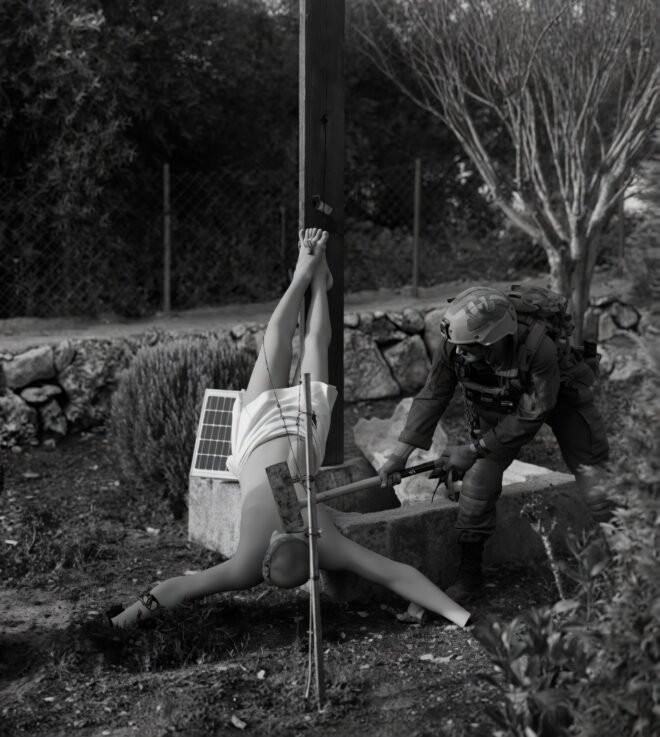
Consider the image at the centre of this inquiry: a soldier’s boot on a crucifix. The image is deliberately chosen for its layered offence – the desecration of the sacred, the casual exercise of dominance, the choreographed contempt that occurs when a person in uniform believes themselves unobserved, or believes that observation will produce no consequence. The sacred object need not be a crucifix. It may be a Quran, a Torah, a ceremonial object, a burial site, a language, a body. The specific content of the desecration matters less than its structure: power enacting its own impunity in the register of the holy.
What follows the act is the more revealing half of the story. There is the press release that never comes – the silence of institutions that have decided, collectively and without formal declaration, that this particular act does not rise to the level requiring public acknowledgment. There is the inquiry that is never opened – not because no one noticed, but because someone decided that noticing officially would cost more than the alternative. There is the careful bureaucratic choreography of inattention: the report filed without escalation, the complaint received without action, the evidence preserved in a file that will not be opened until the statute of limitations has run.
This is not incompetence. Incompetence produces noise – confusion, contradictory statements, the visible friction of institutions struggling with a problem they cannot manage. What follows the desecration of the sacred, in the cases that concern us here, is not noisy. It is smooth. The smoothness is the signature of a decision.
III. MORAL ARCHITECTURE AND ITS BLUEPRINTS
A state’s true moral architecture is not found in its diplomatic communiqués. It is found in what its armed forces do when they believe no one is watching – and in whether anyone is held to account when someone is.
The concept of moral architecture is worth dwelling on. Architecture does not refer merely to the visible structure – the façade, the public entrance, the ceremonial spaces that visitors are shown. It refers to the entire built form: the load-bearing walls, the foundations, the hidden systems that make habitation possible. A building’s moral architecture is the structure that determines who is permitted to enter, who is housed, who is expelled, who is confined, and on what terms each of these outcomes is produced.
States, like buildings, present their most elaborated façades to those whose approval they seek. The diplomatic communiqué is a façade document. It is addressed to a particular audience – foreign governments, multilateral bodies, domestic elites invested in the state’s international reputation – and it speaks in that audience’s preferred register. It invokes universals: peace, dignity, the rule of law, the international order. It is often, in its way, beautiful. It can also be entirely disconnected from what is happening inside the structure it purports to describe.
The interior is revealed by the behavioural record. Not what governments say in The Hague or Geneva, but what they do in the field, on the base, in the interrogation room, in the police station, in the juvenile detention facility, in the town where the mine tailings have poisoned the water supply and the compensation claim has been pending for eleven years. The behavioural record is the blueprint. The communiqué is the marketing brochure.
When we speak of the failure of accountability – whether in the context of war crimes allegations, of racialised policing, of the systemic marginalisation of First Nations communities, of the treatment of asylum seekers, of the conduct of security forces in occupied territories – we are speaking of a gap between the brochure and the blueprint. That gap is not incidental. It is the primary political fact.
IV. THE ARITHMETIC OF THE OTHERED
Those of us who have lived inside that gap – othered, dismissed, lectured about values by those who exempt themselves from them – we know this arithmetic intimately.
To be othered is to be placed outside the default of full citizenship, full humanity, full legibility as a subject whose suffering counts in the ordinary calculation. It is not always accomplished by dramatic means. More often it is accomplished by a thousand small calibrations: the tone of the official correspondence, the length of the wait, the assumption of guilt before the process has begun, the exhaustion of having to explain, again, what should require no explanation. The othered person becomes expert in reading the second constitution because they must. Their survival frequently depends on understanding what the state will actually do, as distinct from what it says it will do.
In the Australian context, this expertise has been accumulated over generations, at enormous cost. First Nations peoples have been reading the gap between the first and second constitutions since 1788. The first constitution proclaimed, at various points, civilization, protection, assimilation, self-determination, reconciliation. The second constitution – the one written in the behavioural record – proclaimed something more consistent: that Indigenous life, Indigenous land, Indigenous law, and Indigenous testimony were accorded a systematically different weight than their non-Indigenous equivalents. The Royal Commissions, the inquiries, the parliamentary reports, the international treaty body reviews – these have documented the gap exhaustively. The documentation has not closed it. This is not because the documentation is inadequate. It is because documentation of a gap and political will to close it are entirely different things.
The arithmetic the othered know is this: when a state consistently fails to hold its agents accountable for conduct that, if directed at the dominant group, would produce swift institutional response – the failure is not random. It follows a pattern. The pattern is a policy. The policy is that some lives count more than others, and that the differential counting is encoded not in any statute but in the accumulated weight of what has been permitted without consequence.
This arithmetic is not peculiar to Australia. It is legible in the United States, where the mathematics of who gets killed by police and who gets prosecuted for killing them has been exhaustively documented. It is legible in France, where the response to racialised violence in the banlieues tracks a political logic that the republican universalism of the official constitution cannot contain. It is legible in Israel and the occupied Palestinian territories, where two populations inhabiting the same geography are subject to different legal regimes, different evidentiary standards, different thresholds of what constitutes an actionable harm. It is legible wherever a state maintains a second constitution that its official rhetoric refuses to name.
V. WORDS, ACCOUNTABILITY, AND THE ECONOMY OF POWER
Words about dignity cost nothing. Accountability costs everything. That is precisely why so few in power offer it.
This asymmetry is the engine of political disappointment. It explains why so many societies are rich in the rhetoric of rights and poor in their enforcement. It explains why governments that have signed every relevant treaty, passed every relevant statute, created every relevant oversight body – can still preside over systematic impunity for those with the power to enact it. The infrastructure of accountability, without the political will to use it, is ornamental. It is the human rights equivalent of a fire extinguisher whose hose has been quietly removed.
The political economy of accountability is brutal and simple. Holding power accountable means creating adversaries among those who hold power. It means absorbing the institutional pressure that those adversaries will bring to bear. It means accepting the narrative costs – the claims of bad faith, the accusations of political motivation, the arguments that accountability undermines morale, operational effectiveness, national security, or social cohesion. These costs are real. The political actors who bear them know they are real.
Against these costs, what is the benefit of accountability? The benefit accrues primarily to those who were harmed – and in the political geometries we are examining, the harmed are disproportionately those whose political weight is already discounted. The soldier who desecrated the crucifix has comrades, superiors, a chain of command, an institutional culture, a media constituency, and a political class invested in not examining what happens in the field too closely. The person whose sacred object was desecrated has – in most cases – less of all of these things. The asymmetry of political weight produces the asymmetry of accountability outcomes. This is not a failure of the system. It is the system working as designed.
This is why the language of shared values is so important to interrogate. When governments invoke shared values with their allies, they are doing something specific: they are asserting equivalence between their own moral conduct and that of the state or community they address. The invocation is a claim: we are like you; our values are your values; we belong in the same moral category. But shared values are not a declaration. They are a performance that must be tested against the behavioural record. When the behavioural record diverges from the claim – when the ally whose shared values are invoked is found to be operating a system of differential accountability that would be unacceptable in any other context – the invocation of shared values becomes a form of moral laundering.
VI. WHAT ENDORSEMENT LOOKS LIKE
What you permit, you endorse. The endorsement need not be explicit. It need not be conscious. It operates through the slow accumulation of condoned conduct – each individual instance insufficient to trigger a response, but the aggregate forming a pattern that is unmistakable to those who live inside it.
Consider the mechanism more closely. An act of abuse occurs. The immediate response is denial – not necessarily dishonest denial, but the institutional reflex to protect the organisation from the implications of what one of its members has done. The denial is followed by minimisation: the act is described as isolated, exceptional, the product of individual failure rather than systemic condition. The minimisation is followed, if the political pressure is sufficient, by a process – an inquiry, an investigation, a review – that is structured in ways that make systemic findings unlikely. The process produces a report. The report is received. Its recommendations are noted. Implementation is partial, delayed, or quietly abandoned when the political pressure that prompted the process has dissipated.
This sequence – denial, minimisation, process, partial implementation, abandonment – is so familiar, in so many jurisdictions and contexts, that it constitutes a genre. It is the genre of institutional self-protection in the face of accountability demands. Its recurrence across different societies, different cultures, different political systems, is evidence that it is not an aberration but a structure: the default mode of institutional response when the alternative – genuine accountability – carries political costs that the institution is unwilling to bear.
The endorsement encoded in this sequence is not of the original act. It is of the principle that those with sufficient institutional power need not be held to the same standard as those without it. That is the deeper endorsement, and it is the one that compounds over time. Each cycle of denial, minimisation, and process-without-consequence adds another layer to the second constitution. Each layer makes the next act of impunity slightly more legible as permission.
VII. THE WITNESS AND THE RECORD
Against the architecture of permitted impunity, there is witness. There is the long, unglamorous, frequently punished practice of looking clearly at what is happening and insisting on its legibility – refusing the offered narratives of exceptionalism and isolation, refusing to be told that what one has seen is not what one has seen.
Witness is not merely documentation, though documentation is one of its forms. Alice Seeley Harris’s photographs from the Congo Free State at the turn of the twentieth century are among the most powerful examples of moral witness in modern history: images that made undeniable what the colonial power was invested in rendering invisible. The photographs did not immediately end the atrocities. What they did was rupture the narrative of benevolent colonialism, making it impossible for those who encountered them to maintain the comfortable fiction. The rupture was necessary. It was not sufficient. Sufficiency required political will that the photographs alone could not supply.
The contemporary equivalents of Harris’s photographs are everywhere: body camera footage, satellite imagery, forensic architecture analysis, the testimony of survivors and witnesses gathered and preserved by human rights organisations, the documentary record assembled by treaty bodies and special rapporteurs and the journalists who still do this work at considerable personal cost. This record exists. It is not secret. It does not suffer from a deficit of evidence. What it suffers from is a deficit of political will to act on what the evidence shows.
This is the condition in which witness finds itself in the present moment: not lacking for documentation, but facing the systematic refusal of those with the power to act to treat the documentation as obligating action. The gap between evidence and response is itself a political fact of the first importance. It tells us that the problem is not epistemic – not a matter of insufficient knowledge – but volitional: a matter of insufficient will. And insufficient will is not a natural condition. It is produced and maintained by the political economy of accountability described above.
VIII. COMPLICITY, ADJACENCY, AND THE LIMITS OF ALLIANCE
The question of what allies permit – and what those permissions mean for the alliance – is among the most uncomfortable in democratic politics. Alliances are justified by their architects in the language of shared values and common interests. They are maintained by the political class’s investment in the narrative of kinship – cultural, historical, ideological – that the alliance represents. The maintenance of the narrative requires that certain questions about allied conduct be quarantined from the zone of legitimate political interrogation.
This quarantine has a name in diplomatic practice: it is called not undermining the alliance. In everyday political speech it sounds like this: now is not the time; we raise these concerns in private; we have more influence inside the tent than outside it; the alternative to this ally is worse; our relationship is too important to jeopardise over this specific issue. These formulations are not always cynical. Sometimes they reflect genuine strategic calculation. But they are always convenient for those whose conduct is being quarantined from scrutiny, and they always impose their costs on those whose harms are being deemed, for strategic reasons, insufficiently important to name publicly.
The person who has been othered – who has spent a lifetime inside the gap between the first and second constitutions – recognises this quarantine immediately. They recognise it because it is the same mechanism that operates domestically: their harm is acknowledged in private, raised in the appropriate channels, noted with concern, and not acted upon because the political costs of acting exceed the political costs of inaction. The domestic and the international operate on the same logic. The ally’s impunity and the citizen’s impunity are produced by the same structure. They are not analogous: they are instances of the same phenomenon operating at different scales.
What are the limits of alliance built on this structure? The question is not rhetorical. Alliances premised on shared values that are demonstrably not shared – or shared only for some people in some circumstances – are not merely hypocritical. They are structurally unstable. They require the constant maintenance of a fiction that is legible as fiction to those who live inside it. The energy required for that maintenance is diverted from the serious work of building the political relationships and institutional frameworks that could actually address the underlying conditions. The fiction of shared values, sustained past the point of its credibility, becomes an obstacle to the genuine article.
IX. THE FULL MEASURE OF CHARACTER
The gap between a government’s rhetoric and its condoned conduct is not a footnote. It is the full measure of its character.
Character, in individuals and in institutions, is not revealed by what we say about ourselves in conditions of ease. It is revealed by what we do when doing the right thing is costly – when the adversaries it creates are powerful, when the narrative costs are high, when the political class that benefits from inaction is better organised than those who would benefit from accountability. Character is the residue of choices made under pressure.
By this measure, the political character of our current moment is not distinguished. We live in a period of extraordinary rhetorical elaboration of human rights norms – more treaties, more reporting mechanisms, more oversight bodies, more national human rights institutions than at any previous point in history – and simultaneously a period in which the gap between the elaboration and the practice is as wide as it has ever been. The infrastructure of accountability has been built with considerable care. The will to use it has not kept pace.
This is not cause for despair. Despair is a luxury for those who can afford to be spectators. For those who live inside the gap, the only posture available is continued insistence – the refusal to accept that the gap is permanent, the refusal to grant to power the permission of resignation, the insistence on holding the rhetoric to its own standards. This insistence is not naive. It is an assessment of what is politically possible over time, as against what is politically available right now.
The second constitution is not written in stone. It is written in accumulated decisions – each of which was a choice, made by specific people with specific interests, under specific pressures. Decisions can be unmade. Precedents can be broken. The record of permitted impunity can be confronted and reversed, given sufficient political will and sufficient organised pressure from those who refuse to be quarantined from the zone of legitimate political concern.
But the precondition of that reversal is naming the thing clearly. Governments do not only govern through law. They govern through what they choose not to see. The silence that follows the boot on the crucifix is a policy. The press release that never comes is a decision. The inquiry that is never opened is an answer to a question that power hoped would not be asked. What you permit, you endorse. The first step in withdrawing the endorsement is refusing to look away from the permission.




This is a serious essay that earns most of what it claims. The argument is coherent, the prose is controlled, and the central analytical framework is genuinely productive. The vulnerabilities are real but addressable: the evidentiary overreach in places, the comparative assertions that need more grounding, the conclusion that undersells the essay’s own originality. In its current form it is a strong first-rank draft. With attention to those pressure points it could be a definitive statement.
Kelly the ACT Government is guilty of every point Bakchos has made in this post.
Bill all governments are guilty of this hypocrisy.
This is a substantial piece of work, and it earns serious critical engagement rather than summary praise.
The essay’s authority comes from its claim to speak from inside the gap — from the experience of being “othered,” of reading the second constitution as a survival practice. That claim is stated most directly in Sections III and IV, but it’s held at a certain distance; the essay speaks about that experience more than from it. This is partly a tonal choice and a legitimate one — the analytical register would be disrupted by a more confessional mode. But it creates a slight asymmetry: the essay’s most powerful claim (that those who have been othered read power differently, and correctly) is asserted from a position that is partially legible and partially withheld. That’s not a flaw exactly, but it’s a tension worth being conscious of, particularly in the context of submission to an international legal arena where the standing of the speaker will be interrog
Friend this post is a statement of fact. A harsh but accurate description of the poor state of democracy worldwide.
Your post speaks truth, what h what your government does, not what it says, before deciding what kind of government you live under.
The ACT Government is the classic, listen to what we say, turn a blind eye to what we do. That’s called apex hypocrisy.
Australia isn’t the only country with a dichotomy between what their government says and what it does.
Hypocrisy is the reality of all governments.