
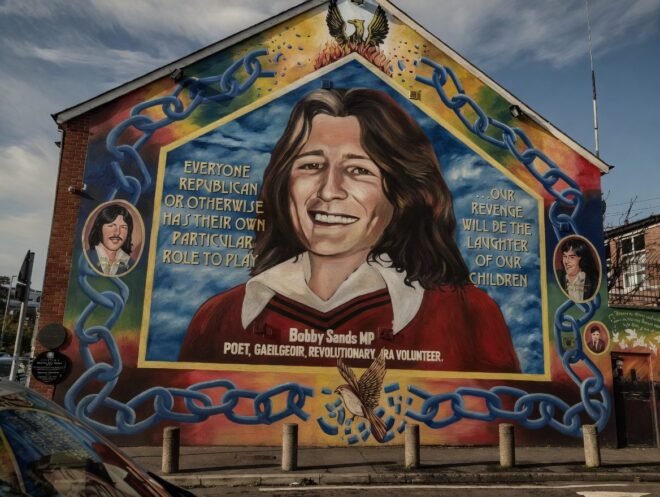
“No part is too great or too small, no one is too old or too young to do something. They have nothing in their whole imperial arsenal that can break the spirit of one Irishman who doesn’t want to be broken. They won’t break me because the desire for freedom, and the freedom of the Irish people, is in my heart.”
~Bobby Sands~
I. A CHILD OF THE DIVIDED CITY
Robert Gerard Sands was born on 9 March 1954 in Abbots Cross, a mixed neighbourhood on the northern outskirts of Belfast. He was the son of John and Rosaleen Sands, working-class Catholics navigating the particular humiliations of life in a state designed, from its very inception in 1921, to ensure their political and economic subordination. The Sands family lived in the kind of street where religion determined not only your church on Sunday but your school, your employer, your neighbours, and, with increasing frequency as Bobby grew, the degree of physical danger you faced simply walking home.
Northern Ireland in the 1950s and 1960s was not, despite its claims to parliamentary normalcy, a liberal democracy in any meaningful sense. It was a one-party Protestant state, administered under the Special Powers Act – legislation so draconian that South African architects of apartheid would famously express their admiration for it and their wish to have something similar on their own statute books. Catholics were systematically excluded from public housing, gerrymandered out of political representation, discriminated against in employment, and surveilled by a paramilitary police force, the Royal Ulster Constabulary (RUC), that was overwhelmingly drawn from the unionist community and deeply hostile to the minority it nominally served.
Bobby Sands was, by all accounts, a gentle and sociable boy. He played football, loved music, and harboured ambitions to become a coach builder. His childhood was marked less by overt political consciousness than by the lived experience of being unwanted in the state of his birth. The family was intimidated out of Abbots Cross when Bobby was around ten years old, sectarian threats forcing them to relocate to Rathcoole, a predominantly Protestant estate. The move brought no respite. Further threats followed, and the family was driven again, eventually settling in Twinbrook in West Belfast – a Catholic enclave that would become a centre of republican activism.
It is a pattern as old as colonialism itself: the dispossessed, moved from one margin to another, told there is no place for them, until they eventually conclude that the only space they will ever truly occupy is the one they carve out through resistance. Bobby Sands did not choose the armed struggle in some abstract ideological meditation. He was pushed into it, steadily, by a state that refused to recognise his humanity on equal terms.
II. THE MACHINERY OF PERSECUTION
The late 1960s brought the civil rights movement to Northern Ireland, modelled self-consciously on the movement that had transformed the American South under Martin Luther King Jr. Young Catholics and a small number of progressive Protestants marched for equal voting rights, fair housing allocation, an end to gerrymandering, and the disbanding of the B Specials – an exclusively Protestant militia attached to the police. The marchers were met not with negotiation but with batons, water cannons, and the violent counter-mobilisation of loyalist mobs, frequently operating with the quiet sympathy or direct assistance of the security forces.
The British Army arrived in 1969, initially welcomed by Catholic communities who hoped for protection from loyalist pogroms. That welcome evaporated rapidly. Internment without trial was introduced in August 1971 under the Civil Authorities (Special Powers) Act. In the first swoops, 342 men were arrested – almost exclusively Catholic nationalists. Loyalist paramilitaries, despite being responsible for significant violence, were conspicuously absent from the internment lists. The message was unmistakable: the law existed not as a neutral instrument of order but as a weapon aimed at one community.
Then came Bloody Sunday, 30 January 1972, when British paratroopers shot dead fourteen unarmed civil rights marchers in Derry. The immediate official response was to exonerate the soldiers and blame the victims – a position maintained through two official inquiries and four decades of state denial before the Saville Inquiry finally, in 2010, confirmed what the bereaved families had always known: that those killed were innocent and that the shootings were unjustifiable.
Bobby Sands joined the Irish Republican Army in 1972. He was eighteen years old. He had watched his community subjected to what the civil rights marchers themselves had named, with deliberate precision, a system of colonial discrimination. He had seen the peaceful path exhausted, ridiculed, and then literally shot off the street. The question of whether his subsequent choices were the right ones – and reasonable people, committed to non-violence as a principle, must grapple seriously with that question – cannot be answered honestly without first confronting the conditions that produced them.
“They have nothing in their whole imperial arsenal that can break the spirit of one Irishman who doesn’t want to be broken.”
III. PRISON, CRIMINALISATION, AND THE HUNGER STRIKE
Sands was arrested for the first time in 1972, released, and then arrested again in 1976 following a bombing operation in which he was found in possession of a revolver. He was sentenced to fourteen years in the Maze Prison, known to republicans as Long Kesh. It was there, in the notorious H-Blocks, that the defining chapter of his life would be written.
In 1976 the British Government, under pressure to demonstrate that the IRA was a criminal rather than political organisation, withdrew Special Category Status from paramilitary prisoners. This status had recognised, in effect, that those convicted of politically motivated offences were something other than ordinary criminals – a distinction with profound implications for how prisoners were housed, governed, and treated. Its withdrawal was not merely an administrative change. It was a statement of political philosophy: that the conflict in Northern Ireland was not a colonial struggle with legitimate grievances on multiple sides, but simply organised crime dressed in political language.
The prisoners, led eventually by Sands, responded with the Blanket Protest – refusing to wear prison clothing and wrapping themselves instead in their cell blankets. This escalated into the Dirty Protest, in which prisoners refused to wash or use toilets, smearing excrement on their cell walls, a protest so viscerally uncomfortable for its participants that it underscores, rather than undermines, the depth of their conviction. These were not the acts of men for whom imprisonment was a comfortable exercise in martyrdom. They were acts of people who had decided that the only thing left to them – their own bodies – would not be surrendered to a system they regarded as illegitimate.
The hunger strike began in October 1980 and ended inconclusively. A second strike began on 1 March 1981. Bobby Sands was the first to refuse food. He was by now the Commanding Officer of the IRA prisoners in the Maze, and he brought to the strike both strategic clarity and a quality of personal resolution that would, as the weeks passed, make him a figure of international significance. Margaret Thatcher’s government refused to negotiate or to concede the five demands – the right to wear their own clothes, to refrain from prison work, to associate freely with fellow prisoners, to receive extra visits and parcels, and to have lost remission restored. The position was inflexible: there would be no political status.
In April 1981, while on hunger strike, Bobby Sands was elected Member of Parliament for Fermanagh and South Tyrone in a by-election, defeating the Ulster Unionist candidate by 30,492 votes to 29,046. The election result demolished the government’s narrative that he was a criminal with no popular support. He was, manifestly, a man whose community had chosen him as their representative in the Parliament of the country that was starving him to death. He died on 5 May 1981, on the sixty-sixth day of his hunger strike. He was twenty-seven years old. Nine more hunger strikers would follow him to death before the protest was ended by the prisoners’ families and the intervention of the Catholic Church.
IV. THE GRAMMAR OF RESISTANCE: WHAT FORCES PEOPLE TO THIS POINT
It is a convenient habit of states and their supporters to treat political violence as a kind of moral pathology – an irrational eruption that can be condemned without reference to its causes. This approach is not only intellectually dishonest but practically counterproductive, since it prevents any genuine reckoning with the conditions that generate resistance in the first place.
Bobby Sands did not arrive at the Maze Prison as a product of some innate criminality. He arrived as the product of a society that had told him, repeatedly and in concrete material terms, that he was not a full citizen. His community had marched peacefully and been beaten. They had voted and been gerrymandered. They had sought legal protection and found the law turned against them. They had buried their dead from Bloody Sunday and watched the state that killed them claim vindication. At every point where the system of non-violent redress was offered, it was found to be either unavailable or violently suppressed.
This is not a defence of political violence as a method. Non-violence is not only a moral preference but, as the careers of Gandhi, King, and Mandela in his later years demonstrate, frequently a more strategically effective one. The discipline of non-violent resistance denies the state the moral legitimacy that comes from responding to violence with violence. It builds broader coalitions, attracts international solidarity, and maintains the ethical high ground. It is, in almost every conceivable context, the preferred path.
But non-violence requires a state willing to be embarrassed by it – a state susceptible, however slowly, to moral pressure. Where the state is not merely indifferent but actively and violently hostile to peaceful protest, where it meets marchers with bullets and buries the evidence in official lies, the space for non-violent resistance contracts to almost nothing. This is the context in which we must understand Bobby Sands. Not to excuse, but to comprehend. Not to celebrate violence, but to ask honestly: what are the alternatives you are leaving people when you foreclose every other avenue?
“No part is too great or too small, no one is too old or too young to do something.”
V. SETTLER COLONIALISM AND ITS DISCONTENTS: A COMPARATIVE FRAME
The dynamics that produced Bobby Sands are not uniquely Irish, nor even uniquely modern. They belong to a recognisable pattern of settler colonialism – a form of domination characterised not merely by conquest but by the sustained effort to replace an existing population, or to permanently subordinate it within a political structure designed around its exclusion. The literature on settler colonialism, from Patrick Wolfe to Lorenzo Veracini, identifies certain consistent features: the dispossession of land; the suppression of language, culture, and religion; the construction of legal frameworks that entrench the dominance of the settler population; and the criminalisation of resistance.
Australia offers one of the most sustained examples in the modern world. Aboriginal and Torres Strait Islander peoples experienced not only the physical violence of the Frontier Wars – still imperfectly acknowledged in the national historical narrative – but the sustained legal violence of protection legislation, the stolen generations, the suppression of language and ceremony, and the denial of citizenship until 1967. The Wiradjuri people of western New South Wales, among whom this writer has personal connection through family heritage and friendship with figures of the stature of Aunty Isobel Coe – co-founder of the Aboriginal Tent Embassy and a woman of extraordinary moral courage – know this history not as academic abstraction but as lived wound.
In the United States, the relationship between settler colonial dispossession and the conditions that produce resistance is written across centuries of Black American history, from the Middle Passage to the plantation, from Reconstruction to Jim Crow, from the civil rights movement to the ongoing crisis of mass incarceration and racialised police violence. The movement that arose after the killing of George Floyd in 2020 was not an aberration. It was the latest chapter in a very long story of people insisting on their humanity in the face of a system designed to deny it.
In South Africa, apartheid – that system openly admired by those who administered Northern Ireland’s Special Powers Act – produced, after decades of non-violent resistance by the African National Congress, the armed struggle of Umkhonto we Sizwe. Nelson Mandela, who authorised that turn to violence, served twenty-seven years in prison. He is now revered globally as a moral hero. The world, wisely, chose not to remember only the violence and forget what produced it.
VI. GAZA: THE WOUND THAT WILL NOT CLOSE
As this essay is written, the people of Gaza are enduring conditions that have drawn comparison, from human rights organisations, United Nations special rapporteurs, and international legal bodies, to the most extreme forms of collective punishment in modern history. A population of approximately 2.3 million people – the vast majority civilians, nearly half of them children – has been subjected to a military campaign of extraordinary destructive intensity following the Hamas attacks of 7 October 2023, in which approximately 1,200 Israelis were killed, many of them in acts of deliberate and horrifying cruelty.
The historical context is one that the international community has too frequently set aside in favour of immediate moral accounting. Gaza has been under a blockade since 2007, restricting the movement of people and goods in ways described by multiple United Nations bodies as collective punishment prohibited under international law. Before October 2023, over half of Gaza’s population lived below the poverty line; unemployment, particularly among young people, ran at catastrophic levels; access to clean water, electricity, and medical care was severely constrained. These conditions did not produce 7 October – no conditions justify the deliberate targeting of civilians, and it is important to state this clearly and without equivocation – but they are part of the context without which 7 October cannot be honestly understood.
The settler colonial dimensions of the Palestinian situation have been documented extensively by Israeli historians, Palestinian scholars, and international observers across the political spectrum. The displacement of the Palestinian population in 1948 – the Nakba – removed approximately 750,000 people from their homes. The occupied West Bank has been subject to a process of settlement expansion that successive Israeli governments have pursued in explicit contravention of international law, fragmenting Palestinian territory and making the prospect of a viable Palestinian state progressively more remote. The Gaza Strip itself has been described by a former British prime minister as an open-air prison.
None of this is to deny Israel’s legitimate security concerns, its right to exist, or the profound horror of the October attacks. It is to insist, as Bobby Sands’s life insists, that when a population is systematically dispossessed, contained, and denied the political means to address its condition, the turn to violence – however much we must mourn and oppose it – does not arise from nowhere. The path to peace in Gaza, as in Northern Ireland, lies not in superior firepower but in the painstaking, humiliating, morally demanding work of acknowledging grievance and constructing a just political settlement. Non-violence, once again, is the preferred path. But its possibility depends on both parties having something to negotiate, and someone willing to negotiate it.
Bobby Sands wrote from his prison cell: “No part is too great or too small, no one is too old or too young to do something.” The children of Gaza, who have grown up knowing nothing but siege and bombardment, who have learned to identify the sound of incoming missiles before they learned to read – they are doing something. They are surviving. They are insisting, in the most fundamental biological act available to them, that they exist and will continue to exist. Whether the world will meet that insistence with justice or with further force is the defining moral question of this moment.
VII. THE PERSONAL AND THE POLITICAL: JUSTICE DENIED AND PURSUED
The argument of this essay – that injustice manufactures resistance, and that the proper response to resistance is not suppression but the removal of injustice – is not merely theoretical for this writer. My own campaign for accountability against the Australian Federal Police and the ACT Government, pursued through every legitimate channel available, has offered its own modest but instructive lessons in the experience of encountering institutional resistance to lawful redress. The mechanisms of accountability that a democratic society promises do not always function as advertised. The law is not always a neutral instrument. These are not radical discoveries; they are the lived experience of a great many people who have sought justice through proper means and found the door inexplicably closed.
I raise this not to compare my circumstances to Bobby Sands’s – such a comparison would be both absurd and offensive – but to make a structural point. The experience of seeking justice through legitimate channels and being frustrated, delayed, and denied is a radicalising experience not because it makes unreasonable people of us, but because it forces a confrontation with the limits of the system’s own professed values. A state that closes the doors to lawful redress must accept some responsibility for what grows in the space those closed doors create. My own response has been, and remains, to keep those doors in view, to keep pushing against them through the tools of writing, advocacy, and the law. The pen, in my considered view, is not merely mightier than the sword. It is the only instrument that builds something worth having once the fighting stops.
VIII. THE WRITER IN THE CELL
One of the least remarked aspects of Bobby Sands’s life is that he was a serious writer. Confined in the H-Blocks, he wrote poetry, kept a diary, and produced political essays – some smuggled out on cigarette papers, others committed to the extraordinary capacity of human memory. His diary from the hunger strike, written in the early days before physical weakness made it impossible, is a document of remarkable moral and literary clarity. He wrote about the small details of prison life alongside the large abstractions of freedom and sacrifice, in a way that refuses to separate the personal from the political.
His poem “The Rhythm of Time” traces the impulse toward freedom across history – in ancient slave revolts, in the struggles of colonised peoples, in the persistence of the human spirit against systems designed to extinguish it. It is not a great poem in the technical sense; Sands was not Yeats. But it is a genuine poem, written from genuine experience, and it contains a truth that technical accomplishment alone cannot manufacture: the truth of a man who has decided that there are things more important than his own survival.
This is what the quote at the head of this essay captures. It is not a statement of fanaticism. It is a statement of dignity. “They won’t break me because the desire for freedom, and the freedom of the Irish people, is in my heart.” There is nothing in that sentence that advocates violence. There is everything in it that advocates the irreducible value of a self that refuses to be defined by the terms of its oppressor. That is a sentiment that transcends its immediate context and speaks to the condition of every person who has ever been told, by law or custom or force, that they are less than fully human.
IX. LEGACY: WHAT WE ARE LEFT WITH
Bobby Sands’s death convulsed Ireland and reverberated around the world. Riots erupted in Belfast. The Irish government was destabilised. In the United States, the longshoremen’s union refused to unload British ships. From France to India, from Australia to the Caribbean, solidarity committees formed and protests were organised. Elected posthumously to the Dáil – the Irish parliament – he became, in death, what he had been in life but with greater symbolic force: the representative of a community that had decided it would no longer negotiate on the terms of its own humiliation.
The political aftermath was complex and not without irony. The hunger strikes, by demonstrating the electoral potential of Sinn Féin, accelerated the movement’s shift toward parliamentary politics – the so-called “armalite and ballot box” strategy. This evolution culminated, eventually, in the Good Friday Agreement of 1998, which recognised the legitimacy of both unionist and nationalist political identities within a framework of power-sharing. The agreement did not deliver a united Ireland. It delivered something arguably more valuable in the short term: a durable peace, based on the mutual recognition that neither community could be simply wished or bombed out of existence.
That agreement was only possible because, eventually, all sides were compelled to acknowledge that the conflict could not be resolved by force, that each community had legitimate interests worth protecting, and that a just settlement required structural change – not merely security arrangements – to address the grievances that had produced the conflict in the first place. It is a template that has application well beyond Northern Ireland. It is a template that has application in Gaza. It is a template that has application wherever settler colonial histories have produced competing claims and unresolved wounds.
Bobby Sands did not live to see it. He died at twenty-seven, in a cell, on the sixty-sixth day of a hunger strike that his government had the power to end at any point. The responsibility for his death is, therefore, distributed. It rests on those who authorised the violence that criminalised a community. It rests on a government that chose symbolic intransigence over the lives of men in its care. It rests on the cycles of colonial history that had been building, in Ireland, for eight centuries before a young man from Rathcoole decided he would not be broken.
X. THE DESIRE FOR FREEDOM
In the end, what Bobby Sands represents – what the quote that anchors this essay represents – is something that no legal system can extinguish and no prison can contain. It is the insistence of the human person on being recognised as such. It is the refusal to accept a definition of oneself supplied by those whose interest lies in your subordination. It is the assertion that freedom is not a gift dispensed by the powerful to the deserving but a condition inherent to every human being, one that can be denied but never legitimately removed.
The particular contexts differ. Northern Ireland is not Gaza. Gaza is not Australia. Australia is not South Africa. Each colonial history has its own textures, its own specific cruelties, its own particular shapes of resistance. But the grammar of dispossession is recognisable across all of them. The experience of being told that the land is not yours, that the law does not protect you, that your identity is an inconvenience to the project of the state – this experience does not produce passivity. History has shown, with great consistency, that it produces resistance.
The question that faces those of us who believe, as I do, that non-violence is always the preferred path – that it is both morally cleaner and, in the long run, more effective – is not whether to condemn resistance born of desperation. It is how to construct political arrangements in which that desperation is never reached. It is how to build states genuinely capable of offering justice to all their inhabitants, not only the ones they were designed to serve. It is how to ensure that the closed doors of institutional redress are opened before the windows are broken.
Bobby Sands spoke of the desire for freedom being in his heart. That desire is not uniquely Irish. It is not uniquely Catholic, or nationalist, or republican. It is not uniquely anything, except human. It beats in the chest of every person who has been told they are less than they are, and it does not stop beating simply because the walls are thick. That is the unbreakable thing. That is the thing that no imperial arsenal has ever been able to touch.
They did not break Bobby Sands. They killed him. Those are very different things.
© Bakchos 2026 | Blak and Black est. 2010


Bobby Sands a brother in the fight for universal justice for all.
Absolutely Faceless one, Bobby was a true brother in arms in the fight for universal justice. Enough of this fucking “just-us”.
Yes FFF Bobby Sands was indeed a brother in arms.
Morituri te salutamus
You fought bravely for the cause that you embraced. You can’t ask more from a person than that they lie down their life for what they believe in.
“They have nothing in their whole imperial arsenal that can break the spirit of one Irishman who doesn’t want to be broken.” Or a Gazan!
Bobby Sands a true warrior to the end.