
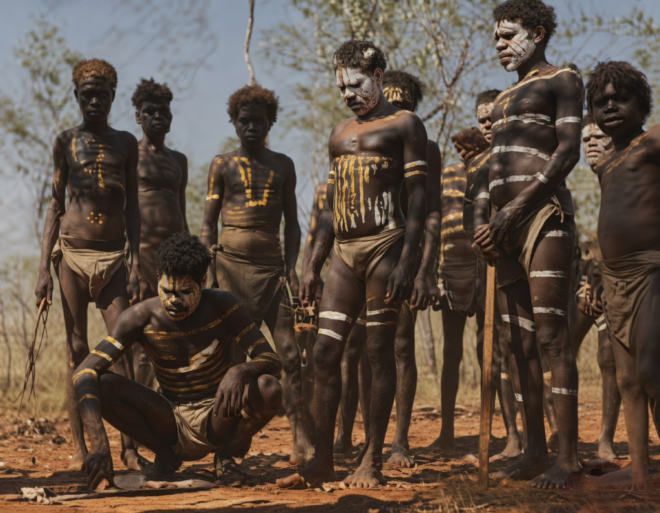
For today’s post I am borrowing a theme from Turgenev, specifically from The Diary of a Superfluous Man. Much of Turgenev’s fiction is built around variations on this “superfluous” type – a hero whose gifts and whose desire for connection can never quite find expression in the world as it is constituted. He anticipates; he is denied; he anticipates again. The structural condition is not incidental to his life – it is his life.
I want to be careful with the analogy from the outset. Turgenev’s superfluous man is afflicted partly from within: a paralysis of will, a Russian intellectual’s self-defeating refinement. That is not the condition of Indigenous Australians, and I do not mean to suggest it. What I am borrowing is the narrower structural insight – that a person, or a people, can be held in a permanent state of anticipation by the arrangements of the world around them; that the denial is not episodic but constitutive; and that, over time, anticipation without consummation becomes a form of being. Where Turgenev’s hero collaborates in his own irrelevance, we have been made irrelevant – by law, by force, and by the slow accretion of political choices. The analogy holds at the level of structure. It breaks, and is meant to break, at the level of cause.
After more than two centuries of dispossession, broken promises and systematic violence, “anticipation without consummation” remains the most honest description of the relationship between Indigenous Australians and the settler state built on our lands.
I first wrote this essay in April 2011. I am rewriting it now, in 2026, not because things have improved – they have not – but because the ground has shifted beneath us in new and bitter ways. A fifth instance of anticipation without consummation is now behind us, and it sits in uneasy proximity to a Royal Commission into Antisemitism that has commanded national attention, government resources and political urgency within weeks, while First Nations people read about it from the margins of a country that has never quite decided we belong to it.
A note on voice. I write here as a Koori man of the south-east, under the name I have used on this blog for many years. The “we” in this essay is not a presumption to speak for every First Nations person on this continent – our nations are many and our politics are not uniform – but a recognition that the structural conditions I describe have been imposed on us collectively, by laws and policies that have rarely distinguished between us.
The First Four Instances
On 26 January 1788, the Gadigal people of the Sydney basin looked out at a fleet of ships and anticipated the strangers would soon move on. They did not understand – how could they? – that what had arrived on their shore was not a temporary intrusion but a permanent occupation, backed by the full force of an empire that considered their country empty and their sovereignty non-existent. That was the first instance of anticipation without consummation: the anticipation that the strangers were transient.
The second came in the decades that followed. The surviving clans, after the smallpox of 1789 and the violence around Sydney Cove, anticipated they might be left to continue in their traditional ways on the parts of Country the newcomers had not yet reached. They underestimated the reach of a colonial project that would spend the next century dismantling every structure of Aboriginal life – language, ceremony, land tenure, kinship – in the name of a Christianity that preached brotherhood on Sunday and practised dispossession on Monday.
The third instance was juridical. Between 1788 and 1836 we were subjected to a catalogue of broken promises, deceptions and outright lies. R v Murrell in 1836 gave those lies a legal architecture. Profound and erudite as Justice Burton’s judgment may have been, its practical effect was to place all Aboriginal people in a category sui generis: living within the Crown’s peace, but as individuals without corporate standing, neither subjects in the full sense nor sovereigns in our own right, perpetual inhabitants rather than owners of the land. From that day we went, in law and in the social imagination of the coloniser, from owners to outcasts.
It is sometimes said that we were classified as fauna. We were not, strictly; the more accurate and equally damning fact is that section 127 of the Constitution excluded us from being counted as part of the population of the Commonwealth at all. The point of the popular memory is correct even if the legal mechanism it names is wrong: a state that will not count you has, in a real sense, decided you are not part of the polity.
Between 1836 and Federation, the killing – for that is what it was, even if no one in the colonial administration had the honesty to name it – proceeded with appalling efficiency. When the South Australian government handed administration of the Northern Territory to the Commonwealth on 1 January 1911, the Territory’s Indigenous population had fallen from approximately 72,000 to 22,000 in fifty years. Across the continent, the pre-contact population – estimated at anywhere from 300,000 to over a million – had been reduced to perhaps 100,000 by Federation in 1901.
In the Commonwealth’s inaugural Parliamentary Debates in May 1901, Senator Matheson was bracingly honest about the consensus view:
“We have taken this country from the blacks, and made it a white man’s country … There are still 100,000 aborigines in Australia. We are aware of that fact, and it is very regrettable, and the only consolation we have is that they are gradually dying out.”
Because we declined to dutifully die out, the policy response, calcifying through the protection era of the early twentieth century, the formal assimilation policy of 1937, and the Stolen Generations that ran from the 1910s into the 1970s, was that we would be made to disappear in a different way: absorbed, our children removed, our languages broken, our ceremonies forbidden. An official Australian Government publication from 1960 stated the problem plainly: the numerically small Aboriginal group within the vastly larger white Australian group must, to survive and to prosper, learn to live as white Australians do.
I have compressed these decades into a single instance – the third – but I want to be honest that I am compressing. The Protection Acts, the missions and reserves, the wages held in trust and stolen, the children removed under official policy across at least three generations – each of these was its own betrayal, its own anticipation denied. I treat them together because they share a single logic: the logic that flows from Murrell. They are not separate from the third instance; they are its working out.
The fourth instance came on 27 May 1967, when 90.77 percent of Australians voted to amend section 51(xxvi) and repeal section 127 – the two provisions of the Constitution that had operated to our specific exclusion. The votes were barely counted before politicians began reassuring themselves that the matter was settled. It was not. The 1967 referendum gave the Commonwealth power to make laws for Aboriginal people. What it delivered, in the decades that followed, was the Northern Territory Intervention in 2007, the abolition of the Aboriginal and Torres Strait Islander Commission, and a Closing the Gap framework that has, by its own measures, demonstrably failed to close the gap. The Commonwealth power, when finally exercised, was as often used against us as for us.
The Fifth Instance and What It Costs
The fifth instance is the one I want to dwell on, because it is the one in which the pattern became, to me, undeniable.
The Uluru Statement from the Heart was issued in May 2017. It was a document of extraordinary restraint and generosity. After decades of dispossession, it asked not for reparations, not for the return of the country, not even, in the first instance, for treaty. It asked for a modest advisory body to be enshrined in the Constitution, so that the Parliament would be required to listen to the people most affected by its laws before making them. It was written in good faith by 250 Aboriginal and Torres Strait Islander delegates after a deliberative process the like of which this country had never seen. It was offered to the Australian people. The Turnbull government rejected it within months, on the spurious ground that an advisory body would constitute a “third chamber” of Parliament.
When Anthony Albanese won government in May 2022, his first public words as Prime Minister-elect included a commitment to the Uluru Statement in full. The referendum on the Voice to Parliament was held on 14 October 2023. The result was 39.9 percent Yes, 60.1 percent No. The Yes vote failed in every state. Where the 1967 amendment had carried with over 90 percent support, the Voice attracted barely two in five voters. Peter Dutton, the leader of the opposition, declared the result was “good for our country.”
I want to put the human meaning of this defeat alongside the numbers that describe the world it was meant to address.
Life expectancy for Aboriginal and Torres Strait Islander males born in 2020–2022 was 71.9 years – 8.8 years less than non-Indigenous males. For females it was 75.6 years, 8.1 years below the non-Indigenous figure. In the most disadvantaged areas, Indigenous males can expect to live to 69.5. The Closing the Gap target of equal life expectancy by 2031 is not on track. Modelling by the Productivity Commission suggests that on current trajectories, the gap will not close this century.
The suicide rate for Indigenous Australians stands at more than twice the national rate. The healthy life expectancy for First Nations people in the Northern Territory – years lived free of serious illness or disability – has been compared by researchers to that seen in some of the world’s poorest countries.
Only 52 percent of Aboriginal and Torres Strait Islander people aged 15 to 64 are employed, compared with 75 percent of non-Indigenous Australians. Household income is substantially lower. The economic distance between First Nations people and the rest of Australia has not meaningfully closed since I first set these figures down in 2011.
The incarceration figures are the most damning of all. In 1991, when the Royal Commission into Aboriginal Deaths in Custody reported, Aboriginal people made up 14 percent of the prison population. By 2008, that figure had risen to 24 percent. When I wrote the first version of this essay in 2011 it was still 24 percent. By June 2024 it was 36 percent. By December 2025, Aboriginal and Torres Strait Islander people – approximately three percent of the Australian population – accounted for 37 percent of all people in Australian prisons, an imprisonment rate of around 2,630 per 100,000 adults. The non-Indigenous rate was approximately 149 per 100,000. The Australian Human Rights Commission, drawing on international comparison, has described us as among the most incarcerated peoples on Earth; the methodology can be argued, the order of magnitude cannot.
This is the world the Voice was offered into. Not a competing vision but a modest mechanism – an advisory body, a structured obligation to listen – by which a state that has made these conditions might begin, slowly, to make better-informed laws about them. Sixty percent of our fellow citizens declined.
What the No campaign offered instead was a vague promise of practical help and a Royal Commission into child sexual abuse in Indigenous communities. Not a Voice. Not recognition. A Royal Commission – into us.
In the aftermath, the Queensland treaty process was abandoned by the incoming Crisafulli government in 2024. The Closing the Gap framework, already struggling, lost further political momentum. The message delivered to First Nations people by the 2023 referendum was unambiguous: you may live here, you may be acknowledged at the beginning of public events by a Welcome to Country, but you will not have a guaranteed place in the architecture of the democracy that governs you. The fifth instance of anticipation without consummation was, in some ways, the most painful, because this time we had organised, articulated, argued and asked – politely, constitutionally, through every proper channel – and been refused.
The Architecture of the State’s Attention
On 14 December 2025, a terrorist attack at a Hanukkah celebration on Bondi Beach killed fifteen people and injured forty more. It was a horrifying act of antisemitic violence. The grief of the Jewish community was real and the nation’s response appropriate. Within four weeks, Prime Minister Albanese had announced a Royal Commission on Antisemitism and Social Cohesion, to be led by former High Court Justice Virginia Bell. It was established by letters patent on 9 January 2026.
This is not an argument against that Royal Commission. Antisemitism is a genuine and ancient evil. The Bondi massacre was a crime that demanded a serious national response. Jewish Australians deserve safety, dignity, and the full protection of the law. Jewish Australians have themselves known persecution, dispossession and the long damage of being told that their lives are worth less; the solidarity between First Nations people and Jewish Australians is a real possibility, and one I want to honour. This is not a competition in suffering.
But it is legitimate – it is necessary – to ask a question about the architecture of the state’s attention. The Aboriginal and Torres Strait Islander Social Justice Commissioner put it plainly in January 2026: the Jewish community waited four weeks for a Royal Commission on an ancient and abhorrent hatred; First Peoples have waited more than two centuries for justice. As a country, we can do better.
When the Royal Commission into Aboriginal Deaths in Custody reported in 1991, it made sweeping recommendations – legislative, institutional, cultural – to address the conditions that produced those deaths. Australia did not implement most of them. Death by death, decade by decade, the toll continued. There has been no Royal Commission into why the recommendations were not implemented. There has been no Royal Commission into the trebling of Indigenous incarceration since the RCIADIC reported. There has been no Royal Commission into the systematic failure of Closing the Gap. There has been no Royal Commission into the deaths of Indigenous women at the hands of partners and family members, at rates that in any other context would prompt talk of a national emergency.
There has been no national truth-telling process. The Uluru Statement asked for one – Makarrata, a Yolngu word for the process of coming together after a struggle – alongside the Voice and Treaty. All three were rejected by the federal government in 2017. The Voice was rejected by the Australian people in 2023. The other two remain unaddressed.
I think many Indigenous Australians watching the political energy generated by the Bondi attack – watching the speed with which the machinery of the state was mobilised, watching ministers compete to denounce antisemitism and stand with the Jewish community – felt something they found difficult to articulate without being misheard. It is not resentment of Jewish suffering. It is the recognition – painful and clarifying – that the state is capable of rapid, decisive, well-resourced action when it decides a community’s suffering demands it. The state’s slowness in our case is therefore not a fact of nature. It is a choice. It has always been a choice.
In December 2025, the Aboriginal and Torres Strait Islander imprisonment rate hit 2,630 per 100,000. No emergency was declared. In the Northern Territory, Indigenous women remain approximately twenty-three times more likely to be subject to family violence than non-Indigenous women. No Royal Commission was announced. The Closing the Gap target on incarceration is not just off-track; it is worsening year on year. No Royal Commission was announced.
The question is not whether antisemitism deserves a Royal Commission. It does. The question is what it tells us about the distribution of moral urgency in this country that a community which has lived under genocidal policies, survived missions and reserves, endured the removal of children across generations, seen its incarceration rate more than double in a generation, watched its Voice referendum fail, and been denied the most basic mechanisms of recognition – still cannot command the same political velocity.
The Superfluous Position
Return to Turgenev for a moment, and to the limit of the analogy I set out at the start.
The structural insight holds. A people can be held in a permanent state of anticipation by the arrangements of the world around them. The denial can be constitutive rather than episodic. Over time, anticipation without consummation can become not merely a description of one’s circumstances but the shape of one’s political existence.
But where Turgenev’s hero is the author of his own paralysis, we are not. The condition I am describing has been imposed. It was imposed by Phillip’s landing, by Burton’s judgment, by Matheson’s frankness, by the Protection Acts, by the policy of assimilation, by the removal of children, by the failure to implement the recommendations of every Royal Commission that has examined our condition, by the No vote of 14 October 2023, and by the thousand smaller decisions in between. To name it as a “superfluous” position is not to accept it. It is to insist that the position has a history and therefore can have an end.
This matters because the rhetoric of Indigenous policy in Australia is overwhelmingly the rhetoric of Indigenous deficit: low life expectancy, low employment, high incarceration, high family violence, as though these were attributes of a people rather than the predictable outcomes of a relationship. The superfluous frame, properly understood, redirects attention. The question is not what is wrong with us. The question is what is wrong with the structure that produces us, again and again, as a problem to be managed.
A people cannot be held permanently in anticipation without that anticipation eventually changing in character. I do not mean this as a threat – I have no interest in writing in that register, and the suggestion would be both inaccurate to the patience our communities have shown and unfair to the many non-Indigenous Australians who have stood with us. I mean it as a description. Hope that is never met is not stable. It becomes something else: in some, withdrawal; in some, despair; in some, a quieter and harder-eyed politics that no longer asks. What kind of country we become depends, in part, on which of those Australia drives us toward.
What Would Actually Break The Pattern
I want to be careful here, because the usual shape of an essay like this is to end with a list of demands – Truth, Treaty, Voice – invoked as though their mere naming did the work. It does not. The 1991 RCIADIC produced 339 recommendations and most went unimplemented; the 1997 Bringing Them Home report produced 54 and most went unimplemented; the 2017 Uluru Statement produced three and all three were refused. The problem in Australia is not a shortage of recommendations. The problem is the gap between recommendation and implementation, and any serious essay has to say something about *that gap* rather than adding to the pile.
So let me try to say something more specific.
First, the comparisons that are routinely offered – South Africa’s Truth and Reconciliation Commission, Canada’s Royal Commission on Aboriginal Peoples and subsequent TRC, New Zealand’s Treaty of Waitangi – are not the success stories Australian commentators often imply. South Africa’s TRC produced extraordinary testimony and limited reparations; structural inequality in that country remains brutal. Canada’s TRC issued 94 Calls to Action in 2015 and most remain incompletely implemented a decade later. The Treaty of Waitangi has been honoured selectively and contested constantly, and is now itself under political attack. The lesson from these comparators is not that the instruments do not matter – they do – but that the instruments are necessary and not sufficient. Without sustained political will across electoral cycles, a Truth Commission becomes an archive and a Treaty becomes a document. Australia would not be exempt from this difficulty. We would simply, finally, be inside it.
Second, the most important reform is therefore not any single instrument but a *mechanism of accountability* that survives changes of government. The reason RCIADIC’s recommendations sit on a shelf is that no body and no statute compelled their implementation, and successive governments faced no electoral cost for ignoring them. The reason the Voice was significant is not that an advisory body would have been transformative on its own, but that constitutional enshrinement would have made it expensive to dismantle. The political class understood this. That is why it was opposed with the resources it was opposed with.
Third, the conversation about social cohesion that Commissioner Bell has been asked to lead cannot honestly exclude First Nations dispossession from its terms of reference. If antisemitism is properly understood as a structural and historical phenomenon – as it must be, if it is to be addressed seriously – then the same analytical seriousness has to be applied to the racism that built this country. You cannot have social cohesion while First Nations people remain the most incarcerated population the AHRC can find in international data, while the life expectancy gap persists, while Closing the Gap is going backwards, and while the structures of recognition remain unbuilt. The thread of racism runs from Bondi back to the frontier; an inquiry that traces only part of it is not an inquiry into cohesion but into a particular community’s safety. That is a worthy thing. It is not the whole thing.
Fourth, and most uncomfortably for those of us who have spent years writing essays like this one: we have to be honest that the politics of recognition has reached, for now, a limit. Sixty percent of our fellow citizens declined to give us the most modest constitutional foothold imaginable. That is the country we live in. The work in front of us is not only to keep asking the state for instruments it has shown itself reluctant to grant, but to build, at the local and regional level, the institutions of self-determination that do not require its permission – community-controlled health, justice, education, land management – and to insist that these be properly resourced rather than perpetually reviewed. The state will eventually have to deal with us as we are constituted, rather than as it would prefer to manage us.
Perpetual Inhabitants No More
R v Murrell made us perpetual inhabitants of our own land – present, tolerated, but never quite belonging in the full political sense. That judgment was made in 1836. One hundred and ninety years later, the structures it put in place have been modified but not dismantled. We are counted in the census now. We are counted, in disproportionate numbers, in the prison statistics. We are not named in the Constitution.
The borrowed frame I began with – the superfluous man – is not a counsel of despair. Turgenev’s hero accepts his fate; we have not, and we will not. What the frame names is a structural condition that has been imposed and that can therefore be ended, but only by acts of political will that this country has so far been unwilling to perform.
The Royal Commission on Antisemitism and Social Cohesion will produce its findings in due course. I hope it does its work seriously. I hope it produces real protection for Jewish Australians, who deserve it, and a serious account of the racism that animated the Bondi attack. I also hope its commissioner has the courage to say what its terms of reference half invite her to say: that the social cohesion of this country cannot be built on a foundation that excludes its First Peoples from the political community whose cohesion is being studied.
We have waited more than two hundred years. We are still waiting. The question is not whether we are patient enough to wait longer. The question is whether Australia is honest enough to finally understand what it is asking us to wait for.
© Bakchos 2026 | Blak and Black est. 2010



Bakchos this post is a vast improvement on the original from 15 years ago. You treat the Antisemitism Royal Commission well. I like the phrase “it’s not a competition in suffering.” I think that you’ve used that before, and it’s a powerful phrase.
This is a strong, eloquent, and structurally sophisticated essay. It uses Turgenev’s “superfluous man” not as cheap analogy but as a precise diagnostic tool for a recurring pattern: anticipation (of recognition, justice, inclusion) followed by systemic denial. The framing is original, the historical sweep coherent, and the voice measured—especially the careful limits placed on the “we” and the explicit rejection of internal paralysis as the cause. The data is current and accurate as of 2026: life-expectancy gaps (males 71.9 vs 80.6 years; females 75.6 vs 83.8), incarceration share (37 % of prisoners while 3–4 % of population, rate ~2,630 per 100,000 Indigenous adults vs ~149 non-Indigenous), and Closing the Gap trajectories all align with ABS, AIHW, and Productivity Commission releases. The fifth “instance” (the Voice referendum) is presented with restraint rather than rage, which gives the piece moral weight.
Hi Kelly,
The comparison to the Antisemitism Royal Commission is legitimate and uncomfortable. An acute terrorist attack killing 15 people rightly triggered rapid state machinery; chronic, intergenerational failures (trebling of the Indigenous imprisonment rate since the 1991 Royal Commission into Aboriginal Deaths in Custody, stagnant or worsening family-violence and suicide metrics) have not. Noticing the disparity in “political velocity” does not diminish Jewish suffering; it simply asks why the same machinery cannot be mobilised for chronic structural pain that has lasted centuries.
For readers who share the author’s premises, this will feel like a necessary and overdue reckoning. For readers seeking maximal truth rather than solidarity, it is an impressive but ultimately partial account—powerful on history and moral urgency, thinner on the full complexity of causation and the trade-offs inherent in any democratic polity’s response. That does not make the disparities any less real or the implementation failures any less damning. It simply means the path forward requires harder thinking about agency on all sides, not just renewed demands on “the state”.
Hi Jen, this is a blog post expressing an opinion, not a thesis. The post is around 4000 words, that’s already more than most people will read. Blog posts don’t lend themselves to the kind of analysis you’re wanting.
Bakchos I didn’t mean to offend you, I understand the limits on a 4,000 word essay, and that you were simply expressing an opinion, like wise, I was simply expressing another opinion.
Bakchos, no people, not even Palestinians are superfluous.
FFF, Palestinians are not an “even”. We are all simply people, deserving of respect and dignity.
Good post but I feel compelled to say all people have value, equal value, and are important.
The Antisemitism Royal Commission shows who matters and who doesn’t matter.
Where the fuck is our Royal Commission?
Where’s our fucking Royal Commission?
Why do Zionists in Australia get a Royal Commission, and Aboriginal people don’t. That doesn’t seem fair.
Hi Hashim, Indigenous people in Australia are treated very much as third class people, while Zionists are without question at the top of the totem pole. The Australian Federal Police are extremely racist when it comes to dealing with non white people.