
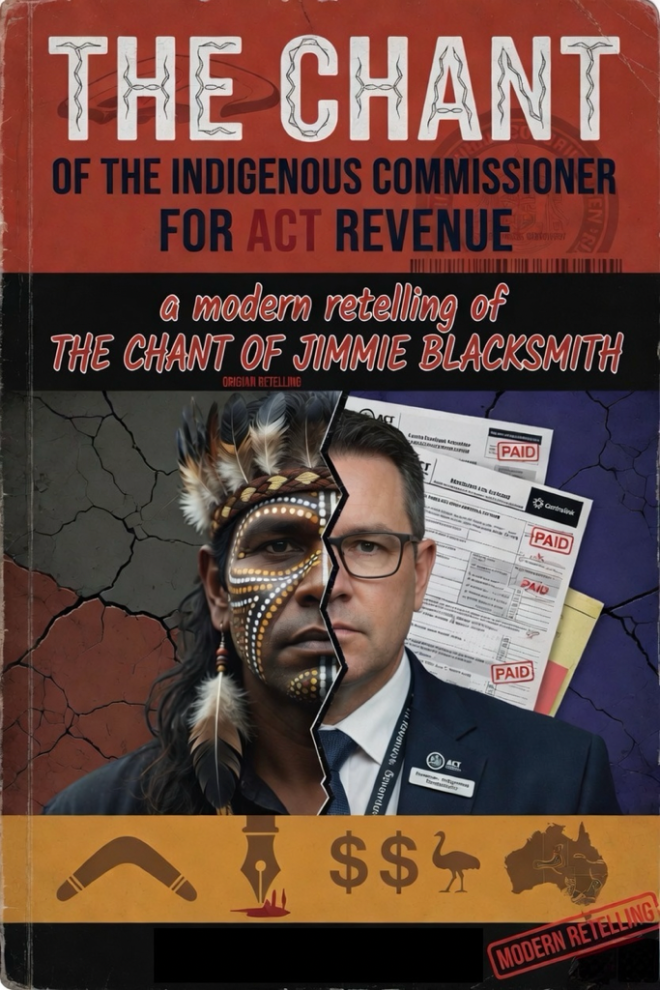
Thomas Keneally did not invent Jimmie Blacksmith. He found him in the colonial archives, buried under depositions and newspaper reports about a man named Jimmy Governor who went to the gallows in 1901 after a killing spree that convulsed white Australia. What Keneally understood – and what Fred Schepisi later translated into searing cinema in his 1978 adaptation – was that Governor’s story was not aberrant. It was exemplary. It was the logical outcome of a system that promised integration while ensuring exclusion, that dangled belonging as a reward for compliance, then snatched it back at the moment of fulfilment. The novel that emerged from those archives, The Chant of Jimmie Blacksmith, published in 1972, stands as one of the most unflinching diagnoses of the settler colonial contract in Australian literary history. More than fifty years after its publication, it has not dated. If anything, it has become more precise.
In the novel, Jimmie tries to do everything “right”. Raised by a white Methodist missionary named Reverend Neville, trained as a stockman and sometime policeman, schooled in the Queen’s English and the protocols of settler civility, he marries a white woman on the explicit advice of his patrons: “If you could ever find a nice girl off a farm to marry, your children would only be quarter-caste then, and your grandchildren one-eighth caste, scarcely black at all!” The promise embedded in this counsel is unmistakable – assimilate fully, dilute the blackness across generations, earn your place in white Australia through the gradual erasure of what you are. It is a promise of belonging conditional on self-annihilation.
What Jimmie receives instead is a daily barrage of casual contempt that no amount of diction or compliance can deflect. “My God, you do use your indefinite articles well, Jimmie. I’ve never met a black who could use one before.” The compliment is the insult; the acknowledgement of his education is simultaneously a reminder that education was never supposed to be his. Slurs follow him from the stockyard to the shearing shed – “black bastard,” “boong,” “bloody missionary black.” Wages are stolen. Dignity is stripped in the most intimate ways: his wife is sexually humiliated, his rations are withheld, his labour is extracted and his personhood is denied. Every door that should open on merit slams shut on race. Keneally does not romanticise Jimmie’s eventual violent rebellion against the Newby family and others. He diagnoses it. The violence is not the story’s moral failure; it is the story’s structural inevitability – the point at which the pressure of an irresolvable contradiction finally ruptures. Assimilation was never a path to belonging. It was a trap.
One of the novel’s most important and most frequently misread qualities is precisely this: Keneally does not populate it with cartoonish villains. Reverend Neville is not a cruel man. He believes, with apparent sincerity, that he is equipping Jimmie for a better life. The Newbys are not presented as monsters by the standards of their time and place. The horror of the novel is not that evil people do evil things – that would be a far more comfortable story, because it would locate the problem in individual character rather than in systemic structure. The horror is that ordinary people, holding ordinary assumptions about what Aboriginal people are and what they deserve, produce an outcome indistinguishable from deliberate persecution. The racism in The Chant of Jimmie Blacksmith is not confined to those who mean harm. It flows through those who mean well, and through institutions that have simply never interrogated their own baseline assumptions about whose testimony is credible, whose ambition is legitimate, and whose dignity is negotiable.
From the Paddock to the Public Service
More than half a century after Keneally identified that trap in the colonial record, its mechanism reproduced itself with remarkable fidelity in the administrative heart of the Australian Capital Territory. In 2002, the Indigenous Commissioner for ACT Revenue became the first – and to this day, the only – Aboriginal person to hold that position in the Chief Minister, Treasury and Economic Development Directorate. This was not a symbolic appointment. It followed a merit-based recruitment process overseen by Deputy Chief Executive Tu Pham, and the appointee brought with them qualifications, substantial experience in public financial administration, and a documented record investigating misappropriation of public funds. This was, in the language of the settler state’s own integrationist logic, exactly what success looked like.
The appointment was formalised on 8 May 2002. The following day – not weeks later, not after any performance review, not after any incident that might be characterised as a professional grievance – a subordinate officer named Angel Marina sent a formal letter to Chief Executive Howard Ronaldson. The letter did not engage with competencies, qualifications, or professional conduct. It demanded the immediate dismissal of the Indigenous Commissioner for ACT Revenue and grounded that demand in a racial proposition stated without euphemism: “that Aborigines are compulsive liars and criminals.” Marina cited the appointee’s family background as supporting evidence for this generalisation, and claimed corroboration from an Ernst & Young recruiter who had allegedly confirmed the racial stereotype in conversation. For good measure, he invoked unspecified “friends” in the Australian Federal Police.
This was not a private opinion. It was not an informal complaint. It was a formal, written demand, addressed to the Chief Executive of a major ACT Government directorate, for the removal of the most senior Indigenous public servant in the Territory – on the explicit grounds of that person’s Aboriginality, and on the basis of a racial theory indistinguishable from the assimilationist contempt Keneally had documented from the 1890s. The language had been laundered through bureaucratic register, but the content was unchanged: an Aboriginal person in a position of authority was, by definition of their race, unfit to hold it. Marina’s letter is, in this respect, the explicit edge of a much larger phenomenon – the point at which what is ordinarily left unstated was committed to writing, with a date and a signature.
The Instrument of Transparency and the Architecture of Retaliation
The Indigenous Commissioner for ACT Revenue did what Jimmie Blacksmith could not do in 1900: used the system’s own mechanisms. On 27 June 2003, a formal Public Interest Disclosure was lodged directly with Chief Minister Jon Stanhope, detailing the racism of Marina’s letter, the threats embedded in his invocation of AFP connections, and broader allegations of corruption and misconduct within ACT Treasury. The Public Interest Disclosure Act is one of the foundational instruments of democratic accountability in the Territory – the mechanism through which public servants can report wrongdoing without fear of reprisal, and through which institutions are supposed to hold themselves to account.
What followed the disclosure was not protection. It was the systematic application of the same institutional power that had produced Marina’s letter in the first place, now turned toward ensuring that the complainant, not the conduct complained of, became the subject of investigation and sanction. On 19 December 2003, Marina lodged a counter-Public Interest Disclosure against the Indigenous Commissioner for ACT Revenue. That counter-disclosure, subsequent examination would reveal, relied on information that was fraudulently obtained or fabricated outright. The original complainant was dismissed. A personal diary – a document of private psychological record – was seized by police in 2006 and examined as though it were evidence of wrongdoing rather than what it was: a contemporaneous record of a sustained and racially motivated campaign against its author.
The diary’s contents, far from supporting any allegation against the Indigenous Commissioner for ACT Revenue, documented the toll of that campaign with clinical clarity: the stress responses, the periods of medical leave, the progressive isolation that accompanies institutional persecution when the persecutor wears the same badge as the protector. The original Public Interest Disclosure – a formal complaint lodged through the proper channel with the Chief Minister himself – sat uninvestigated for more than two decades. The Ombudsman’s office, the AFP, the Directorate itself: each institution that should have constituted a checkpoint against the cover-up instead became a node within it.
Angel Marina resigned from the ACT Government public service and moved, without apparent impediment, into a position in the Commonwealth Public Service. The Indigenous Commissioner for ACT Revenue suffered severe psychological trauma and found difficulty settling back into the workforce. Subsequently in 2015, Bakchos was charged on the same material by the Australian Federal Police. A jury – weighing the evidence as juries are constituted to do – acquitted the accused on all sixteen charges: a complete and unambiguous vindication across every count that had been laid. Bakchos’ defence, accepted by the jury, was that all the documents were genuine, and he was acquitted. In criminal law, an acquittal of that scope is as thorough a vindication as the system can produce. It represents the jury concluding, on each charge individually, that the evidence did not meet the required standard. In ordinary circumstances, such an outcome would prompt serious institutional reflection about the process that produced the prosecution. In this case, it produced silence.
The Structure Beneath the Surface
The structural parallels between Jimmie Blacksmith’s trajectory and that of the Indigenous Commissioner for ACT Revenue are not a matter of poetic licence or retrospective pattern-matching. They are the signature of a persistent mechanism, operating across more than a century of Australian governance, that produces the same outcome through different procedures. In both cases, the subject was educated, professional, and operating fully within the rules of the settler state. In both cases, the promise of belonging – conditional on compliance – was extended as genuine. In both cases, the promise dissolved at the precise moment it was tested by an assertion of equal dignity.
For Jimmie, the testing came through the accumulation of insults in the paddock and the sexual humiliation of his wife – violations that his missionary education had equipped him to recognise as violations, without equipping him with any mechanism to address them that the system would acknowledge. For the Indigenous Commissioner for ACT Revenue, it came through a written demand for removal, citing “the general disposition of Aborigines to lie,” submitted the morning after a merit-based appointment to the most senior Indigenous public service role in the Territory’s history. The distance between 1901 and 2002 is, in this respect, a distance measured not in changed assumptions but in changed vocabularies. The raw contempt of the frontier had been laundered into bureaucratic formal register, but the operative logic – that an Aboriginal person in a position of authority was an affront to be corrected – remained structurally identical.
The response of institutions to the assertion of rights followed the same logic. In 1900, the colony mobilised its police and its courts to pursue Jimmy Governor across New South Wales until he was captured, tried, and hanged. In 2002-2004, the ACT Government directorate, the AFP, and the Ombudsman’s office mobilised their respective instruments – counter-disclosures, criminal charges, the seizure of private documents – to pursue the Indigenous Commissioner for ACT Revenue through the justice system until a jury stopped the process. The frontier’s physical violence had been sublimated into institutional process, but the directional logic – punish the Aboriginal person who refuses the subordinate position – was preserved intact.
The Human Rights Act and the Distance Between Text and Practice
This is not, it must be emphasised, ancient history in any sense that might permit comfortable distance. The Public Interest Disclosure lodged by the Indigenous Commissioner for ACT Revenue was made in 2003. The ACT Human Rights Act – one of the first such instruments in Australia – was passed in 2004, in the immediate temporal proximity of these events. The Territory was, in its own self-presentation during this period, a jurisdiction distinguished by its commitment to rights-based governance, to Indigenous recognition, and to institutional accountability. Jon Stanhope’s Labor government was vocal about its reforming credentials. The machinery of formal rights protection was being assembled precisely as that machinery was being tested by a concrete case, and the test revealed the gap between legislative aspiration and administrative reality with uncomfortable clarity.
The ACT’s Human Rights Act could not compel the investigation of a PID that successive administrations chose not to investigate. It could not prevent the AFP from seizing a private diary as though the victim of a racially motivated campaign were the offender. It could not ensure that a counter-disclosure built on fabricated material would be assessed differently from the original, legitimate disclosure. Rights instruments, as critical legal scholars have long noted, protect rights only to the extent that the institutions responsible for implementing them are willing to do so – and institutional willingness is not a function of legislative text but of administrative culture, which changes far more slowly than the legislation that claims to express it.
For twenty years, the original PID remained uninvestigated. For twenty years, successive ACT Labor administrations and the AFP declined to revisit a matter that a jury had resolved with complete unanimity in favour of the person who had been charged. The Jumbunna Institute’s review of AFP conduct toward Indigenous people in the ACT, Freedom of Information data, and documented named cases all point in the same direction: the gap between the Territory’s stated commitments to Indigenous justice and its institutional practice is not a rounding error or an aberration. It is a pattern.
Not Every Actor, But Every Outcome: The Anatomy of Structural Racism
At this point, a distinction must be made – not to diminish the gravity of what occurred, but to articulate its full gravity more precisely. It would be a mistake to read this case as a story in which every person who failed the Indigenous Commissioner for ACT Revenue was consciously motivated by racial hatred. That reading, though understandable, would actually produce a weaker account of what happened, because it would allow the many individuals involved to escape scrutiny by demonstrating that they harboured no personal animus. It would reduce a systemic failure to a series of individual moral failures, and in doing so would miss the mechanism that makes the pattern so durable and so difficult to interrupt.
Keneally understood this. Reverend Neville is not a villain. He is a man of his time who believes he is helping. The Newbys are not unusually brutal people by frontier standards. The novel’s power lies precisely in its insistence that the machinery of colonial dispossession does not require malice to function. It requires only that ordinary people hold ordinary assumptions about what Aboriginal people are, what they are capable of, what they deserve – and that those assumptions are never examined, never challenged, and never made to bear the weight of evidence that contradicts them. When those assumptions are embedded in institutional culture, they do not require a racist in every chair to produce racist outcomes. They require only the absence of anyone willing to interrupt them.
The same logic applies to the ACT case with precise and uncomfortable force. The critical question is not whether Jon Stanhope, or the Ombudsman, or every AFP officer involved in the subsequent investigation, woke each morning intending to persecute an Aboriginal public servant. The critical question is whether the Indigenous Commissioner for ACT Revenue received the benefit of the doubt that a non-Indigenous person in the same position would have received as a matter of institutional reflex. Did Marina’s counter-disclosure receive the same sceptical scrutiny that any unsupported allegation against a senior officer should attract – or did its claims gain traction because they confirmed assumptions about Aboriginal credibility that the institution had never interrogated? When the diary was seized, was the decision informed by the same evidentiary standard that would have applied to a non-Indigenous complainant’s private records, or did the mere existence of a counter-allegation produce a readiness to treat the victim as a suspect that the evidence did not warrant?
These questions matter because they point to something Marina’s letter, explicit as it was, cannot fully explain. Marina named his prejudice. Most institutional racism does not name itself. It operates through the application of differential standards – a higher bar of proof required from Indigenous complainants, a lower threshold of suspicion applied to Indigenous subjects, a greater readiness to accept allegations against Aboriginal people and a greater reluctance to credit their rebuttals. Scholars of racialised credibility call this the credibility gap: the documented pattern by which Indigenous testimony, character assessments, and formal complaints are systematically weighted less favourably than equivalent testimony from non-Indigenous people, not because of conscious bias, but because of unexamined assumptions that have never been required to justify themselves.
This is not a theoretical abstraction. It is the most plausible explanation for a series of institutional decisions that are otherwise very difficult to account for. Why did a counter-disclosure built on fabricated information proceed while a formally lodged PID sat uninvestigated for two decades? Why did a jury acquit unanimously while the institutions that produced the prosecution have never been asked to explain their reasoning? Why did the person who sent a written demand for dismissal grounded in racial generalisation move on without consequence, while the person who received that letter faced criminal charges? The answer that requires the fewest additional assumptions is not that every decision-maker was a racist. It is that every decision-maker was operating within an institutional culture that had never built in the habit of extending to Indigenous people the presumptions of credibility, good faith, and professional dignity that were extended to others automatically.
This is what makes the parallel with Keneally’s novel so structurally precise. Jimmie Blacksmith is destroyed not by exceptional evil but by the ordinary operation of a system in which his dignity was never assumed. The Indigenous Commissioner for ACT Revenue was failed not (or not only) by individual bigots, but by institutions that, confronted with a racial allegation against an Aboriginal person, found it easier to investigate the Aboriginal person than to interrogate the allegation. The mechanism is the same across a century. Only the vocabulary has changed.
What the Archive Refuses to Permit
One of the most important distinctions between Jimmie Blacksmith’s situation and that of the Indigenous Commissioner for ACT Revenue is the existence of a documentary record. Keneally worked from court transcripts, depositions, and newspaper accounts – the fragments that survived the colonial archive’s tendency to record Indigenous people primarily as defendants or subjects of administration. The record in the ACT case is of a different order. There is the original letter from Marina to Ronaldson, with its explicit racial propositions stated in formal bureaucratic correspondence. There is the timeline of the PIDs – the original disclosure, the counter-disclosure, the date of lodgement with the Chief Minister, the absence of investigation. There is the jury’s unanimous verdict. There is the diary. There are the FOI-obtained documents, the Jumbunna review findings, the public record of named cases.
This archive does not permit the case to die in silence. It does not allow the convenient narrative in which the ACT Government, the AFP, and the broader Australian state have already reckoned with what occurred. The documents establish, with specificity and without ambiguity, what happened and what did not follow from it. They also establish the specific institutional choices that gave structural racism its operational form in this case: who was investigated and who was not, whose disclosures were acted upon and whose were filed and forgotten, whose private records were seized and whose conduct was allowed to disappear into a resignation letter.
Australia has, over the past three decades, produced a substantial infrastructure of acknowledgement: the formal Apology of 2008, the Closing the Gap framework, successive iterations of reconciliation policy, and constitutional recognition debates that placed Indigenous political representation at the centre of national conversation. Each of these moments has been accompanied by rhetoric about truth-telling, about confronting the past, about the necessity of structural change rather than symbolic gesture. The case of the Indigenous Commissioner for ACT Revenue is a test of that rhetoric applied to a specific, documented, recent instance of precisely the conduct the rhetoric claims to repudiate. It is a test that, to date, the institutions involved have not passed.
The Chant Is Not a Relic
Keneally chose the word “chant” with care. A chant is not an argument; it is a repetition that accumulates meaning through insistence, that refuses to resolve into silence, that continues across the responses of those who would prefer not to hear it. Jimmy Governor went to the gallows, but the chant of his life – the account of what the settler colonial contract had promised and what it had delivered – persisted in the archives that Keneally found a century later. It persisted because the underlying condition it described had not been resolved. It had been modernised, institutionalised, and re-dressed in the language of administrative process and legal procedure, but the mechanism had not changed.
The chant of the Indigenous Commissioner for ACT Revenue’s case is of the same order. It is not simply the story of one explicit racist and the damage he caused. It is the story of what happened after – of the institutions that, without necessarily sharing Marina’s explicit views, produced outcomes that his letter had anticipated and that his counter-disclosure had set in motion. It is the story of a system in which the readiness to think the worst of an Indigenous person, to require more of them before extending trust, to credit allegations against them more readily than their own rebuttals, operated as a kind of institutional gravity – pulling every decision toward the same point regardless of who was sitting in the chair making it.
Jimmie Blacksmith’s story ends in tragedy because Keneally, working from the historical record, understood that a racist order cannot be reformed by the goodwill of its victims. What Jimmie lacked – what Jimmy Governor lacked before him – was not effort, education, or willingness to operate within the system’s own rules. What they lacked was an institution with both the power and the will to enforce those rules symmetrically: to apply to every actor in the chain the same standard of scrutiny, the same presumption of good faith, and the same requirement of evidence that the system demanded of those it was failing. That symmetry is what structural accountability means in practice. And it is what has been absent from the response to this case.
The story of the Indigenous Commissioner for ACT Revenue is still being written, and what remains unwritten is the institutional response – the accounting, the acknowledgement, and the structural reform – that would make it a story of reckoning rather than repetition. A jury has already delivered its verdict. The archive has already assembled the case. What is required now is not more documentation but a willingness, on the part of the ACT Government, the AFP, and the Directorate, to ask honestly why each decision in the chain was made – and to answer that question to a standard that would satisfy not the institutions themselves, but the person whose career, health, and freedom those decisions cost.
Until that accounting is rendered, the chant continues. It is not a relic of the frontier or a metaphor drawn from literary history. It is the sound of an unresolved contradiction at the heart of Australian governance – the contradiction between a state that presents itself as committed to Indigenous justice and institutions whose baseline assumptions, embedded in culture rather than policy, have continued to produce the same outcome across more than a century of nominal reform.
The past is not past. It is policy. And policy, unlike the past, can still be changed – but only by those willing first to read what the archive says, and then to ask, without flinching, why the system found it easier to pursue the Indigenous Commissioner for ACT Revenue than to protect them.
© Bakchos, May 2026



This is a sophisticated application of structural-racism analysis: the mechanism persists because baseline assumptions about credibility, legitimacy, and “fit” for authority have never been uprooted, even after the Apology, the Human Rights Act 2004, Closing the Gap, etc. The essay repeatedly returns to the irony that the ACT positioned itself as a rights-leading jurisdiction precisely while these events unfolded.
Rhetorically, this post is highly effective. The repeated metaphor of “the chant” (insistent, unresolved, accumulating meaning through repetition) unifies the piece. The prose is measured yet insistent—never hysterical, always analytical. Key sentences land like hammer blows: “The promise of belonging conditional on self-annihilation”; “The raw contempt of the frontier had been laundered into bureaucratic formal register.” The refusal to make every actor a conscious villain is intellectually honest and strengthens the structural argument.
FFF this is one of those times when fiction becomes fact. The fictional story of Jimmie Blacksmith becomes the factual reality of the Indigenous Commissioner for ACT Revenue.
The essay’s thesis is explicit and sustained: Australian settler-colonial logic—conditional acceptance through self-erasure, followed by punishment when dignity is asserted—operates as a durable structural mechanism rather than a series of individual moral failings. It is not merely about one racist subordinate (Angel Marina) but about how institutions (ACT Treasury, AFP, Ombudsman, successive Labor governments) default to protecting the system and its assumptions when an Indigenous person in authority challenges them.
Good morning Polina, this all comes back to Angel Marina, he is the hardcore racist in all of this, most of the other players suffered from inertia, which in itself is unacceptable.
The modern case is anchored in verifiable specifics: exact dates, the text of Marina’s letter (which explicitly cites “the general disposition of Aborigines to lie”), the timeline of PIDs, the unanimous jury acquittal on all 16 charges, Marina’s unhindered move to Commonwealth service, and the 20+ years of inaction on the original PID. This is not vague allegation; it is an archive-based argument.
The parallel between Jimmie Blacksmith (educated, compliant, then punished for asserting dignity) and the Commissioner (merit-appointed, qualified, then targeted the day after appointment) is not forced. It illuminates both the novel and the contemporary events.
Insisting the problem is not “every person… consciously motivated by racial hatred” but unexamined institutional reflexes (differential credibility, lower threshold of suspicion), the essay avoids the trap of reducing everything to individual bigotry. This makes the critique harder to dismiss.
I’ve said many times on this platform and elsewhere that I don’t believe that all that many Aussies are actually racist. The problem, most won’t challenge the racists.
Keneally himself taps into that, I think Kelly. The Reverend Neville is the clear example, unaware of his bias and thinking that he’s helping or doing the right thing. It’s a mark of the brilliance of the writer, that he is able to cast the characters from such juxtaposing positions, meaning well but ultimately harming.
.
I have said for many years that the way Pat was treated was I believe, by some, driven by a belief that someone else, often senior, had good reason for their actions and hence, were not questioned. There’s also a significant element of those who have been too afraid to speak out, people across the spectrum the public service, AFP, DPP, Ernst & Young and the University of London. People who knew something was amiss, people who saw the racism for what it was. Meredith Whitten’s email to Tu Pham dated 15 December 2003 shows that both of them were very much aware, as was the Government Solicitor who was mentioned in the communication.
.
Racism is a culture, a behaviour, enabled by those who have something to lose. Pham had a great deal to lose as she faced investigation for her handling of the matters with Angel Marina.
After Pat informed Tu Pham that he was proceeding with litigation against her — because it appeared that either she or Meredith Whitten had fraudulently altered the Public Service Commission Report to protect Will Hogan and Kathy Goth — Pham responded that, as Chief Executive, she had the full power and backing of the ACT government. She stated that she and the government would use all available resources to protect her reputation and warned that she feared for Pat’s reputation if the litigation proceeded.
.
A contemporaneous exchange about this matter occurred with Michael Long of Bradley Allen.
.
In short, this was a threat by Pham to misuse her official position to protect her own interests, which she went on to do extensively.
This is an exceptionally well-written and intellectually coherent essay that succeeds on multiple levels: as literary criticism, as historical analysis, as personal testimony, and as a demand for institutional accountability. It makes a compelling case that the “unfinished business” is not ancient history but live policy failure. The parallel with The Chant of Jimmie Blacksmith is not decorative; it reveals a continuity of logic that polite bureaucratic language obscures.
The distance between 1901 and 2002 is measured not in changed assumptions but in changed vocabularies.
Why hasn’t Peter Garrisson been charged with using a false document to have Bakchos charged on?
Hi Melissa the reality is my case would never have progressed to trial based on a forged document that was given to the AFP by Peter Garrisson. Unless Garrison himself pressured the AFP and the DPP to pursue those charges against me. My 16-0 win means the question has to be asked: why hasn’t Garrisson been charged by the police? Simple? It’s a white man’s world, and I’m Indigenous.
Have we established yet, what role, if any, Angel Marina played in your prosecution. The one you won 16-0?