
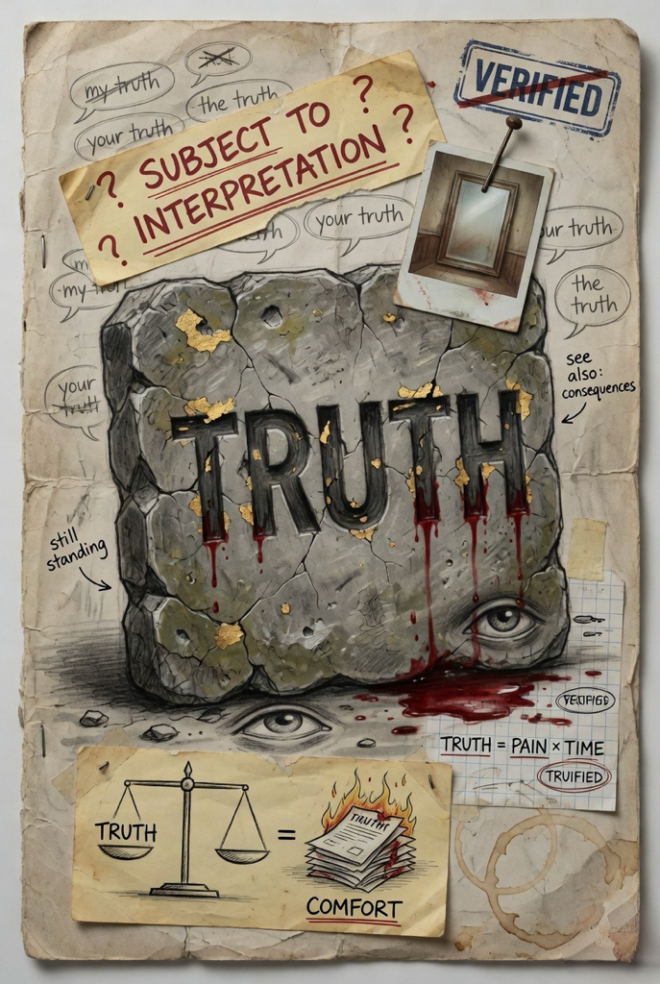
I. Pilate’s Question
When Pontius Pilate asked, ‘What is truth?’ – and then turned and walked away before the answer could be given – he performed an act of intellectual cowardice that has echoed across two millennia of philosophy, politics, and science. Whether Pilate was a Roman pragmatist, a cynical colonial administrator, or a man genuinely overwhelmed by the enormity of what stood before him matters less than the gesture itself: the question posed, the answer refused. That refusal is the founding wound of much of Western thought. We keep asking the question. We keep walking away before we are satisfied.
I am not immune to this. Anyone who reads my writing on this platform will know that truth – what it is, how it is known, who gets to determine it – is a question I return to compulsively. It runs through everything I write about First Nations justice, about institutional accountability, about the way law can become an instrument of oppression while wearing the mask of neutral procedure. It runs through my own life: through a Supreme Court acquittal built on the exposure of a fabricated affidavit, through the long experience of watching the machinery of the state produce ‘official versions’ of events that bore little resemblance to what actually occurred. Truth, for me, is not an academic question. It has skin in the game.
What follows is an attempt to work through this question seriously – not to resolve it, because I do not believe it admits of a simple resolution, but to map the terrain with as much honesty as I can manage. I will draw on the three major philosophical traditions that have shaped Western debate about truth – correspondence theory, constructivism, and pragmatism – and I will push beyond them, into questions that philosophy alone cannot answer: questions about power, about silence, about what it costs to tell the truth, and what it costs not to.
II. The Mirror and the World: Correspondence Theory
The oldest and most intuitive account of truth is what philosophers call the correspondence theory. A statement is true, on this view, if and only if it corresponds to the facts – if it accurately describes how things actually are. When I say, ‘the river is flooded,’ that statement is true if the river is, in fact, flooded. When a court record states that an affidavit was sworn, that statement is true if the affidavit was genuinely sworn, and false if it was fabricated. The theory seems almost trivially obvious. Of course truth means getting the facts right. What else could it mean?
Aristotle gave the classic formulation: ‘To say of what is that it is not, or of what is not that it is, is false, while to say of what is that it is, or of what is not that it is not, is true.’ Bertrand Russell refined this into the language of twentieth-century analytic philosophy: propositions are true when they stand in the right kind of correspondence relation to the facts of the world. The natural sciences have been the great institutional embodiment of this aspiration. The scientific method – hypothesis, observation, experiment, verification – is built on the assumption that there is an objective world out there, independent of our wishes, beliefs, or social position, and that careful empirical investigation can give us reliable access to its truths.
The achievements of science on this basis are extraordinary. We know the age of the universe to remarkable precision. We can predict the motion of planets, the behaviour of electrons, the replication of viruses. The correspondence between our theories and reality is close enough to build bridges, synthesise medicines, and land instruments on Mars. Whatever else is contested about truth, the practical success of this enterprise is not nothing. It represents humanity’s most sustained and disciplined effort to get the world right.
Yet correspondence theory carries within it a philosophical difficulty that has never been fully resolved. To check whether a statement corresponds to reality, we need access to reality independent of our statement about it – a view from nowhere, as the philosopher Thomas Nagel called it. But we are always somewhere. We perceive through specific sensory organs, shaped by evolution. We think in specific languages, each of which carves the world at somewhat different joints. We carry specific cultural inheritances that shape what we notice, what we count as evidence, what questions we think to ask. The ‘objective reality’ against which we test our statements is never directly accessible; it is always mediated by the very cognitive and cultural apparatus that we are trying to hold up to it.
This is not a counsel of despair. It does not mean that all accounts of reality are equally valid, or that the fabricated affidavit is just as true as the genuine one. It means that the aspiration to correspondence is real and important, but that achieving it is a harder, messier, more social process than the theory in its clean philosophical formulation sometimes suggests. Knowing the truth requires work, and that work is always done by particular people, in particular circumstances, with particular interests and particular blind spots.
III. The Architecture of Belief: Constructivism
Constructivist accounts of truth begin from exactly the difficulties I have just described. If our access to reality is always mediated – by language, culture, power, history – then what we call ‘truth’ may be less a mirror of the world than a product of the practices, institutions, and social arrangements through which we collectively make sense of experience.
Thomas Kuhn’s landmark work on the history of science showed that scientific ‘facts’ do not simply accumulate, brick by brick, toward a complete picture of reality. Instead, science operates within paradigms – overarching frameworks of assumption, method, and exemplary practice – and what counts as a fact, a problem, or a solution is defined by the paradigm in force. When paradigms shift – as they shifted with Copernicus, Newton, Darwin, Einstein – it is not merely that new facts are added to the existing structure; the entire conceptual architecture is rebuilt, and old ‘facts’ are reconstituted as errors, or as valid within a narrower domain. The history of science is not a straight line toward truth but a succession of historically conditioned ways of knowing.
Michel Foucault pushed this insight in a more explicitly political direction. In his genealogical analyses of medicine, psychiatry, criminology, and sexuality, Foucault showed how ‘truth’ is produced within what he called regimes of truth – the institutional arrangements, disciplines, and power relations that determine what counts as legitimate knowledge, who gets to speak with authority, and whose testimony is dismissed. A psychiatrist’s diagnosis is ‘true’ in a sense that a patient’s self-report is not, not because the psychiatrist is necessarily more accurate, but because the institutional arrangement of the clinic grants the psychiatrist the authority to produce binding verdicts about mental states. Truth, on this view, is not simply found; it is made, and the making is always an exercise of power. (It is worth noting that even Foucault never denied the existence of brute empirical constraint – he never suggested that the guillotine was merely a discursive event; his point was that what we do with that reality, how we classify and respond to it, is shaped by power. The knife is real; the meaning of the knife is contested.)
From my own experience and my work on First Nations justice in Australia, this account has an almost uncomfortable degree of explanatory power. The history of Australian law’s treatment of Aboriginal and Torres Strait Islander people is a history of official truth being constituted against Indigenous testimony. The Stolen Generations were officially ‘not happening’ for decades. Deaths in custody are officially ‘investigated’ through processes that have consistently failed to produce accountability – not because the facts are genuinely obscure, but because the institutional arrangements of coroner’s courts, police oversight bodies, and prosecutorial discretion systematically weight certain kinds of evidence and certain kinds of witness over others. What the state says happened is not the same as what happened, but the state’s account carries the weight of institution, of law, of the monopoly on legitimate force.
The constructivist account does something important: it refuses the political innocence of the correspondence theory. It insists that the question ‘whose truth?’ is never merely academic. But it carries its own dangers. If taken to an extreme, constructivism slides toward a relativism in which no account of events is more true than any other, in which the survivor’s testimony and the perpetrator’s denial are simply two competing narratives with no fact of the matter between them. This is not only philosophically untenable; it is politically catastrophic. The fabricated affidavit is not, in any meaningful sense, as true as the one that accurately records what was sworn. Facts matter. The body in the cell is a fact. Relativism does not serve justice; it serves those with the power to impose their version of events on everyone else.
IV. Truth in Action: The Pragmatist Synthesis
Pragmatism emerged in the late nineteenth and early twentieth centuries, primarily through the work of American philosophers Charles Sanders Peirce, William James, and John Dewey, as an attempt to cut through the impasse between correspondence and constructivist views. It did so by relocating the question: rather than asking ‘does this statement correspond to a mind-independent reality?’ or ‘is this statement a product of social constructivism?’, pragmatism asks ‘what difference does it make, in practice, whether we treat this statement as true?’
For William James, a belief is true if it ‘works’ – if acting on it leads to successful outcomes, if it helps us navigate experience, if it enables us to satisfy our purposes and needs. John Dewey developed a more sophisticated version of this, arguing that truth is not a fixed property of statements but an achievement of inquiry: a process by which we bring our beliefs into better alignment with experience, resolve problems, and open new possibilities for action. Truth, for Dewey, is not a relationship between a statement and a static reality; it is a quality that emerges in the dynamic interaction between thought and world.
This is a more attractive position than it might initially appear, because it captures something important about how both science and practical reasoning actually work. Scientists do not simply ‘read off’ facts from nature; they test hypotheses against experience, revise their theories in light of anomalies, and converge – over time, and imperfectly – on accounts that work reliably across a wide range of circumstances. A theory is not ‘true’ in a timeless, Platonic sense; it is the best available answer to a specific question, tested against specific evidence, in a specific historical moment, always open to revision. This is not relativism; there is still a difference between a theory that works and one that does not, between a medicine that cures and one that kills, between a map that corresponds to the territory and one that does not. But it is a more modest, more historically situated, more intellectually honest account of what ‘truth’ means in practice.
Pragmatism also has attractive political dimensions. If truth is understood as an achievement of inquiry – of sustained, disciplined, collective investigation – then the conditions of inquiry matter enormously. Free inquiry requires freedom: freedom to ask questions, to challenge received wisdom, to dissent from official accounts, to bring marginalised testimony into the record. An inquiry conducted under conditions of coercion, or in institutions systematically structured to suppress certain kinds of evidence and amplify others, will produce distorted outcomes. Justice requires truth, and truth requires justice – in the conditions of its production.
Yet pragmatism, too, has its limits. ‘What works’ is not always morally neutral. Slavery ‘worked’ for slave economies, in the narrow sense that it produced wealth for those at the top of the hierarchy. Colonial dispossession ‘worked’ for colonisers, in the sense that it secured land and resources. If we define truth purely by practical success, we risk defining it in ways that are indexed to existing power relations – reproducing the very problem that constructivism identified, but now with a philosophical gloss of instrumentalism. Pragmatism needs to be disciplined by a robust account of whose purposes count, whose experience of ‘working’ or ‘not working’ gets to enter the reckoning. Contemporary pragmatists like Cheryl Misak and Robert Talisse have tried to meet this challenge by grounding inquiry in something like democratic norms: the epistemic community that gets to judge whether a belief ‘works’ must itself be genuinely open, inclusive, and responsive to evidence from all affected parties. That is a promising direction, even if it defers rather than dissolves the political question.
V. The Politics of Truth
The three philosophical traditions I have outlined – correspondence, constructivism, pragmatism – are not merely academic exercises. They describe real features of how truth functions in the world: as an aspiration toward accurate description of reality, as a product of social and institutional arrangements, and as an achievement of practical inquiry. The question of which of these is ‘really’ true about truth is, in an important sense, less interesting than the question of what each of them helps us to see.
What they collectively help us to see is that truth is always at risk – of distortion by power, of suppression by structures of authority, of corruption by those with interests in its concealment. This risk is not uniform across all domains: the replication-driven natural sciences have developed partial immune systems against it – peer review, open data, adversarial collaboration – which is precisely why they have produced more reliable knowledge than, say, coronial inquiries into deaths in custody or bureaucratic investigations of their own misconduct. The success of science demonstrates that the conditions for truthful inquiry can be built; the failure of those other institutions demonstrates what happens when they are not. This is not a paranoid or nihilistic observation; it is a description of the historical record. The history of every major social injustice – colonialism, slavery, totalitarianism, mass incarceration – is in part a history of the suppression of inconvenient truths and the manufacture of convenient falsehoods. The perpetrators rarely say ‘we are doing evil’; they say ‘this is how things are’, ‘this is necessary’, ‘these people are different’, ‘the evidence does not support your claims’. The language of truth is always available to be weaponised in the service of untruth.
Hannah Arendt, one of the twentieth century’s most penetrating analysts of political power, distinguished between factual truth – the brute contingencies of what has happened – and rational truth, the insights of philosophy, mathematics, and science. Both, she argued, are peculiarly vulnerable to political attack, because both are capable of contradicting the stories that political actors want to tell. Factual truth is attacked by those who wish to rewrite history. Rational truth is attacked by those who wish to substitute ideology for inquiry. Both forms of attack involve what Arendt called the ‘defactualization’ of reality – the systematic effort to replace what has happened with a preferred fiction, until enough people become uncertain enough that the fiction acquires the social weight of fact.
We are living through a period of intense defactualization. The tools are different from Arendt’s era – social media platforms algorithmically amplify outrage and tribalism, large language models can generate plausible-sounding text at industrial scale, and the sheer volume of information makes the signal-to-noise problem nearly unmanageable. But the underlying dynamic is recognisable. Official denials, strategic ambiguity, the drowning of specific claims in a flood of competing assertions – these are the instruments by which those who control state and corporate machinery seek to manage the authorised account, to substitute their preferred version for the one that evidence supports.
Resistance to defactualization is not merely a philosophical virtue; it is a political and moral necessity. It requires institutional structures – independent courts, a free press, academic freedom, robust public record-keeping – that preserve and protect factual truth against the pressure of power. It requires epistemic courage: the willingness to say what the evidence shows, even when the evidence is unwelcome, even when saying so carries personal costs. And it requires a genuine pluralism of testimony – a commitment to including, and taking seriously, the accounts of those who have historically been excluded from the production of official truth.
VI. Country Remembers: Truth and Indigenous Knowing
Any serious engagement with truth in the Australian context must reckon with the fact that there are epistemological traditions on this continent that long predate Western philosophy’s debates about correspondence and constructivism, and that offer resources for thinking about truth that are not yet adequately incorporated into mainstream Australian intellectual life.
Wiradjuri epistemology – the knowledge tradition of my own people – does not separate truth from Country. The land itself is a record: of history, of relationship, of responsibility. The songlines are not merely mnemonic devices; they are truth-telling practices, ways of encoding and transmitting accurate knowledge of geography, ecology, ceremony, and law across thousands of years and thousands of kilometres. This is not metaphor. The songlines contain real information – about water sources, seasonal patterns, sacred sites, the movements of ancestors – that has been tested against experience across deep time and found to work.
The Yolngu concept of gurrutu – the relational framework through which all entities, human and non-human, are understood as kin – embeds truth in relationship. What is true is what is known from within a web of accountability: to Country, to ceremony, to the ancestors who established the Law. This is not relativism; it is a different epistemological architecture, one in which the conditions of inquiry are not individual rational reflection but sustained relational and ceremonial practice. The question ‘is this true?’ is inseparable from the question ‘who has the authority and responsibility to know this?’
When Aboriginal people say, ‘always was, always will be, Aboriginal land,’ they are not making a merely political claim. They are making an epistemological one: that the truth of custodianship is established in Country itself, recorded in law, ceremony, and oral tradition across a timeframe that dwarfs the documentary records of the colonial state. The colonial legal fiction of terra nullius – that the continent was legally unoccupied before 1788 – was not merely unjust; it was, in any meaningful sense of the word, false. The High Court’s Mabo decision of 1992 was, among other things, a moment of epistemological correction: an acknowledgment that a particular official truth had been a lie, and that a different account of the facts was closer to reality.
The lesson I take from Indigenous epistemology is not that Western accounts of truth should be abandoned, but that they should be held more honestly – with an acknowledgment of their historical conditions, their exclusions, and their limits. The truth about this country cannot be known through Western epistemology alone. It requires a genuine engagement with the knowledge traditions that have been systematically suppressed, marginalised, and denied. Decolonising epistemology is not a slogan; it is a substantive intellectual and political task – and a productive one. The adoption of Indigenous fire management practices in Australian land management offers one concrete instance: knowledge systems refined over sixty thousand years of careful observation and relationship with Country, initially dismissed by colonial forestry as primitive superstition, are now formally integrated into land management policy across multiple states, with measurable ecological benefits that Western reductive science has subsequently been able to document and confirm. The flow of knowledge, when the epistemological gate is genuinely opened, is not zero-sum. It is additive.
VII. The Courage of Uncertainty
I began with Pilate’s question and Pilate’s retreat. Let me end with a different model: the figure of the witness.
In the Hebrew prophetic tradition, which is part of my own inheritance, the prophet is not primarily a predictor of the future but a truth-teller about the present. The prophet stands before power and says: this is what is happening; this is what the evidence of your own law and your own stated values requires you to see; this is the gap between your proclamations and your practices. The prophet does not claim omniscience. The prophet claims fidelity – to what has been observed, to what the tradition requires, to what conscience demands.
The Persian poet Hafez – whom I have loved for the way he holds together the mystical and the ironic, the sacred and the earthly – wrote often about the difficulty of knowing and the necessity of sincerity. In the ghazal tradition, the beloved is both present and absent, known and unknowable; truth is approached asymptotically, through the discipline of longing and the willingness to be changed by what one encounters. This is not epistemological defeatism. It is a different kind of rigour – the rigour of remaining open, of refusing premature closure, of honouring the complexity of what one is trying to understand.
What both traditions share – and what I find most useful in thinking about truth – is the idea that the pursuit of truth requires something more than intellectual technique. It requires character. It requires the willingness to follow the evidence where it leads, even when it leads somewhere uncomfortable. It requires the honesty to acknowledge when one does not know, and the courage to say what one does know, even under pressure to be silent.
In my own work – in the long advocacy over deaths in custody, in the documented exposure of institutional misconduct, in the effort to bring First Nations perspectives into spaces designed to exclude them – I have found that the hardest part of truth-telling is not always the gathering of evidence. The evidence is often available. The hardest part is the willingness to be accountable to it: to let it constrain what you say, to revise your account when new evidence requires it, to resist the temptation to make the facts fit the story you wish were true.
This is what I mean by the courage of uncertainty. Not the performance of perpetual scepticism – which can be its own form of evasion – but the genuine willingness to hold open questions open, to sit with complexity without forcing premature resolution, to pursue truth as a discipline rather than a possession. The Stoics called this the discipline of assent: the commitment to neither affirm nor deny beyond what the evidence actually supports, to keep the mind honest in its relation to reality.
Pilate asked the question and walked away. The witness stays. The witness returns, with more evidence, with revised accounts, with a deepened understanding of what the question requires. The witness does not achieve final truth; no one does. But the witness is accountable to truth in a way that Pilate was not – and that accountability, even when it falls short of its aspiration, is what keeps the pursuit of truth from collapsing into either dogmatism or nihilism.
VIII. What We Owe the Question
What is truth? I have not answered this question. I am not sure it admits of a final answer. What I have tried to do is trace the outlines of the terrain – the aspiration toward accurate correspondence with reality, the recognition that our access to reality is always mediated and socially conditioned, the pragmatist insight that truth is an achievement of inquiry rather than a timeless given, the political recognition that truth is always at risk from power, and the epistemological breadth that Indigenous knowledge traditions bring to a question that Western philosophy has tended to answer too quickly and too narrowly.
If I were to distil something from this, it would be this: truth is a practice before it is a possession. It is something we do – through disciplined inquiry, honest testimony, institutional accountability, genuine pluralism of perspective, and the courage to remain answerable to what the evidence actually shows – rather than something we simply have. The correspondence theory is right that there is a reality to get right, and that some accounts of it are better than others. The constructivists are right that the getting right is always a social and political process, shaped by power and context. The pragmatists are right that the test of our accounts is always, in the end, practical: do they help us navigate reality, solve real problems, do justice to what has actually occurred?
And beyond all three traditions, there is the witness’s imperative: to stay with the question, to keep gathering evidence, to resist the official fictions that power generates to protect itself, to honour the testimony of those who have been excluded from the production of authorised truth. In a country with Australia’s history, that imperative has particular weight. The truth about this continent – about its deep history, about what was done in the name of civilisation, about the ongoing costs of that history in the lives of real people – has been suppressed, distorted, and denied with remarkable persistence. Telling it, as accurately and as fully as we can, is not merely an intellectual exercise. It is a political act, a moral obligation, and an act of love for the Country and the people it sustains.
The question remains open. So do I.
Further Reading
For readers who wish to pursue these questions further, the following works have shaped the argument of this essay.
On correspondence theory: Aristotle, Metaphysics (Book IV); Bertrand Russell, The Problems of Philosophy (1912).
On constructivism: Thomas Kuhn, The Structure of Scientific Revolutions (1962); Michel Foucault, Power/Knowledge (1980).
On pragmatism: William James, Pragmatism (1907); John Dewey, Logic: The Theory of Inquiry (1938); Cheryl Misak, Truth and the End of Inquiry (1991).
On political truth: Hannah Arendt, “Truth and Politics” in Between Past and Future (1968).
On Indigenous epistemology: Tyson Yunkaporta, Sand Talk: How Indigenous Thinking Can Save the World (2019); Deborah Bird Rose, Nourishing Terrains: Australian Aboriginal Views of Landscape and Wilderness (1996); and Bruce Pascoe, Dark Emu (2014).
– – –
Bakchos is the founder of Blak and Black, an Australian media and advocacy platform established in 2010. Bakchos writes from the intersecting perspectives of Wiradjuri heritage, Jewish identity, and humanism.
© Bakchos, June 2026



This is a substantial and genuinely impressive piece — the philosophical architecture is sound, the personal grounding gives it authority that purely academic treatments of this topic lack, and the move through correspondence ? constructivism ? pragmatism ? Indigenous epistemology follows a coherent argumentative logic. The Pilate framing is elegant and the witness figure at the end earns its weight because you’ve built toward it.
Hi Polina, I’ve often wondered what would have happened if Pilate waited for Jesus to answer what truth is.
One tension worth naming: the essay oscillates between the personal-confessional register (the fabricated affidavit, the Supreme Court acquittal) and the academic-survey register (Aristotle to Misak). These can coexist — you manage it well in the introduction and in the witness section — but in the middle of the essay they sometimes sit awkwardly beside each other. The constructivism section in particular reads more like a philosophy lecture than the rest of the piece. That’s not a fatal flaw, but a reader unfamiliar with Kuhn and Foucault might find the gear-shift jarring.
If only Pilate waited for an answer, the world might be a very different place.
If only Pilate waited for an answer, the world might be a very different place. Maybe Jesus wouldn’t have been crucified.
Does truth still exist in the age of Trump with all that fake news, alternative facts, stolen elections, and so on, and so forth.
I still don’t know what truth is?
Mark the rise of right wing extremism around the world has spelled the end of many formally agreed truths. Gertie xoxo
Hello Gertie,
Agreed, right wing populism is built on the destruction of previously agreed societal truths and values.