
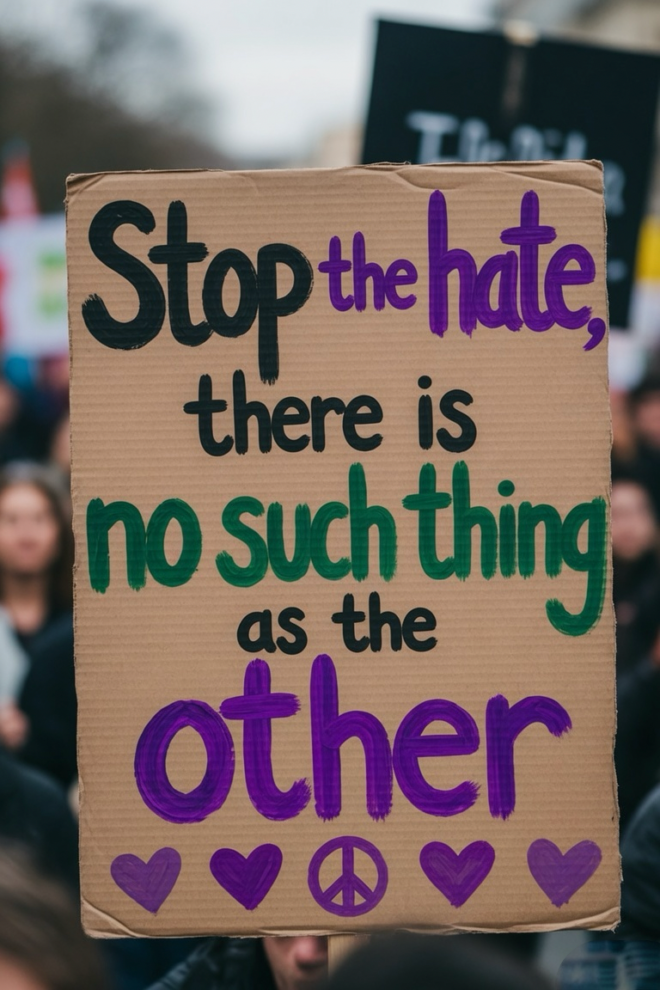
Preface to the Revised Edition
The first version of this paper was criticised on several grounds. The core criticisms were correct. The paper framed right-wing populism as the singular contemporary driver of political othering while remaining silent on post-October 7 antisemitism – a surge in hate crime against Jewish people that, by FBI and ADL metrics, dwarfed the anti-Asian and anti-Latino spikes the paper highlighted. It overclaimed causation, using the language of established causal structure where the honest formulation is strong temporal and contextual correlation. It relied heavily on advocacy-organisation data without acknowledging the methodological caveats attached to that data. And it treated the underlying economic anxieties fuelling populist movements as irrelevant to the analysis, when in fact the distinction between legitimate policy grievance and dehumanising attribution is analytically central.
This revised edition corrects those failures. The framework of othering is applied symmetrically – to right-coded and left-coded political environments alike. Causation is claimed where the evidence supports it and qualified where it does not. The sourcing is broadened and its limitations are named. And the paper attempts the harder analytical task: distinguishing between the legitimate expression of economic and social concern, on one hand, and the deployment of those concerns as vehicles for constructing designated groups as subhuman threats, on the other. The line between those two things matters enormously, and the failure to draw it clearly in the first version was both an analytical and an ethical weakness.
I. Introduction: The Mechanism and Its Conditions
Scapegoating is not the exclusive property of any political tradition. The mechanism – the displacement of collective anxiety onto a designated outgroup, whose constructed threat then becomes the organising principle of political identity – is available to any political movement that finds it useful. History offers examples across the entire spectrum. What matters analytically is not the ideology of the practitioners but the structure of the practice: the identification of a group, the attribution of collective guilt, the withdrawal of their full membership in the political community, and the downstream social permission that withdrawal generates.
This paper examines that structure in four contemporary contexts: right-wing populism in the United States under Donald Trump, targeting immigrants and Latino and Asian communities; right-wing populist politics in Australia under Pauline Hanson and One Nation, targeting Muslim Australians and Aboriginal and Torres Strait Islander peoples; Hindu nationalist politics in India under Narendra Modi and the BJP, targeting the Muslim minority; and the post-October 7, 2023, wave of antisemitism in the United States and on university campuses, fuelled in part by rhetoric that held Jewish people collectively responsible for the actions of the Israeli state.
These cases are not equivalent in their institutional power, their historical depth, or the scale of their consequences.
State-backed communal violence in India is not the same phenomenon as campus harassment in the United States, and the paper does not pretend otherwise. What they share is the core mechanism: a political or social environment in which a designated group is constructed as a collective threat or villain, and in which that construction correlates with measurable increases in harm to members of the group. The framework should be applied consistently, or it should not be applied at all.
II. Othering as Political Technology: What the Evidence Shows and What It Does Not
The academic literature on populism identifies a consistent structural logic: the political world is divided into an authentic, virtuous ‘people’ and their enemies – corrupt elites above and threatening outsiders beside. As UN High Commissioner for Human Rights Michelle Bachelet observed, this logic contains a compulsion to define who the ‘real’ people are and to demonise the ‘other’ as less deserving of rights and a voice.
Research in social psychology identifies several plausible mechanisms through which inflammatory political rhetoric increases hostility toward named outgroups. Normalisation: authoritative voices shift perceived social norms, lowering the threshold for acting on existing prejudice. Permission-giving: language that constructs a group as dangerous or illegitimate functions as a social grant of permission to treat them as such. Prejudice amplification: political rhetoric does not typically create hatred from nothing; it activates and legitimises latent hostility, making it more shareable and more actionable. These mechanisms are theoretically coherent and are supported by correlational evidence.
The word ‘correlational’ matters. Establishing that a politician’s inflammatory statement preceded a spike in hate crime is not the same as establishing that the statement caused the spike. Confounding variables are numerous and genuine: economic anxiety, international events, algorithmic amplification by social media platforms, pre-existing baseline prejudice, and systematic under-reporting biases in advocacy-group data. The scholarly literature on Trump’s 2016 campaign found county-level correlations but explicitly cautioned against inferring direct causation. The same caution applies throughout this paper. The correlation between political othering and downstream hate crime is strong, documented, and multiply replicated – and the mechanisms that would explain the causal relationship are plausible and supported by experimental social psychology. That is not the same as proof that the words directly caused the violence. The paper proceeds on the basis of probable causal contribution, not established causal determination.
A further methodological caveat: several of the organisations whose data this paper draws on – Stop AAPI Hate, Human Rights Watch, India Hate Lab, the Anti-Defamation League – have documented genuine harm but are not neutral academic arbiters. Their methodological choices, definitional expansions, and institutional mandates shape their outputs. Where possible, this paper cross-references advocacy-organisation data with FBI statistics and peer-reviewed research. Where that is not possible, the limitations are noted.
A populist attack on democratic institutions is compounded by a fixation on defining who the ‘real’ people are, and demonizing the ‘other’: those who are somehow less deserving of rights and a voice. – UN High Commissioner for Human Rights Michelle Bachelet
III. The United States: The Trump Effect on Immigrant Communities
The Rhetoric
Donald Trump’s political project has been organised, in significant part, around the systematic othering of immigrants, Muslims, Latinos, and Asian Americans. During his 2024 campaign he described undocumented immigrants as people who were ‘poisoning the blood of our country’. He described immigrants as ‘animals’, invoked language of infestation and invasion, and built his policy architecture – mass deportation operations, the Muslim ban, the border wall – as the institutional expression of this rhetorical positioning.
The ‘great replacement’ theory – the claim that elites were deliberately engineering the demographic displacement of white Americans – migrated from white nationalist forums to mainstream political discourse under his stewardship. Research from the University of Chicago found that the most determinant characteristic in voting for Trump was what scholars termed ‘dominant group sentiments’: the fear that the in-group’s status was under threat from the gains of others.
The Evidence
The data shows strong temporal and contextual correlation between Trump’s most inflammatory statements and spikes in hate incidents against targeted communities, with plausible mechanisms that suggest causal contribution.
Following Trump’s 2024 election victory, Stop AAPI Hate recorded a 66 per cent increase in anti-Asian slurs in extremist online spaces within weeks, with January 2025 recording the highest number of anti-Asian slurs since monitoring began. Violent threats against Asian Americans increased by 59 per cent between November and December 2024. An Axios analysis of data from the Center for the Study of Hate and Extremism found that anti-Latino hate crimes have spiked repeatedly in direct correlation with Trump’s most inflammatory statements. In New York’s Manhattan, anti-national origin hate crimes prosecuted by the District Attorney’s office surged 900 per cent in 2024 compared to 2023. By 2025, preliminary FBI data indicated that hate crimes against Latinos and Sikhs had reached record highs.
Analysts from the Centre for the Study of Hate and Extremism identified a pattern of structural concern: hate crime spikes driven by political catalysts do not return to their previous baseline once the precipitating event passes. Instead, they settle at permanently elevated levels, leaving communities more vulnerable to the next cycle.
IV. The United States: The Post-October 7 Surge in Antisemitism
The Scale of the Problem
The first version of this paper did not address antisemitism. That omission was not defensible. By every available metric, the surge in antisemitic incidents in the United States following Hamas’s October 7, 2023, massacre in Israel represents one of the most dramatic and sustained hate crime spikes in recent American history – larger in absolute terms than the anti-Asian or anti-Latino spikes highlighted in the preceding section.
The ADL recorded 9,354 antisemitic incidents across the United States in 2024 – the highest number since the ADL began tracking in 1979, a 5 per cent increase from the previous record set in 2023, a 344 per cent increase over five years, and an 893 per cent increase over ten years. Assaults increased by 21 per cent. Campus incidents rose 84 per cent. The FBI confirmed the trend: anti-Jewish hate crimes accounted for nearly 70 per cent of all religion-based hate crimes reported in the United States in 2024, with 1,938 single-bias anti-Jewish incidents recorded – up 5.8 per cent from 1,832 in 2023, and a record high in the FBI’s data series. Over 58 per cent of ADL-recorded incidents contained elements related to Israel or Zionism, marking the first time Israel-related content has constituted a majority of recorded antisemitic incidents.
This is not a temporary spike. Antisemitism has reached historically elevated baselines and remained there. Jewish Americans have faced harassment, assault, vandalism, and bomb threats at synagogues at levels without precedent in the modern era.
The Rhetoric and Its Sources
The mechanisms driving this surge are not identical to those driving anti-immigrant hate – and the political configuration is different. Antisemitic incidents in this period have drawn from multiple ideological sources: far-right white nationalist movements, which have traded in antisemitic conspiracy theories for decades; and segments of left-coded anti-Israel activism on university campuses, where rhetoric that constructed Jewish people as collectively responsible for Israeli state actions contributed to an environment of hostility and fear.
The ADL documented campus protest environments in which chants included calls to ‘globalise the intifada,’ slogans that functioned as calls to destroy Israel, open veneration of Hamas’s military wing, and the harassment of Jewish students at or near Jewish institutions. A Brandeis University survey found that, at institutions with the highest levels of antisemitic hostility, 66 per cent of respondents said they were ‘very concerned’ about antisemitism related to Israel, and 18 per cent reported being personally blamed for Israeli government actions because they were Jewish.
The important and difficult analytical task here is to distinguish between criticism of Israeli government policy, which is a legitimate form of political speech and which many Jewish people themselves engage in, and the construction of Jewish people as a collective enemy whose presence in public life is a threat to be opposed. The first is protected political discourse. The second is the othering mechanism this paper is examining. The evidence shows that both were present in the post-October 7 environment – often in proximity and sometimes in the same spaces – and that the presence of the second produced measurable harm to Jewish individuals who bore no responsibility for the actions of a foreign state.
Since the Hamas-led October 7 massacre in Israel, Jewish Americans have not had a single moment of respite and have experienced antisemitism at K-12 school, on college campuses, in the public square, at work and at Jewish institutions. – ADL CEO Jonathan Greenblatt, 2025
The same ‘permission-giving’ mechanism identified in the context of Trump’s anti-immigrant rhetoric applies here. When political environments – whether right-wing nationalist or left-coded activist – construct a group as a collective threat or villain, they lower the social threshold for acting on that construction. The political affiliation of those environments is not morally relevant to the people who are assaulted, harassed, or threatened.
V. Australia: Three Decades of Permission
The Rhetoric and Its Targets
Pauline Hanson’s political career, now extending across three decades, is a sustained study in the use of othering as electoral strategy. Her 1996 maiden speech in the House of Representatives – declaring that Australia was ‘in danger of being swamped by Asians’ and making dehumanising claims about Aboriginal Australians – was not an aberration. It was a programme that has been refined and redeployed against successive targets: Asian immigrants, then Muslims, then Indigenous Australians, then immigrants generally.
In 2017 and again in November 2025, she entered the Australian Senate chamber wearing a full burqa as a theatrical protest against the chamber’s refusal to consider a ban on face coverings – a stunt that was simultaneously a mockery of Muslim religious practice and a political signal to her constituency. In 2022, she told Greens Senator Mehreen Faruqi, a Pakistani-born Muslim woman, to ‘pack your bags and piss off back to Pakistan’ – a statement a Federal Court found in 2024 to have violated the Racial Discrimination Act and to have been anti-Muslim or Islamophobic in character.
One Nation’s current policy platform proposes abolishing the National Indigenous Australians Agency, winding back Welcome to Country ceremonies, and capping permanent migration at levels the party characterises using gross overseas migration figures that are nearly twice the actual net permanent migration figure. The political currency is the construction of Indigenous Australians as beneficiaries of illegitimate preference, and of immigrants as a demographic threat to the ‘real’ Australia.
Grievance, Evidence, and the Analytical Distinction That Matters
The original version of this paper treated the economic anxieties underlying populist resentment as essentially manufactured. That was analytically wrong, and it is worth correcting directly.
Australia’s housing crisis is real. Net overseas migration reached 340,600 in 2024, against a historical average of roughly one new home built per net migrant – a ratio that fell to one home per 2.1 migrants in 2024 and as high as one per 3.2 in 2023. New home approvals are tracking nearly 60,000 below the annual benchmark required under the National Housing Accord. The Reserve Bank of Australia has acknowledged a basic short-run demand effect in tight rental markets: a population increase of 50,000 can raise private rents by around 0.5 per cent relative to baseline. At the same time, the National Housing Supply and Affordability Council and the Australia Institute identify supply-side constraints – zoning restrictions, construction costs, planning failures – as the primary structural driver of unaffordability. The housing crisis is real and has multiple causes, of which migration is one genuine contributory factor among several.
The distinction the analysis requires is between these two claims: (1) Australia’s migration settings have contributed to housing demand in a supply-constrained market, and this warrants policy debate; and (2) people ‘who look like they’ve recently arrived’ are the cause of housing costs, and their displacement from the housing market would restore affordability to ‘dinki-di Aussies’. The first is a legitimate, empirically grounded policy position. The second – Barnaby Joyce’s formulation – is othering: the racialised attribution of a complex structural problem to a visible, identifiable outgroup, in defiance of evidence (0.05 per cent of 2024–25 property purchases were made by foreigners) and in a form designed to activate resentment rather than inform deliberation.
This distinction is not minor. The failure to make it is what allows populist politicians to claim the mantle of legitimate grievance while trafficking in dehumanisation. A politics that names real problems but assigns them to false causes is not serving the people whose grievances it claims to address. It is exploiting those grievances to construct enemies.
The Consequences
Islamophobic incidents in Australia more than doubled between January 2023 and December 2024, with 309 recorded in-person incidents and 366 verified online cases. Visible Muslim women report persistent harassment and social exclusion. Community organisations report significant under-reporting, as victims fear they will not be taken seriously. For Aboriginal and Torres Strait Islander peoples, the ongoing delegitimisation of Indigenous identity and political expression – conducted from the floor of the Australian Senate – represents a harm that does not always appear in discrete hate crime statistics but is no less real for that.
VI. India: When the State Becomes the Instrument
The Scale of State Complicity
India presents the most acute contemporary case examined in this paper, not because its rhetorical environment is uniquely inflammatory but because the machinery of the state has been enlisted directly in the project of constructing the Muslim minority as an internal threat.
During Modi’s 2024 election campaign, Human Rights Watch documented BJP leadership making repeated statements inciting discrimination, hostility, and violence against Muslims and other minorities. Modi described Muslims as ‘infiltrators’ and promoted a conspiracy theory – contradicted by government data showing that India’s Muslim fertility rate has halved over three decades – that Muslim Australians were producing excess children to eventually outnumber Hindus. Instances of hate speech against minorities in India rose 74.4 per cent in 2024, reaching 1,165 documented events; politicians including Modi and Home Minister Amit Shah were among the most frequent purveyors; 98.5 per cent of recorded instances targeted Muslims.
Between June 2024 and June 2025, 947 hate-related incidents were recorded: 602 hate crimes and 345 instances of hate speech. At least 25 Muslims were killed. Of the hate speech incidents, 178 were attributed to BJP-linked individuals including prime minister and chief ministers. Two judges and a governor also made inflammatory public remarks, prompting the report to describe ‘the institutional normalisation of hate’.
Bulldozer Justice
The Human Rights Watch World Report 2025 documents a pattern in which officials fail to act against BJP supporters responsible for attacks while instead targeting the victims of communal violence. Several BJP state governments demolished Muslim homes, businesses, and places of worship without due process – a practice BJP figures have publicly branded ‘bulldozer justice’, presenting collective punishment of entire communities as a legitimate response to alleged individual wrongdoing. In June 2024, authorities in Madhya Pradesh demolished 11 Muslim houses on the stated basis that beef had been found in their refrigerators.
India’s case illustrates the endpoint of the othering continuum. When the state actively participates in the construction and punishment of the designated outgroup – when the government is not merely permissive of communal violence but provides its ideological architecture and its institutional machinery – the analysis of ‘rhetoric producing downstream harm’ becomes inadequate. The harm is policy.
VII. The Shared Mechanism and Its Limits
Across these four cases – anti-immigrant populism in the United States, Islamophobia and anti-Indigenous politics in Australia, Hindu nationalist violence in India, and post-October 7 antisemitism in the United States – a common structure is visible. A political or social environment identifies a group. It attributes to that group collective agency for the grievances of the in-group. It constructs the group’s presence as a threat to the safety, culture, or economic wellbeing of the authentic community. And this construction correlates with measurable increases in hostility and harm directed at members of the group.
The correlations are strong and multiply replicated. The mechanisms that would explain the causal relationship – normalisation, permission-giving, prejudice amplification – are theoretically coherent and experimentally supported. The available evidence warrants the conclusion that political othering makes a probable causal contribution to hate crime and communal violence. It does not warrant the stronger claim that identified rhetoric directly and independently causes specific acts of violence, because the confounding variables – economic conditions, international events, platform algorithms, baseline prejudice – are real and their effects cannot be isolated with precision from advocacy-organisation data alone.
What the evidence does establish clearly is that hate crime spikes driven by political catalysts do not return to their prior baselines. Each cycle of othering rhetoric elevates the floor from which the next cycle begins. The cumulative effect – in all four contexts examined here – is a social environment that is structurally more hostile to the designated outgroups than it was before the rhetoric began.
The framework also has limits that are worth naming. Not every expression of political concern about immigration, security, or demographic change is othering. The line between legitimate policy critique and dehumanising attribution is real and important. The test is not whether the rhetoric names a group, but whether it constructs the group as a collective threat whose presence or power must be opposed for the in-group to be safe. Policy debate about migration levels is not antisemitic; rhetoric that holds Jewish people collectively responsible for Israeli policy is. Policy debate about migration settings is not Islamophobic; theatrical mockery of Muslim religious practice by elected senators is.
VIII. The Democratic Stakes
Beyond the immediate harm to targeted communities, the politics of othering poses a structural threat to democratic culture. Democracy requires, as its minimum operating condition, the recognition that all citizens are entitled to equal standing in the political community. Othering systematically denies this recognition to designated groups – and it does so in a way that is self-reinforcing, because any institution that resists the othering can itself be constructed as captured by the enemy.
This dynamic is visible across the political spectrum examined in this paper. Trump’s attacks on the judiciary, media, and electoral system as captured by anti-American elites protecting undeserving immigrants; BJP rhetoric constructing courts and civil society that resist ‘bulldozer justice’ as sympathisers of Muslim infiltrators; campus environments in which Jewish students’ complaints about harassment were dismissed as bad-faith weaponisation of antisemitism charges to silence criticism of Israel. In each case, the othering of the primary target group generates a secondary othering of the institutional mechanisms that might otherwise constrain the harm.
The long-term democratic cost is the degradation of the epistemic commons – the shared framework of evidence, argument, and good faith within which political disagreement can be conducted without producing violence. When a significant portion of a political community has been habituated to the construction of some of its members as enemies, the conditions for democratic deliberation are themselves undermined.
IX. Conclusion: The Principle and Its Application
The conclusion of this paper is the same as it was in the first version, but reached by a different route. The route matters.
Political othering – the systematic construction of designated groups as alien, dangerous, and undeserving of equal belonging – is associated with measurable increases in hate crime, communal violence, and institutional discrimination against the targeted groups. The association is strong, documented across multiple jurisdictions, and supported by plausible causal mechanisms. It is not a peculiarity of right-wing politics. It operates in right-wing populist movements targeting immigrants and Muslims. It operates in Hindu nationalist politics targeting the Muslim minority. And it operates in political environments – including those coded as progressive – where Jewish people are held collectively responsible for the actions of the Israeli state.
The principle is simple: the construction of any group of human beings as a collective threat or villain, whose mere presence or power justifies the withdrawal of their equal membership in the community, produces harm to members of that group. The principle applies symmetrically. An analysis that applies it only to some groups and not others is not a principled analysis. It is advocacy dressed as scholarship, and it deserves the criticism it receives.
The harder analytical work – distinguishing between legitimate policy grievance and dehumanising attribution, between criticism of a state’s actions and collective blame of an ethnic or religious group, between the genuine economic anxieties that populist movements exploit and the false causal stories they construct around those anxieties – is where the honest intellectual labour lies. That work requires the willingness to name what is happening across the political spectrum, not just in the places where it is politically comfortable to look.
The costs of this failure are borne by the people who are harassed, assaulted, and killed. The ledger belongs to all of them.
Sources & References
Anti-Defamation League. Audit of Antisemitic Incidents 2024. adl.org (released April 2025).
Anti-Defamation League. Anti-Jewish Hate Crimes Comprised Nearly 70% of all Religion-Based Hate Crimes in 2024, FBI reports. adl.org (August 2025).
Anti-Defamation League. Two Years of Turmoil: The Strategic Evolution of Anti-Israel Activism on US Campuses. adl.org (November 2025).
Anti-Defamation League. One Year Later: Antisemitic Trends Post-10/7. adl.org (2024).
Times of Israel. FBI says anti-Jewish hate crimes across US hit record high in 2024. timesofisrael.com (August 2025).
Stop AAPI Hate. State of Anti-AA/PI Hate Report (2024 and 2025 editions). stopaapihate.org
Stop AAPI Hate Action. New Data: Asian Communities Face Surge in Hate in Response to Donald Trump’s Presidential Victory. stopaapihate.org (February 2025).
Human Rights Watch. India: Hate Speech Fueled Modi’s Election Campaign. hrw.org (August 2024).
Human Rights Watch. World Report 2025: India. hrw.org (January 2025).
India Hate Lab. Hate Speech Events in India – Report 2024. indiahatelab.com (February 2025).
Association for Protection of Civil Rights & Quill Foundation. Hate Crimes in India: June 2024 to June 2025. cjp.org.in
Council on Foreign Relations. India’s Muslims: An Increasingly Marginalized Population. cfr.org (March 2024).
Axios. Hate crimes against Latinos and Sikhs hit record high in 2025. axios.com (April 2026).
Documented NY. Hate Crimes Against Migrants Surge in Manhattan. documentedny.com (March 2025).
Eastern Herald. From ‘Swamped by Asians’ to Burqa Humiliation: Pauline Hanson’s Islamophobia Crisis. easternherald.com (November 2025).
SBS News. From political oblivion to poll surge: Inside Pauline Hanson’s comeback. sbs.com.au (March 2026).
National Housing Supply and Affordability Council. State of the Housing System 2024. nhsac.gov.au
Centre for Independent Studies / RBA. Growth that Builds: Beyond the Immigration Blame Game. cis.org.au (March 2026).
Australian Property Update. The Missing Link Between Migration and Housing Policy. australianpropertyupdate.com.au (May 2025).
Brandeis University Magazine. The Crisis of Antisemitism on College Campuses. brandeis.edu (Summer 2024).
PMC / National Institutes of Health. Antisemitism on Campus in the Wake of October 7. pmc.ncbi.nlm.nih.gov (2025).
Uysal, Mete Sefa et al. Populism Predicts Sympathy for Attacks Against Asylum Seekers. SAGE Journals (2024).
Pape, Robert A. Testimony to the Senate Judiciary Committee. University of Chicago Project on Security and Threats (June 2022).
UN DESA. Countering Nationalist Populism for Racial Equality. social.desa.un.org
– – –
Bakchos is the founder of Blak and Black, an Australian media and advocacy platform established in 2010. Bakchos writes from the intersecting perspectives of Wiradjuri heritage, Jewish identity, and humanism.
© Bakchos, June 2026




I have lived experience of being othered by Israel, Israeli othering and hatred of Palestinians is about to end with the complete annihilation of the Palestinian people while the world sit by and watches sitting on their hands. I think that Israel has well and truly spent the holocaust credit card limit and it’s now in deficit no more hiding behind the holocaust to justify another genocide.
Faceless it must be difficult watching the destruction of your homeland and your people by a ruthless colonial power.
Faceless it’s a tragedy what Zionism has done to your country. Worse, the world is covering up the crimes committed by the IDF because Awesome misguided guilt over what happened to the Jews in Europe in the 1940s. That guilt has well and truly been spent and it’s time the world took concrete action against the crimes of Israel in Gaza.
Pauline Hanson is dumb, racist, and a sellout. Only fools would vote for her.
The only thing Pauline Hanson knows and understands is hate.
Pauline Hanson is dumb, you can hear it in her voice, you can see it written all over her face, you can feel her stupidity every time she gives an interview. The thing is, to oligarchs dumb is good, dumb people are easy to manipulate.
Pauline Hanson has built a career out of hate.