
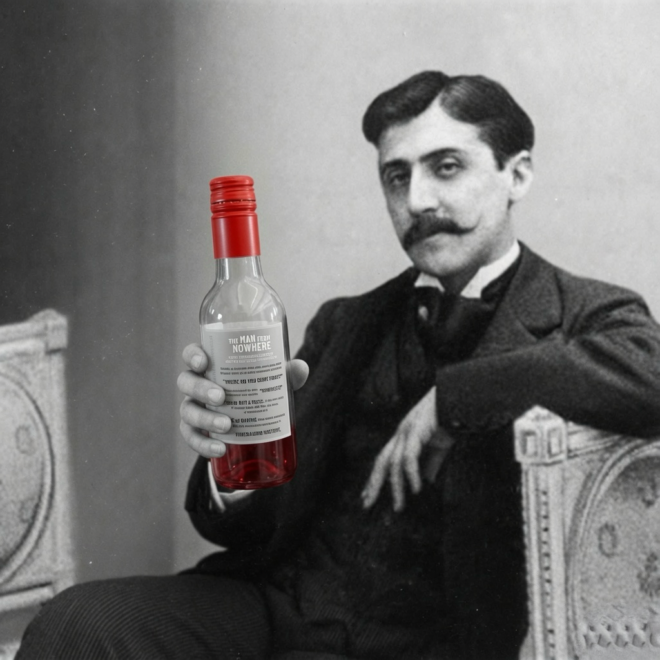
Flight JQ513, Sydney to Melbourne. A tray table, a plastic cup, and a four-dollar bottle of red pulled from the seatback pocket. On the label, between the varietal and the region, someone at a marketing agency had printed a story: THE MAN FROM NOWHERE. 2025 Shiraz Cabernet, South Eastern Australia. Arriving in Australia with little more than he could carry on his back, adventure beckoned. Where do you come from? A home destroyed by war. Nowhere, his response was simple.
It is a strange place to encounter the sublime, but Proust never asked permission of geography either. The madeleine did not wait for a cathedral; it arrived in a teaspoon, at a kitchen table, on an ordinary afternoon, and split time open regardless. Involuntary memory does not consult taste. A wine label at cruising altitude will do exactly as well as a cake dipped in lime-blossom tisane, if the label happens to be honest about the thing it is selling.
The Door That Opens Without Asking
What that label opened in me was not the marketed romance of reinvention. It was my grandmother’s table. It was my mother’s voice, pitched low, telling the secondhand geography of a catastrophe: the towns that no longer appear on current maps, the surnames altered at each successive border, the names of those who reached Australia and, spoken in the same breath and the same reverence, the names of those who did not. A life rebuilt, as so many were, from the ash of a European war. Nowhere was not a rhetorical flourish on that label. It was the only honest answer available to a person whose somewhere had been requisitioned, shelled, and struck from the record. My grandmother could have written it herself. So could my mother.
This is what the madeleine does that ordinary remembering does not: it does not ask you to consent, and it does not arrive alone. It brings the whole stratum with it. Time, for Proust, was never a river carrying the past away downstream. It was sediment – layered, compressed, and pressing upward through the present the instant the correct key is turned. A wine label at thirty thousand feet turned mine.
The Same Hunger, A Different Coastline
But the honest memoirist does not stop at the comfortable half of the recollection. The same forces that manufactured nowhere out of my family’s Europe did not stay in Europe. They travelled – not always as instrument, sometimes as inheritance carried unknowingly in the very people who came here to escape them, and, too often, absorbed into the institutions those people and their descendants went on to build. The impulse that turns a living place into rubble, and rubble into paperwork, and paperwork into silence, is not bound to a single continent or a single century. It found, on this continent, a people already standing on solid ground – sixty-five thousand years of somewhere, unbroken, sovereign, and named – and was turned against them: erasure by register, by court file, by casual and un-casual hatred alike.
The racial hatred directed by Angel Marina at Indigenous people is not a separate story from the one on the wine label. It is the same story told in a different register, on a different coastline, against a people for whom nowhere was never true and was made to be enforced as though it were. That a European migrant, arriving on a continent already inhabited for sixty-five thousand years, could carry this same nowhere-making with him and turn it outward against the world’s oldest continuing culture is the harder inheritance, the one the label does not print: that displacement survived does not inoculate anyone against inflicting displacement on others. Memory, left unexamined, can console the rememberer while doing nothing at all for the next person being made into nowhere.
What The Glass Asks In Return
Marcus Aurelius kept returning, in his private notebook, to the same discipline: to see the thing as it truly is, stripped of the story sold alongside it. The label sells reinvention, a heroic arc, a man from nowhere who became a man from somewhere through will and shiraz grapes. The truer telling is heavier and more useful. It says: nowhere is not a myth of origin. It is a weapon, and it has been used more than once, on more than one people, including by the children of its own survivors when they forget to keep looking.
So the bottle stays unopened on the tray table a moment longer than it needs to. Not out of sentiment, but out of the plain Stoic obligation Proust’s involuntary memory imposes on anyone honest enough to follow it all the way down: if the taste of the past is going to be handed to you uninvited, the least you owe it is to drink all of what rises, not merely the part that flatters your own family’s grief. My grandmother’s ash-country. My mother’s ash-country. The stranger’s ash-country, printed for sale. And the ash-country made here, deliberately, of a people who never asked to be anybody’s metaphor – all of it arriving together, at altitude, insisting on being reckoned with in the same glass.
The Man from Nowhere (JQ513, Sydney–Melbourne)
Not lime-blossom tea, not a shell-shaped cake – a bottle of red, four dollars cheap, wedged into a seatback pocket, tray table down, cabin lights dimmed for descent.
THE MAN FROM NOWHERE, the label says, 2025 Shiraz Cabernet, South Eastern Australia – and underneath, in smaller print, a stranger’s whole biography: arriving with little more than he could carry on his back, adventure beckoned. Where do you come from? A home destroyed by war. Nowhere, his answer, simple.
And there it is. The involuntary door swings open mid-air, somewhere over the Murray, and I am not in seat 14C at all —
I am at my grandmother’s table, I am at my mother’s knee, listening to the secondhand geography of ash – the towns that don’t exist on any current map, the surnames that changed at three different borders, the ones who made the boat and the ones whose names live only in the mouths of the living, recited like kaddish, like ballast, so the boat of memory does not capsize.
Nowhere was not an insult to that man on the label. Nowhere was the only honest answer a person can give when the somewhere has been shelled, sorted, deported, erased – when home is a word that now requires a translator. My grandmother could have printed it on a bottle too. So could my mother. So, in another register, in another key of the same terrible music, could Angel Marina —
because this nowhere-making did not begin with my family and did not end with them either. It came here, this same European hunger that turns living places into rubble and rubble into paperwork, and it did not stop at our grief. It found the oldest continuing culture on earth already standing on solid ground, already somewhere, already sixty-five thousand years of somewhere, and set about making it nowhere too – a name off a register, a body off a count, a hatred so casual it could be worn like a uniform and still catch a bus home after.
This is the cruelty of the shared inheritance: that the displaced can learn displacement’s grammar well enough to inflict it on others, that the survivor’s child can fly business-or-economy between two cities built on someone else’s nowhere, and not think of it, until a four-dollar shiraz insists that he does.
Time, Proust said, is not a river but a stack – the past not behind us but underneath us, pressing up through the present at the first correct provocation: a taste, a smell, a phrase on a wine label read at 30,000 feet with the seatbelt sign still on.
So here is what rises, unbidden, through the cabin air: my grandmother’s ash-country, my mother’s ash-country, the man from nowhere’s ash-country, and the ash-country made here, deliberately, of a people who never asked to become anybody’s metaphor –
all of it arriving at once, the way real memory arrives, not in order, not politely, but all together, insisting to be drunk.
– – –
Bakchos is the founder of Blak and Black, an Australian media and advocacy platform established in 2010. Bakchos writes from the intersecting perspectives of Wiradjuri heritage, Jewish identity, and humanism.
© Bakchos, August 2026

It’s strange what fires up out involuntary memory. It generally happens for me over a scotch and an open fire.
What triggers my involuntary memory is my grandmother’s beetroot soup with cream. It brings back great childhood memories. I do miss my grandmother and her cooking.
I can relate. First time I pulled Mum’s old pressure cooker out to make stock from lamb shanks the smell in the kitchen was overwhelmingly nostalgic. Even Dad was amazed. It smelled like Mum’s kitchen again. Being in her kitchen is a journey in memory, but that moment was blissfully visceral.
That’s a powerful essay, Bakchos. Australia is a land of immigrants, there are 28 million such stories.
I arrived in Australia very much like “the man from nowhere” arrived in Australia. Very like the post. World War II refugees Bakchos discusses, arrived in Australia. All of us have built lives here, and all of those lives contribute positively to the wider Australian community. One Nation is anti-Australian, not immigrants, not refugees, not those of us wanting to build better lives. It’s One Nation, and the hate spewed by Pauline Hanson that’s the problem.
When my father first arrived in Australia he was the man from nowhere, he met my mother here, and they built a successful life. They had five children, and have built successful lives here, and contribute positively to the Australian community. Pauline Hanson needs to grow up, and take a long hard look at herself and her personal bigotry, think about the advantages of immigration to the country like Australia.
We’re all from nowhere at some point in our lives. When my parents arrived in Israel from Russia they were definitely from nowhere. Maybe they still are. I think many people live their entire lives being from nowhere.