
A Verdict Already Rendered
The NSW Court of Appeal has already delivered its verdict on the legal foundation underpinning the events of 9 February at Town Hall. A three-judge bench – Chief Justice Andrew Bell sitting alongside two other justices of appeal – found that amendments to the Public Assembly Restrictions and Dispersal law – the legislative instrument that gave police their authority that night – impermissibly infringed upon the constitutionally implied freedom of political communication. The PARD regime was, in plain terms, unconstitutional. It should never have been used.
This is not a finding that can be quietly absorbed into the machinery of government and forgotten. It is not a procedural footnote, an academic curiosity for constitutional lawyers to debate in seminar rooms while the rest of the state moves on. It is a declaration, from the State’s senior appellate court, that the legal instrument used to clear Town Hall of protesters on the night of 9 February had no constitutional authority to exist. Three judges of the Court of Appeal – led by the Chief Justice himself – examined the PARD Amendments regime against the bedrock requirements of the Australian Constitution and found it wanting. Not wanting in some marginal, technical sense, but wanting in the sense that matters most: it impermissibly burdened the freedom of political communication that the High Court has long recognised as implicit in the structure of representative government established by sections 7 and 24 of the Constitution.
That finding is not a technicality. It goes to the heart of the prosecutions now being pursued against protesters who, in many cases, committed no offence that a constitutional law would have recognised. Had the PARD Amendments not existed, there would have been no unlawful dispersal order, no unlawful kettling, no pepper spray deployed in the manner reported, and no physical confrontations of the kind that have since been widely documented – and, for a substantial number of those now charged, no basis for prosecution at all. The entire chain of events that night flows from a law the Court of Appeal has since struck from the ledger. Reports that NSW Police and the Office of the Director of Public Prosecutions are already conducting internal reviews of charges arising from 9 February are a welcome sign that this reality is being taken seriously within the system – but a review is not the same as a resolution, and the longer those reviews take, the longer people remain under the cloud of charges that may never have had a lawful foundation.
The Anatomy of 9 February
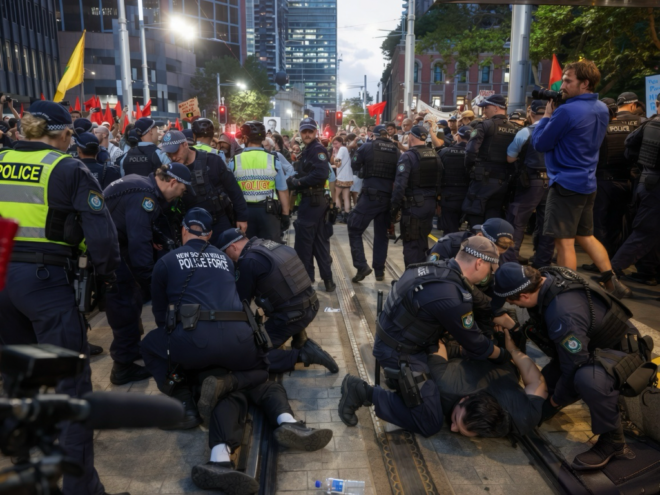
To understand why this matters, it is worth recalling what actually happened at Town Hall, because the passage of time and the fog of competing narratives can obscure the plain sequence of cause and effect. A crowd gathered, as crowds have gathered at that site for over a century, to express a political view. Police, acting under the authority – or what they believed to be the authority – of the PARD Amendments, issued a dispersal order. When the crowd did not disperse with sufficient speed, or in sufficient numbers, or in the manner police demanded, officers moved to kettle sections of the crowd: to encircle and contain them, denying any means of egress. Pepper spray was deployed against people who had nowhere to go. Some were struck. Some were dragged. Charges followed – for failing to comply with a police direction, for remaining in a prohibited assembly, for resisting or hindering police in the execution of their duties.
Many of those charges presuppose that the direction being resisted, the assembly being prohibited, the duty being executed, was lawful. Strip away the amendments, and a significant part of that sequence collapses. Where a dispersal order, a declared prohibited assembly, or a direction relied squarely on PARD’s authority, there was no lawful order to disobey, because the law authorising it was never validly enacted in the first place – or, more precisely, was enacted in a form that exceeded the constitutional limits on State legislative power. Where a charge rested on a “prohibited assembly” declared under PARD, that prohibition was constitutionally void. Where a “duty” being executed by police derived from PARD itself, that duty derived entirely from a statute that the State’s own Court of Appeal has now declared invalid.
It is important to be precise here, because not every power exercised that night necessarily traces back to PARD alone. Police operations of this kind often draw on a patchwork of authorities – ordinary public order offences under the Crimes Act and the Law Enforcement (Powers and Responsibilities) Act, and, where applicable, powers under instruments such as the Major Events Act governing conduct in and around declared event precincts. Some individual charges may yet stand on one of these independent bases, untouched by the Court of Appeal’s ruling on PARD. That is precisely why a blanket, case-by-case review is the right mechanism – and precisely why it should not be allowed to become an exercise in quietly re-badging PARD-dependent charges under some other head of power after the fact, simply to keep prosecutions alive. Where PARD was the operative authority – as it plainly was for the core dispersal, containment, and non-compliance charges that defined the night – the analysis above applies in full.
This is the uncomfortable arithmetic that the Director of Public Prosecutions, and ultimately the Attorney-General, must now confront for the PARD-dependent charges. It is not, for those charges, a question of weighing competing public interests, or balancing the gravity of the alleged conduct against the cost of prosecution. It is a question of whether the State can continue to assert, through its courts, that people broke a law which – as a matter of constitutional fact – never validly existed.
The Implied Freedom and Why It Exists
It is worth pausing on what the implied freedom of political communication actually protects, because its abstraction can make it feel remote from the very physical reality of pepper spray and kettling on a Sydney street. The freedom was first articulated by the High Court in the early 1990s and refined in the landmark case of Lange v Australian Broadcasting Corporation, where the Court held that the Constitution’s provisions for representative and responsible government necessarily carry with them a freedom for people to communicate about political and government matters – because without that freedom, the system of government the Constitution establishes simply cannot function as intended. Voters cannot exercise an informed choice at elections, and cannot hold their representatives accountable between elections, if the State can freely suppress the communication of political ideas.
The freedom is not absolute. The High Court has developed a test – refined through cases such as McCloy v New South Wales and Brown v Tasmania – that asks whether a law burdening political communication serves a legitimate purpose, and whether it is reasonably appropriate and adapted (or proportionate) to achieving that purpose in a manner compatible with the maintenance of representative government. Laws that go further than necessary, that sweep up legitimate political protest in pursuit of some other objective, or that hand police sweeping discretionary powers without adequate safeguards, have repeatedly fallen foul of this test – most notably in Brown v Tasmania, where anti-protest laws aimed at forestry activists were found to impermissibly burden political communication.
PARD now joins that list. And it is no small thing that it does so. Public assembly – the literal, physical act of gathering with others to make a political point visible and audible – is not an incidental or peripheral form of political communication. It is, arguably, the most direct and democratically significant form there is. It costs nothing to attend a rally beyond one’s own time and presence. It requires no ownership of a newspaper, no algorithmic reach on social media, no access to the halls of power. For people without wealth, without institutional platforms, without the ear of ministers, the right to stand in a public square and be seen and heard is often the only form of political communication genuinely available to them. A law that allows police, on their own discretion, to disperse such gatherings and to criminalise those who do not comply quickly enough strikes at the freedom in its most elemental form.
From Bondi Beach to Town Hall: The Politics of Emergency Law
None of this happened in a vacuum. The PARD Amendments were rushed through Parliament in the febrile aftermath of the Bondi Beach massacre – a moment of genuine public horror and genuine political pressure, in which governments of every persuasion feel the pull to be seen to be “doing something.” That pressure is real, and it is not illegitimate for a government to respond to a security crisis. But the manner of that response matters enormously, and it is precisely in moments of crisis that constitutional safeguards are most necessary and most likely to be discarded.
It is also worth acknowledging the government’s own stated rationale and the genuinely difficult environment in which NSW Police were operating that night. The Minns Government has consistently framed PARD as a necessary, time-limited response to a heightened security threat, intended to give police clear and immediately enforceable tools at a moment when public anxiety about mass gatherings was at its highest in living memory. Officers on the ground at Town Hall were not making constitutional law in real time; they were applying the powers Parliament had given them, in a tense and fast-moving situation, with the information and legal authority they had been told they possessed. None of that is in dispute, and none of it should be lost in an essay that is, ultimately, critical of the decisions made above their heads. The argument that follows is not an argument that the government acted in bad faith in responding to Bondi Beach, or that individual officers acted unreasonably in applying the law as it was given to them. It is an argument that the legal tools handed to those officers were constitutionally defective – for a second time, on the same point – and that the political leadership responsible for handing them those tools bears the consequences of that defect.
There is now a pattern here that deserves to be named plainly. The NSW Government’s emergency protest legislation enacted in the wake of Bondi Beach has already been struck down once before as unconstitutional. PARD is the second instance of emergency legislation, drafted in haste under the same general justification, to be found by the courts to exceed the State’s constitutional powers. Two strikes, on the same theme, in the same political moment, is not an unfortunate coincidence. It is evidence of a pattern of governance in which the urge to appear decisive after a security failure consistently overrides the basic constitutional discipline that any competent government – and any competent first law officer – ought to apply before legislation is introduced.
This is where the question of political responsibility becomes unavoidable.
A Premier Who Should Have Known: Questions of Political Responsibility
It is not enough to treat this as an institutional failure with no human author. Legislation does not write itself, and it does not pass itself through Parliament. The PARD Amendments were introduced, championed, and pushed through by a government led by Premier Chris Minns, at a time when his own government had, mere months earlier, watched its first piece of emergency protest legislation struck down by the courts on precisely the same constitutional ground – that it impermissibly burdened the implied freedom of political communication.
This is the crux of it. A Premier who has already had one piece of emergency legislation declared unconstitutional for infringing the implied freedom of political communication cannot credibly claim ignorance when a second piece of legislation, addressing substantially the same subject matter in substantially the same manner, is challenged on substantially the same ground. The first ruling was not some obscure precedent buried in the law reports. It was a major political and legal event, reported widely, debated in Parliament, and – one assumes – the subject of advice from the Crown Solicitor and the Solicitor-General before PARD was ever drafted. A Premier briefed on that advice, or who failed to seek it, or who received it and proceeded regardless, bears direct responsibility for what followed at Town Hall.
There are a limited number of explanations for how PARD came to be enacted in a form a unanimous bench, led by the Chief Justice, would find unconstitutional so soon after an almost identical finding against its predecessor – and it is fair to set them out, while acknowledging that only the government itself can say which applies. One possibility is that the Premier was advised that PARD carried a serious constitutional risk and proceeded anyway, judging that the political benefit of “tough on protest” legislation in the wake of Bondi Beach outweighed the risk of a later adverse ruling – in which case the gamble was made with the rights and physical safety of citizens, while the political cost of losing it has so far fallen on those citizens rather than on the government. The other possibility is that the advice was not properly sought at all, despite his government’s very recent experience on precisely this point – in which case the failure is one of process rather than calculation, but a serious one nonetheless. Neither possibility sits comfortably with the standard of care the public is entitled to expect from a Premier exercising the coercive power of the State against people exercising their fundamental rights.
This is not merely a matter of an unfortunate legal misjudgement for which a government might reasonably apologise and move on. People were kettled. People were pepper-sprayed. People were charged, and many have spent months – in some cases longer – under the shadow of criminal prosecution, with all the attendant stress, cost, and disruption to their lives that entails, for conduct that the Court of Appeal has now confirmed was, in substantial part, the exercise of a constitutional right. That is the direct, foreseeable, and now-realised consequence of legislation enacted on Premier Minns’s watch, championed by his government, and used by police under his government’s direction within weeks of being passed.
A Premier who presides over the second unconstitutional curtailment of the same fundamental freedom, in pursuit of the same broad political objective, in the same term of government, has a serious case to answer. That is not a failure that can be remedied by a press release expressing “respect” for the Court’s decision while the prosecutions grind on regardless. At minimum, this pattern raises serious questions about whether the Premier retains the confidence of the public – and, frankly, the confidence of his own colleagues – to safeguard the constitutional limits that bind his government, having now failed to do so twice on the same point within a single term. It is the view of this publication that those questions point toward one answer: that Premier Minns’s position has become untenable, and that he should resign. Readers may reasonably disagree with that conclusion while still agreeing with everything that precedes it – but the underlying facts, on any view, demand more from the government than an acknowledgment of the ruling and business as usual.
To be clear: this is not an argument that every adverse constitutional ruling against a government should trigger a resignation. Governments legislate at the frontier of constitutional doctrine constantly, and courts sometimes draw lines that were genuinely unclear beforehand. But that is not what happened here. This was not a novel question at the margins of the law. It was the same question, asked and answered against this same government, within the same political cycle – and answered again, the second time, with people’s bodies bearing the consequences in real time on the steps of Town Hall.
Continuing Prosecutions as Institutional Contempt
There is a word for prosecuting people under the authority of powers a court has found to be constitutionally invalid: injustice. And there is a particular kind of institutional contempt involved in continuing those prosecutions after the legal foundation has collapsed beneath them. It sends a message that the state will pursue you regardless – that the charges were never really about the law to begin with.
Consider what it communicates to every person who was at Town Hall that night, and to everyone watching from outside, if the PARD-dependent charges are allowed to proceed regardless of the Court of Appeal’s ruling. It says that the constitutional limits on government power are, in practice, optional – that they bind the State only when it is convenient, and that once the machinery of prosecution has been set in motion, it can continue under its own momentum even after the legal scaffolding supporting it has been dismantled by the State’s senior appellate court. It says that “law and order” rhetoric trumps the actual rule of law. And it says, to the particular individuals facing those charges, that their vindication in the constitutional sense – the formal acknowledgment that the power used against them was never lawful – counts for nothing in the practical sense, while the relevant review remains unresolved, because they will still be dragged through the courts, still incur legal costs, still carry the anxiety of pending charges, regardless.
This is precisely the kind of institutional behaviour that erodes public confidence in the administration of justice – not through any single dramatic act, but through the accumulation of small, grinding demonstrations that the State’s commitment to the rule of law is conditional, contingent, and ultimately subordinate to its own institutional momentum.
The Right to Assemble
The Civil Liberties Defence Centre is right. These charges are legally untenable. They are also morally indefensible. The people kettled and pepper-sprayed at Town Hall were exercising one of the oldest and most fundamental rights in democratic life – the right to gather, to speak, and to be heard by those in power. The fact that a desperate government rushed through constitutionally dubious emergency legislation in the aftermath of the Bondi Beach massacre does not transform that right into a crime.
The right of public assembly has a long history in this country, as it does in every democracy worth the name. It is the right exercised by union members on picket lines, by suffragists demanding the franchise, by returned soldiers marching for better treatment, by communities demanding action on causes ranging from environmental protection to industrial safety to, yes, the treatment of First Nations people by the institutions of this State. Governments of every political stripe have, at various points in history, found such assemblies inconvenient, embarrassing, or politically costly. That is, in a sense, the entire point of the right – it exists precisely to protect forms of political expression that are inconvenient to those in power, because convenient forms of expression need no constitutional protection at all.
When a government enacts legislation that allows police to disperse, kettle, and ultimately prosecute people for exercising that right – and when the courts subsequently find that legislation invalid precisely because it burdens that right beyond what the Constitution permits – the proper response is not to search for some alternative legal basis on which the prosecutions might limp forward. The proper response is to recognise that the State got it badly wrong, that real people suffered real harm as a direct result, and that the only honest course is to undo as much of that harm as remains within the State’s power to undo. Dropping the charges does not undo the pepper spray or the kettling. But it is the minimum the State can do to avoid compounding the original wrong with an ongoing one.
What the Attorney-General Must Do
The Attorney-General should act. Many, if not most, of the charges arising from 9 February that depend on the now-invalidated PARD powers are legally untenable and should be reviewed – and, in the absence of an independent and surviving basis, discontinued – in the public interest. This is not a discretionary nicety extended as a gesture of goodwill – for the PARD-dependent charges, it is the outcome most consistent with the Court of Appeal’s findings and with the basic principle that the State should not continue to prosecute people for conduct that a constitutionally valid law would never have proscribed. The reviews reportedly under way within NSW Police and the DPP are the appropriate vehicle for this, provided they are conducted with real urgency and with a presumption in favour of discontinuance wherever PARD was the operative authority – rather than treated as an opportunity to search for alternative charges to keep matters alive.
Prosecutorial discretion exists precisely for moments like this. The Director of Public Prosecutions, and the Attorney-General as the State’s first law officer, retain the power to discontinue proceedings where continuing them would not serve the public interest. For the PARD-dependent charges, this is about as clear a case for that power as is likely to arise. Continuing those prosecutions serves no legitimate law enforcement purpose, since the conduct in question – assembling, refusing a dispersal order, declining to comply with directions issued under what has since been found to be an invalid law – was not, on the Court of Appeal’s reasoning, unlawful at all. It serves no deterrent purpose, since deterring people from exercising a constitutionally protected freedom is not a legitimate objective of the criminal law. And it imposes real, ongoing costs – financial, psychological, and reputational – on individuals who have already borne the physical consequences of the policing operation that night.
Anything less than a genuine, urgent review leading to discontinuance of the PARD-dependent charges compounds the original harm and risks treating the Court of Appeal’s constitutional finding as an inconvenience rather than the definitive judgment it is. A government that truly respected the Court’s ruling would not need ongoing public pressure to see that review through.
Conclusion
The events of 9 February at Town Hall were not an aberration, a one-off failure of policing on a single difficult night. They were, in substantial part, the foreseeable consequence of a political choice – made in the genuine pressure of the post-Bondi Beach environment, but made by a government that had every reason to know better, following a near-identical constitutional rebuke just months before – to enact sweeping emergency powers without the constitutional discipline the office of Premier demands. The Court of Appeal has now done its part, identifying with clarity and authority exactly what went wrong and why. What remains is for the political and prosecutorial arms of the State to do theirs: for the relevant charges to be reviewed urgently and discontinued wherever PARD was the operative authority, and for the government to reckon honestly with what it means that this is the second time, in one term, that an emergency response to a national tragedy has been found to exceed the constitutional limits on its power. Whether that reckoning extends, as this publication believes it should, to the Premier’s own position is ultimately a political question for the public and the Parliament to answer. But it is a question this episode has earned, and one that a press release expressing “respect” for the Court’s decision will not be enough to settle.
– – –
Bakchos is the founder of Blak and Black, an Australian media and advocacy platform established in 2010. Bakchos writes from the intersecting perspectives of Wiradjuri heritage, Jewish identity, and humanism.
© Bakchos, June 2026


Minns really needs to resign. It’s the only honourable thing he can do.
The filth behaved like cunts in pursuit of Minns’ Zionist agenda.
Zionist tentacles run deep inside Mossad Minns.
God help us blackfullas if Pauline Hanson ever becomes Prime Minister
Minns has been captured by Zionism. He should resign.
Minns needs to resign and any police who assaulted any member of the public must be charged.
Agree Melissa, Minns should resign and the cops who bashed the protesters should be charged!