
A Dinner On The Run
On Friday 12 June 2026, a fundraising dinner for Pauline Hanson’s One Nation, headlined by the senator herself and her sometime ally Barnaby Joyce, was supposed to unfold quietly in an Italian restaurant in Moonee Ponds, in Melbourne’s north?west. It did not unfold quietly. The venue, Casa Giorgio, withdrew as host after activist groups – among them Victorian Socialists, No Room for Racism and Free Palestine Melbourne – announced their intention to make Hanson’s presence in the city as uncomfortable as possible. The event was relocated, at short notice, to South Melbourne, where Hanson and Joyce arrived to find a small group of demonstrators already gathered. Among the chants that greeted them was the word “Nazi.” Joyce’s response, delivered to the assembled cameras, was characteristically blunt: “We’re no Nazis.”
It is worth sitting with that sentence for a moment – not because anyone seriously expects a senior parliamentarian to confirm fascist sympathy on the record, but because of what it reveals about the discursive terrain Hanson and her party now occupy. “We’re no Nazis” is not a phrase that political figures need to reach for unless the accusation has become, in some sense, ambient: present in the air around them often enough that denial becomes part of the script, rehearsed and ready before the cameras even arrive.
Hanson, for her part, offered a different account of the venue change altogether. Not protests, she insisted, but popularity – “we had too many bookings, people wanting to come.” Victoria Police’s version sits closer to the protesters’: the restaurant cancelled, under pressure, and the party scrambled to find somewhere else. Two explanations, then, for one cancelled dinner. But the disagreement over why the venue changed is almost beside the point. What the episode confirms, again, is the now?familiar choreography of a Hanson event: a public venue, a public backlash, a hasty relocation, and a chorus – from both sides of the barricade – invoking the spectre of Nazism, either as accusation or as something to be hurriedly disclaimed.
The Mask Slips, Again
This was not the first time in 2026 that the words “Hanson” and “neo?Nazi” had appeared in the same sentence, and the repetition matters. In April, footage from a Canberra anti?immigration rally showed Hanson bounding onto a stage to embrace a man in a navy shirt. Social media moved faster than verification: the man, posts claimed, was Thomas Sewell – the National Socialist Network leader whose public profile has been built on Hitler salutes, antisemitic banners, and, as of September 2025, a violent assault on Camp Sovereignty, the Aboriginal site in Melbourne’s Kings Domain, during the “March for Australia” rallies.
As it turned out, the man Hanson embraced was not Sewell but a different figure, identified in subsequent reporting as Ben Shand. The misidentification was real, and on its own it proves nothing about Hanson – a debunked claim should be treated as debunked, not quietly repurposed as evidence of something else. What the episode does illustrate is something about the speed and confidence of the assumption itself: tens of thousands of people, on seeing that footage, did not pause to check who the man was before concluding it must be Sewell. That reflex did not come from this incident, which cannot support it. It came from somewhere else – from the documented pattern set out below, which exists independently of this one mistaken claim.
Consider what that pattern actually contains. In August and September 2025, the National Socialist Network – the organisation Sewell leads – used the cover of the “March for Australia” anti?immigration rallies to storm Camp Sovereignty, tearing down First Nations flags, trampling the Aboriginal flag, and stamping out a sacred fire kept burning in honour of the dead. Witnesses reported chants of “white power.” Sewell was arrested days later. Hanson, along with federal MP Bob Katter, had marched in those same nationwide rallies. In their aftermath, federal Liberal Senator Jacinta Nampijinpa Price described the marches not as protests but as a “pro?Australia march,” telling reporters that Australians “proud to call themselves Australian” had been “under attack” – a characterisation that found no room, in the same breath, for the flags torn down or the fire stamped out at Camp Sovereignty.
None of this means Hanson personally chants “white power” or tears down flags, and there is no evidence she has ever endorsed such acts – on the contrary, she and her colleagues have repeatedly disavowed them. But disavowal after the fact is a different thing from a movement’s framing before it. When the entry point to a rally is “anti?immigration” and the exit point includes men in black storming a sacred site, the more useful question is not whether the senator is personally complicit. It is whether her movement’s settled vocabulary – multiculturalism has failed, anti?white racism is rampant, ordinary Australians are under siege – supplies a shared language that the unrespectable end of that movement can occupy and amplify without ever needing an invitation.
Moonee Ponds: What “We’re No Nazis” Doesn’t Answer
Which brings us back to the relocated fundraiser itself. What is documented is this: protesters greeted Hanson and Joyce with chants of “Nazi,” one demonstrator yelled “Die Pauline,” and Joyce’s reply – “We’re no Nazis” – was aimed at that general charge. Reports from the scene also describe the broader chaos of a hastily relocated event arriving at an already?assembled protest, with the kind of overlapping shouting and confrontation that makes any single utterance difficult to verify after the fact.
What the denial did not do, on the record, was engage with a narrower and more useful question than “are you a Nazi.” Nobody seriously argues that One Nation is, formally, a neo?Nazi organisation – it plainly is not, and Hanson and Joyce have repeatedly and explicitly disavowed such groups. The real question is whether the language the party has spent thirty years cultivating – multiculturalism has failed, anti?white racism is rampant, ordinary Australians are under siege – has become a vocabulary that the genuinely unrespectable can pick up and run with, unprompted, at the edges of these events. “We’re no Nazis” answers the extreme version of the accusation, which costs nothing to deny. It does not answer the narrower one, which is the one that actually matters.
“It’S Okay To Be White” – The Template
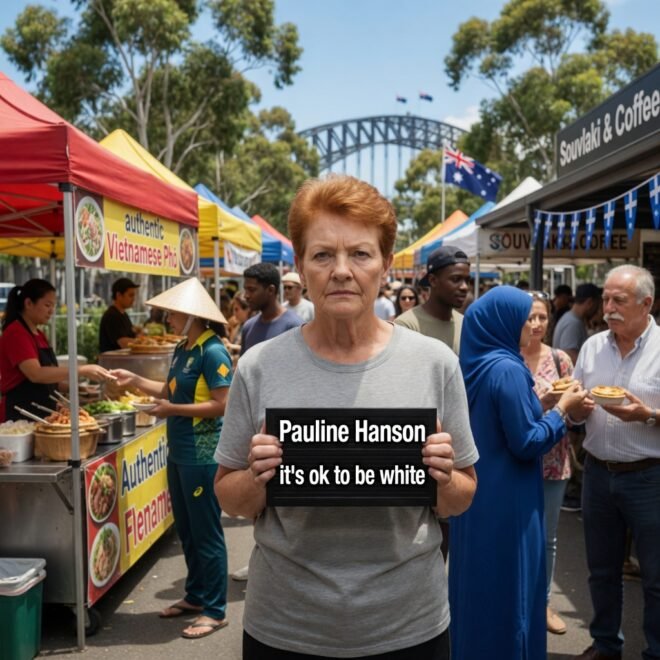
To understand why this keeps happening, it helps to return to October 2018, when Hanson brought a motion before the Senate declaring, among other things, that “It’s OK to be white.” The phrase did not originate with Hanson. It originated online, engineered explicitly as a piece of trolling designed to provoke an “anti?white racism” backlash narrative, and subsequently adopted wholesale by white nationalist movements internationally as a slogan and recruitment device.
Hanson imported it into the Australian Senate more or less unmodified, wrapping it in language about “attacks on Western civilisation” and “anti?white racism.” On 15 October 2018, the motion was defeated 31–28 – but only just, and only after a scramble. Twenty?three Coalition senators initially voted in favour. The government’s leader in the Senate, Mathias Cormann, attributed this to a “regrettable administrative error,” and the following day the Senate recommitted the motion and rejected it unanimously, with Labor and the Greens explicitly naming the phrase for what it was: a white supremacist mantra, laundered through the language of grievance and briefly granted a parliamentary imprimatur before being hastily withdrawn.
The 2018 episode is worth dwelling on because it is the template for everything that has followed. The mechanism is always the same: take a phrase, a frame, or a grievance with a traceable provenance in explicitly racist organising – “It’s OK to be white,” “anti?white racism,” “Australia for the white man,” the running war on “multiculturalism” – and present it not as racial politics but as a defence of ordinary Australians against a hostile elite. The trick, if trick is the word, is that it makes the racism load?bearing while keeping it deniable. When the slogan’s origins are pointed out, the response is wounded incomprehension: how could wanting it to be “OK to be white” possibly be racist? When men who chant “white power” turn up at your events invoking your name, the response is “We’re no Nazis.” The disavowal and the dog?whistle are two halves of the same operation, and each depends on the other to function.
The Burqa and the Performance of Threat
This same mechanism – manufactured threat, performative defence, genuine consequence – has played out repeatedly in Hanson’s career, and not only in relation to race in the abstract. Twice, in August 2017 and again in November 2025, Hanson wore a burqa into the Senate chamber as a protest against parliament’s refusal to ban full?face coverings, framing the garment as a threat to national security and to the treatment of women. Both occasions ended with Hanson being asked to leave the chamber; the 2025 repeat performance ended in formal censure.
What is notable is not the stunt itself – political theatre is hardly unique to One Nation – but its function. It performs the existence of a civilisational threat (the burqa, standing in for Islam, standing in for a broader “Muslim immigration” anxiety) requiring urgent legislative response, while offering no actual policy mechanism beyond the wearing of the garment by a white Anglo?Australian senator in a chamber she knows will eject her for it. The censure becomes, in the retelling, further proof of an establishment unwilling to confront the “real” issue. The cycle is self?sustaining: manufacture the threat, perform the defence, be punished for the performance, and present the punishment as vindication. It is the same cycle, in miniature, as the fundraiser that wasn’t cancelled because of protests, except when it was.
Sovereignty For Some
Which brings us to the word “sovereignty” itself – a word Hanson and One Nation deploy constantly, almost liturgically, in relation to immigration, the United Nations, foreign investment, AUKUS, vaccine mandates, and any number of other grievances. Australian sovereignty, in the One Nation lexicon, is something perpetually under siege: from globalists, from Canberra elites, from the UN, from “foreign” cultures and “foreign” capital alike.
What is conspicuously, structurally absent from this account of sovereignty is any reckoning with the sovereignty that actually predates the Commonwealth of Australia by tens of thousands of years – the sovereignty of the First Nations whose unceded title to this continent has never been extinguished, legally or morally, by the arrival of the people whose modern political descendants now invoke “Australian sovereignty” as though the nation began in 1788, or perhaps 1901, with nothing prior worth the name.
This is not a minor omission. It is the tell. A genuinely sovereigntist politics – one concerned with who has the right to determine what happens on this land, and on what authority – would have to begin with the question of whose sovereignty was here first, and what was done to it. One Nation’s sovereignty talk does the opposite: it treats the colonial settlement of Australia as the zero point from which all subsequent sovereignty is measured, and it treats any assertion of First Nations sovereignty – land rights, Treaty, a Voice, even basic acknowledgment of historical dispossession – as itself a threat to “Australian” sovereignty, an example of the country being “divided” by people who refuse to “move on.”
It is difficult to overstate how revealing this is. The same movement that marched alongside men who, weeks later, would tear down First Nations flags and stamp out a sacred fire at Camp Sovereignty has spent years describing Welcome to Country ceremonies, the Uluru Statement from the Heart, and any discussion of a treaty as forms of “reverse racism” or national self?flagellation. Sovereignty, in this framework, is something Australia has and must defend – never something Australia took and has never returned.
The Multicultural Mirage
A similar hollowness runs through Hanson’s relationship to “multicultural identity.” One Nation’s foundational claim, dating back to Hanson’s 1996 maiden speech, has always been that Australia risks being “swamped” by some external group – Asians then, Muslims and African migrants more recently – and that multiculturalism represents a civic experiment that has failed, or is failing, or was never properly consented to by “ordinary Australians” in the first place.
None of this requires pretending that the concerns animating One Nation’s base are imaginary. Housing affordability, wage stagnation, pressure on infrastructure in fast?growing suburbs, and genuine anxiety about the pace of demographic change are real and widely felt, and they register in polling well beyond One Nation’s own vote share. A serious political response to those concerns would look at migration intake settings, housing supply, planning law, and wage policy – the actual levers available to government. What One Nation offers instead is a substitution: real material grievances are renamed as a crisis of identity, and the proposed remedy shifts from policy to belonging – who counts as properly Australian – which does nothing to build a single additional house or lift a single wage, but does a great deal to determine who gets blamed for their absence.
It is against this backdrop that a slogan like “Australia for the white man” – the explicit, unembarrassed language of the old White Australia Policy – is not simply a defence of “Australian identity” against some foreign imposition. Wherever and whenever it surfaces, it is a demand that Australian identity be redefined, retroactively and exclusively, around a racial category that a large and growing proportion of actual Australians do not belong to. It is, in other words, the opposite of patriotism. It is a rejection of the nation as it exists, in favour of a nation that exists only in the imagination of those nostalgic for a policy that was itself only ever a settler project layered on top of a much older, much darker dispossession.
Hanson and her allies will say, of course, that they are not talking about race at all – that their concerns are about “values,” “assimilation,” “the pace of change,” or “social cohesion.” But the test of whether a politics is really about shared culture rather than race is what happens when people espousing explicit racial exclusion show up at its events invoking its leader’s name. A politics genuinely concerned with shared civic values would treat such an arrival as an emergency – a sign that something in its messaging had gone badly wrong, requiring urgent, public, specific correction. What we get instead is a generalised, deflective denial – “We’re no Nazis” – aimed at the broad accusation, while the specific incident that prompted it goes unaddressed, the specific slogan unrebuked.
Borrowed Iconography, Native Grievance
There is something almost poignant, in a bleak way, about the cultural mechanics on display here. Hanson’s movement positions itself as the authentic voice of a put?upon, “ordinary” Australia – battlers, “the forgotten people,” the suburban and the regional, set against inner?city elites and foreign interference alike. Yet at the level of slogan and symbol, very little of it is actually homegrown. “It’s okay to be white” is an imported piece of online agitation. “Australia for the white man” echoes, almost verbatim, the language of the explicitly imperial White Australia Policy of the early twentieth century – itself developed in dialogue with racial exclusion movements across the British settler?colonial world, from North America to southern Africa. The aesthetics of the National Socialist Network – the salutes, the flags, the chants – are, obviously, European imports of the most catastrophic provenance imaginable.
What gets presented as a defence of something distinctly “Australian,” in other words, turns out on inspection to be largely an Australian?accented remix of imported reactionary material – material that has, at various points in the twentieth century, been responsible for some of the worst atrocities in human history, and which First Nations Australians in particular have every reason to recognise immediately, because earlier versions of it were turned on them first. The Stolen Generations, the missions, the massacres, the systematic exclusion from citizenship until 1967 – all of this was conducted in the name of a “white man’s Australia” that Hanson’s movement now, in its more unguarded moments, seems nostalgic for restoring.
This is the deeper irony of the sovereignty framing. The political tradition Hanson draws on – however much it dresses itself in the language of defending Australia from external threats – has historically been one of the primary instruments by which actual, prior Australian sovereignty was suppressed. To invoke “Australian sovereignty” in this register is not to defend the nation against outsiders. It is to reassert, in updated language, the original outsider’s claim – the claim of the colonial settler?state – against the people whose sovereignty long predates it, and whose sovereignty has never been ceded.
The Grievance Economy
None of this comes without a price tag attached – or rather, a price tag generated. In the days surrounding the Moonee Ponds fundraiser, a black van promoting One Nation’s “Fire the Liar” donations campaign, aimed at the federal Labor government, was spotted touring the Melbourne CBD. The party claims the campaign has raised more than three million dollars from close to fifty thousand donors. Whatever one makes of the substance of the campaign, the figures illustrate something important about how this politics actually functions in practice: grievance is not merely an emotional register, it is a revenue model.
A fundraiser that gets cancelled, relocated, protested, and denounced as a Nazi gathering is not, from this perspective, a failure. It is content. It generates exactly the kind of footage – angry protesters, shouted insults, a beleaguered senator standing her ground – that fuels the next round of “they’re coming for us” fundraising appeals. This dynamic is hardly unique to One Nation: outrage?driven fundraising is a feature of movement politics across the spectrum, and causes of every persuasion monetise a sense of existential threat. What distinguishes this case is not the mechanism but the content of the grievance being sold, and the company it keeps at the edges of the room while the cameras are rolling.
What Sovereignty Actually Requires
None of this is to say that questions of national sovereignty, immigration policy, foreign investment, or cultural cohesion are illegitimate subjects for political debate. They are not. A serious country needs to be able to discuss its borders, its alliances, its economic dependencies, and the terms on which it welcomes newcomers, without those discussions being treated as inherently suspect.
But a politics that claims the mantle of “sovereignty” while remaining silent – or worse, hostile – on the question of the sovereignty this continent’s First Peoples have held since time immemorial is not engaged in a debate about sovereignty at all. It is engaged in a debate about who gets to belong, dressed in the borrowed clothes of a more serious?sounding argument. And a politics that claims to speak for “Australian identity” while repeatedly attracting people whose vision of that identity is explicitly racial and explicitly exclusionary – while offering only the thinnest, most generic denials when challenged – has told us, again and again, and in its own words, what it actually is.
Hanson and Joyce can say “We’re no Nazis” as often as they like, and on the narrow technical question of party membership cards, they may even be telling the truth. But the measure of a political project is not only what its leaders call themselves. It is who turns up to their events, what those people say, what slogans they invoke, and what the leadership does – or, more tellingly, does not do – in response. Judged by that measure, the events of 12 June in Melbourne were not an unfortunate one?off. They were a moment of unusual clarity: a brief glimpse, amid the protest chants, the venue changes, and the practised denials, of who One Nation’s politics of “sovereignty” and “Australian identity” actually serves – and who it was always going to attract.
For a continent whose first and oldest sovereignty was never surrendered, and whose multicultural present is not a passing experiment but a settled fact, that is a clarity worth holding onto.
– – –
Bakchos is the founder of Blak and Black, an Australian media and advocacy platform established in 2010. Bakchos writes from the intersecting perspectives of Wiradjuri heritage, Jewish identity, and humanism.
© Bakchos, June 2026

If it walks like a Nazi, talks like a Nazi, we have a Nazi.