
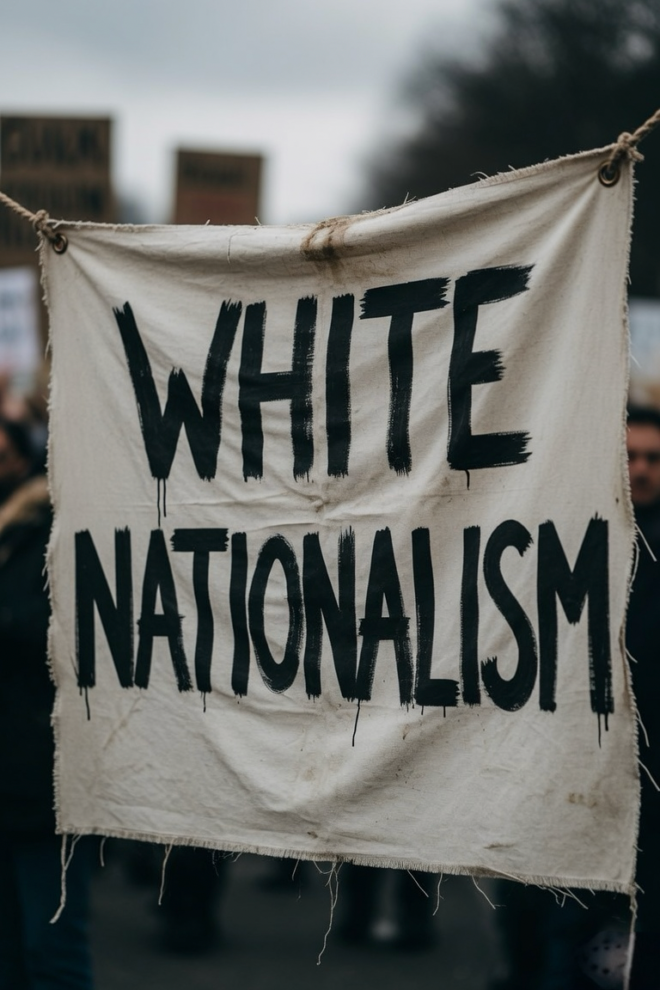
I. Introduction: The Return of the Spectre
In 1848, Marx and Engels opened their famous manifesto with the declaration that a spectre was haunting Europe. In the early decades of the twenty-first century, a different spectre has returned – one far older, and in many respects more persistent: the ideology of white nationalism. Unlike the revolutionary promise of universal emancipation, this spectre carries with it the logic of exclusion, racial hierarchy, and demographic panic. It is not a relic of the past. It is a living force, adaptable and aggressive, capable of donning the respectable garments of parliamentary politics as easily as it can incite murderous violence.
This essay proceeds from the conviction that white nationalism cannot be adequately understood as a mere political aberration or a fringe pathology. It must be analysed as a coherent, historically embedded ideology with deep structural roots – one that has repeatedly found fertile soil in periods of social dislocation, imperial contraction, and economic anxiety. To understand it only as extremism is to miss its most dangerous feature: its capacity to normalise itself, to migrate from the margins to the mainstream, and to reframe the language of democracy against democracy itself.
Drawing on the theoretical frameworks of Hannah Arendt, Antonio Gramsci, and Frantz Fanon, alongside First Nations epistemologies and the Hebrew prophetic tradition, this essay traces the historical architecture of white nationalist ideology, examines its contemporary expressions, analyses the damage it inflicts upon democratic institutions and human rights, and argues for a response that is equally structural, cultural, and moral in its ambitions.
II. Historical Architecture: Colonialism, Eugenics and the Fabrication of Race
The Colonial Matrix of Race
White nationalism did not spring fully formed from the anxious imaginations of contemporary political actors. Its foundations were laid across four centuries of European colonial expansion, during which the racial classification of human beings was not merely a cultural prejudice but a juridical and economic instrument of governance. As Aime Cesaire argued in Discourse on Colonialism, colonialism operated through the systematic dehumanisation of the colonised – a dehumanisation that required, in turn, the moral and intellectual corruption of the coloniser.
The construction of whiteness as a category of superiority was always a political act. It served to justify the dispossession of Indigenous peoples across the Americas, Africa, Asia, and the Pacific – including, critically, the lands of the Wiradjuri, the Eora, the Arrernte, and hundreds of other First Nations peoples of this continent. The terra nullius doctrine, applied in Australia with devastating effect, was not merely a legal fiction: it was white nationalist ideology in its most naked juridical form, a declaration that non-white existence did not constitute civilisation and therefore warranted no recognition, no rights, and no sovereignty.
Gramsci’s concept of hegemony is instructive here. Colonial racial ideology did not sustain itself through brute force alone; it achieved the deeper and more durable victory of consent – the incorporation of racial hierarchy into common sense, into the taken-for-granted assumptions of law, science, religion, and culture. The colonised were invited to internalise their own inferiority. The coloniser was invited to experience their own privilege as natural, even as a burden charitably borne. This is the grammar of white nationalism: not merely the assertion of dominance, but its naturalisation.
Eugenics and the Pseudo-Science of Race
The late nineteenth and early twentieth centuries witnessed the systematic pseudo-scientific elaboration of racial ideology through the eugenics movement. Drawing on a corrupted reading of Darwinian evolutionary theory, eugenicists across Britain, the United States, Germany, and Australia argued that racial characteristics were heritable, that non-white races were evolutionarily inferior, and that the biological health of the nation demanded policies of selective reproduction and, in their most extreme formulations, elimination.
The consequences were not abstract. In Australia, the policies flowing from eugenic and white nationalist logic produced the Stolen Generations – the systematic removal of Aboriginal and Torres Strait Islander children from their families in an effort to breed out Indigeneity. In Nazi Germany, the same ideology produced the Holocaust. In the United States, eugenic sterilisation laws affected hundreds of thousands of people. These were not aberrations from the logic of white nationalism; they were its logical conclusions.
The lesson Hannah Arendt drew from the Nazi catastrophe in The Origins of Totalitarianism was stark: the ideologies that produced the death camps did not emerge from nowhere. They were continuous with the racial logic of European colonialism, exported back to Europe from the imperial periphery. White nationalism is not an exotic eruption of evil. It is a homecoming.
III. Contemporary Expressions: Mainstreaming the Margin
The Populist Turn and the Normalisation of Exclusion
The contemporary resurgence of white nationalism must be understood within the broader context of right-wing populism. Since approximately 2015, across the United States, Europe, and Australia, political movements have achieved electoral success by combining anti-immigration rhetoric, nativist cultural anxiety, and the language of democratic grievance into a potent ideological cocktail. The crucial analytical move these movements share is the redefinition of the demos – the people – in ethnic and racial terms. The people, in this framing, are not all citizens; they are white citizens, whose authentic interests have been betrayed by cosmopolitan elites, immigrant communities, and minority groups.
This is Gramsci’s war of position translated into electoral strategy. Rather than seizing power through direct confrontation, the movement for white nationalist politics has worked patiently to shift the terrain of common sense – to make its assumptions about race, nation, and belonging feel natural, defensible, even moderate. Pauline Hanson’s One Nation in Australia provides a local illustration: a movement that has oscillated between the fringes and the mainstream for three decades, each time returning with its core racial anxieties intact, now finding new recruits from the discontented flank of the National Party.
Digital Ecosystems and Accelerated Radicalisation
The internet has proven to be the most powerful radicalisation tool white nationalism has ever possessed. Unlike the pamphlets and gatherings of historical fascism, digital platforms allow extremist content to reach vast audiences at negligible cost, to be algorithmically amplified to those most susceptible, and to construct immersive ideological worlds in which white nationalist premises appear self-evident. The phenomenon of the so-called pipeline – whereby individuals are drawn progressively deeper into extremist content through recommendation algorithms – has been extensively documented.
The consequences are not merely rhetorical. The Christchurch mosque attacks of March 2019 were the product of a man comprehensively radicalised online, whose manifesto bore the unmistakable hallmarks of internet white nationalist culture – ironic, meme-inflected, and simultaneously earnest in its genocidal ideology. He was not an isolated madman. He was the product of a digital ecosystem that had been constructing him for years.
Institutional Penetration
Perhaps most troubling is the evidence of white nationalist ideology’s penetration into institutions that ostensibly exist to protect democratic values. The January 6, 2021 assault on the United States Capitol was not merely a riot; it was an attempted constitutional coup in which white nationalist organisations – the Proud Boys, the Oath Keepers, and others – played an organised role. That the assault came after four years of an administration that had consistently deployed the language and logic of white nationalist politics was not coincidental.
In Australia, the evidence of white nationalist sentiment within law enforcement, the military, and the public service has been documented in successive reviews and inquiries. The Australian Security Intelligence Organisation has, in recent years, identified right-wing extremism as a principal domestic security threat. This is not a foreign pathology being imported; it is, in significant part, homegrown.
IV. Democratic Damage: The Erosion of Pluralism and Rights
The Perversion of Democratic Language
One of the most sophisticated aspects of contemporary white nationalism is its appropriation of democratic language. Freedom of speech, national sovereignty, the rights of the majority – these are the rhetorical garments in which white nationalist politics now routinely clothes itself. This creates a profound interpretive problem for democratic societies: how to defend democratic values against an ideology that presents itself as their defender.
Arendt’s analysis of totalitarianism offers guidance here. She observed that totalitarian movements do not announce their contempt for rights and law; they operate, initially, within legal and democratic frameworks, using the legitimacy of those frameworks to advance their agenda while simultaneously hollowing out the institutions that sustain them. White nationalism, in its contemporary parliamentary forms, follows this logic precisely. It enters legislatures committed to reducing the rights of minorities, weakening anti-discrimination frameworks, and eroding the institutional cultures of inclusion that diverse democracies require.
The Silencing of Marginalised Voices
Democracy is not merely a set of procedures; it is, at its best, a practice of collective self-governance in which the full range of a society’s members can participate as equals. White nationalism is, at its structural core, a project of exclusion – the removal from effective democratic participation of those who are deemed to not truly belong. Its most immediate victims are communities of colour, Indigenous peoples, religious minorities, and immigrants. But the damage extends beyond those directly targeted.
First Nations peoples in Australia understand this dynamic with particular clarity. The systematic exclusion of Aboriginal and Torres Strait Islander peoples from democratic participation – denied the vote until 1962, subjected to discriminatory welfare regimes until the 1970s, and still profoundly underrepresented in political institutions – is not merely a historical grievance. It is the ongoing consequence of a colonial racial logic that white nationalism seeks to perpetuate rather than dismantle. The defeat of the Voice to Parliament referendum in 2023 demonstrated the continuing capacity of white nationalist rhetoric – framing Indigenous political recognition as a threat to equality – to mobilise a majority against minority rights.
The Violence of Structural Inequality
White nationalism does not require guns and manifestos to do its damage. Its most pervasive and damaging expression is structural: the perpetuation of racial inequality across education, housing, employment, health, and justice systems. In Australia, the overrepresentation of Aboriginal and Torres Strait Islander peoples in the carceral system – adults and children alike – is not a statistical accident. It is the product of a racially encoded justice system whose underlying logic has never been adequately challenged.
The Hebrew prophetic tradition, which has animated centuries of social justice movements from abolitionism to civil rights, understood justice not as procedural fairness but as the active dismantling of structures that crush the vulnerable. The prophet Amos declared: ‘Let justice roll down like waters, and righteousness like an ever-flowing stream.’ This is not a call for technical reform; it is a demand for structural transformation. White nationalism, by contrast, is precisely the project of conserving structures that produce racial hierarchy – and resisting the transformation those structures require.
V. Human Rights Violations: Violence, Discrimination and Fear
The Terrorism of White Nationalism
The Global Terrorism Database and the work of researchers at institutions including the Australian Strategic Policy Institute have consistently documented the rise of right-wing extremist violence in the period since 2015. White nationalist terrorism – attacks on mosques, synagogues, Black churches, immigrant communities, and LGBTQ+ venues – has become one of the primary forms of domestic political violence in Western democracies. The perpetrators of these attacks are not random lunatics; they are ideologically motivated actors who understand themselves to be serving a political project.
Frantz Fanon observed, in The Wretched of the Earth, that colonial violence is never merely physical; it is constitutive – it defines and confines the existence of the colonised, shaping what is possible for them to think and do and be. The violence of contemporary white nationalism functions similarly. The mosque shooting does not merely kill the individuals in that building; it sends a message to every Muslim in the country about the fragility of their belonging. The synagogue attack does not merely harm the congregation; it reconstructs Jewish vulnerability. This is the terrorism of white nationalism: not only the violence, but the atmosphere of fear that violence manufactures.
Institutional Discrimination and Structural Racism
Beyond spectacular violence, white nationalism sustains and is sustained by more quotidian forms of discrimination. Racial bias in hiring practices, in lending, in policing, in healthcare – these are not the aberrations of a few prejudiced individuals. They are the systemic expressions of a society in which racial hierarchy has been institutionally encoded over generations. What Gramsci called the integral state – the ensemble of institutions, both coercive and consensual, through which a ruling class maintains its dominance – has in racially stratified societies included the systematic disadvantaging of non-white populations as a core function.
The challenge this poses to counter-measures should not be underestimated. Individual acts of discrimination can be addressed through anti-discrimination law, though imperfectly. Structural racism requires structural intervention: affirmative programmes, redistribution of resources, transformation of institutional cultures. It is precisely these interventions that white nationalist politics opposes most ferociously, framing them as reverse discrimination, as anti-white bias, as the tyranny of political correctness. The rhetorical inversion is deliberate and effective.
VI. The Exploitation of Real Problems: Grievance, Cohesion and the Category Error at the Heart of White Nationalism
Taking the Grievance Seriously
Any intellectually honest account of white nationalism’s appeal must begin with an uncomfortable acknowledgement: the social conditions it exploits are not fabrications. The anxieties that white nationalist politics channels – about cultural belonging, about the pace of demographic change, about the erosion of community cohesion, about economic displacement – are, in significant measure, real. To dismiss them as mere prejudice dressed in sociological language is not only analytically inadequate; it is politically counterproductive, because it leaves the terrain of legitimate grievance entirely to the forces of exclusion.
The social scientist Robert Putnam, whose research on social capital has been among the most cited in democratic theory, produced findings in his 2007 study ‘E Pluribus Unum’ that proved deeply uncomfortable for liberal multiculturalism. Examining data across forty-one American communities, Putnam found that increased ethnic diversity was associated, in the short term, with reduced social trust – not merely between ethnic groups, but within them. Diverse communities, he found, tended to produce a kind of social withdrawal: lower participation in civic life, reduced confidence in political institutions, and a diminished sense of shared fate. These findings were not congenial to Putnam’s own politics, and he delayed their publication for some years while searching for counterarguments. He found some: over longer time horizons, diverse societies tend to construct new, broader forms of solidarity that can be more durable than the homogeneous trust they initially displace. But the short-term cohesion costs, he concluded, were real and should not be wished away.
Similarly, questions about integration – about the conditions under which immigrant communities and host societies find genuine common ground, as opposed to parallel lives conducted in mutual indifference – are empirically serious questions that deserve empirically serious answers. Where integration fails, the consequences are real: social fragmentation, the emergence of parallel normative systems, the erosion of the shared institutional fabric that democratic self-governance requires. These are not invented concerns. The question is what conclusions follow from them.
The Category Error: From Social Fact to Racial Solution
White nationalism commits what philosophers call a category error: it correctly identifies a set of social phenomena and then draws from them a conclusion of an entirely different logical type. The phenomena – reduced social trust in diverse settings, integration difficulties, crime disparities correlated with socioeconomic disadvantage, the erosion of community cohesion – are social and economic in their causation. The conclusion white nationalism draws – that the presence of non-white populations is itself the problem, and their exclusion the solution – is racial in its logic. The move from the first to the second is not a logical inference; it is an ideological substitution.
Consider crime disparities, one of the most frequently invoked concerns in white nationalist rhetoric. The empirical literature on crime is unambiguous on one point: the strongest predictors of crime are socioeconomic – poverty, unemployment, residential instability, educational disadvantage, and the absence of social support structures. Where racial minorities are overrepresented in crime statistics, it is overwhelmingly because they are overrepresented in conditions of socioeconomic disadvantage – conditions that are themselves, as we have established, the product of structural racism. The white nationalist analysis inverts the causal arrow: it treats the racial correlation as the explanatory variable, when in fact it is a symptom of the underlying socioeconomic causation. This inversion is not an innocent analytical mistake; it is a politically motivated substitution that directs remedial energy away from the actual causes of disadvantage and toward the scapegoating of racialised populations.
The same analytical move applies to trust erosion. Putnam’s findings do not support the conclusion that diversity causes social fragmentation as a racial fact of nature. His own analysis suggests that the trust costs of diversity are mediated by institutional design, by the quality of civic infrastructure, by whether diverse populations are given genuine stakes in shared institutions. Societies that invest in those institutions – in genuinely accessible public services, in civic education, in democratic participation – tend to build cross-ethnic solidarity more successfully than those that allow market forces and residential segregation to govern the terms of encounter. The problem, on this analysis, is not the presence of diverse populations; it is the failure to invest in the institutional architecture that makes diverse societies cohere.
Civic Principles and Their Genuine Defence
There is an important distinction – consistently obscured by white nationalist rhetoric – between the defence of civic principles and the defence of racial hierarchy. Rule of law, individual rights, free inquiry, and the expectation that all residents of a democratic society will participate in shared civic institutions: these are genuine values, and their defence is a legitimate project. But they are not the property of white nationalism. They are, in fact, the values that white nationalism most consistently violates.
The rule of law is not served by the selective application of criminal justice to racialised populations, or by the legal impunity that has historically shielded police violence against Black and Indigenous people. Individual rights are not advanced by immigration regimes that apply due process selectively, or by counter-terrorism frameworks that treat Muslim communities as collective suspects. Free inquiry is not protected by the suppression of historical truth-telling about colonial violence, or by the coordinated campaign – now evident across multiple Western democracies – to remove from school curricula any account of racism that might disturb white comfort.
The expectation of civic participation and institutional assimilation is more complex. There is a genuine and important argument that democratic societies require some shared normative floor – a commitment to democratic process, to the rule of law, to the equal dignity of all citizens – and that this floor cannot simply be negotiated away in the name of cultural difference. No defensible pluralism extends to the acceptance of practices that deny the equal standing of women, or that enforce compliance through communal coercion. This is the kernel of truth in the civic assimilation argument, and it deserves to be named as such.
But – and this is the critical qualification – the demand for civic assimilation has historically been deployed not as a demand for shared democratic commitment, but as a demand for cultural submission. The requirement that Aboriginal children abandon language and ceremony was not a civic demand; it was a colonial one. The expectation that immigrant communities perform cultural self-erasure as the price of belonging is not a defence of democratic institutions; it is an assertion of cultural supremacy in civic costume. The genuine civic principle – shared commitment to democratic norms and institutions – must be distinguished from its white nationalist counterfeit, which demands not civic participation but cultural disappearance.
Evidence, Not Inherited Guilt – But Evidence Honestly Read
There is a legitimate methodological point concealed within the objection to inherited-guilt narratives: that analysis of contemporary racial inequality should proceed from evidence rather than from unfalsifiable moral axioms. This is correct, as far as it goes. But the demand for evidence must be applied consistently – and when it is, the evidence does not support the white nationalist conclusion.
The evidence that racial disparities in wealth, health, education, and incarceration are the product of historically accumulated structural disadvantage rather than of inherent racial characteristics is, by any reasonable scientific standard, overwhelming. The evidence that diverse societies can build strong social cohesion when they invest in the civic infrastructure to do so is substantial. The evidence that the primary drivers of integration failure are socioeconomic rather than cultural or racial is robust. What the evidence does not support is the proposition that the solution to any of these problems is the exclusion or suppression of non-white populations.
The demand to address real problems with evidence rather than inherited guilt is, in principle, sound. Applied honestly, however, it leads not toward white nationalism but away from it – toward the kinds of structural investments in education, housing, employment, and civic infrastructure that white nationalist politics consistently opposes. The evidence-based response to Putnam is not to restrict immigration; it is to build the institutions that make diversity cohere. The evidence-based response to integration failure is not to demand cultural submission; it is to address the socioeconomic conditions that make integration difficult. The evidence-based response to crime disparities is not racialised policing; it is the elimination of the poverty and disadvantage that drive crime across all populations.
VII. Counter-Strategies: Education, Law and the Building of Solidarity
Education as Counter-Hegemony
Gramsci’s concept of counter-hegemony – the construction of alternative common sense that challenges the naturalised assumptions of the dominant order – suggests that education is not merely one tool among many in combating white nationalism, but a primary terrain of political contest. If white nationalism succeeds by making racial hierarchy feel natural, then education that foregrounds the historical construction of race, that centres the perspectives of colonised and marginalised peoples, and that builds the capacity for critical analysis of political rhetoric is intrinsically counter-hegemonic.
In Australia, this means taking seriously the educational imperatives of truth-telling about the colonial past and its ongoing consequences. It means the integration of First Nations histories, knowledge systems, and epistemologies not as an addendum to an otherwise unchanged curriculum, but as a genuine reorganisation of what counts as knowledge and whose perspectives are authoritative. It means equipping young people to recognise the architecture of white nationalist rhetoric – the dog whistles, the demographic panic, the naturalisation of racial hierarchy – and to analyse it critically rather than absorb it passively.
Legislative and Institutional Safeguards
No society can rely on education alone to defend democratic values against an ideology as organised and as strategically sophisticated as contemporary white nationalism. Legislative measures – robust hate speech laws, effective regulation of extremist online content, statutory protections for the rights of minority communities – are indispensable. The challenge is to design these measures in ways that genuinely protect vulnerable communities without creating tools of state power that can be turned against the same communities they purport to protect.
This is not a merely theoretical concern. Australian history offers repeated examples of laws ostensibly designed to protect Indigenous peoples being used as instruments of surveillance, control, and dispossession. The Northern Territory Intervention, initiated in 2007 under the Howard Government, was presented as a child protection measure but functioned, in significant respects, as a racially encoded regime of welfare conditionality and land access. Legislative safeguards must be designed with an explicit consciousness of the ways in which state power has historically been weaponised against the communities they are meant to serve.
Community and Solidarity
Ultimately, the resilience of diverse, pluralist societies against white nationalism depends less on any particular policy than on the quality of the solidarities that bind them. Solidarity – genuine, embodied, cross-cultural solidarity, built through shared struggle and mutual recognition rather than liberal multiculturalism’s celebration of difference-at-a-safe-distance – is the most durable defence against the politics of division.
The Friday Shabbat table, where people of diverse faiths and backgrounds gather around shared bread and shared story, is a small but not negligible model of what this solidarity can look like. The Tent Embassy, established on the lawns of Parliament House in 1972 by a generation of Aboriginal activists including Aunty Isobel Coe, was a more confrontational and politically consequential expression of the same impulse: the insistence that excluded voices would not be silent, that the democratic promise would be held to its own standard.
These acts of solidarity do not resolve the structural conditions that white nationalism exploits. But they build the social fabric that structural change requires – the relationships of trust, mutual recognition, and shared commitment across lines of difference that make pluralist democracy more than a procedural abstraction.
VII. Conclusion: The Moral Imperative
White nationalism is not merely a political problem to be managed through clever policy. It is a moral crisis that calls for moral clarity. It is the reassertion, in democratic garments, of the oldest and most destructive of modern ideologies: the belief that some human beings are, by virtue of their race, more fully human than others, more deserving of dignity, of belonging, of life itself.
The Hebrew prophetic tradition from which this writer draws spiritual sustenance understood that justice is not achieved through detachment or moderation. The prophets did not counsel their contemporaries to consider all perspectives equally. They named injustice. They demanded accountability. They insisted, against every form of rationalisation and comfort, that the treatment of the vulnerable was the measure of a society’s moral worth.
Stoic philosophy, another touchstone, offers a complementary wisdom: that what we cannot control, we must release, but what falls within our power – our judgements, our responses, our commitments – we must exercise with full responsibility. The rise of white nationalism is not within any individual’s control. The response to it – in our writing, our teaching, our political engagement, our solidarity – is.
Fanon reminded us that decolonisation is never merely the transfer of power from coloniser to colonised; it is the creation of new human beings, freed from the psychological and social deformations of racial hierarchy on all sides. This is, ultimately, what resistance to white nationalism requires: not merely the defeat of a political movement, but the construction of societies genuinely committed to the equal dignity of all their members – societies in which no one’s belonging is conditional on their race, their religion, their ancestry, or their complexion.
The architecture of exclusion has been built over centuries. Its dismantlement will require comparable patience, comparable resolve, and – above all – the moral conviction that this work is not optional. It is, as the prophets would have said, what justice demands.
Selected References And Further Reading
Arendt, Hannah. The Origins of Totalitarianism. Harcourt, 1951.
Cesaire, Aime. Discourse on Colonialism. Monthly Review Press, 1955.
Fanon, Frantz. The Wretched of the Earth. Grove Press, 1961.
Gramsci, Antonio. Selections from the Prison Notebooks. Lawrence and Wishart, 1971.
Moreton-Robinson, Aileen. The White Possessive: Property, Power, and Indigenous Sovereignty. University of Minnesota Press, 2015.
Perkins, Charles. A Bastard Like Me. Ure Smith, 1975.
Putnam, Robert D. ‘E Pluribus Unum: Diversity and Community in the Twenty-first Century.’ Scandinavian Political Studies, 30(2), 2007.
Watson, Irene. Aboriginal Peoples, Colonialism and International Law: Raw Law. Routledge, 2015.
Wolfe, Patrick. Settler Colonialism and the Transformation of Anthropology. Cassell, 1999.
– – –
Bakchos is the founder of Blak and Black, an Australian media and advocacy platform established in 2010. Bakchos writes from the intersecting perspectives of Wiradjuri heritage, Jewish identity, and humanism.
© Bakchos, June 2026


White nationalism is a ridiculous concept in a settler society like Australia.
I am 100% in agreement with you Kelly it’s ridiculous to say that Australia is a life man’s country. It never was and it never will be. If white people want their own homeland. They can go back to Europe where their ancestors came from in a settler country like Australia it’s not possible to claim that it’s a white man’s country.
White nationalism in Australia is beyond a joke, it won’t happen and it can’t happen in a multicultural country.
White nationalism is nothing more than imported bull shit from America.
White nationalists should go and get jobs instead of bellyaching about the supposed injustices they face.
Lovely work.
Will you be at the Pine Gap Convention.
I will be there.
I would like to see you there if you are going.
Love Bel